
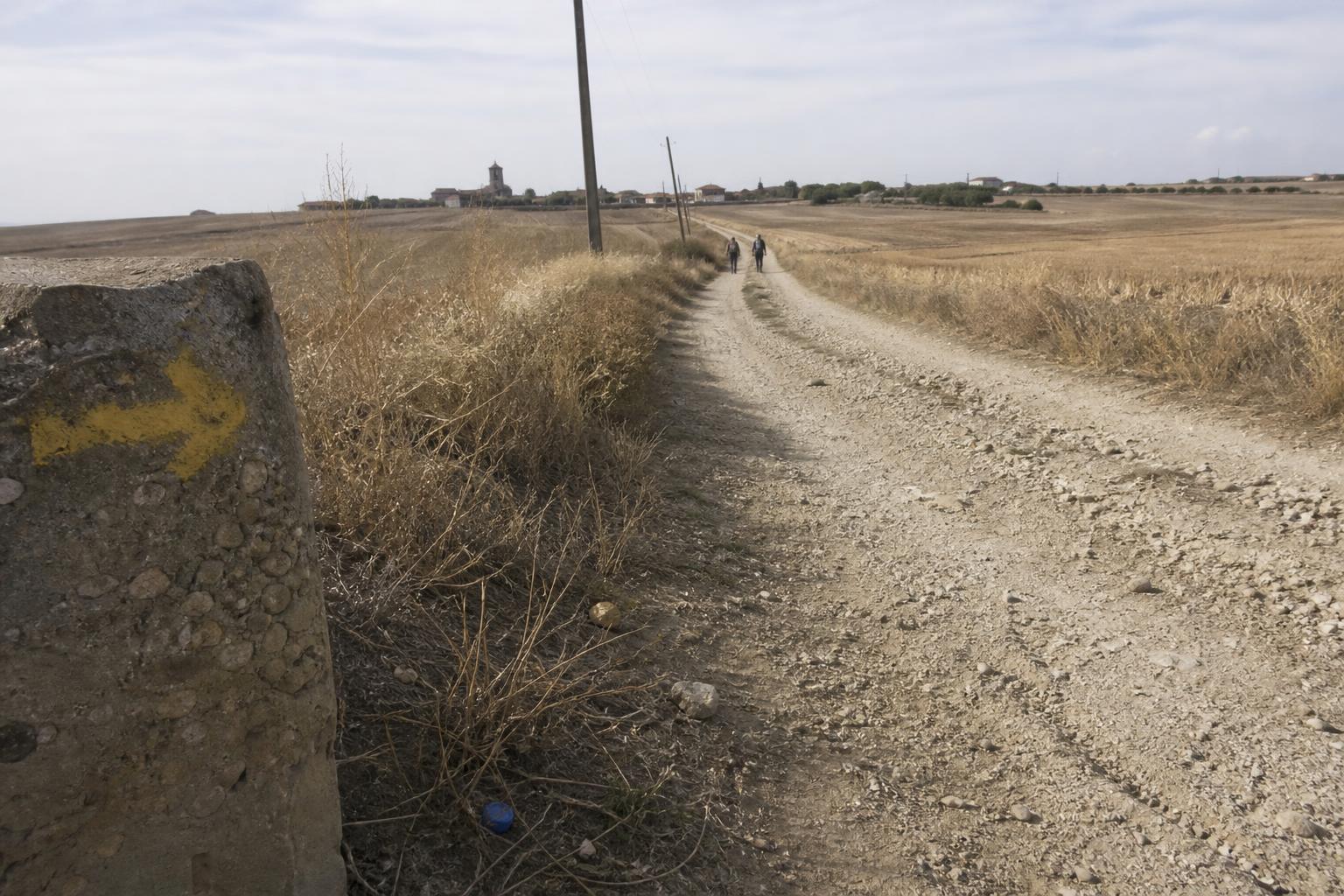
You fly into France or Spain, travel to a start town, and pick up a pilgrim credential. Each day you walk 20 to 25 km to the next town, sleep in an albergue that stamps your credential, and repeat. After 33 guidebook stages from Saint-Jean-Pied-de-Port you reach Santiago and collect the Compostela at the Pilgrim's Office.
That is the whole system. Everything else in this guide is detail: which town to start from, how the first day over the Pyrenees works, what the weeks feel like, what it costs, and what to do when the plan stops matching your feet. The Camino Francés is the busiest of the Camino routes. In 2025, 241,999 pilgrims finished it and collected a Compostela, 45.6 percent of all Compostelas that year, according to the Pilgrim's Office figures we track in our Camino de Santiago statistics. That crowd is the reason the system works so well. There are beds, cafés and waymarks almost everywhere.
The daily rhythm: walk, stamp, shower, eat, sleep
A normal day starts between 6 and 8 in the morning, because public albergues ask you to leave by 8. You walk for five to seven hours with a stop for a second breakfast, usually a café con leche and a slice of tortilla in the first village with a bar. You arrive in early afternoon, show your credential at the albergue, pay, get a stamp and a bunk.
The afternoon has a fixed order: shower, hand-wash your clothes, hang them to dry, then rest. Dinner in Spain starts late, but most bars on the route serve a pilgrim menu from about 7 in the evening. Albergues close their doors around 10 at night. After a week the rhythm stops feeling like a schedule and starts feeling like the only sensible way to live.
What you must book and what you can leave open
Book your flights, your first night in Saint-Jean-Pied-de-Port and, if you want to split the Pyrenees, a bed in Orisson. Leave almost everything else open. Public albergues on the Francés take no reservations at all, and in spring and autumn there is usually a bed within a few kilometres of wherever you stop.
Two stretches are the exception. The first nights out of Saint-Jean fill in May and September, and the last 100 km from Sarria fills from May to October. Our guide to booking albergues in advance covers both. Also book anything that must happen on a fixed date, like a flight home, and leave two spare days before it.
The Camino Francés runs about 764 to 800 km from Saint-Jean-Pied-de-Port in France to Santiago de Compostela. It crosses the Pyrenees and four Spanish regions: Navarra, La Rioja, Castilla y León and Galicia. Guidebooks split it into 33 stages, but most pilgrims adjust the stages to their own pace.
The route has a long history. It was declared the first European Cultural Route by the Council of Europe in 1987, and UNESCO inscribed it as a World Heritage Site in 1993. The towns along it grew up to serve pilgrims, which is why so many of them still have a hospital building, a pilgrim bridge or a church dedicated to Saint James.
Why distance figures differ: 764, 780 or 800 km
You will see several totals, and none of them is wrong. The 33 stages listed by Gronze, the Spanish guide we use for every distance in this guide, add up to about 764 km. Other guidebooks print figures between 780 and 800 km, and the GPS trace behind our own app measures just under 800 km, because it follows every bend through the cities.
The differences come from three places: which variant a guide follows (there are optional detours at Valcarlos, after León and at Samos), whether city walking is counted to the door of the albergue or to the centre, and how the line was drawn. For planning, the exact total does not matter. What matters is your daily distance, and it is the same whichever book you carry.
Camino Francés stages: how 33 guidebook stages become your own plan
The 33 stages are not official. Guidebook authors chose end towns that have enough beds and services, at an average of about 23 km apart. The shortest Gronze stage is 17.8 km, the longest 28.5 km. Our list of the 33 stages of the Camino Francés shows every one with its distance.
Treat the list as a menu, not a timetable. Because almost everyone follows it, the classic end towns fill up first, while a village 4 km earlier or later can be half empty. Many pilgrims walk shorter days in the first week, longer ones on the flat Meseta, and split hard days like the climb to O Cebreiro. If you want a starting point, our free Camino Francés stage planner splits the route into days that suit your pace and end in villages with beds.
Five landscapes: Pyrenees, Navarra and La Rioja, the Meseta, León and El Bierzo, Galicia
The route changes character roughly every week:
- The Pyrenees. One hard mountain day from Saint-Jean to Roncesvalles, then beech forest down into Navarra.
- Navarra and La Rioja. Rolling farmland, vineyards and medieval towns: Pamplona, Puente la Reina, Estella, Logroño, Nájera.
- The Meseta. About 178 km of high, open wheat country from Burgos to León, with long stretches between villages.
- León and El Bierzo. The climb over the Montes de León to the Cruz de Ferro, at about 1,500 m the highest point of the route, then down to Ponferrada and the vineyards of El Bierzo.
- Galicia. The steep climb to O Cebreiro, then green hills, stone villages, oak and eucalyptus woods and frequent rain all the way to Santiago.
Start in Saint-Jean-Pied-de-Port if you have five to six weeks and want the full route. Start in Burgos with three weeks, León with two, and Ponferrada with ten days. Start in Sarria if you have one week: it is about 114 km from Santiago, just over the 100 km minimum on foot for the Compostela.
Where people actually start is lopsided. In 2025, 161,922 pilgrims began in Sarria, about two in three of everyone who finished the Francés, while 30,338 began in Saint-Jean-Pied-de-Port, about one in eight. So the full route is quiet for most of its length and very busy for its last five days.
| Start point | Distance to Santiago (km) | Typical walking days | How to get there | Best for |
|---|---|---|---|---|
| Saint-Jean-Pied-de-Port | 764 | 32 to 35 | Train from Bayonne, about an hour; seasonal bus or taxi from Pamplona | The full route, with five to six weeks off |
| Pamplona | 698 | 29 to 32 | Train or bus from Madrid; small airport | The full Spanish route without the mountain day |
| Burgos | 482 | 20 to 22 | Train or bus from Madrid | Three weeks, including the Meseta |
| León | 305 | 13 to 14 | Train from Madrid | Two weeks of mountains, El Bierzo and Galicia |
| Ponferrada | 204 | 8 to 10 | Train or bus from León or Madrid | About ten days; also the usual start for cyclists |
| Sarria | 114 | 5 to 7 | Train or bus, usually via Lugo | One week and the Compostela minimum |
Distances follow the Gronze stage list. Walking days assume the guidebook stages, without rest days.
Saint-Jean-Pied-de-Port: the full route
Starting in Saint-Jean gives you everything: the Pyrenees on day one, the wine towns, the Meseta, the mountains of León and Galicia. It takes 32 to 35 walking days, so plan five weeks at the very least and six if you want rest days and a margin for injury. It also gives your body time. The pilgrims who suffer least in Galicia are often the ones who walked from France, because by then their feet and legs have adapted. Our guide to getting to Saint-Jean-Pied-de-Port covers every connection.
Burgos, León and Ponferrada: the middle options
Burgos is the natural start for three weeks. It has good rail and bus links, a cathedral worth a morning, and it puts the Meseta at the front of your walk, when you are fresh. León suits two weeks and skips the Meseta entirely. Ponferrada works for about ten days and is the classic start for cyclists, because the Compostela by bicycle needs at least 200 km.
All three are on the main Madrid rail lines, which matters when you fly into Madrid. If the Meseta is the part you wonder about, our guide to the Meseta from Burgos to León explains what those days are really like.
Sarria and the 100 km rule
The Pilgrim's Office issues the Compostela to pilgrims who walk at least the last 100 km on one route, in order, ending in Santiago. Sarria is the nearest large town with good transport beyond that line, which is why so many people start there. Expect full stage towns and booked private rooms from May to October. Our guide to the last 100 km from Sarria shows how to walk it without the worst of the crowds.
The credential is a pilgrim passport. You show it to sleep in pilgrim albergues and collect stamps in it every day. In Santiago, the Pilgrim's Office checks the stamps and issues the Compostela if you walked at least the last 100 km. In that last stretch, stamp the start and end of each stage, which means two dated stamps a day.
Where to get a credential before or at the start
You have two options. Order one by mail from a Camino association in your country, four to eight weeks before you fly, or buy one when you arrive. The pilgrim welcome office in Saint-Jean-Pied-de-Port sells official credentials for a few euros, as do the offices in Roncesvalles, Pamplona and Sarria. Our guide to the pilgrim credential lists the issuers and costs.
Albergue types: municipal, parish, private
Albergues are hostels for pilgrims with a credential. They come in a few kinds:
- Public albergues, run by a town council or, in Galicia, by the regional government. Cheap, first come first served, one night only, and you leave by 8.
- Parish and association albergues, often run by volunteers and sometimes on a donation basis. Many serve a shared dinner. Our guide to donativo culture explains what to give.
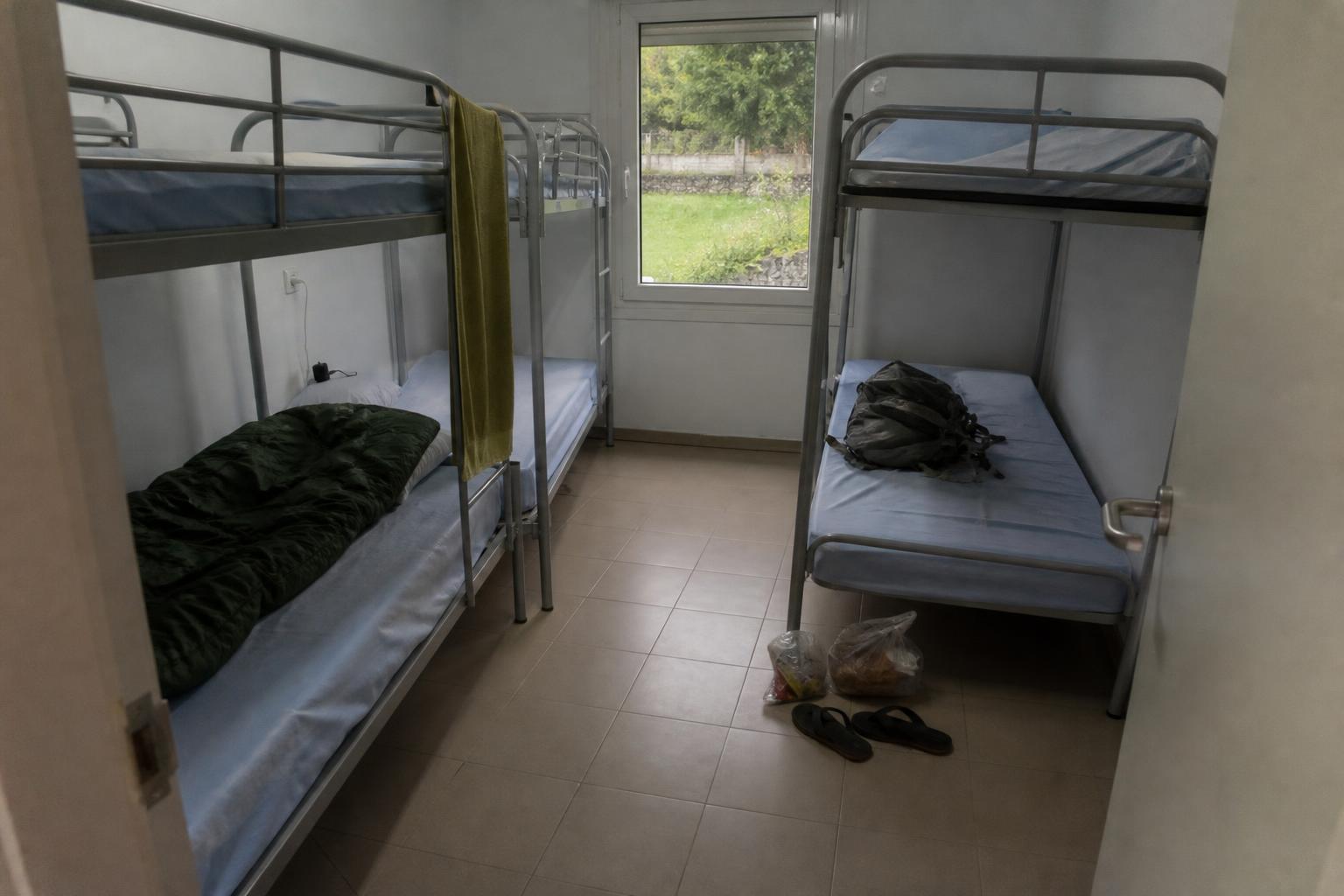
- Private albergues, which take bookings, cost a little more and often have smaller rooms, better showers and a washing machine.
Most have bunk beds in shared rooms, shared bathrooms and a place to hang laundry. Bring a sleeping bag or liner, earplugs and flip-flops for the showers. Our complete guide to Camino albergues covers prices, rules and etiquette.
What the Pilgrim's Office checks in Santiago
The office is at Rúa das Carretas 33, a short walk downhill from the cathedral square. You register through a web form reached by a QR code, take a numbered ticket, and wait. At the desk, a member of staff looks at your credential to see that the stamps form a continuous line of at least 100 km on foot, with the stage stamps dated, and asks the motive of your walk. Then they print the Compostela with your name in Latin. Our guide to the Compostela certificate walks through every step, including the separate certificate of distance.
Most international pilgrims fly to Biarritz, Bordeaux, Paris or Madrid and continue by train or bus, usually via Bayonne or Pamplona, to Saint-Jean-Pied-de-Port. Visit the pilgrim office, get your credential, and sleep there. The next day you cross the Pyrenees to Roncesvalles, about 24 km with roughly 1,300 m of climbing.
From Biarritz, Bordeaux or Paris you reach Bayonne first, then a regional train runs up the Nive valley to Saint-Jean in about an hour. From Madrid most pilgrims go to Pamplona by train or bus, then continue on a seasonal bus or by shared taxi. Arrive the day before you walk. The pilgrim office on Rue de la Citadelle gives out the credential, a stage sheet with distances and altitudes, and the current conditions on the mountain route. Saint-Jean is small and fills in high season, so book that first night. Our guide on how to get to Saint-Jean-Pied-de-Port compares every train, bus and taxi option, including what still runs in winter.
Napoleon route or Valcarlos route
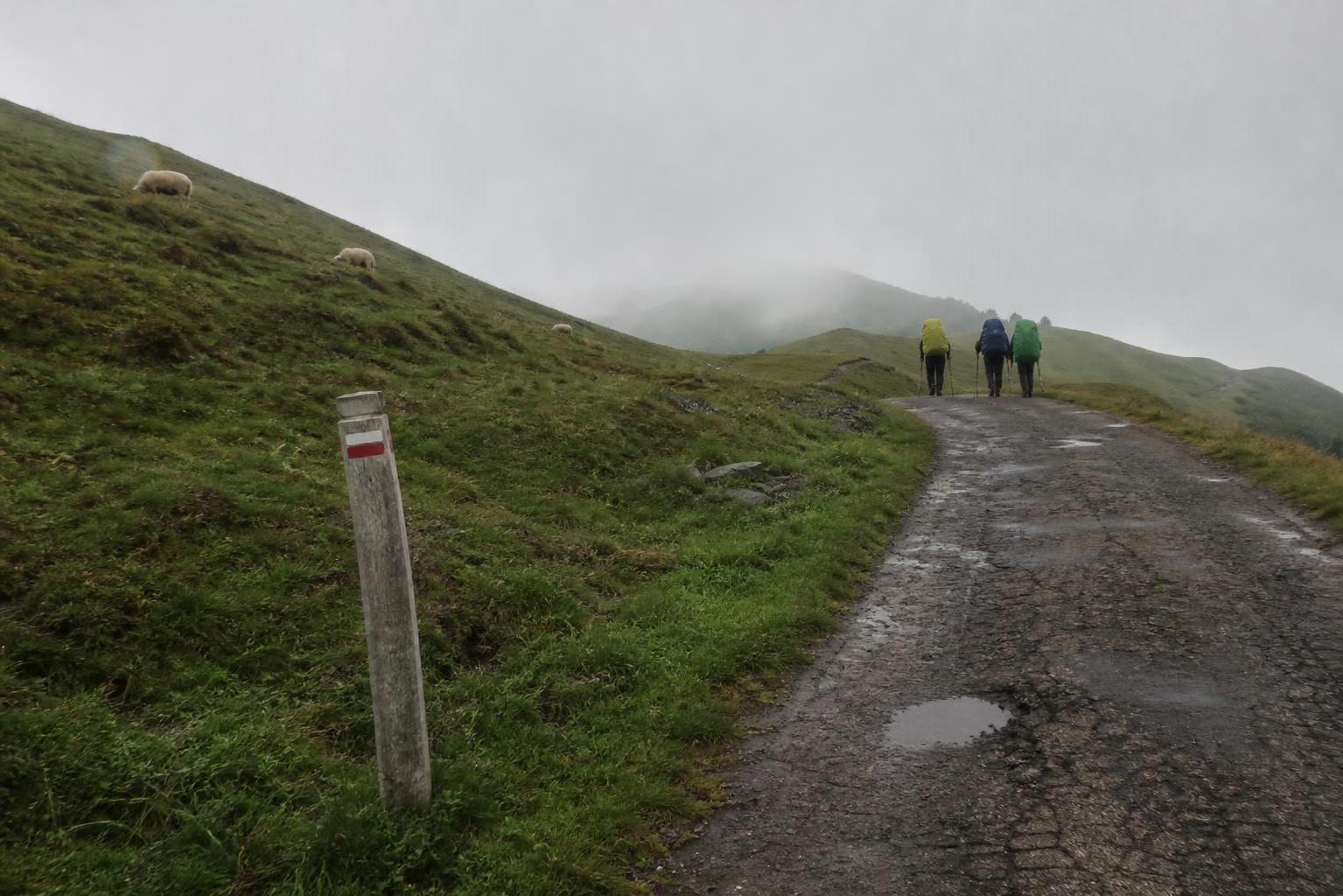
There are two ways over the mountains. The Napoleon route climbs on a quiet road and then on open grassland to the Col de Lepoeder, about 1,430 m, before a steep descent through beech forest to Roncesvalles. It is about 24 km with no village after Orisson, and the views on a clear day are the best of the whole Camino. The Valcarlos route follows the valley and the road through the village of Valcarlos, about 23 km, with more shelter and less exposure.
The Napoleon route is closed from 1 November to 31 March by order of the Government of Navarra, after years of mountain rescues. In those months, Valcarlos is the only permitted way. Outside them, the pilgrim office will tell you if fog, snow or high wind make Valcarlos the wiser choice. Our comparison of the Napoleon and Valcarlos routes goes deeper.
Splitting the Pyrenees with a night in Orisson
About 8 km and 650 m of climbing out of Saint-Jean, the Refuge Orisson is a small mountain refuge with a shared dinner and a view over the valleys. Sleeping there turns one hard day into two shorter ones, which is kind to knees and to anyone who did not train on hills. It has few beds, so book it months ahead for spring and autumn. If it is full, stop there for a drink instead and walk the full stage in one day, starting early.
Day two: Roncesvalles to Zubiri
The second day is about 21 km to Zubiri, mostly downhill through woods and small Navarran villages like Burguete and Espinal. It sounds easy after the Pyrenees, but the long descent into Zubiri is rocky and slippery when wet, and it is where many knee and blister problems start. Walk it slowly. Some pilgrims continue 5 km more to Larrasoaña, which is quieter.
Week one is hills and sore feet through Navarra to Logroño. Week two crosses La Rioja to Burgos. Weeks two to three are the flat, open Meseta to León. Week four climbs through El Bierzo to O Cebreiro. The last week descends through green Galicia, where the trail fills with Sarria starters.
Week 1: Pyrenees and Navarra
The first seven stages cover about 160 km from Saint-Jean to Logroño. After the Pyrenees you pass through Pamplona, climb the Alto del Perdón with its line of iron pilgrim figures, and walk through Puente la Reina, where the route from Somport joins, and Estella. This is the week of blisters and adjustment. Keep the days short, stop at the first hot spot, and read our guide to treating blisters on the trail before you need it.
Week 2: La Rioja to Burgos
About 121 km through vineyards and red earth to Nájera and Santo Domingo de la Calzada, where a live rooster and hen are kept inside the cathedral. Then the route rises over the Montes de Oca, a long wooded climb, to San Juan de Ortega and past the prehistoric sites at Atapuerca. Burgos, with its Gothic cathedral, is a common rest day.
Weeks 2 to 3: the Meseta to León
About 178 km of high plateau, at 750 to 950 m, through Castrojeriz, Frómista, Carrión de los Condes and Sahagún. The walking is flat but not easy: there is little shade, the wind can blow all day, and after Carrión one stretch runs about 17 km with no village. Carry two litres of water. Some pilgrims skip the Meseta by bus, but many later say it was where the walk changed for them, because there is little to do except walk and talk. León and its cathedral of stained glass mark the end.
Week 4: Astorga, Cruz de Ferro and O Cebreiro
After León the land rises. From Astorga you climb through the Montes de León to Foncebadón and the Cruz de Ferro, an iron cross on a pole at about 1,500 m, where pilgrims leave a stone brought from home. A long, steep descent leads to Molinaseca and Ponferrada, with its Templar castle. Then come the vineyards of El Bierzo, Villafranca del Bierzo, and the hardest climb since the Pyrenees: nearly 800 m up to O Cebreiro, the first village in Galicia, at about 1,300 m.
Week 5: Galicia and the arrival in Santiago
From O Cebreiro the route drops through Triacastela, with an optional detour to the monastery at Samos, to Sarria. From there the crowd grows sharply. Stone waymarkers count down the kilometres, the villages have hórreos, the stone granaries on stilts, and the octopus in Melide is a ritual. The last morning crosses Monte do Gozo and ends in the Praza do Obradoiro, in front of the cathedral.
A pilgrim who sleeps in albergues and eats pilgrim menus spends about 50 to 65 euros a day in 2026. You can manage on about 40 if you use public albergues and cook. Public albergues cost about 8 to 12 euros, and 10 in Galicia; private ones 15 to 25. A pilgrim menu is about 12 to 18 euros. Private rooms and bag transfer can double the total.
A sample day, line by line
A typical mid-range day on the Francés:
| Item | Cost (€) |
|---|---|
| Bed in a private albergue | 17 |
| Breakfast | 4 |
| Second breakfast, coffee and snacks | 10 |
| Lunch from a shop | 6 |
| Pilgrim menu dinner | 13 |
| Laundry, share of a machine every few days | 3 |
| Pharmacy, stamps and small extras | 5 |
| Total | 58 |
Over 33 walking days plus a rest day or two, that is about 2,000 euros on the trail. Our 30-day Camino budget breaks this down by tier.
Costs before you start: flights, transfers, gear, insurance
Before your first step, budget for flights, the train or bus to the start and home from Santiago, gear and insurance. Depending on where you fly from, that adds between about 400 and 1,600 euros. A 35-day travel insurance policy is usually 70 to 200 euros, and it is not optional.
Where pilgrims overspend
Most overspending happens in four places: cafés, because a coffee in every village adds up; private rooms booked out of anxiety in quiet months when a public bed would have been free; bag transfer every day instead of on the hard stages only; and gear bought new on the trail because something at home was untested. Test your shoes and pack on long walks before you leave.
France and Spain are both in the Schengen area. Many non-EU visitors can stay up to 90 days in any 180 without a visa, but the rules depend on your passport, so check before you book. A full Camino uses five to six weeks of those days. Buy travel insurance that covers hiking, medical care and repatriation.
Schengen days and the full Camino
The 90-day count is shared across all Schengen countries, and it runs over any 180-day window, not per calendar year. Days in France at the start count the same as days in Spain. If you plan to add Portugal, Italy or Paris to the trip, add those days too. The European Commission's short-stay calculator does the arithmetic for you. The EU's ETIAS travel authorisation for visa-free visitors is planned, but it had no confirmed start date when we wrote this, so check the official EU travel site before you book.
Travel insurance that covers walking
Read the policy for three things: cover for long-distance walking or hiking below a certain altitude (the route never goes above about 1,500 m), medical treatment in Spain and France, and repatriation. If you rely on a credit card's travel cover, check its length limit, because many stop at 30 days and the full Francés takes longer. EU citizens should also carry their European Health Insurance Card.
Pharmacies and health centres on the route
Pharmacies, marked by a green cross, are in every town of any size and most of the larger villages. Pharmacists give good advice on blisters, tendons and stomach trouble, often in some English. For anything more serious, ask for the nearest centro de salud, the public health centre. In an emergency, call 112, which works across Spain and France and can usually connect you to someone who speaks English.
Most signs, albergue rules and menus are in Spanish, and many guidebooks exist only in English. Learn a dozen key phrases, save your stage plan in your own language, and keep albergue addresses ready to show. Pilgrims from Italy, Germany, Korea and Japan are common, so you will rarely be the only one.
The numbers show it. In 2025 the Pilgrim's Office recorded about 26,700 pilgrims from Italy, about 24,400 from Germany, 7,481 from South Korea and 1,648 from Japan, across all routes. Most of them walk the Francés. Navigation needs no language at all: the route is marked with yellow arrows and scallop shells from start to finish.
Twelve Spanish phrases that cover most days
- ¿Hay camas libres? Are there free beds?
- Una cama para esta noche, por favor. One bed for tonight, please.
- ¿Me sella la credencial, por favor? Could you stamp my credential, please?
- ¿Dónde está el albergue? Where is the albergue?
- ¿A qué hora abren? What time do you open?
- El menú del peregrino, por favor. The pilgrim menu, please.
- Soy vegetariano / vegetariana. I am vegetarian.
- ¿Dónde hay una farmacia? Where is a pharmacy?
- Me duele la rodilla / el pie. My knee / my foot hurts.
- Tengo una ampolla. I have a blister.
- ¿Cuánto es? How much is it?
- ¿Puedo pagar con tarjeta? Can I pay by card?
Reading albergue rules and menus
Albergue rules follow the same pattern almost everywhere, so a few words go a long way: entrada (check-in time), salida (leave by), cierre (doors close), completo (full), donativo (pay what you can). On a pilgrim menu, primero is the first course, segundo the main and postre the dessert, with bread and a drink included. Our guide to the pilgrim menu lists the dishes you will see most.
Plan in your own language
Write your plan where you can read it fast when you are tired: stage towns, distances, albergue names and addresses, and the phone number of anyone you booked. A translation app with a camera mode reads signs and menus. Keep a screenshot of each booking, because a host can read an address even when they cannot read your language.
Your stage plan is a draft. Blisters, a full albergue, heat or rain will move it. Keep a list of towns with beds every 5 to 10 km past your planned stop, shorten days early in the walk, and rebuild the remaining stages from wherever you are, so your arrival date stays realistic.
The most common reasons plans change
Feet come first: blisters, shin pain and tendon strain usually appear in the first ten days. Then beds: a full stage town in May, June or September, or a closed albergue in the quiet months. Then weather: a heatwave on the Meseta, fog on the Pyrenees, a wet week in Galicia. And then the good reasons: a town you want to see properly, or people you want to keep walking with.
How to shorten or extend a day
On the Francés you are rarely more than a few kilometres from the next village with a bed, so shortening a day is easy. Stop early, collect your stamp, and start the next morning from there. Extending is just as easy on the flat stretches, but be careful about adding distance early: most overuse injuries come from too many long days in the first two weeks. If your body asks for a full stop, our guide to when to take a rest day helps you decide.
If
Full or closed albergue
If
Pain or blisters
If
Heat, fog or storms
Rebuilding the rest of the route after a rest day
A rest day or a short day pushes every later stage back, and with it your arrival date. Recount from where you are: the kilometres left, the days left before your flight minus one spare day, and the average that leaves you. If the average climbs above about 28 km a day, do not force it. Skip a flat section by bus before Sarria, rather than walking long days that cause the next injury. Remember the Compostela only needs the last 100 km walked continuously.
Our free stage planner recomputes the split from any start point. On the trail, Camino Mío, the iPhone app we build, does it for you: change one day and walk mode reworks the days after it.
Late April to mid-May and mid-September to early October give the best mix of weather and open albergues. July and August are hot and busy. From November to March many albergues close and the Napoleon route over the Pyrenees is closed. Pack light: aim for about 10 percent of your body weight.
Season by season
- Spring (April to June). Green fields, wildflowers and long days, with snow possible on the Pyrenees into April. May is one of the three busiest months.
- Summer (July and August). Long hot days on the Meseta, start at dawn. Spanish holidaymakers and groups fill the last 100 km.
- Autumn (September and October). Stable weather, harvest in La Rioja, cooler nights. September was the busiest month of all in 2025.
- Winter (November to March). Quiet and cold, with closed albergues and short days. The Napoleon route is closed and many villages have no open bed.
Our guide to the best time to walk the Camino Francés compares the months in detail, and when to walk the Camino covers the whole network.
The core packing list
Pack for one day, then repeat. A 30 to 40 litre backpack, light trail shoes or boots you have walked in for weeks, three pairs of good walking socks, two sets of walking clothes, one warm layer, a rain jacket or poncho, a sleeping bag liner or light bag, a sun hat, a 1.5 to 2 litre water capacity, a small first aid kit, earplugs, a headlamp and flip-flops. That is close to everything. Our Camino Francés packing list gives weights and seasonal swaps, and the 10 percent rule explains why the weight matters so much.
Frequently asked questions
How much does walking the Camino Francés cost per day, including albergues and food?
Plan on 50 to 65 euros a day if you sleep in albergues and eat pilgrim menus, and about 40 if you use public albergues and cook. A public albergue bed is about 8 to 12 euros, 10 in Galicia, a private one 15 to 25, and a pilgrim menu 12 to 18. Private rooms, daily bag transfer and rest days in cities push the total higher.
What do I do if I need to change my Camino Francés stages mid-walk?
Pick a nearer town with beds, call or message ahead if the albergue takes bookings, and recompute the remaining stages from there. Shorter days early on cost little. If you lose several days, take a bus over one section before Sarria rather than walking long days that cause injury.
Do I need to book albergues in advance on the Camino Francés?
Mostly no. Public albergues are first come, first served and take no bookings. Book ahead for Orisson, for the first nights out of Saint-Jean in spring and autumn, and for the last 100 km from Sarria between May and October, when beds fill early.
Can I walk the Camino Francés if I do not speak Spanish or English well?
Yes. The trail is marked with yellow arrows and scallop shells, so navigation needs no language. Learn basic phrases for beds, food and pain, keep your stage plan and key addresses in your own language, and use a translation app with a camera mode for signs and menus.
Is the Camino Francés hard for a first-time pilgrim?
The first day over the Pyrenees is the hardest, with about 1,300 m of climbing. After that the difficulty comes from walking 20 to 25 km day after day. Train with your loaded pack for several weeks before you go and keep the first week short.
Is the Napoleon route open in winter?
No. The Government of Navarra closes the Napoleon route over the Pyrenees from 1 November to 31 March. In those months walk the lower Valcarlos route to Roncesvalles.
Is it safe to walk the Camino Francés alone?
It is one of the busiest long-distance trails in Europe, and most solo pilgrims feel safe. Use normal travel care, share your daily plan with someone at home, and save the European emergency number 112.
External citations
Pilgrim's Reception Office: the Compostela
oficinadelperegrino.com/en/pilgrimage/the-compostelaThe rules for the Compostela: 100 continuous kilometres on foot or 200 by bicycle, the final stage into Santiago, and stamps at the start and end of each stage.
Oficina de Acogida al Peregrino: statistics
oficinadelperegrino.com/estadisticasThe 2025 counts for the Camino Francés and for pilgrims starting in Sarria and Saint-Jean-Pied-de-Port, and the nationality figures, read from the office's dashboard.
Gronze: Camino Francés stages
www.gronze.com/camino-francesOne source for every stage distance in this guide, including the Valcarlos variant.
UNESCO World Heritage Centre: Routes of Santiago de Compostela
whc.unesco.org/en/list/669The World Heritage inscription of the Camino Francés in 1993 and its later extension to the routes of northern Spain.
European Commission: short-stay calculator
home-affairs.ec.europa.eu/policies/schengen/border-crossing_enThe official 90 days in any 180-day period rule and the calculator for checking your own dates.
La Compostela del Lector
You walked this guide to Santiago.
All 771 km, 0 stages, stamped end to end.