
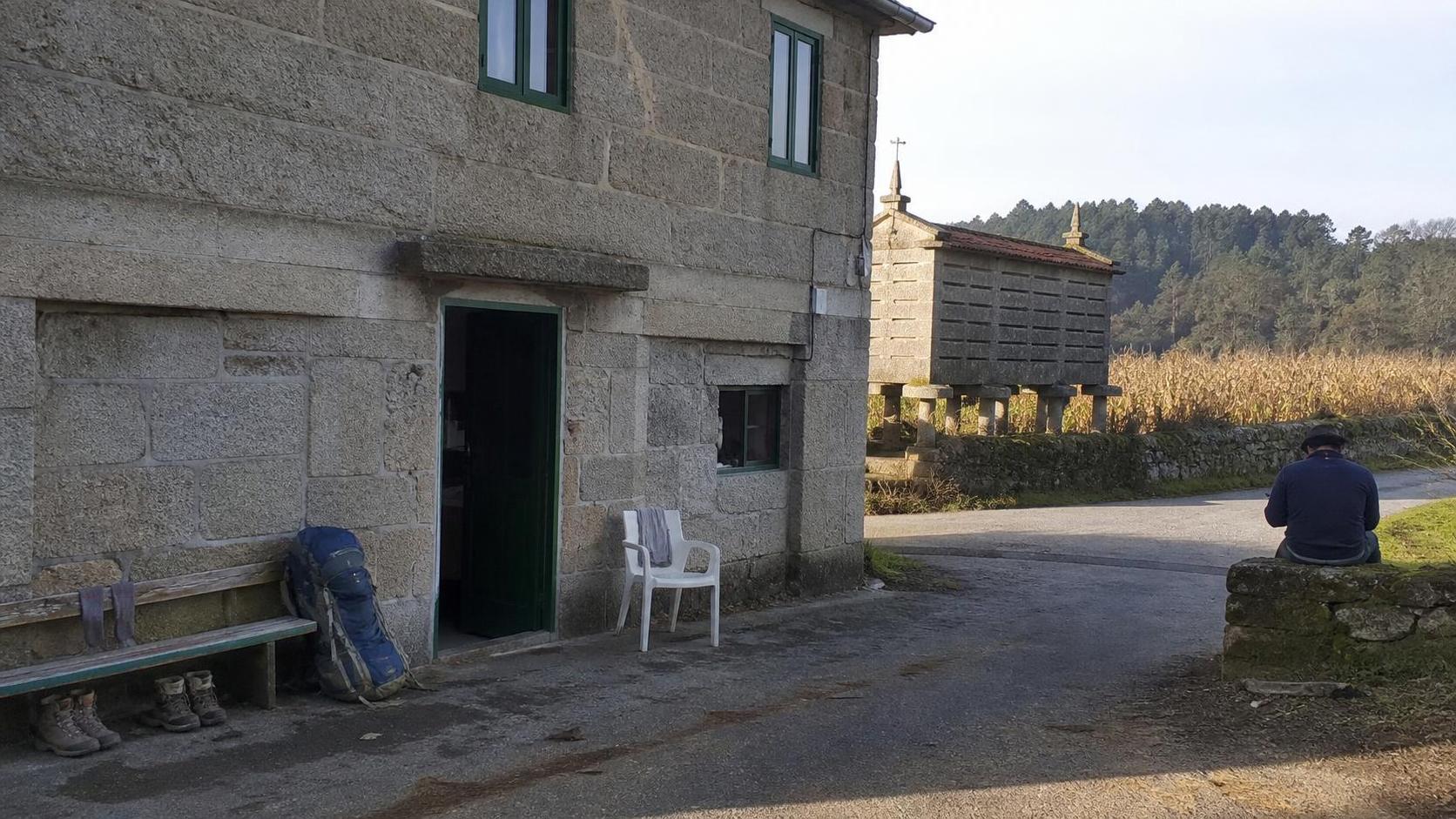
Do not end your days where the guidebooks do. Sleep in the villages between Portomarín, Palas de Rei, Arzúa and O Pedrouzo, start from Sarria on a weekday, leave a little later than the morning wave, and avoid a Saturday arrival in Santiago. The path stays busy, but your evenings and your beds become quiet.
The crowd forms for a simple reason. Almost every guidebook, tour package and bag-transfer company cuts Sarria to Santiago into the same five days, so thousands of people arrive in the same four towns on the same afternoon. The path between those towns has room. The towns at three in the afternoon do not.
Four moves change your days:
- Sleep off-stage. End each day a few kilometres before or after the classic stop.
- Start midweek. Leave Sarria on a Monday, Tuesday or Wednesday.
- Leave after the wave. Set off an hour after the early rush, or take a long breakfast.
- Arrive on a weekday. Skip the weekend crowd on the last morning.
From Sarria the Camino Francés changes character. In 2025, 161,922 pilgrims started in Sarria, 30.5 percent of everyone who collected a Compostela, by the Pilgrim's Office count in our Camino de Santiago statistics. Pilgrims who set out from Saint-Jean or León weeks earlier suddenly share the path with fresh walkers, school groups and tour groups whose bags travel by van.
The route itself is easy to like: green farmland, oak and chestnut woods and, after Melide, tall eucalyptus. Climbs are short, hamlets are close together, and there is a café every few kilometres. Concrete waymarkers with a scallop shell count down the kilometres to Santiago.
Where the 100 km marker actually stands
The km 100 stone stands at A Pena, in Paradela, about 14 kilometres from Sarria, just past the church of Ferreiros and the hamlet of Mirallos. Many guides still put it at Morgade, 2 kilometres earlier, because the old stone stood near there until the markers were replaced around 2016.
How it differs from the Camino before Sarria
Before Sarria, most people around you have walked for weeks, and you meet the same faces each evening. After Sarria the faces change every day, private beds in the stage towns are often booked well ahead in summer, and the queue at the public albergues starts early.
The tourigrino label, and why it misses the point
Some long-distance walkers call Sarria starters tourigrinos, a blend of tourist and pilgrim. The label misses the point. The Compostela rules were written for exactly this distance, and the Cathedral asks why you walked, not where you began. What makes it a pilgrimage is how you walk it.
Crowds are not even along the route. They peak leaving Sarria, on the descent into Portomarín, from Palas de Rei to Melide, and again on the final morning into Santiago. Arzúa and O Pedrouzo fill up every evening because almost every five-day plan ends there. Between those towns the path thins out within an hour. Every distance here comes from one source, the Spanish guide Gronze.
Sarria to Portomarín
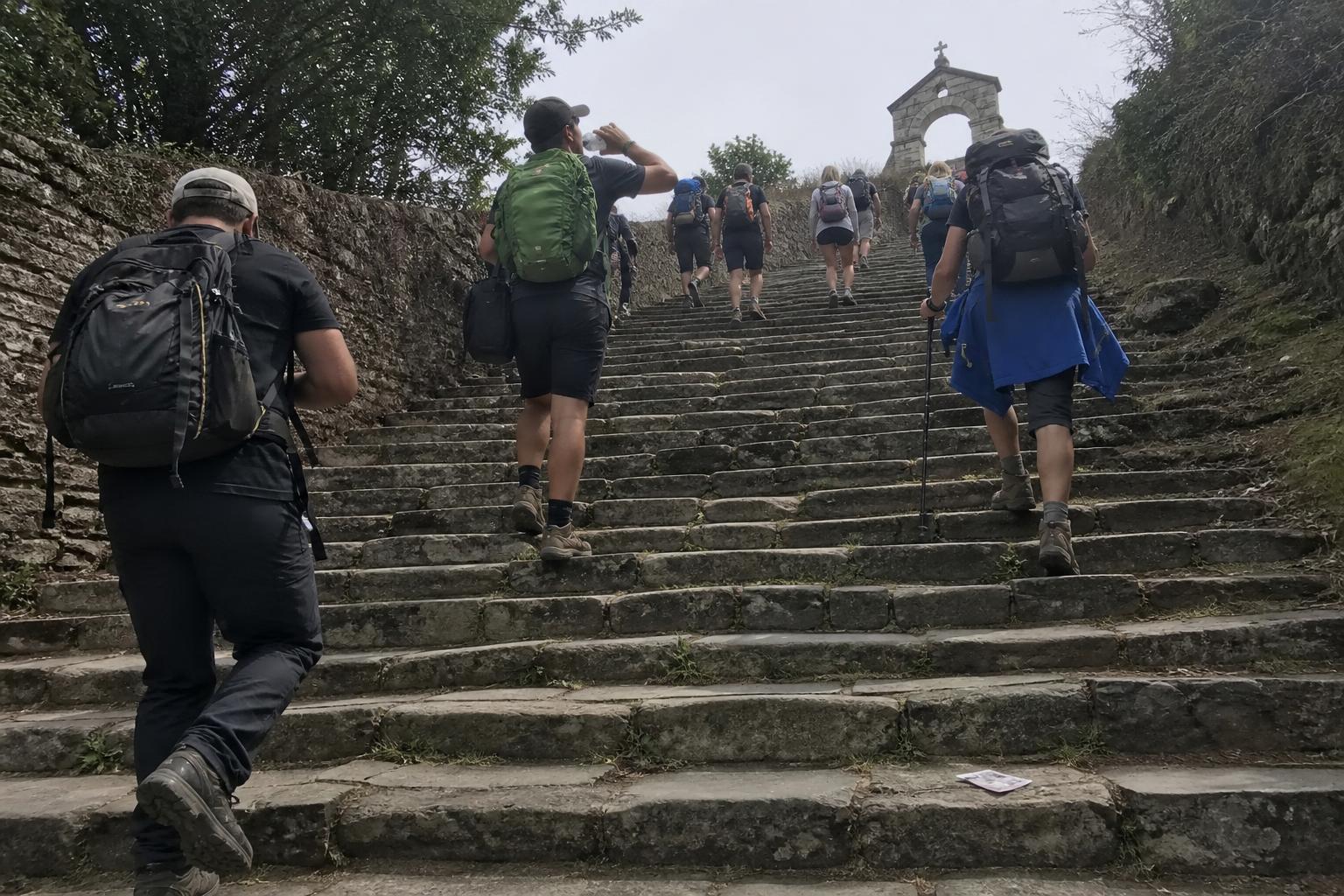
About 22 kilometres. The first hour is the busiest of the whole walk, because most of Sarria sets off between 7 and 8, many on their first day. The crowd thins after Barbadelo, gathers for photos at the km 100 stone, and bunches again on the steep descent to the long bridge into Portomarín. By late afternoon the town is full.
Portomarín to Palas de Rei
About 25 kilometres, starting with a long, steady climb out of the river valley. The groups spread out on it. Gonzar, Hospital da Cruz, Ventas de Narón, Ligonde and Airexe all have beds before Palas de Rei, which fills in the afternoon.
Palas de Rei to Arzúa
About 28.5 kilometres, the longest and hardest classic day, with short, steep dips into river valleys after Melide. The path to Melide is busy all morning, and Melide at midday is full of walkers eating pulpo, the town's boiled octopus. Arzúa fills every evening.
Arzúa to O Pedrouzo
About 19 kilometres of eucalyptus woods and small hamlets, the gentlest day. Leave late and much of it is quiet. O Pedrouzo is where almost every five-day plan ends, so its beds go early.
O Pedrouzo to Santiago
About 19.4 kilometres. Many pilgrims leave O Pedrouzo in the dark to reach Santiago early, so the last morning is busy again, past Lavacolla, over Monte do Gozo and into the city.
The easiest way to escape the crowd is to sleep where the itinerary sheets do not. You walk the same path, but you wake up ahead of the main wave or behind it.
- Instead of Sarria: Barbadelo, 4 kilometres on. Its public albergue is closed for now, but its private albergues are open.
- Instead of Portomarín: Ferreiros, 9 kilometres before, or Gonzar, 8 kilometres after. Both have a public albergue.
- Instead of Palas de Rei: Airexe, 8 kilometres before, or Casanova, 5.6 kilometres after. Both have a public albergue.
- Instead of Arzúa: Ribadiso, 3 kilometres before, with a public albergue in an old pilgrim hospital beside a medieval bridge.
- Instead of O Pedrouzo: Santa Irene, 3.4 kilometres before, with a public albergue, or Lavacolla, 9.5 kilometres after, with private albergues and guesthouses. From Lavacolla the last day is about 10 kilometres.
There is a catch. Small villages have few beds: Gonzar's public albergue has 28, Casanova's 20, and one group can fill a village.
Public albergues versus private rooms
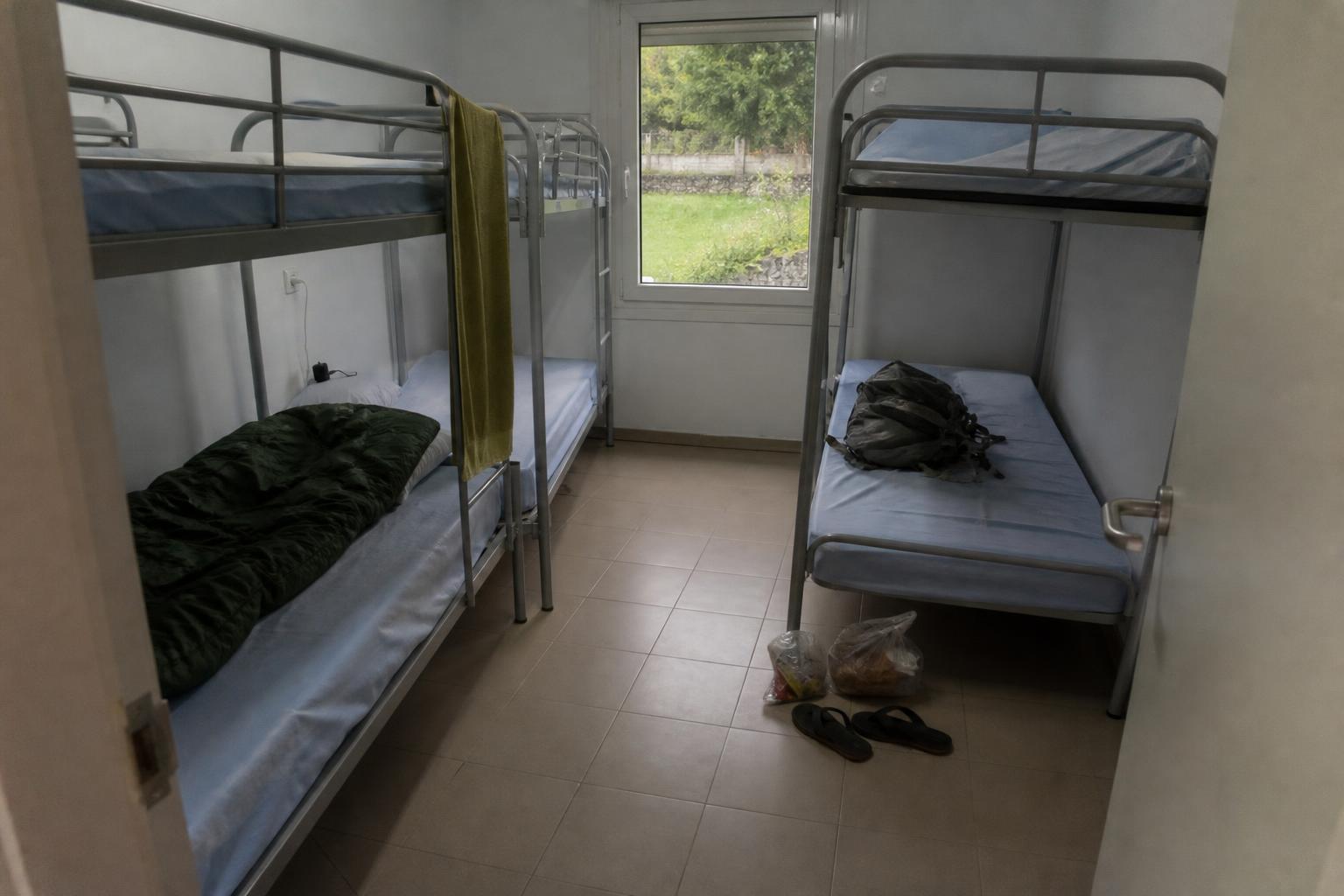
Public albergues on this stretch are run by the Xunta de Galicia. A bed costs 10 euros, and "in no case, is it possible to make reservations": beds go in order of arrival, for one night, and you leave by 8 the next morning. Private albergues, casas rurales and pensions take bookings and cost more, usually from 15 euros for a bunk. In return you skip the afternoon race for a bed. Our complete guide to Camino albergues covers both.
When booking ahead is worth it
From May to October, book ahead for any village with only one or two places to sleep, and for any private room in a stage town. Walking up still works at the larger public albergues if you arrive early in the afternoon, and almost anywhere outside the busy months. Our guide to booking albergues in advance explains how.
Five days is the classic split, ending in Portomarín, Palas de Rei, Arzúa and O Pedrouzo, and it is exactly why those towns are full. A six- or seven-day plan shortens the long Palas de Rei to Arzúa day and moves your nights into smaller villages. Four days suits fit walkers who start early and accept long days.
| Split | Overnight stops | Longest day (km) | Average day (km) | Crowd level at night | Best for |
|---|---|---|---|---|---|
| 4 days | Gonzar, Melide, Santa Irene | 31.3 | 28.6 | Medium | Fit walkers who are short on time |
| 5 days (classic) | Portomarín, Palas de Rei, Arzúa, O Pedrouzo | 28.5 | 22.8 | High | Walkers who want every service and book early |
| 6 days | Ferreiros, Gonzar, Casanova, Ribadiso, Santa Irene | 22.8 | 19.0 | Low | Most first-time pilgrims |
| 7 days | Ferreiros, Gonzar, San Xulián do Camiño, Boente, Salceda, Lavacolla | 20.3 | 16.3 | Low | A slower pace and a short last morning |
For a first-time pilgrim we would pick six days. The first day is only 13 kilometres, so you can arrive in Sarria the same morning. No day is longer than 23 kilometres, and every night is in a village the five-day crowd walks through. Seven days adds a 10-kilometre last morning, so you reach the Pilgrim's Office in the morning, when its queue is usually shortest.
This is our advice, not an official rule, and no official count breaks arrivals down by weekday. It follows from how trips are planned. A week off usually runs from weekend to weekend, and organised groups fill those weeks, so leaving Sarria on a Saturday or Sunday puts you in the thickest stream for five days. Start on a Monday to Wednesday and you also reach Santiago midweek.
Season matters too. American Pilgrims on the Camino notes that Sarria starters are more likely to walk in August and September, and that large Spanish school groups walk in summer. Late April and early October are quieter and still have most services open, as our guide to when to walk the Camino shows.
Public albergues send everyone out by 8, so the path is fullest between 7 and 9. Leave an hour later, or take a long breakfast at the first café, and the largest groups pull ahead. Do this only when your next bed is booked, because walk-up public beds go to the early arrivals.
The Pilgrim's Office asks for at least 100 continuous kilometres on foot on one recognised route, and "the final stage must include at least, the last one leading into Santiago's Cathedral." You may walk it in parts, "provided they are in chronological and geographical order." Sarria is about 114 kilometres out, so you have about 14 kilometres to spare.
Two stamps a day, and where to get them
The office words the stamp rule by stage, not by day: "you must always get your Credencial stamped at the start and end of each stage, including the corresponding date." Walk one stage a day and that is two dated stamps a day. Albergues, churches, cafés and bars all stamp, and many bars on this stretch keep a sello by the till. Our guide to the Compostela certificate covers the full process.
What counts as continuous
No gap inside the 100 kilometres. A rest day does not break it, as long as you get a stamp with that day's date. A bus or taxi forward does. Some websites claim the 2025 rules dropped continuity, but the office's page still says "100 continuous kilometers on the same route," so plan on that.
Why cycling from Sarria does not qualify
Cyclists need at least 200 kilometres, "following the same conditions as the pilgrimage on foot." Sarria is only 114 kilometres out, so a cyclist on the Camino Francés starts around Ponferrada or earlier.
Blisters, rain or a full albergue will change your plan at some point. Because the last 100km is dense with villages and beds, you can almost always shorten a day by five to ten kilometres. Recalculate the remaining stages to Santiago, keep your dated stamps, and do not skip ahead by taxi.
Shorten a day without breaking the Compostela
Stop at the next village with beds, get your end-of-stage stamp there, and start the next morning from the same place. If your feet are the problem, our guides to treating blisters on the trail and when to take a rest day help you decide.
Let a planner recompute the rest of your stages
A short day pushes every later stage back, and your arrival date with it. Our free Camino Francés stage planner splits the route from any start point into days that end in villages with beds. On the trail, Camino Mío, the iPhone app we build, does it for you: change one day and its walk mode reworks every later day, then checks your bookings and your flight date against the new plan.
Frequently asked questions
Is starting the Camino Francés in Sarria a real Camino, or just the Compostela minimum?
It is a real Camino. Walking from Sarria meets the Pilgrim's Office rules for the Compostela, and almost a third of all Compostela pilgrims started there in 2025. Some long-distance walkers call Sarria starters tourigrinos, but the Camino has no single complete version. What makes it a pilgrimage is how you walk it, not where you start.
Do I still get my Compostela if I skip a stage between Sarria and Santiago?
Probably not. The Pilgrim's Office asks for 100 continuous kilometres on foot, and Sarria is only about 114 kilometres out. That leaves about 14 kilometres to spare, and every classic stage is longer than that. A rest day is fine. A bus or taxi forward is not. If you think you might need a ride, start a day or two further back, in Triacastela or Samos, so that any ride falls before the last 100 kilometres.
How many days do I need from Sarria to Santiago?
Most first-time pilgrims take five or six walking days. Five days follows the classic stages and averages about 23 kilometres a day. Six or seven days gives shorter days and quieter villages at night. Four days is possible for fit walkers, but it means three days of about 30 kilometres.
When is the last 100km of the Camino Francés least crowded?
Outside August and September, and on weekdays. Sarria starters lean toward late summer, and September, May and August are now the busiest months across the network. Late April and early October are quieter. Winter is quietest of all, but many albergues close. Starting from Sarria between Monday and Wednesday avoids the largest weekend waves even in busy months.
Where is the 100 km marker on the Camino Francés?
At A Pena, in the municipality of Paradela, about 14 kilometres from Sarria on the first day, just past the church of Ferreiros and the hamlet of Mirallos. Older guides put it at Morgade, about 2 kilometres earlier, because the markers were replaced around 2016. It is one of the most photographed stones on the route, so expect a short queue in the morning.
Where should I sleep to avoid the busiest stage towns?
Pick villages a few kilometres before or after the classic stage ends: Barbadelo instead of Sarria, Gonzar or Ferreiros instead of Portomarín, Casanova instead of Palas de Rei, Ribadiso instead of Arzúa, and Santa Irene or Lavacolla instead of O Pedrouzo. You stay on the same path but avoid the evening rush for beds and dinner. Barbadelo's public albergue is closed for now, so book one of its private beds.
External citations
Pilgrim's Reception Office — the Compostela
oficinadelperegrino.com/en/pilgrimage/the-compostelaThe binding rules: 100 continuous kilometres on one route, the final stage into the Cathedral, stages in order, stamps at the start and end of each stage, and 200 kilometres by bicycle.
Oficina de Acogida al Peregrino — statistics
oficinadelperegrino.com/estadisticasThe 2025 count of pilgrims who started in Sarria, read from the office's dashboard on 2 September 2026.
American Pilgrims on the Camino — statistics
americanpilgrims.org/statisticsThe note that Sarria and Tui starters lean toward August and September, and that large Spanish school groups walk in summer.
Gronze — Sarria to Portomarín
www.gronze.com/etapa/sarria/portomarin/recorridoOne source for every distance in this guide, including the position of the km 100 stone at A Pena.
Xunta de Galicia — public albergue network
www.caminodesantiago.gal/en/discover/the-way-at-the-present/1.4.2.-the-network-of-public-hostelsThe 10-euro price and the rule that public albergues in Galicia take no reservations.
La Compostela del Lector
You walked this guide to Santiago.
All 771 km, 0 stages, stamped end to end.