
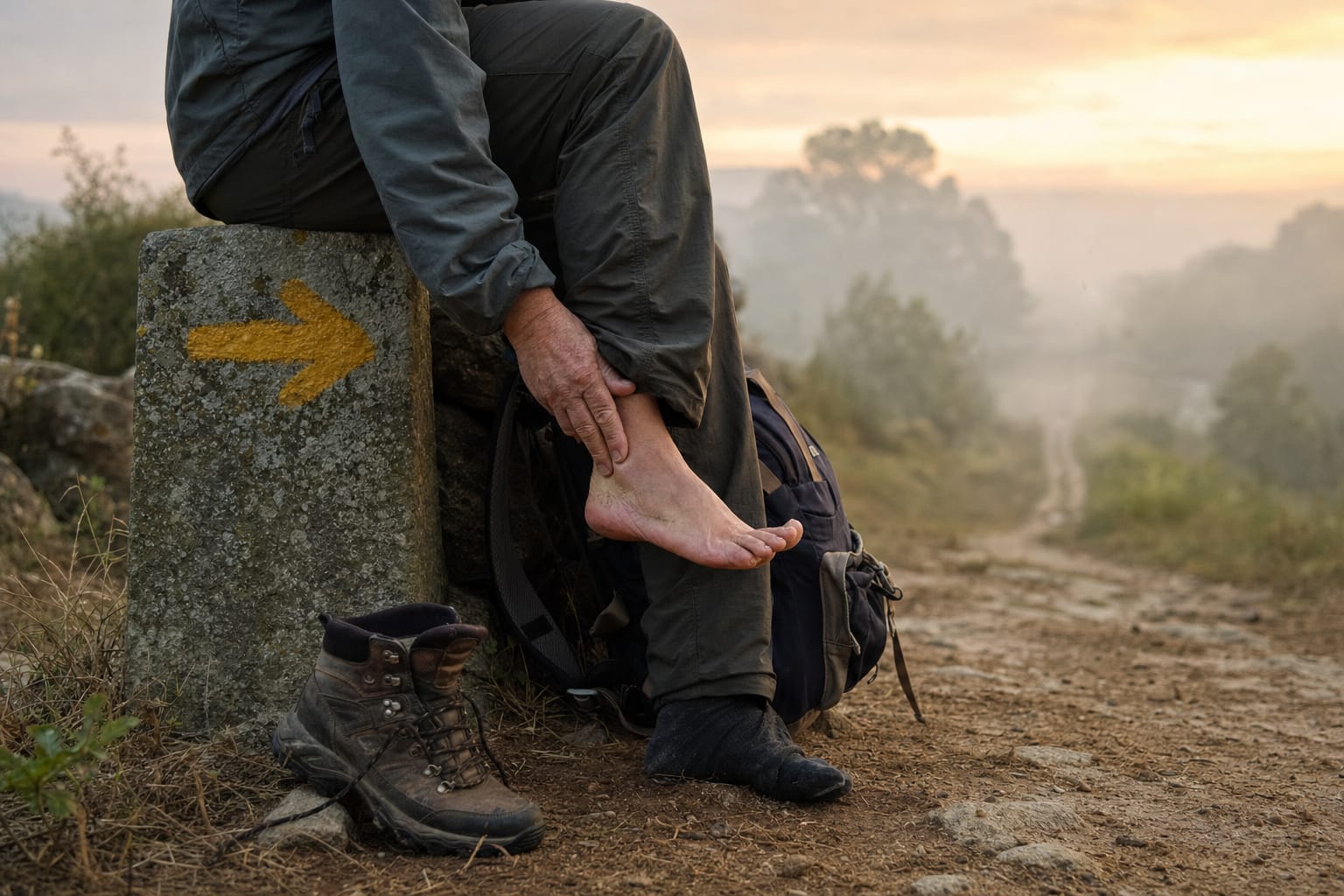
Decide with a same-morning test, not a feeling. Score your worst pain out of ten, walk the first 500 metres slowly, and watch what the pain does. Pain that fades and stays below four out of ten means walk. Pain that sharpens as you move, changes how you walk, or is sharp and localised to one spot means rest today. The point of the test is to take the decision out of your mood: on day fourteen your legs will always vote to stop, and your pride will always vote to push on. Neither is a reliable judge.
If
Dull ache, eases in the first 500 m, below 4/10
If
One borderline signal, or soreness at 4–6/10
If
Pain sharpens as you walk, or two or more signals
If
Sharp pinpoint pain on bone, night pain, swelling, or red streaks and fever
The two-minute morning pain test
Before you lace up, sit on the edge of the bunk and give your worst spot a number from zero to ten. Zero is nothing; ten is pain that stops you mid-sentence. Then press the spot gently with a thumb. Diffuse tenderness spread across a big muscle is soreness. Pinpoint tenderness you can cover with a fingertip, especially over a bone or a tendon, is a warning. Write the number in your phone or your notebook. The number itself matters less than the trend: a spot that reads three, then four, then five across three mornings is heading the wrong way regardless of how it feels at breakfast.
The 500-metre walk test
Numbers at rest only tell you half the story. Load the foot and walk the first 500 metres slowly, ideally before your pack goes on. Soreness warms up and eases as blood moves through the muscle; you often forget it by the first kilometre. An injury does the opposite: it stays level or sharpens the longer you walk, and it may change your gait so that you unconsciously limp or roll the foot to protect it. If the pain is worse at 500 metres than it was at the door, that is your answer. Do not walk it off. Shin-splint pain that fades after the first hour is masking the problem, not healing it.
Before you lace up, run through five signals: a resting heart-rate spike above your normal, sleep that never repaired the fatigue, joint or tendon pain that lingered overnight, a new limp or altered gait, and hot spots that already sting before you have taken a step. Two or more present means default to rest. One borderline signal means walk cautiously, keep the stage short, and reassess at the first café. Fatigue and low mood count too: emotional exhaustion and broken sleep are legitimate rest-day triggers, not only physical pain.
Five signals to check before you lace up
Check your resting pulse before you get up. A resting heart rate sitting five to ten beats above your normal baseline is a recognised sign of incomplete recovery. Check your sleep: if you woke as tired as you lay down, your tissues did not get their repair window. Check whether last night's joint or tendon ache is still there this morning; soreness usually clears overnight, injury does not. Check your gait on the walk to the bathroom for a limp you did not choose. And check your feet for hot spots that already sting, because those will only get worse under load. For catching those before they turn into blisters, see our two-minute hot spot protocol.
When one signal is borderline
One soft signal on its own is rarely a reason to lose a whole day. If your legs are heavy but nothing is sharp, treat it as a caution rather than a stop: shorten the stage, drop your pack onto a bag-transfer van, start early to beat the afternoon heat, and promise yourself you will stop at the first sign the signal is turning into two. Walking a gentle 10 kilometres can leave you better recovered than a restless day pacing a strange town. The foot care on the Camino guide covers the daily habits that keep those borderline mornings rare.
Normal soreness is dull, symmetrical, spread across the big muscles, and eases within the first kilometre. Injury pain is sharp, localised to a joint, tendon, or bone, usually one-sided, and worsens as you walk. Swelling, pain that wakes you at night, or pinpoint tenderness on the shin bone are stop-now signals, not push-through aches. The table below sorts the common signals into walk, walk cautiously, and stop.
| Signal | Normal soreness (walk) | Warning sign (walk cautiously) | Red flag (stop today) |
|---|---|---|---|
| Pain quality | Dull, achy, spread out | Sharpening, catches on some steps | Sharp, stabbing, or burning |
| Location | Big muscles: calves, thighs, glutes | A single joint or tendon | Pinpoint on bone, tendon, or joint |
| Symmetry | Both legs, roughly even | Mostly one side | Clearly one-sided |
| Over the first km | Eases and warms up | Stays level | Worsens with every step |
| Swelling or heat | None | Mild puffiness by evening | Visible swelling, hot to the touch |
| At night | Quiet, you sleep fine | Aches when you roll over | Wakes you or throbs at rest |
Soreness that is safe to walk on
Delayed-onset muscle soreness is the ache that peaks a day or two after a hard effort and fades on its own. It lives in the large muscles, feels the same on both sides, and loosens once you are moving. This is the background hum of walking 25 kilometres a day, and it is not a reason to stop. Keep eating enough protein, keep the first few kilometres slow, and let the muscle warm into the day. Soreness that has eased by the first café was never the problem.
Red-flag pain that means stop today
Some pain is a stop sign, not a negotiation. Sharp, localised pain on a tendon or joint, pain that is clearly worse on one side, swelling that does not settle overnight, and pain that wakes you at rest all mean stop. The one to take most seriously is severe, constant, pinpoint pain on the shin bone: mild shin splints ease with 48 to 72 hours of rest, ice, and compression, but a sharp point of pain on the bone can signal a stress fracture and warrants a doctor, not another stage. Red streaks spreading up the leg, fever, or pus from a broken blister are also doctor territory the same day; the blister treatment field protocol covers when a blister has crossed that line.
Most first-timers take three to seven rest days across the roughly 800-kilometre, 33-day Camino Francés, which lands near one per week. But that is a starting guideline, not a rule. Cadence should follow your body, not the calendar: trained legs and lighter walkers may need fewer, while older pilgrims, heavier packs, and first-time feet often need one every five or six days. The best rest is the one you take before your body forces it on you.
The one-rest-day-per-week guideline
One rest day per week of walking is the number most pilgrims settle on, and it maps neatly onto the Francés. The route runs about 800 kilometres over four to five weeks on foot, so three to seven rest days spreads the load without stretching your calendar out of shape. Averaging around 29 kilometres a day with no rest at all finishes the route in about four weeks, but almost nobody should plan it that way; the schedule leaves no margin for the day your body says no.
Fitness-adjusted cadence
Move the number to match the load you actually carry. A pack over 10 percent of your body weight raises overuse-injury risk measurably, so heavier packs argue for more frequent rest. Age, sleep quality, and how much you trained before flying all pull the same way. If you built up to back-to-back 25-kilometre days in training, you may stretch to one rest every seven or eight days. If your longest training walk was 15 kilometres, plan a rest every five. Our foot care on the Camino guide and a sensible pack weight do more to protect your rest cadence than any fixed schedule.
Losing a day does not cost you Santiago; it costs you kilometres you redistribute. Take your remaining distance to Santiago, divide by the days you have left after the rest day, and check the new daily average against your comfortable pace. If it comes out higher than what your legs can hold, you have three levers: split a long stage into two shorter ones, book a bag transfer so you walk light, or skip a flat section by bus. None of them touches your Compostela.
The remaining-kilometres math
Say you have 180 kilometres left and 8 walking days after your rest day. That is 22.5 kilometres a day, which most pilgrims can hold. If instead you have 180 kilometres and only 6 days, the average jumps to 30 a day, which is a lot on tired legs. The math is the honest part of planning: it tells you before you set off whether the plan you are carrying still fits the days you have. Recompute it the evening of any rest day, while you still have time to move a booking.
Bag transfers, stage splits, and buses
When the average comes out too high, spend money before you spend your tendons. Bag-transfer services move your pack between stages for roughly 5 to 8 euros a day, which turns a hard stage into a merely long one. Splitting a 30-kilometre stage into an 18 and a 12 with a night in between costs you one extra bed, not your knees. And a short bus over a flat, dull section is not cheating; it is stage management. Book beds only one to three nights ahead so the plan can flex around the next rest day you might need.
A true rest day keeps you off your feet. Sleep in, elevate and air your feet, do some gentle mobility, eat protein, and cap any sightseeing at a short, flat stroll. The goal is tissue recovery, not a second itinerary. The trap is the rest day that is secretly a walking day: ten hours wandering a city on cobblestones does more damage than a gentle 12-kilometre stage would have. If your feet are up and the swelling is dropping, it is working.
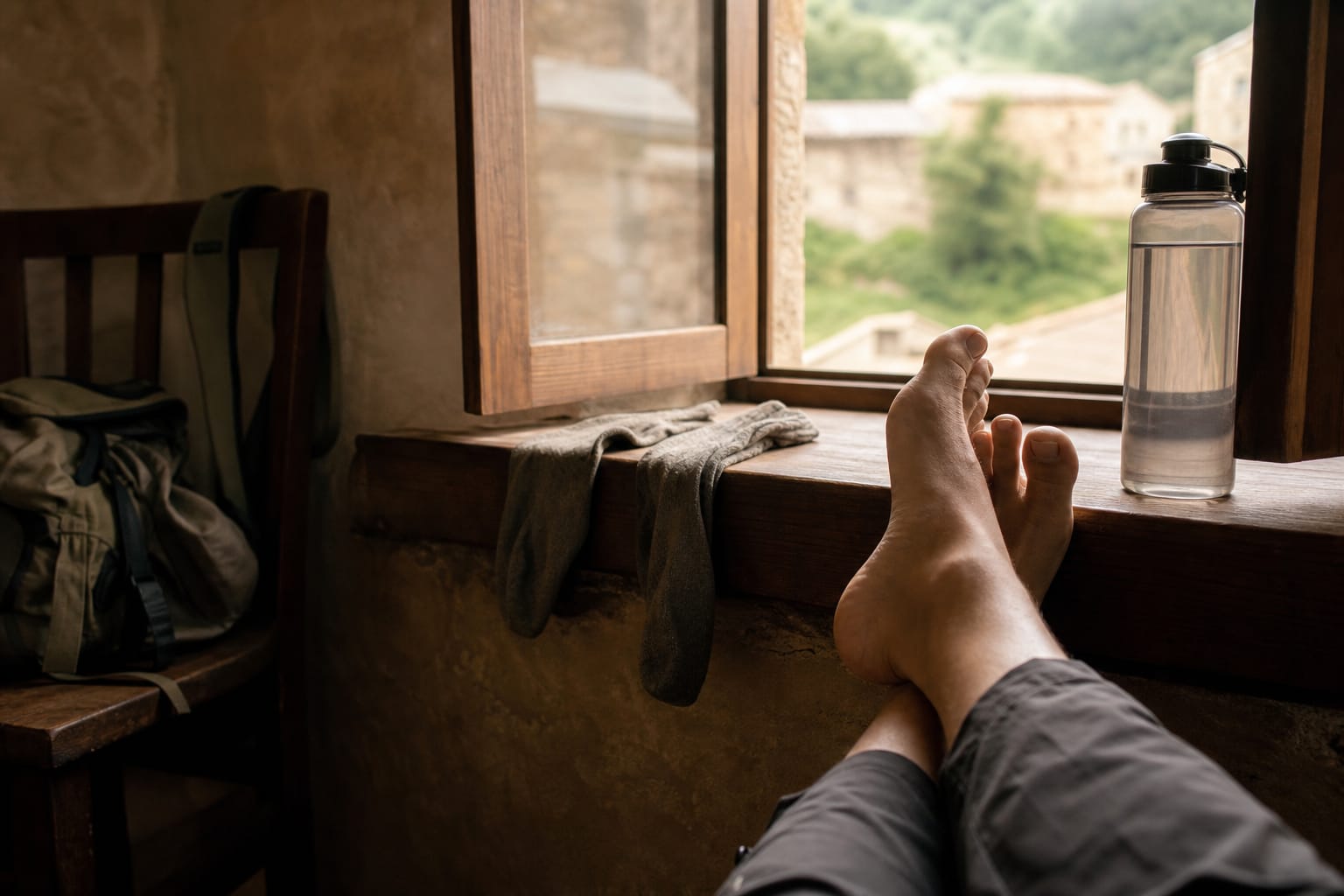
What quietly isn't one
Popular rest-day cities on the Francés, such as Pamplona, Logroño, Burgos, León, and Ponferrada, are wonderful and full of things to see, and that is exactly the risk. A day spent walking museum floors and cobbled old towns is a walking day wearing a tourist's clothes. If you want both the rest and the city, split the difference: see one thing in the morning, then get your feet up for the whole afternoon. The best rest stop is not always a famous city anyway; it is wherever your body reaches its limit, even if that turns out to be a small village with one bar and a good bed.
Frequently asked questions
Which aches on the Camino are normal soreness versus an injury that means stop?
Normal soreness is dull, symmetrical, and spread across large muscles, and it eases within the first kilometre of walking. An injury is sharp, localised to a joint, tendon, or bone, usually one-sided, and worsens with each step. Swelling, night pain, or pinpoint tenderness on bone means stop and rest today.
How do I recompute my remaining Camino stages after an unplanned rest day?
Take your remaining kilometres to Santiago and divide by the days you have left after the rest day. Compare that new daily average to your comfortable pace. If it is too high, split a long stage into two shorter ones, book a bag transfer, or bus a flat section. Adjust bookings only one to three nights ahead so the plan stays flexible.
How often should pilgrims take rest days on the Camino Francés?
About one rest day per week is the common guideline, or three to seven across the full route. Let fitness, age, and pack weight move that number: trained legs may need fewer, while heavier packs or first-time walkers often need one every five to six days.
Will a rest day stop me from earning the Compostela?
No. Rest days and shorter stages do not affect eligibility. The Compostela requires walking the final 100 kilometres into Santiago on foot with two daily stamps in your credential; a rest day earlier on the route has no impact on qualifying.
Where are the best places to take a rest day on the Camino Francés?
Pamplona, Logroño, Burgos, León, and Ponferrada are popular because they sit near natural week markers and offer pharmacies, physiotherapists, comfortable beds, and things to see. But the best rest stop is wherever your body reaches its limit, even if that is a small village.
Is a full rest day better than walking a shorter stage?
It depends on the signal. For deep fatigue or a flaring tendon, a full day off your feet does more than a short walk. For mild stiffness or low mood, a short, flat 8 to 12 kilometre stage with a light pack can keep momentum while still easing the load.
External citations
American College of Sports Medicine — overuse injury and recovery guidance
www.acsm.org/education-resources/trending-topics-resourcesEstablishes the evidence-based rest-and-recovery thresholds behind the go/no-go rule, including the role of elevated resting heart rate and delayed-onset muscle soreness in judging incomplete recovery.
British Journal of Sports Medicine — medial tibial stress syndrome versus tibial stress fracture
bjsm.bmj.comPeer-reviewed criteria distinguishing ordinary shin splints from a stress fracture, which anchor the red-flag distinction between diffuse shin ache and sharp, pinpoint pain on the bone.
Pilgrim's Reception Office, Santiago (Oficina de Acogida al Peregrino) — Compostela requirements
oficinadelperegrino.com/enAuthoritative confirmation that rest days do not affect Compostela eligibility; only the final 100 kilometres on foot, with two daily stamps, count toward qualifying.
La Compostela del Lector
You walked this guide to Santiago.
All 771 km, 0 stages, stamped end to end.