
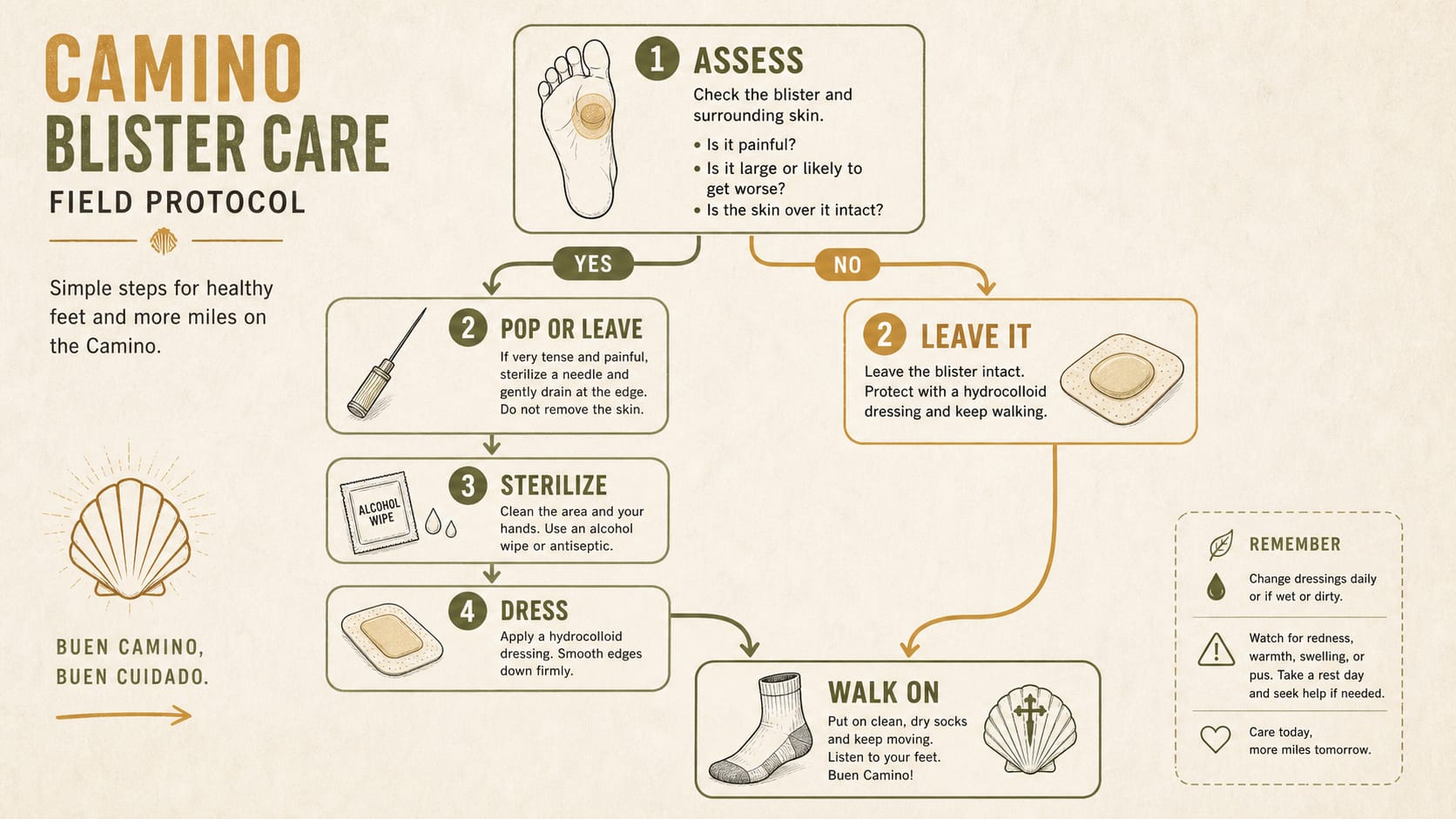
The moment you feel friction, stop and run the protocol. Five steps: assess the blister, decide pop or leave, sterilize the tools, drain through the side if you must keep walking, then dress with hydrocolloid or an improvised tape-and-gauze sandwich. Change the sock, walk on, re-check at the next bar before the blister grows or tears under load.
The mistake most pilgrims make is finishing the kilometer first. Friction that produces a hot spot turns into a fluid-filled blister in 15 to 30 minutes of continued walking. The cost of stopping is five minutes of lost time. The cost of not stopping is a torn deroofed blister you will dress for the next three stages. Get the foot up, the sock off, the boot off, and into shade.
A complete protocol assumes you are carrying a kit (see next section). If you are not, scroll to the burst-blister section for the no-kit variant and the hot-spots-catching-blisters guide for the upstream catch that prevents this whole conversation. The wider foot-care pillar sets the daily-care system that surrounds this protocol.
What counts as a hot spot versus an early blister
A hot spot is warmth, redness, and a sharp sting that fades the second you lift the load. The skin is intact, the layers are still bonded. An early blister has a soft, fluid-filled dome under the skin that you can feel with a fingertip and which keeps stinging even off-load. Hot spots take tape and a sock change. Early blisters take the full protocol. Read the hot-spots-catching-blisters article for the catch-it-early window.
How to drain safely without a sterile clinic
Wipe the blister and the surrounding skin with an alcohol wipe. Pass the tip of a sewing needle or safety pin through a flame for two seconds, let it cool five seconds, then enter the blister through the side at the base of the dome (not through the roof). Press the fluid out with a gauze square, keep the skin flap in place, dab a thin layer of antiseptic ointment around the puncture, and seal with a hydrocolloid pad.
Carry a small zip bag with six hydrocolloid pads, two meters of zinc-oxide or kinesiology tape, four sterile gauze squares, four alcohol wipes, three sterile sewing needles or safety pins, a small tube of antiseptic ointment, a roll of paper tape, and one pair of nitrile gloves. The whole kit weighs under 80 grams and rides in a hip-belt pocket so you can run the protocol without unpacking the rucksack.
The 80-gram kit list
Six hydrocolloid pads (15 g) handle the main dressings. Two meters of cloth tape (12 g) anchor gauze, secure socks, and tape over hot spots. Four alcohol wipes (4 g) sterilize hands, needle, and skin. Three sterile needles (1 g) drain. A 2-gram tube of antiseptic ointment seals the puncture. Four sterile gauze squares (8 g) clean and pad. Paper tape (6 g) holds gauze without yanking skin off. One pair of nitrile gloves (8 g) keeps the field sterile for friends asking for help.
Hydrocolloid pads vs zinc-oxide tape vs Leukotape
Hydrocolloid pads (Compeed and clones) form a gel cushion that absorbs fluid and cuts pain inside an hour. They peel off after two or three days and pull the new skin with them if forced early. Zinc-oxide cloth tape is the workhorse anchor and is breathable enough to leave on between stages. Leukotape P is the strongest of the three: a single strip stays on through two showers and three rainy stages, which is what you want for a weight-bearing patch that must outlast the next farmacia stop.
Improvised supplies when you forgot the kit
If the kit is at the hostel and the blister is forming on a side road, swap supplies item for item. Vinegar from a bar swap replaces alcohol. A cloth napkin folded into quarters replaces gauze. Duct tape from a passing pilgrim replaces cloth tape. A sewing needle borrowed from a hospitalero, flamed by a lighter, replaces the sterile pack. None of this is ideal. All of it gets you to the next farmacia without a torn deroofed blister.
Leave the blister intact if it is under 5 mm, off the load-bearing pad, and you can stop walking within the hour. Drain it through the side with a sterilized needle if it is over 5 mm, sits where every step crushes it, or you still have 10+ kilometers ahead. Never deroof a fresh blister. That flap of skin is a free sterile dressing while the wound bed underneath rebuilds.
The decision rule for intact blisters
Three factors decide. Size: under 5 mm leaves alone, over 5 mm drains. Location: a blister on the side of a toe survives the rest of the stage, a blister on the ball of the foot does not. Remaining distance: under an hour, leave; over 10 km, drain so the dome does not tear under load. Bring all three to bear, not just one. A 4 mm blister on the heel pad with 18 km to go gets drained.
How to drain a blister through the side, sterile-field style
Sit down, wash your hands with bottled water and soap or an alcohol wipe. Put on the nitrile gloves. Clean the blister and surrounding skin in concentric circles outward. Flame the needle, let it cool. Enter through the side wall at the very base, parallel to the skin surface, until the tip is inside the fluid pocket. Press the fluid out toward the puncture with a gauze square, dab dry, apply a pinhead of antiseptic ointment to the entry hole, then seal with a hydrocolloid pad or non-stick gauze taped on all four sides.
Blood blisters and deep blisters: a different branch
Blood blisters are not friction blisters. The dome is dark red or purple because a small vessel under the skin burst. Do not drain them. Cover with a sterile pad, lace looser, take pressure off the spot, and let the body reabsorb the blood over five to seven days. A deep blister sitting under a callus shows up as a soft spot inside hard skin with localized pain. These need same-day attention at a farmacia: the callus has to be thinned to expose the dome before drainage works.
Find shade. Peel the sock carefully, in the direction of the toes, so the deroofed skin stays connected. Irrigate the raw bed with bottled water or sterile saline. Dab dry with sterile gauze. Apply a thin layer of antiseptic ointment, then cover with a hydrocolloid pad or a non-stick gauze pad taped on all four sides. Swap to your dry spare sock, slow the pace, and finish at the next bar instead of pushing through the last 8 km.
Cleaning a burst blister without sterile saline
Bottled water from any bar works for a one-time rinse. Tap water from a farmacia or albergue fountain works if it is the same water locals drink. Avoid streams, ditches, and standing water for an open wound: agricultural runoff on the Camino Francés has bacterial loads that turn a burst blister into a clinic visit in 48 hours. If only river water is available, boil it on a stove if you carry one, otherwise irrigate with the last of your drinking water and resupply at the next fountain.
Dressing options when the skin has torn off
Hydrocolloid is still the first choice on a clean, drained, deroofed blister. It seals, cushions, and starts the new skin layer growing. If the bed is dirty or oozing, use a non-stick gauze pad with antiseptic ointment underneath, anchored with paper tape on all four sides. Avoid plain cotton gauze touching the wound bed directly; it bonds to the new skin and tears it off at the next change.
Adjusting pace and laces to finish the stage
Loosen the laces by one eyelet over the affected area to drop pressure. Walk 10 percent slower so the heel strike is gentler. Take five-minute sock-off breaks every 45 minutes to dry the foot and check the dressing. End the stage at the next town with a pharmacy or albergue, not the kilometer count you started the morning with. A short stage with a healing blister beats a full stage with an infected one.
Walk into any farmacia and ask for "apósitos para ampollas" (blister dressings), "compeed" (the most common hydrocolloid brand), "esparadrapo de tela" (cloth tape), "gasas estériles" (sterile gauze), "povidona yodada" (iodine antiseptic, brand Betadine), and "agujas estériles" (sterile needles). Most farmacias in towns over 1,000 people stock everything without prescription, and a complete pilgrim base kit runs 6 to 10 euros.
Spanish phrase list with phonetic spellings
"Apósitos para ampollas" (ah-POH-see-tohs PAH-rah am-POH-yahs) means blister dressings. "Esparadrapo" (es-pah-rah-DRAH-poh) is medical tape. "Gasas estériles" (GAH-sahs es-TEH-ree-lehs) is sterile gauze. "Povidona yodada" (poh-vee-DOH-nah yoh-DAH-dah) is iodine antiseptic. "Agujas" (ah-GOO-hahs) is needles. "Tengo una ampolla" (TEN-goh OO-nah am-POH-yah) is I have a blister.
Where farmacias actually are between Sarria and Santiago
On the final 115 kilometers from Sarria, a farmacia appears in every settlement above 1,000 residents: Sarria, Portomarín, Palas de Rei, Melide, Arzúa, O Pino, Santiago. That works out to one every 12 to 20 kilometers. Smaller villages between (Ferreiros, Gonzar, Boente, Salceda) have bars but no pharmacy. Standard hours are 09:30 to 14:00 and 17:00 to 20:30, closed Sundays. Many summer farmacias on the Francés run a 24-hour rotation; ask at the counter for the "farmacia de guardia" sheet.
Cruz Roja first-aid posts on the Francés
Cruz Roja runs seasonal first-aid posts at the Camino's worst bottlenecks: Roncesvalles after the Pyrenees crossing, O Cebreiro after the Galicia climb, and pop-up points around major fiestas. Care is free, blister-focused, and run by trained volunteers. They will drain, dress, and refer to a clinic if they spot infection. Look for the red cross on white and the words "puesto de socorro".
Suspect infection if you see expanding redness past the dressing edge, yellow or green pus, warmth around the blister, pain that worsens at rest hours after stopping, or red streaks running up the foot. The first three are manageable with cleaning and observation. The last two mean visit a farmacia or Cruz Roja the same day. Red streaks or fever mean stop walking and go to an ambulatorio now.
Five infection signs ranked by urgency
One: expanding redness past the dressing edge over 12 hours. Two: yellow or green pus inside the dressing. Three: warmth around the blister that does not fade overnight. Four: pain that gets worse hours after stopping (instead of better). Five: red streaks tracking up the foot toward the ankle (lymphangitis). Signs one through three call for a clean redress, a fresh antiseptic, and same-day pharmacy advice. Signs four and five call for medical care that day.
Antibiotic ointment versus oral antibiotics
Topical antibiotic ointment from a farmacia (mupirocina or similar) covers early surface infection: redness, mild pus, warmth. Apply twice a day, redress with sterile gauze, walk shorter stages. Oral antibiotics are a doctor's call, not a farmacia's, and require the triage step. If you have a fever above 38 °C, red streaks, or rapidly worsening redness, you need the next ambulatorio or centro de salud, not a longer course of cream.
When to leave the Camino and seek a clinic
Stop walking the same day for any of: red streaks, fever above 38 °C, deep throbbing pain at rest, redness that doubles in 12 hours, or pus that keeps refilling within hours. Take a bus to the nearest town over 5,000 people and walk into the centro de salud during opening hours, or the urgencias door if it is closed. Compostela credit is not worth a hospital stay; the next month's stage from the same town is.
In a shared albergue, never walk barefoot to the showers; wear flip-flops in the cubicle and on the tile floors. Wash the wound with mild soap and clean water before bed, air-dry the blister for 20 minutes on a clean towel, then redress with a fresh hydrocolloid. Keep socks off in the bunk and let the foot breathe overnight so the dressing seals before the morning sock goes back on.
Communal shower routine for blister-positive feet
Peel the old dressing in the cubicle, not at the basin. Shower with the affected foot last so the rest of the body's run-off does not pass over the wound. Use unscented soap; perfumed gels can irritate the new skin layer. Pat dry with your personal towel, then sit on the bunk with the foot elevated for the 20-minute air dry. Hostel floors are the highest-bacteria surface on the Camino. The flip-flop rule is non-negotiable.
Why bunk-bed air time beats a sealed dressing
A sealed hydrocolloid that has absorbed fluid all day is a small sweat trap. Twenty minutes of air time before the new dressing goes on lets the surface skin firm up and prevents maceration (white waterlogged skin) under the next pad. Maceration triples the chance of a deroofed blister mid-stage the next morning. Plain air, on a clean towel, at the end of the day, is the most underrated piece of foot care on the Camino.
Laundry and sock rotation that actually works
Two pairs of merino-blend socks beat five pairs of cotton. Wash the dirty pair in the sink with the bar of laundry soap, wring tight in a microfiber towel, hang on the bunk's clothesline or pin to the back of your pack for the next morning. Always start the day in the dry, clean pair. A worn-in second pair under your spare matters more than the brand. See the sock-strategy guide for the rotation that saves stages, and the foot-care pillar for the evening washing, airing, and callus routine that surrounds it.
Frequently asked questions
When should I pop a blister on the Camino and when should I leave it alone?
Leave it intact if it is under 5 mm, off the load-bearing pad, and you can stop walking within an hour. Pop it through the side with a sterilized needle if it is over 5 mm, sits where every step crushes it, or you have 10+ km left. Keep the roof of skin on; that flap is your free sterile dressing while the wound bed heals.
How do I know if my Camino blister is infected and when should I stop walking?
Watch for five signs: spreading redness past the dressing, yellow or green pus, warmth around the blister, pain that worsens at rest, and red streaks running up the foot. The first three call for a clean redress and same-day pharmacy advice. Red streaks, fever, or rapidly spreading redness mean stop walking the same day and find a farmacia, Cruz Roja post, or ambulatorio.
What if I have no kit at all and the blister has already burst?
Rinse with bottled water, dab dry with the cleanest fabric you have (bandana, buff, fresh underwear), and tape a thin folded section of napkin over the bed with whatever tape a fellow pilgrim can spare. This holds you for about two hours of walking. Resupply at the next farmacia and redress properly that night.
Should I keep walking with a blister or take a rest day?
Most pilgrims keep walking with a properly drained and dressed blister. Stop the stage early or take a rest day if you are limping (which transfers load and creates new blisters and tendon strain), if a deep blister forms under a callus, or if any infection sign appears. See when to take a rest day for the call. A single rest day costs less than three days of compensatory injuries.
What is the minimum blister kit I should carry on the Camino?
An 80-gram zip bag with six hydrocolloid pads, two meters of zinc-oxide cloth tape, four alcohol wipes, three sterile sewing needles or safety pins, a 2 g tube of antiseptic ointment, four sterile gauze squares, paper tape, and one pair of nitrile gloves. This runs the full mid-stage protocol without needing a pharmacy and fits in a hip-belt pocket.
Can I shower in an albergue with an open blister?
Yes, but peel the old dressing first, wear flip-flops on the shared tile, wash the wound with mild soap and clean water, pat dry with a personal towel, air it for 15 to 20 minutes, then apply a fresh hydrocolloid. Never walk barefoot in communal showers. Hostel floors are the highest-bacteria surface on the Camino.
External citations
American Academy of Dermatology: friction blister care
www.aad.org/public/everyday-care/injured-skin/burns/treat-blistersClinical baseline on intact-skin protection, drainage method, and infection signs, grounding the pop-or-leave decision rules and the field protocol used here.
Rebecca Rushton, BSc: Blister Prevention
www.blisterprevention.com.auSports-medicine reference on shear-deformation as the actual mechanical cause of friction blisters, used for the protocol's drainage technique and the differentiation of blood blisters from friction blisters.
Ministerio de Sanidad: pharmacy services overview
www.sanidad.gob.es/areas/farmacia/home.htmAuthoritative reference for what a Spanish farmacia is permitted to dispense without prescription and the standard operating hours, used in the pharmacy-supplies section.
Cruz Roja Española: first aid services
www.cruzroja.es/principal/web/cruz-roja/que-hacemosSpanish Red Cross overview of seasonal first-aid posts and free pilgrim care along the Camino routes, used for the Cruz Roja first-aid post reference.
La Compostela del Lector
You walked this guide to Santiago.
All 771 km, 0 stages, stamped end to end.