
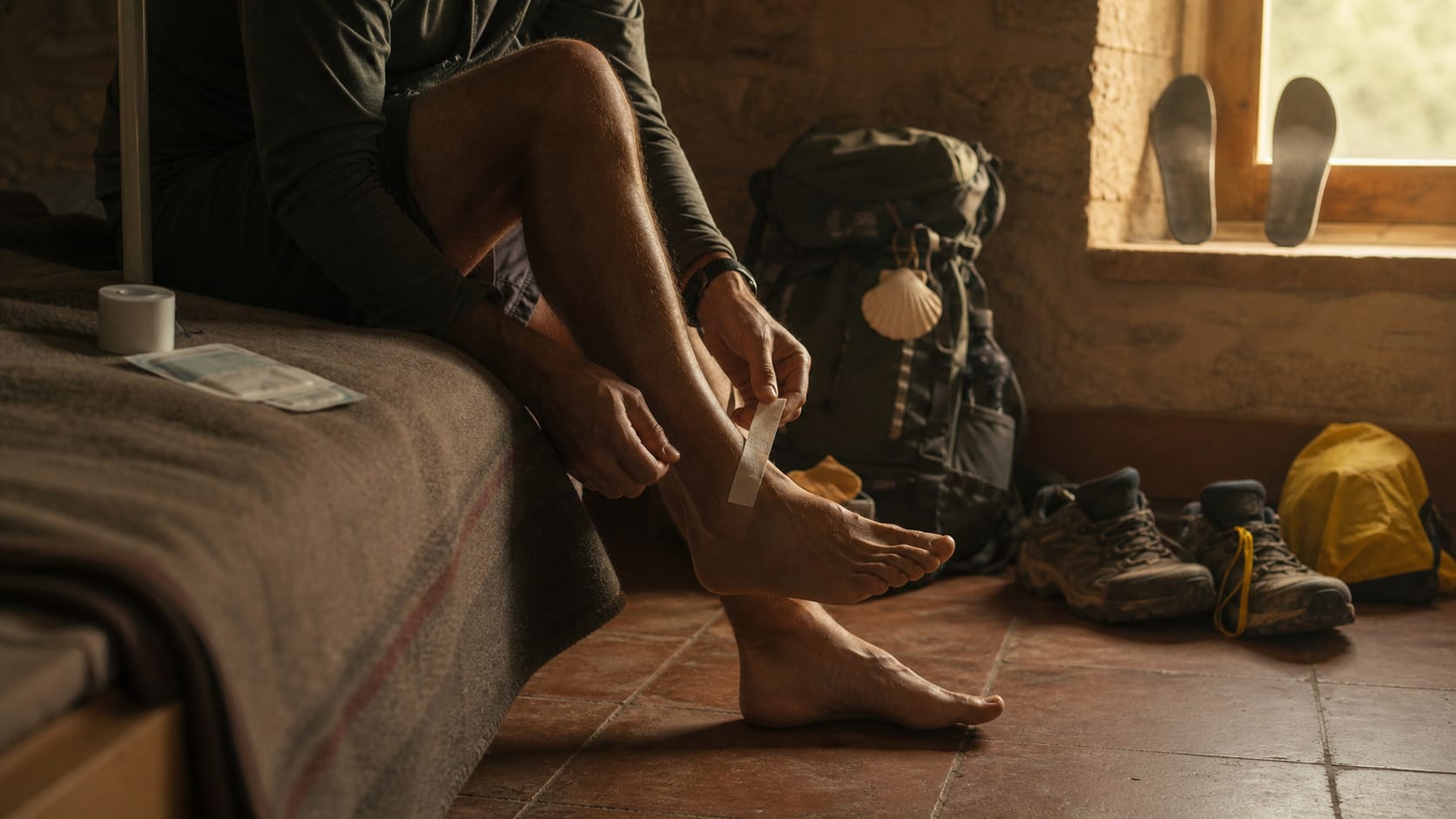
Follow a three-part routine every day. Each morning, dry your feet, tape known hot spots with paper tape, and lace snugly before you leave the albergue. Every 90 minutes on trail, stop for two minutes to air your feet and fix anything that rubs. Each evening, wash and fully dry your feet, inspect every toe, treat blisters, elevate, and sleep barefoot. That is the whole system. It works because it removes friction, heat, and moisture before they get a chance to build a blister, rather than waiting to react once the damage is done.
The routine matters more than any single product because feet fail slowly, over hours, in ways you can head off if you have a habit that catches them. A pilgrim who tapes in the morning and airs their feet at every break will out-walk one who carries a fancier kit but only opens it after the limping starts.
Morning: dry, tape, lace
Dry your feet completely
Damp skin blisters faster than dry skin. Towel between every toe. If your feet were sweaty overnight, a light dusting of foot powder or a thin smear of vaselina on friction points helps, depending on which your skin prefers.
Tape your known hot spots
Cover the places that rubbed yesterday with paper tape (esparadrapo de papel) before they have a chance to complain. A randomized trial of endurance runners found paper tape cut blister incidence by 40 percent, and it costs a euro or two a roll. Tape the spot, not the whole foot.
Put on dry socks and lace snugly
Fresh socks, seams sitting flat, no wrinkles. Lace firmly enough that your foot does not slide forward on descents, but not so tight that it cuts circulation. Wiggle your toes before you stand up.
Midday: the two-minute break check
Every 90 minutes or so, stop for two minutes and take your shoes off. This is the single most skipped step and the one that saves the most feet. Air dries the sweat, and airing lets you catch a hot spot while it is still a warm patch of skin rather than a fluid-filled blister. An untreated hot spot can turn into a full blister within hours of continued walking, so the two minutes you spend now buys you days of pain-free walking later.
Evening: wash, inspect, air
In the albergue, wash your feet, dry them completely (between the toes especially, since that is where athlete's foot starts), and look at every toe and both heels under good light. Treat anything that has formed while it is small. Then get your feet up: lie on the bunk with your feet against the wall for ten minutes to drain the swelling of the day. Sleep barefoot or in loose sandals so the skin breathes overnight. Prop your shoes open with the insoles pulled out so they dry too, because dry shoes in the morning are worth as much as dry socks.
Blisters form when friction, heat, and moisture act on the skin at the same time. Remove any one of the three and the blister cannot form. That is the whole science, and it is why the daily routine targets all three: tape kills friction, airing kills heat, dry socks kill moisture. You do not have to win on all three fronts. You only have to break the combination.
The scale of the problem is real. A case-control study of 298 Camino de Santiago hikers found that 207 of them, about 69 percent, had at least one blister, and the blistered walkers reported significantly more pain and disability than those who stayed clear. Sprains and strains affect roughly 17 percent of pilgrims, making them the most common injury after blisters. So this is not a niche worry for the unlucky. Most pilgrims blister at some point, and the ones who cope best are not the ones with the toughest feet. They are the ones with a habit.
Skin condition plays a part too. A 2024 study of Camino Francés pilgrims in León province found that how hydrated the skin was influenced whether blisters occurred, which is one more reason the evening wash-and-dry step earns its place. Feet that are either soaking wet all day or cracked and dry are both more vulnerable than skin kept clean, dry, and intact.
Blister prevention starts weeks before Saint-Jean-Pied-de-Port, not on day one. Walk at least 50 km in the exact shoe-and-sock combination you plan to wear, size your shoes up for the swelling that a multi-week walk brings, switch to merino or liner socks, trim your toenails straight across, and tape your personal hot spots from the first training walk so you already know where they are. The pilgrim who arrives with broken-in shoes and a known taping map is most of the way to a blister-free Camino before they take a single step in Spain.
The 50 km break-in rule
Footwear needs two to three months and at least 50 km of loaded walking to break in properly. New shoes are the most reliable way to guarantee blisters, so this is not optional. Walk in the shoes you will actually carry your pack in, on the terrain you can find, until they feel like part of your foot. If a pair still pinches after 50 km, they are the wrong pair, and it is far better to learn that at home than in Pamplona.
Sock system: liner, merino, and sizing up
Cotton socks hold sweat against the skin, which is exactly what you do not want. Merino or synthetic wicking socks, often paired with a thin liner sock underneath, measurably reduce friction blisters by moving moisture away and letting the two sock layers rub against each other instead of against your skin. Size your shoes up by half a size to a full size, because feet lengthen and widen over a multi-week walk and a shoe that fits perfectly in the shop will feel a size too small by the second week. If your toes touch the front on a downhill, you will lose toenails.
Toenails, calluses, and the podiatrist visit
Trim your toenails straight across, not curved, so they do not catch and blacken on descents. If you carry calluses or ingrown nails, a pre-trip appointment with a podiatrist about eight weeks out is worth the money. They will reduce calluses, sort the nails, and check your gait for anything that will cause trouble over hundreds of kilometres. First-time pilgrims should also start with 10 to 15 km days and build distance, because conditioning and pace protect your feet more than any product on the pharmacy shelf.
For most pilgrims on the Camino Francés, trail runners beat boots. They are lighter, they dry overnight, and they need little break-in. Choose boots only if you have ankle instability, you are carrying a pack over 10 kg, or you are walking winter mud. Whichever you pick, buy it a half size large and log 50 km in it before you fly. The full comparison, with the case for boots laid out fairly, lives in our guide to hiking boots vs trail runners, but the short version fits here.
The Francés is a walked path, not a mountaineering route. The ground is mostly gravel track, farm road, and packed earth, with rocky stretches you can manage in a good trail runner. Lighter shoes mean less lift with every step, which over 25 km a day adds up to real energy saved and, more to the point, less heat and friction at the foot. The one place boots earn their weight is drainage and ankle support: if you roll ankles easily or you are hauling a heavy pack in wet months, the extra structure is worth the extra weight. For most other pilgrims the modern advice has shifted toward the lighter shoe, and the blister data tends to follow.
If a blister has already formed, wash your hands, clean the area, and only drain it if it is tense and painful. A small blister that does not hurt when you walk is best left alone, since the intact roof is the cleanest dressing you will find. When one is large and pressing, drain it carefully and keep the skin on top. For the full field protocol, with dressing choices and infection signs, see our guide to blister treatment on the trail.
Drain or leave intact
Decide first
Small and painless? Leave it, cover it, walk on. Tense, large, and painful under load? Drain it. Never peel the skin away, because the roof protects the raw layer underneath.
Clean your hands and the blister
Wash your hands, then clean the blister and the skin around it with povidona yodada (Betadine) or rinse with suero fisiológico (sterile saline).
Puncture the edge
Sterilize a needle, puncture the blister at its lower edge, and gently press the fluid out. Draining from the edge, not the top, keeps the roof intact.
Dress and cover
Cover with a hydrocolloid dressing (apósitos hidrocoloides). It cushions the spot and keeps it clean while it heals under the roof.
Check it daily
Look at it every evening for redness, heat, swelling, or pus. Those are infection signs, and infection is the one blister complication that ends Caminos.
The needle-and-thread debate
You will meet pilgrims, and hospitaleros, who swear by the old Spanish method: thread a sterilized needle, pass it through the blister, and leave a length of thread inside as a drainage wick. It has a long history on the route and plenty of walkers still use it. Current wound-care guidance has moved away from it, though, because leaving thread inside the blister gives bacteria a path in and keeps the wound open. The safer version keeps the roof intact and drains once from a clean edge puncture. If you already trust the thread method and keep everything sterile, you will probably be fine; if you are choosing now, choose the edge puncture.
Every stage town on the Camino Francés has a pharmacy, marked with a green cross, and nearly all of them have handled pilgrim feet before. You do not need to speak Spanish. Learn five product names, or point at the table below, and any farmacia will sort you out. Staff on the route see blisters every single day of walking season.
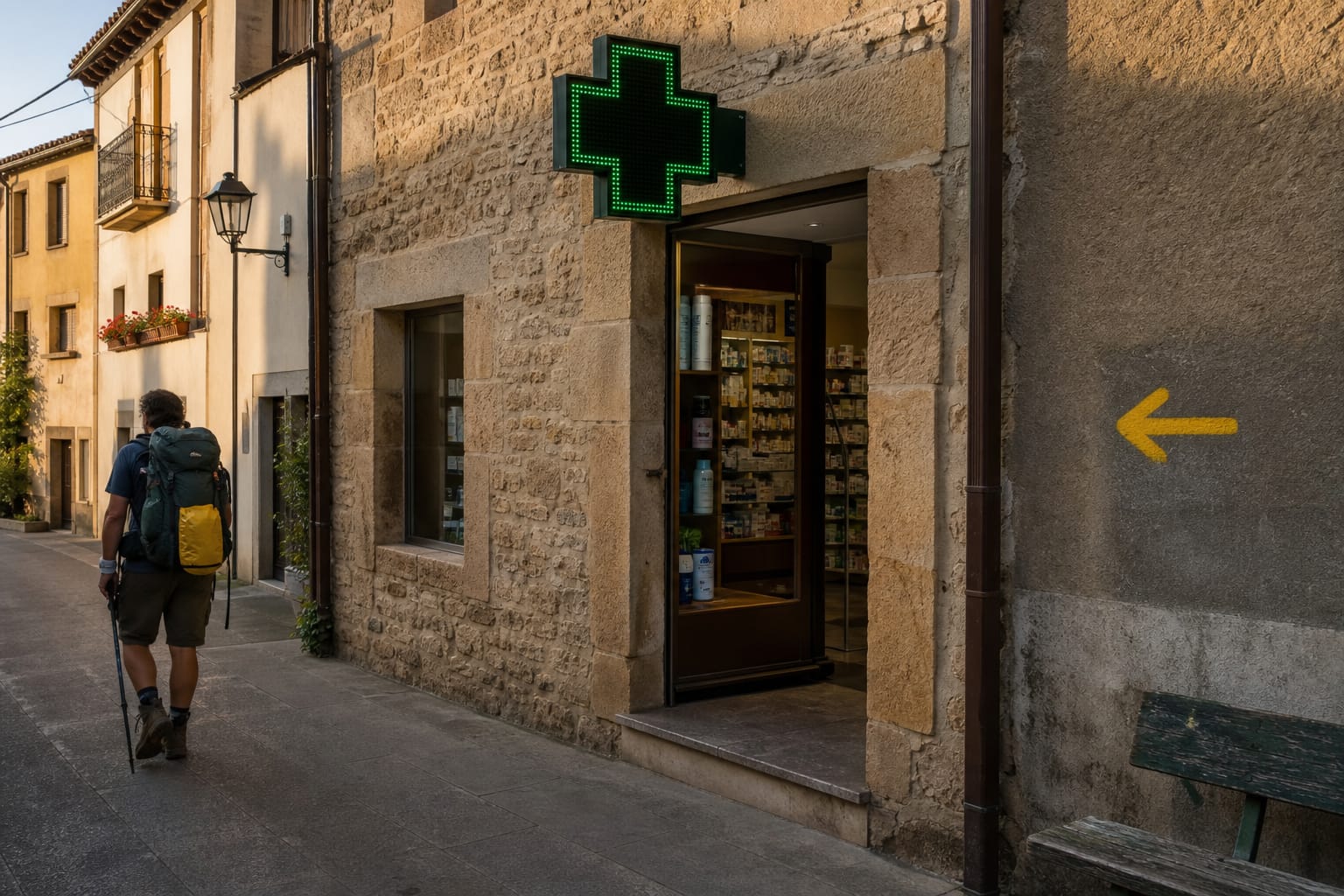
The five things worth knowing by name: apósitos hidrocoloides (hydrocolloid blister dressings, the Compeed type), esparadrapo de papel (paper surgical tape, your cheapest prevention), povidona yodada (Betadine, the 10 percent povidone-iodine antiseptic stocked in every farmacia on the route), suero fisiológico (sterile saline for cleaning), and vaselina (petroleum jelly for friction). Add a sterile needle or a single-use lancet and you have a full foot kit for well under 25 euros.
| Product (Spanish name) | What it is | Best for | When to avoid | Typical price (EUR) |
|---|---|---|---|---|
| Apósitos hidrocoloides | Hydrocolloid blister dressings (Compeed style) | Cushioning and healing a drained or intact blister | Signs of infection (see a doctor, do not just cover it) | 6–10 |
| Esparadrapo de papel | Paper surgical tape | Prevention: taping hot spots before they blister | Broken skin that needs a breathable dressing instead | 1–3 |
| Povidona yodada | Betadine, 10% povidone-iodine antiseptic | Cleaning a blister or small wound before dressing | Known iodine allergy | 3–6 |
| Suero fisiológico | Sterile saline | Rinsing and cleaning without stinging | Nothing; it is the gentle default | 2–4 |
| Vaselina | Petroleum jelly | Reducing friction on rub-prone spots | Skin that stays too wet (powder may suit better) | 2–4 |
For pilgrims flying in from Korea or Japan: the Spanish pharmacy system may look unfamiliar, but a farmacia is a full health resource, not just a shop. Pharmacists can advise on minor injuries and point you to the centro de salud (public health center) for anything bigger, and pointing at the product names above works across any language barrier. Many Korean pilgrims carry their own hydrocolloid dressings from home, which is fine, since they are the same product and you can top up on the route.
Blisters are the loudest foot problem but not the only one. Use a three-question test each morning to decide whether to keep walking or rest: does the pain change how you walk, is it worse than yesterday, and is there swelling, heat, or redness? One yes means a short stage of 10 to 15 km. Two or more yeses mean a rest day. Red streaks spreading up the leg, fever, or pus mean a doctor, not a pharmacy: go to the centro de salud that same day.
If
No to all three questions
If
One yes
If
Two or more yeses
If
Red streaks, fever, or pus
Tendonitis and shin pain
Tendon pain along the front of the shin or the Achilles is the body telling you the load is too high, too fast. It does not respond to taping or tougher skin; it responds to rest, ice, and less distance. Push through it and you turn a two-day problem into a two-week one. If a tendon flares, shorten stages, cut your pack weight where you can, and take a genuine rest day before it forces one on you. This is the injury most likely to end a first Camino, and almost always because someone kept walking on it.
Plantar fasciitis and heel pain
A stabbing pain under the heel, worst in the first steps of the morning, is usually plantar fasciitis. Stretch your calves and the sole of the foot before you stand, walk shorter days for a while, and make sure your shoes still have cushioning left; worn-flat insoles are a common trigger. A gel heel cup from the farmacia helps some pilgrims. If it does not settle over a few days of shorter stages, treat it as a rest-or-see-someone problem, not a walk-it-off one.
Black toenails and athlete's foot
Black toenails come from toes hitting the front of the shoe on descents, which is why sizing up and lacing to stop foot slide matters so much. A blackened nail usually does not hurt and does not need draining unless it is painful and pressured. Athlete's foot (itching, peeling, cracking between the toes) thrives in the warm, damp conditions of a walked-in shoe. Dry thoroughly between the toes every evening, rotate socks, and pick up an antifungal cream from any farmacia at the first sign. Left alone, it cracks the skin and opens the door to worse.
Three sections of the Camino Francés cause the most foot damage, and knowing them lets you plan shorter stages and extra sock changes before you get there. The day-one descent, the Meseta heat, and the drop from Cruz de Ferro account for a large share of the route's blisters and black toenails. Plan them softer than the stages around them.
The day-one descent into Roncesvalles or Zubiri hits your feet before they have adapted, on the hardest single day of the whole route. Your pack is heaviest, your shoes are newest, and the long downhill into the valley pounds toes into the front of the shoe. Lace tight on the descent, and if your itinerary allows, break the Saint-Jean-to-Roncesvalles stage rather than doing it in one push.
The Meseta between Burgos and León is roughly 180 km of flat, largely shadeless track where midday heat peaks and feet swell. Swelling turns a good fit into a tight one, so this is where sizing up pays off and where the two-minute airing breaks matter most. Start early, carry water, and change socks more often than the terrain seems to demand.
The descent from Cruz de Ferro to Molinaseca drops roughly 1,000 m from around 1,500 m on loose rock, and it is the hardest toenail test on the Francés. This is the classic black-toenail stage. Trim your nails before it, lace to stop your foot sliding forward, use poles if you have them, and take it slow; a twisted ankle here is far more costly than a slow descent. Of the 530,987 pilgrims who collected the Compostela in 2025, 242,058 walked the Francés, and a good number of them limped down this exact slope.
FAQ
What blister products should I buy at a Spanish pharmacy on the Camino?
Buy five things: apósitos hidrocoloides (Compeed-style blister dressings), esparadrapo de papel (paper surgical tape) for prevention, povidona yodada (Betadine antiseptic), suero fisiológico (sterile saline) for cleaning, and vaselina (petroleum jelly) for friction. Add a sterile needle or single-use lancet. Every farmacia on the route stocks all of them, usually for under 25 euros total.
How do I decide whether to keep walking or rest a foot injury on the Camino?
Ask three questions each morning: does the pain change your gait, is it worse than yesterday, and is there swelling, heat, or redness? One yes means walk a short stage of 10 to 15 km. Two or more mean a rest day with elevation and ice. Red streaks, spreading redness, fever, or pus mean visit a doctor or centro de salud that same day, not a pharmacy.
Should I pop a blister or leave it intact while walking the Camino?
Leave it intact if it is small and does not hurt when you walk; the roof is the best dressing. Drain it only if it is tense and painful: clean with antiseptic, puncture the edge with a sterile needle, press the fluid out, keep the roof on, and cover with a hydrocolloid dressing. Never cut the skin away.
How far should I walk each day in the first week to protect my feet?
Keep the first two or three stages at 10 to 15 km if your itinerary allows, and under 20 to 25 km at most. Feet typically swell and hot spots peak on days three to five, before the skin adapts. Booking a mid-stage albergue on day one, instead of pushing Saint-Jean to Roncesvalles in one go, prevents more blisters than any product.
Do I need to speak Spanish to get foot care help on the Camino?
No. Pharmacies are marked with a green cross, pharmacists on the route see pilgrim feet every day, and pointing at the product list in this guide or showing a photo of your foot is enough. For infections or injuries, ask for the centro de salud (public health center). A translation app covers the rest; the vocabulary in this article covers the essentials.
What should I do the moment I feel a hot spot while walking?
Stop within two minutes; a hot spot can become a blister within hours. Take the shoe and sock off, let the skin dry, cover the spot with paper tape or a blister dressing, switch to dry socks if you have them, and re-lace to stop the rubbing. Two minutes now saves three days of limping later.
Two sibling guides go deeper than this routine can. For the full pre-departure break-in and sock plan, read blister prevention on the Camino and sock strategy for long-distance walking. To catch a blister in the two minutes before it forms, read hot spots: catching blisters before they form. And to pack the kit these products go into, see the Camino first aid kit. If you are still building fitness and shaping your itinerary, start with how to plan your first Camino de Santiago and training for the Camino.
External citations
Lipman GS et al., Paper Tape Prevents Foot Blisters: A Randomized Prevention Trial, Clinical Journal of Sport Medicine, 2016
Randomized trial of endurance runners showing paper tape cut blister incidence by 40 percent — the evidence base for the article's cheapest prevention recommendation.
Pilgrim's Reception Office, Santiago (official statistics)
oficinadelperegrino.comThe cathedral's official pilgrim statistics ground the article's scale claims (530,987 Compostelas in 2025, of which 242,058 walked the Francés) in the primary source.
Influence of blistering lesions on foot functionality in hikers (case-control study of 298 Camino de Santiago walkers), Journal of Tissue Viability, 2023
Field data collected on the Camino itself, quantifying that 207 of 298 walkers had blisters and that blisters significantly increase pain and disability.
Skin hydration and blister occurrence in Camino Francés pilgrims, León province, International Wound Journal, 2024
Field study linking skin hydration level to blister occurrence, supporting the evening wash-and-dry step of the daily routine.
La Compostela del Lector
You walked this guide to Santiago.
All 771 km, 0 stages, stamped end to end.