
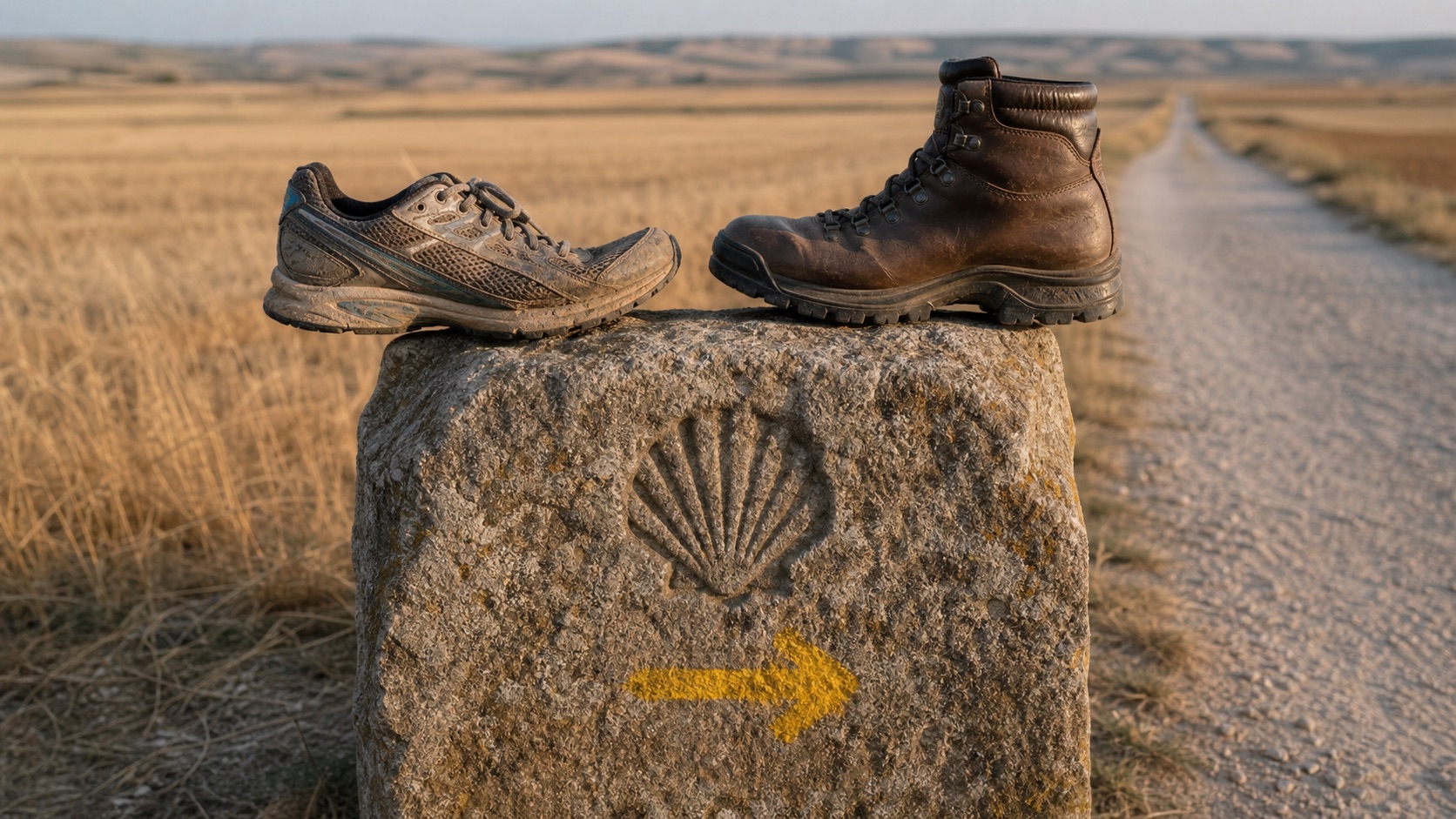
Most first-time pilgrims should choose cushioned trail runners, not hiking boots, for the Camino Francés. The route is graded gravel, farm tracks, and roughly 240 kilometres of asphalt. On surfaces like that, cushioning, low weight, and fast drying decide how your feet feel in week three, while the things boots are built for, rock armour and ankle collars, mostly add weight you lift a million times.
Long-distance walkers have largely settled this. About 75 percent of 2019 Appalachian Trail thru-hikers wore trail runners and fewer than 10 percent wore boots, and in a 277-pilgrim footwear poll, trail runners were the most recommended category for the Camino, ahead of hiking boots and road running shoes. The boot as default pilgrim footwear is a leftover from heavier packs and rougher gear, not a verdict on today's options.
Boots still win in three cases. In winter, November to March, long stretches of the path turn to cold mud, and a waterproof boot earns its keep. Under heavy loads, above roughly 10 kilograms of pack weight, a stiffer sole and a more structured upper start to pay for themselves. And if you already own boots with hundreds of comfortable kilometres on them, a proven pair beats a theoretical upgrade bought six weeks before your flight; deciding which of the hiking gear you already own transfers to the Camino is a question of its own.
The Camino Francés is a walking route, not a mountain trail. It covers 770 to 800 kilometres from Saint-Jean-Pied-de-Port to Santiago de Compostela, typically in 30 to 35 stages averaging around 24 kilometres a day. About 30 percent of that distance, roughly 240 kilometres, is asphalt or concrete; the rest splits between pale gravel sendas, dirt farm tracks, forest paths, and short rocky descents. If your mental image involves scrambling over boulders, you are picturing a different Camino. Our guide to choosing your Camino route sorts the paths that genuinely demand mountain footwear from the ones that do not.
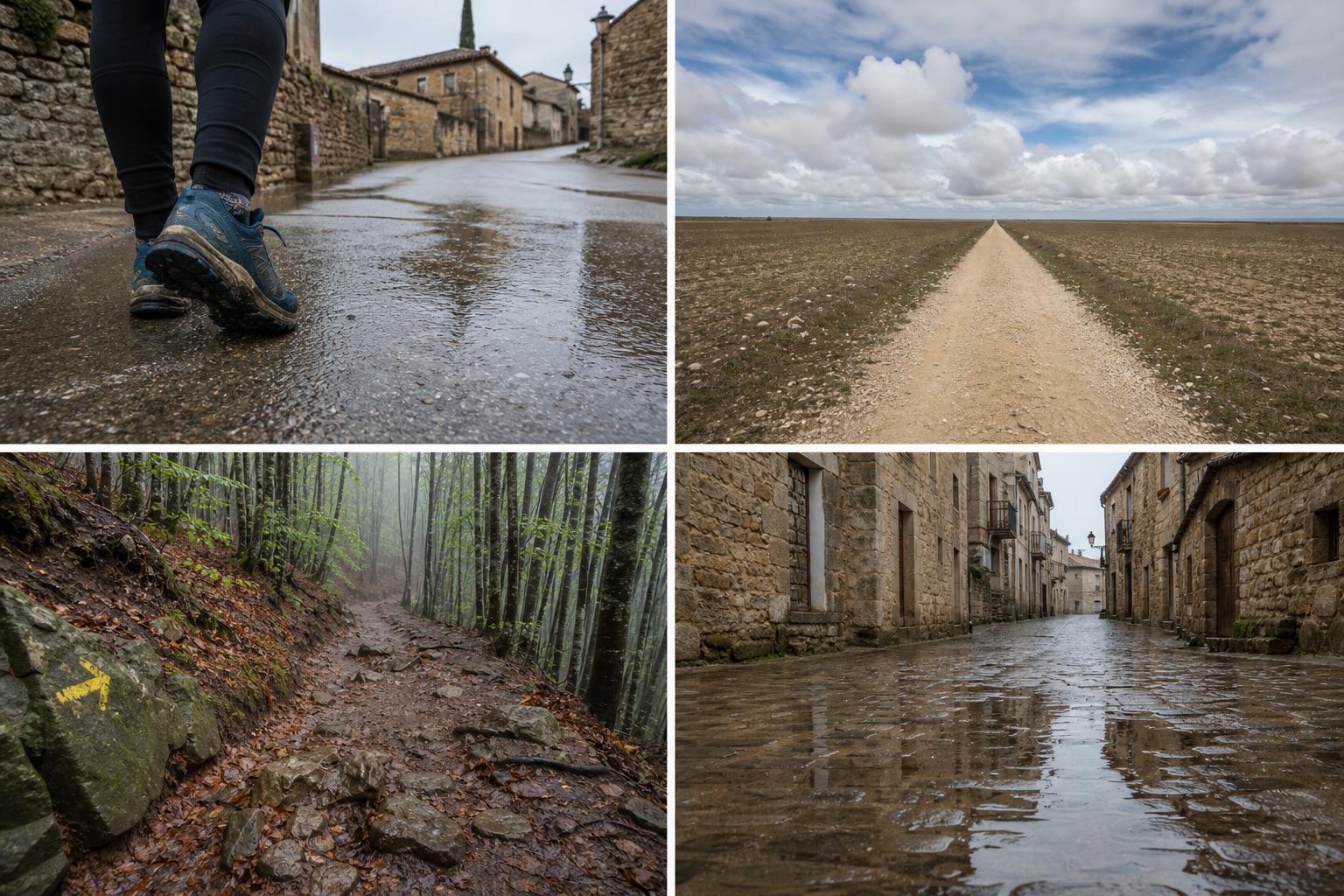
Repetition does the damage, not technicality. Finishing the Francés takes roughly one million steps, and the repeated impact of hard surfaces, not twisted ankles on rock, is what wrecks feet. Blisters are the most commonly reported ailment on the route, affecting roughly half of pilgrims, which is why cushioning outranks ankle armour and aggressive tread on the spec sheet.
The profile has two real climbs: the 1,430-metre Col de Lepoeder coming out of Saint-Jean on day one and the roughly 1,500-metre Cruz de Ferro in week four. Both hurt less than their descents. The drops into Roncesvalles and Molinaseca are where toes hit toe boxes and knees absorb the route's hardest kilometres, which makes toe room and cushioning, again, the deciding specs. Plenty of feet run this experiment every year: the Pilgrim's Office issued 530,987 Compostelas in 2025, and about 46 percent of arriving pilgrims, just over 242,000 people, walked the Francés.
Spec by spec, trail runners win on weight (roughly half a boot's), drying time (overnight against days), break-in (minimal), and price. Boots win on durability, toe protection, and cold-weather warmth. The classic argument for boots, ankle support, has the weakest evidence of the lot.
Weight first, because it compounds. A typical pair of mid-weight hiking boots weighs 1,200 to 1,600 grams; cushioned trail runners weigh 500 to 700. US Army research (Soule and Goldman, 1969) measured that weight carried on the feet costs five to six times as much energy as the same weight on the torso, the origin of the old rule that "a pound on your feet equals five on your back". Close to a kilogram of difference, lifted with every stride, for a million strides.
The ankle question has been studied directly. A prospective randomized study of 622 athletes (Barrett et al., 1993) found no significant difference in ankle sprain rates between high-top and low-top shoes. What stability your footwear provides comes mainly from the torsional rigidity of the sole and from proprioception, your foot's ability to feel and react to the ground, not from collar height. A history of repeated sprains may justify a mid-cut shoe or taping; for everyone else, ankle support should not decide the purchase.
Waterproof membranes are the other spec that reads better than it walks. A membrane keeps rain out until water arrives over the collar or through the seams, and then it holds that water in. Soaked waterproof boots can take 24 to 48 hours to dry; mesh trail runners drain as you walk and usually dry overnight in an albergue. On the Meseta between Burgos and León, where July and August afternoons regularly pass 30°C, the same membrane traps heat and raises blister risk.
Durability is the honest boot win. Boots commonly cost $200 or more and outlast several pairs of trail runners; trail runners cost $100 to $150 and last 500 to 750 miles, so a single pair can cover the whole Francés but arrives in Santiago at the end of its usable life. Where footwear sits in the overall trip math is covered in our realistic Camino budget breakdown.
| Criterion | Hiking boots | Hybrid hiking shoes | Trail runners | Road running shoes |
|---|---|---|---|---|
| Weight per pair | 1,200–1,600 g | 800–1,100 g | 500–700 g | 400–600 g |
| Cushioning | Firm, protective | Moderate | High, built for impact | High but fragile |
| Drying time when soaked | 24–48 hours | Up to a day | Overnight | Overnight |
| Durability over 800 km | Multiple Caminos | One to two Caminos | One Camino | Outsole wears early |
| Break-in needed | 100 km or more | Moderate | Minimal | Minimal |
| Typical price | $200+ | $140–180 | $100–150 | $90–140 |
Run the choice through three filters: your feet, your pack, and your calendar. Each one can move the verdict.
Feet first, measured rather than guessed. Wide forefeet and bunions point to wide-toebox trail runners, because descending with toes pressed against the upper is how pilgrims lose toenails. Low-volume feet often do better once the stock insole is swapped for a supportive one. Ankles with a genuine sprain history are the one case where a mid-cut shoe is worth testing, with the evidence caveat from the section above.
Pack weight is the second filter. Below roughly 10 kilograms all-in, a flexible trail runner carries you fine; above that, a stiffer midsole stops long days from bruising your soles. Footwear is also the heaviest single decision on a packing list, and the complete packing list with target weights is a guide of its own.
Season is the third. The Spanish meteorological agency's 1991–2020 climate normals put Santiago de Compostela at roughly 1,900 millimetres of rain a year, with monthly totals at or above 200 millimetres from November through February, and about 19 rain days in November against 9 in July. An April-to-October start favours mesh trail runners; a late-autumn or winter start is the strongest case waterproof footwear has. If your dates are still open, settle them inside the larger sequence in our guide to planning your first Camino de Santiago.
Treat Camino shoes as consumables with a known service life. Trail runners last 500 to 750 miles (800 to 1,200 kilometres), and the kilometres you put on them in training count against that total, so a pair that starts the Francés with 300 training kilometres on it can die before Galicia. Know your model's typical lifespan, and start the walk on a mostly fresh pair.
The warning signs are predictable. Around Burgos, roughly a third of the way in, pay attention to the midsole: cushioning that suddenly feels dead, new aches in knees or shins, or outsole lugs rounded flat all mean the shoes are finishing before you are. Pamplona, Logroño, Burgos, León, and Ponferrada all have outdoor retailers on or within a short detour of the route, so no point on the Francés is much more than a week's walk from a replacement pair. Swapping shoes in a city at kilometre 400 is a far better outcome than nursing a collapsed pair into Santiago.
Buy your Camino shoes eight to twelve weeks before departure and put at least 100 kilometres on them before you fly, including back-to-back 20-kilometre days under your loaded pack. Trail runners need little mechanical break-in, but your feet need the testing window: any hotspot that shows up in training is a fit verdict, not a toughness test, and you still have time to exchange the pair. The walking volume slots neatly into the schedule in our Camino training plan for beginners.
Size up a half to a full size from your street shoes. Feet swell measurably over multi-week distance walking, and toes striking the front of the shoe on descents is how toenails go black. Fit shoes in the afternoon, when feet are at their largest, wearing the socks you will walk in, and leave a thumb's width of space in front of your longest toe.
Socks carry as much of the blister load as the shoes do. Merino blends insulate when damp, dry fast, and stay comfortable for a second day when laundry plans fail; carry three pairs and rotate. The shoe-sock combination is the unit you are breaking in, so train in both.
Wet feet on the Camino are a management problem, not an emergency. Mesh trail runners drain as you walk, and damp merino socks stay warm, so the routine matters more than the membrane: change socks at the midday stop, and at the albergue pull the insoles out and stuff the shoes with newspaper. Mesh shoes treated this way usually dry by morning; a soaked boot does not.
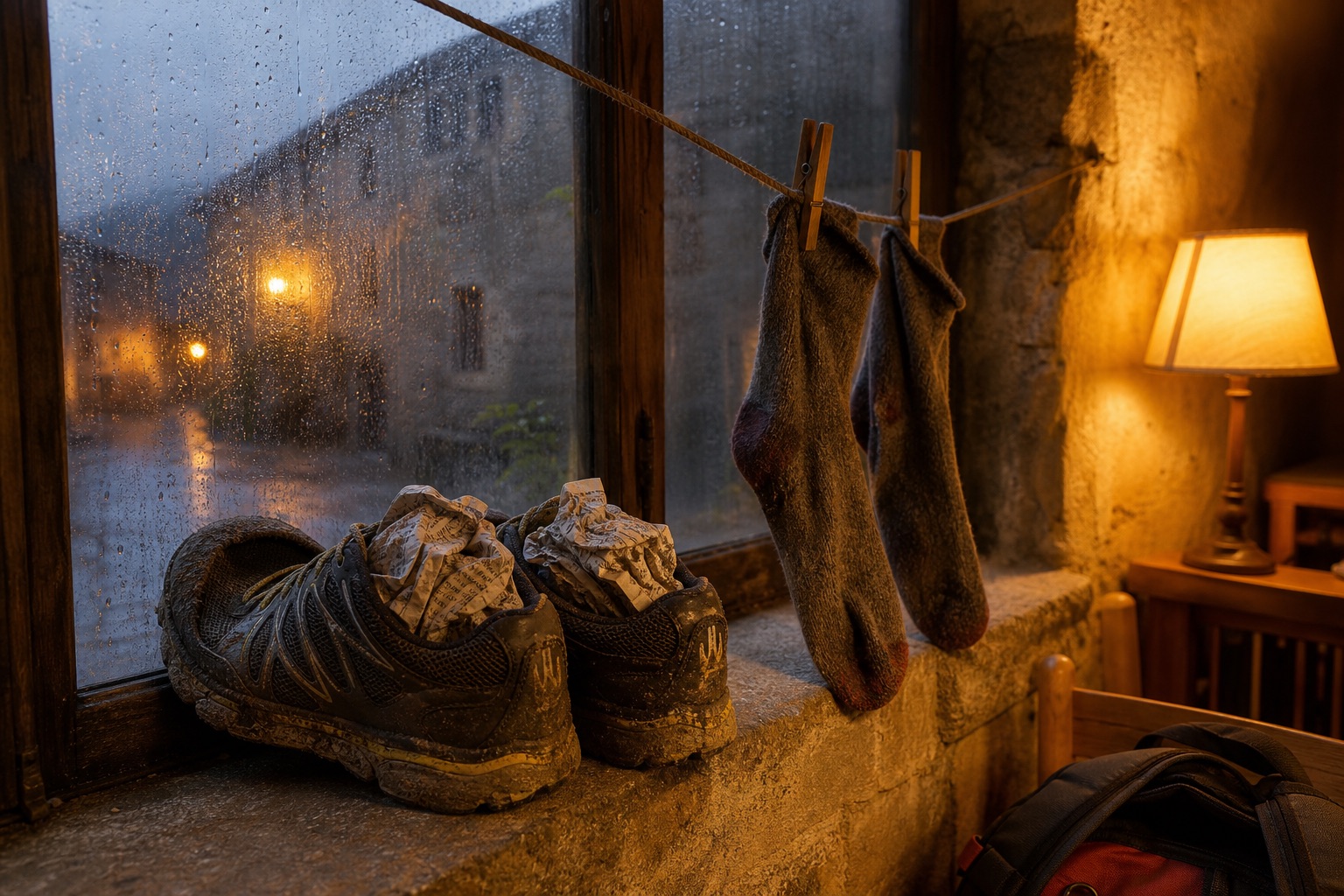
For all-day rain, add a layer at the feet rather than switching shoes: waterproof socks or light gaiters keep feet warm through hours of downpour and pack away to nothing. The matching upper-body question, poncho or rain jacket, is a debate of its own and deserves its own settling.
FAQ
What do I do when it rains on the Camino if my trail runners are not waterproof?
Accept wet shoes and protect the feet instead: wear merino socks that stay warm when damp, change socks at the midday stop, and dry shoes overnight by removing the insoles and stuffing them with newspaper. For all-day downpours, waterproof socks or light gaiters keep feet warm. Mesh trail runners usually dry by morning, faster than any soaked boot.
Will trail runners survive the Camino's asphalt, or should I plan a mid-route replacement?
A new pair rated for 500 to 750 miles will normally finish the 800-kilometre Francés, but start with fewer than about 150 training kilometres on them. If the midsole feels dead or new aches appear around the halfway point, replace the pair in Burgos or León; both cities have outdoor retailers stocking major trail runner brands.
Is ankle support a good reason to choose boots for the Camino?
The evidence is weak. A randomized study of 622 athletes found no significant difference in sprain rates between high-cut and low-cut shoes, and stability comes mainly from sole rigidity and ground feel, not collar height. If you have a history of repeated sprains, a mid-cut shoe or taping may help; for everyone else it should not decide the purchase.
Can ordinary road running shoes handle the Camino Francés?
They can finish it, and some pilgrims prove it every year, but they give up outsole grip on wet gravel and mud, rock protection underfoot, and durability, because road outsoles wear fast on coarse surfaces. A cushioned trail runner delivers the same comfort with a tougher outsole, so road shoes are the fallback, not the recommendation.
How far in advance should I break in my Camino footwear?
Buy eight to twelve weeks before departure and put at least 100 kilometres on the shoes, including consecutive 20-kilometre days under your loaded pack. Trail runners need little break-in, but the testing window protects you from fit mistakes; leather boots need the full timeline. Never start the Camino in box-fresh shoes.
Should I buy my Camino shoes a half size larger?
Yes: a half to full size larger than your street shoes, fitted in the afternoon when feet are largest and wearing your walking socks. Feet swell over multi-week distance walking, and toes striking the front of the shoe on descents is how pilgrims lose toenails. Leave a thumb's width of space in front of your longest toe.
External citations
Barrett JR et al. — High- versus low-top shoes for the prevention of ankle sprains in basketball players, American Journal of Sports Medicine (1993)
A prospective randomized trial of 622 athletes that found no significant difference in ankle sprain rates by shoe collar height; the strongest direct evidence against choosing boots for ankle support.
Oficina del Peregrino — official pilgrim statistics
oficinadelperegrino.com/en/statistics-2The Camino's primary data source, anchoring the scale claims in this article: 530,987 Compostelas issued in 2025, with about 46 percent of pilgrims arriving via the Camino Francés.
AEMET (Spanish State Meteorological Agency) — climate normals 1991–2020
www.aemet.es/en/serviciosclimaticos/datosclimatologicosOfficial rainfall and temperature normals for Galicia and the Meseta that ground the season-based waterproofing recommendation in primary data rather than anecdote.
La Compostela del Lector
You walked this guide to Santiago.
All 771 km, 0 stages, stamped end to end.