
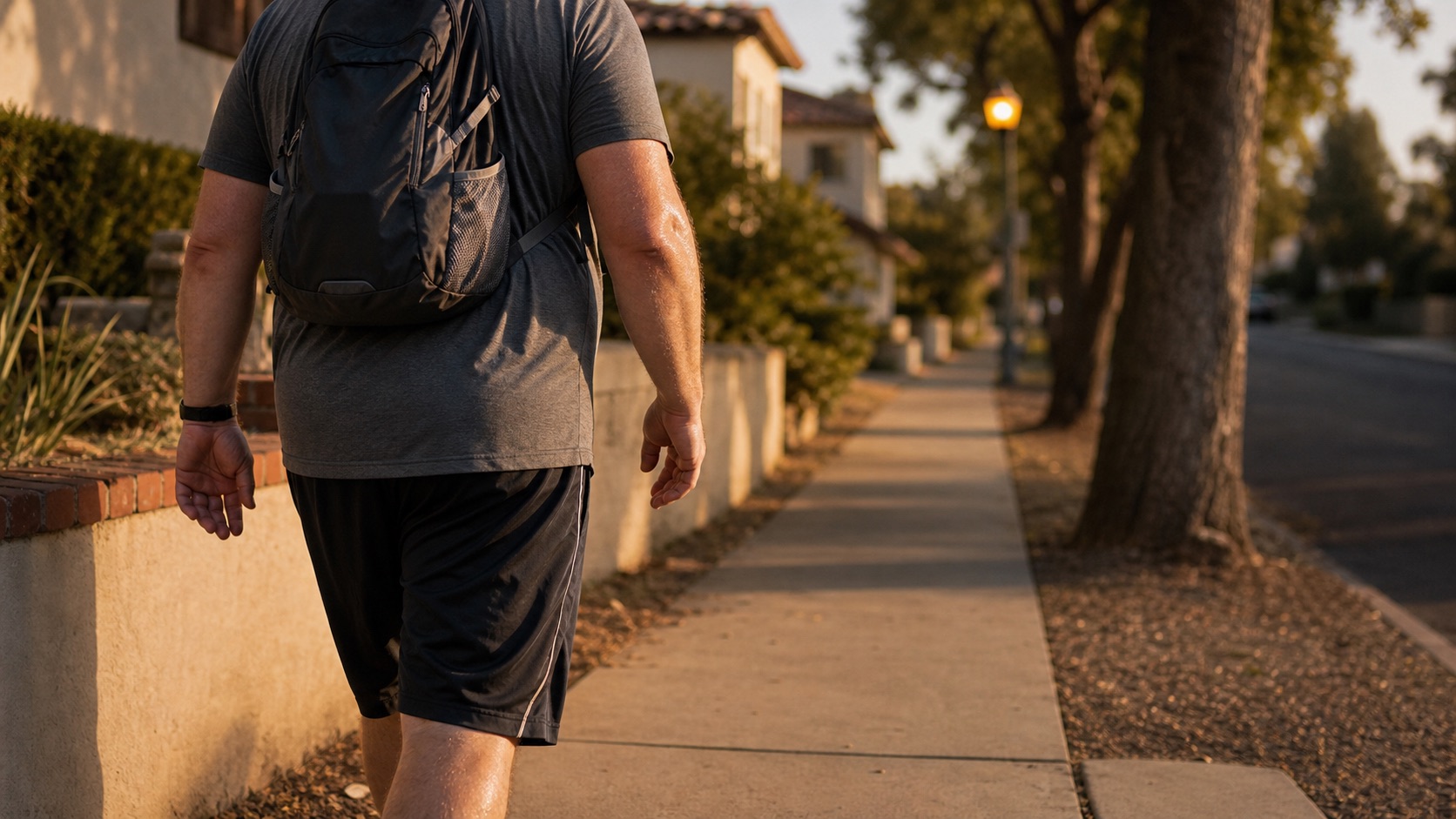
Train for the Camino de Santiago by walking three to four times a week, adding 10 to 20 percent distance each week, rehearsing back-to-back walking days with your loaded backpack, and protecting one recovery week each month. Pick the 8-, 12-, or 16-week plan that matches your current fitness, not the time you happen to have left.
Tendons and feet adapt on a slow schedule that does not care about your departure date. Push the weekly distance up faster than roughly a fifth and shin splints, knee pain, or a swollen Achilles arrive before your flight does. The American College of Sports Medicine puts the safe progression rule at about 10 percent per week for new walkers, and the rule holds for Camino prep too.
If you have not picked your dates or route yet, walk through the broader planning sequence first. Our pillar guide on how to plan your first Camino de Santiago covers credential, route, and timing decisions that feed back into how long you have to train.
Yes. The Camino Francés runs roughly 800 kilometres and most pilgrims complete it in 30 to 35 walking days, averaging 20 to 25 kilometres a day. Those stages hurt without preparation, but they do not require hiking experience. They require walking volume, gradually built.
The American Pilgrims on the Camino preparation pages put it plainly: pilgrims who train at least eight to twelve weeks usually finish comfortably; pilgrims who skip training are the ones who quit in week one. The most common physical problem on trail is blisters. The most common training-side injuries are shin splints and tendinitis from ramping distance too fast.
Take a 30-minute walk at a normal pace and notice how you feel afterwards. If your legs are sore the next morning and you were out of breath halfway through, you are at the sedentary baseline. If 30 minutes felt fine but a follow-up 60-minute walk left you tired, you are at the light-walker baseline. If you already walk an hour several times a week without thinking about it, you are at the active baseline. This self-test, not the weeks on the calendar, decides which ramp is realistic.
The sedentary baseline needs 16 weeks if your dates allow it: build a pain-free base before adding distance. The light-walker baseline fits the 12-week plan, the default for most first-time pilgrims. The active baseline (already walking an hour several times a week or running regularly) suits the 8-week ramp, with the caveat that loaded back-to-back days still matter just as much.
Eight weeks is the floor for someone already walking 30 minutes daily without soreness. Twelve weeks is the sweet spot for most beginners. Sixteen weeks suits sedentary starters or anyone aiming at a hilly route start like Saint-Jean-Pied-de-Port, where the Pyrenees stage descends roughly 600 metres over the final six kilometres and chews up untrained knees. If you have not chosen your start yet, our routes and distances guide walks through the trade-offs.
The peak loaded distance below is the longest walk in the plan, carried in your actual Camino pack.
| Plan length | Starting fitness | Weekly walks | Peak loaded distance | Recovery weeks | Best for |
|---|---|---|---|---|---|
| 8 weeks | Already walks 30 minutes daily | 4 per week | 22 km | 1 (week 6) | Active starters short on runway |
| 12 weeks | Light walker, comfortable for 30 minutes | 3–4 per week | 24 km | 2 (weeks 5, 9) | Most first-time pilgrims |
| 16 weeks | Sedentary, or hilly route start | 3 per week ramping to 4 | 25 km | 3 (weeks 5, 9, 13) | Non-hikers and Saint-Jean starts |
The cluster will add companion spokes on choosing your Camino route and on when to walk; once those publish they help set the destination this training is aiming at.
By week two of any plan you should walk an hour without joint pain. By week four, complete a 10-kilometre walk carrying a 4-kilogram pack. By week eight, hit a back-to-back weekend of 15 kilometres and 12 kilometres. By week twelve, manage a 22-kilometre loaded walk without next-day soreness. Miss a milestone and repeat the most recent completed week. Do not jump ahead to catch up.
Weeks 1 to 3 are about confirming a pain-free base: three or four short walks per week, 30 to 60 minutes each, on flat ground, no backpack yet. The goal is one boring thing: no sharp pain anywhere by the end of week three. Weeks 4 to 7 introduce the loaded pack starting at 3 kilograms and adding 1 kilogram per week. The Confraternity of Saint James and most pilgrim associations agree backpack weight should stay under 10 percent of body weight, with 6 to 8 kilograms as the practical target.
Weeks 8 onward rehearse the trail. Add a Sunday walk after your Saturday long walk starting in week four, with Sunday at 60 to 70 percent of Saturday's distance. By the second half of the plan, your weekend should look like the trail does: a long day followed by a slightly shorter day, both loaded. Taper to roughly half-volume the week before your flight so you arrive rested.
Most Camino fatigue happens on day two, not day one. Single long walks do not rehearse this; the body recovers between sessions and never learns what consecutive walking days feel like. Back-to-back weekends teach the body to recover overnight, which is the actual trail skill.
The rhythm that works is a four-week cycle: three weeks of progressive volume, then one recovery week at roughly half volume. Skip the recovery week and weeks five through eight will go worse, not better. Most overuse injuries on the Camino trace back to a missed recovery week, not to one long walk.
If you can only walk on weekends, double the Saturday-Sunday distance and add a single mid-week walk at 30 to 50 percent of weekend volume. The pattern still works; the absolute numbers just shift.
Walking alone does not condition the small stabilisers that protect ankles, knees, and the arch of your foot. Add two short strength sessions a week of 20 to 25 minutes each: calf raises, step-ups onto a knee-high step, single-leg balance holds with eyes closed, and a one-minute plank. None of this requires a gym.
Train in the exact pack and shoes you will carry; hips and shoulders adapt to a specific frame, not to "a backpack" in the abstract. Trail runners are the standard choice for the Francés, with proper boots reserved for the Norte. Break shoes in over at least 80 kilometres of training walks before departure. Buying new shoes the week before your flight is the most reliable way to ruin the first week of your Camino. Pack and shoes are also the line items your overall Camino budget for 2026 plans around.
Sharp shin pain, swollen knees, an Achilles that feels tight every morning, or fatigue that lingers into the next workout all mean you are progressing too fast. Stop, drop one full week of walking volume, and rebuild from the last comfortable mileage. The 10 to 20 percent rule is a ceiling, not a target. Going slower is always safe.
Miss a single week and repeat the most recent completed week before moving on. Miss two or more weeks and drop back two weeks in the plan. The Camino runs every year. Arriving healthy matters more than arriving on the original date.
For the night-by-night side of trail planning, our spoke on whether to book albergues in advance on the Camino covers what the planning load looks like once training is behind you. To set training inside the broader credential, dates, route, and budget sequence, return to the how to plan your first Camino de Santiago pillar. A future cluster piece on foot care will go deeper on blister prevention and on-trail recovery.
FAQ
What is the shortest realistic training plan for the Camino?
Eight weeks is the shortest realistic plan, but only if you already walk 30 minutes daily without soreness. The 8-week ramp covers base, distance, and peak in two-week blocks and rehearses two back-to-back loaded days before departure. Sedentary starters need 12 to 16 weeks instead.
What is a training plan for the Camino if I am not a hiker?
For non-hikers, follow a 12-week ramp. Weeks 1 to 3 build a 30-minute pain-free base. Weeks 4 to 6 push toward a 10-kilometre loaded walk. Weeks 7 to 9 add back-to-back weekends. Weeks 10 to 12 peak at a 22-kilometre loaded walk, with a final taper week before your flight. Sedentary starters extend the same shape to 16 weeks.
Can I train for the Camino without hills nearby?
Yes. Use treadmill inclines at 5 to 8 percent, parking-garage stairs, or stadium-step laps. Add a dedicated hill simulation twice a week in the second half of your plan. Without any hill prep, the Pyrenees stage from Saint-Jean and the climb from Triacastela to O Cebreiro will hurt your knees more than necessary.
How heavy should my training backpack be?
Start at 3 kilograms in week 4 and add 1 kilogram per week until you reach your real Camino weight: under 10 percent of body weight, ideally 6 to 8 kilograms. Train in the exact pack you will carry so your shoulders, hips, and torso adapt to its specific frame and strap geometry.
Do I need to run, or just walk to train for the Camino?
Walking alone is sufficient; running is optional. The Camino is a long-duration, low-intensity event, and walking volume builds the right tendons and feet. If you already run, swap one weekly run for a long walk so you accumulate the specific load you will face on trail.
What if I miss a week of training?
If you miss one week, repeat the most recent completed week. Do not jump ahead. If you miss two or more weeks, drop back two weeks in the plan and rebuild from there. Compressing lost time is the most common cause of pre-trip injuries.
External citations
American Pilgrims on the Camino — Preparing for the Camino
americanpilgrims.org/preparationUS pilgrim association whose preparation pages set the English-language consensus on training timelines and pack weight, including the 8- to 12-week minimum framing used throughout this article.
American College of Sports Medicine — guidelines on progressive aerobic training
www.acsm.orgPeer-reviewed evidence base for the 10 to 20 percent weekly progression rule and the four-week recovery cycle that anchor every ramp in the plans above.
Confraternity of Saint James — Practical Pilgrim resources
www.csj.org.ukLong-standing UK pilgrim association whose practical notes corroborate daily distance ranges and the under-10-percent-of-body-weight pack guidance for first-time walkers.
La Compostela del Lector
You walked this guide to Santiago.
All 771 km, 0 stages, stamped end to end.