
Match your available time to a route, fix a start point and rough daily distance, sort documents, insurance, and gear, then book only your first night or two. On trail, keep the plan loose: when an albergue closes or you get injured, recompute the day around the next viable stop rather than chasing a fixed schedule.
Most first-time pilgrims arrive at planning the same way — late at night, on the laptop, with twelve browser tabs and a packing list someone else wrote. The advice scatters. One forum says boots, the next says trail runners. One blog says book months ahead, another says walk in and trust the road. Both can be right depending on the season you walk. The job of this guide is to take all of that and reduce it to a small set of decisions that you make once, in order, and then stop second-guessing.
The five decisions that anchor everything
Every other planning question collapses into five choices. Make them in this order and the rest follows:
How much time do I have on the ground?
This is the only non-negotiable. Everything downstream is shaped by the number of walking days you can spend.
Which route, and from where?
Time determines whether you can walk the full Camino Francés or a partial route. Choosing the start point sets your first stage.
What time of year?
Season decides weather risk, albergue availability, and how aggressively you need to book ahead.
What am I carrying, and on what feet?
A well-fitting pack and broken-in footwear matter more than any other gear choice you will make.
What is fixed, and what stays flexible?
Documents, insurance, and the first night are fixed. Daily stages are not.
If you pin those five down, the rest — water bottles, sleeping bag liners, whether to use a baggage transport service — sorts itself out. Most planning paralysis comes from treating gear choices as load-bearing. They aren't. The five above are.
Why a loose plan beats a rigid itinerary
The Camino punishes rigidity. An albergue you booked from home closes for renovations. A blister on day three slows your pace by 5 km per day. A storm rolls in over the Pyrenees and the high route closes. None of these are emergencies on a flexible plan and all of them are emergencies on a rigid one.
A loose plan looks like this: a start date, a target end date, a route, your first one or two nights booked, and a rough sense of which stretches might be busy. Everything else is decided the night before, over dinner, looking at where the next viable stop lies and how your feet feel. That is not under-planning. That is planning for the trail you will actually walk, not the trail in your head.
Time available is the primary driver of route and start point. The full Camino Francés runs roughly 790–800 km and takes most people four to five weeks. Two weeks covers about 280–378 km, so pick a start point that fits your window rather than forcing the whole route.
The mistake first-timers make is choosing a route first, then trying to compress it into the time they have. The result is either a brutal pace that ruins the trip or a panicked airport sprint to make the flight home. Reverse the order. Start with the calendar, work backward to the kilometres, and the start point chooses itself.
Full Francés vs partial routes
The full Camino Francés from Saint-Jean-Pied-de-Port to Santiago de Compostela is the canonical pilgrimage and the one most planning advice silently assumes. It is also a four-to-five-week commitment in walking days alone, before travel days at either end. Most people doing it for the first time take 30 to 35 days on the trail with one or two rest days built in.
That length is a real obstacle. Most working pilgrims do not have four uninterrupted weeks. The honest answer is that partial routes are not a compromise — they are the way most first-timers walk, and they earn a Compostela just the same as long as you cover the final 100 km on foot. A pilgrim who walks Sarria to Santiago in five to seven days has done a Camino. So has one who walks León to Santiago in two weeks.
Choosing your start point
The common start points, working backwards from Santiago:
Saint-Jean-Pied-de-Port
The classic full Francés. Crosses the Pyrenees, the Meseta, and the Galician mountains.
Pamplona
Skips the Pyrenees but keeps almost the whole Spanish route.
Burgos
Starts at the western edge of Navarra wine country and includes the Meseta.
León
Skips the Meseta. A common choice for the "two weeks of leave" pilgrim.
Sarria
The minimum distance for a Compostela. Busiest section of the route, especially in summer.
If your window is two weeks of actual walking days, León to Santiago fits comfortably. Three weeks opens up Burgos. Anything shorter than five days and you are negotiating with the Compostela rules, which require continuous walking over the final 100 km. Pick the start point that puts you in Santiago two days before your flight, not the day of it. Travel days disappear into the schedule faster than first-timers expect.
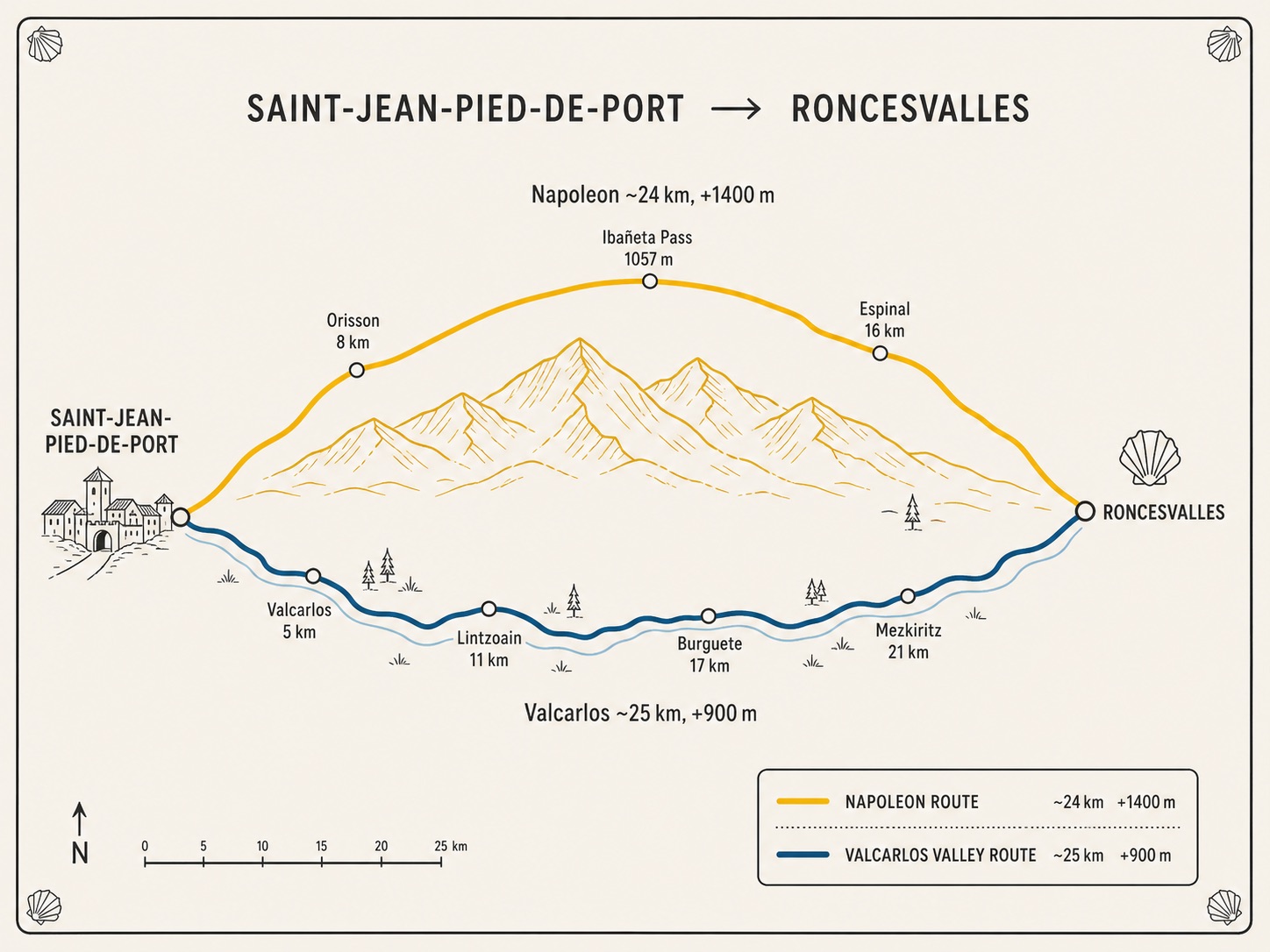
From Saint-Jean-Pied-de-Port the first stage crosses the Pyrenees by either the Napoleon route or the lower Valcarlos route. Choose based on weather, fitness, and season. Route choice is the first and most daunting decision, but it narrows quickly once your time window and scenery preference are set.
For pilgrims doing the full Francés, the first walking day is the hardest of the whole route. It is a 25 km climb out of France over a Pyrenean pass and down into Roncesvalles. You will not be acclimated. Your pack feels heaviest. The weather can change three times in an afternoon. The decision you make about which version of this stage to walk shapes how your Camino begins. For a deeper look at this single decision, see our future deep-dive on Napoleon vs Valcarlos.
Napoleon vs Valcarlos
Napoleon
Distance
~25 km
Difficulty
Strenuous
Best season
Late spring – mid-autumn
Climbs to roughly 1,400 m and crosses open mountainside before dropping into the Roncesvalles forest. In good weather it is the more famous and more scenic of the two. Officially closed November–March and in storms.
Valcarlos
Distance
~24 km
Difficulty
Moderate
Best season
Year-round
Follows a valley road most of the way before climbing more gently to the same destination. Less photogenic but lower, sheltered, and walkable in conditions that close the Napoleon.
Fit, well-trained walkers with a light pack and clear weather almost always choose Napoleon. First-timers walking in shoulder season, carrying more than they should, on a forecast that includes the word "rain" should take Valcarlos without shame. The route rejoins itself at Roncesvalles. No Compostela committee asks which version you walked.
When weather forces the lower route
In summer the question is less about closure and more about heat. Starting at first light on the Napoleon avoids the worst of the afternoon sun. Carry more water than you think you need. There is a fountain at Orisson and another further along, but spacing varies by season.
Before leaving, secure a valid passport, travel insurance, and a pilgrim credential, notify your bank, break in your footwear, and arrange any baggage transport. A credential is mandatory to collect stamps and earn the Compostela. Consolidate these into one list so nothing fragments across tabs and PDFs.
A 12-month pre-departure timeline is overkill for most pilgrims and a useful crutch for some. If you want the long version of this list with monthly cadences, we cover that in a future article on the year-out planning timeline. The short version, which works for most first-timers, fits below.
Documents and money
Passport
Validity should exceed six months beyond your return date. EU citizens travel on their national ID inside the Schengen Area; non-EU citizens check Schengen entry rules well ahead of departure.
Travel insurance
Standard travel insurance is enough for most pilgrims. Confirm it covers walking and hiking explicitly; some policies exclude "adventure activities" in ways that quietly include the Camino.
Bank notification
Tell your bank you will be in Spain (and France, if starting in Saint-Jean-Pied-de-Port) so your card does not freeze on day one. Carry a backup card stored separately from the primary.
Cash
Some smaller albergues are cash-only. Carry €100–200 in small notes when you arrive and refill at ATMs in larger towns.
Gear and footwear
Footwear
Break it in two weeks before departure at minimum. Walk in it daily. If your toes feel a hint of pressure on a flat road, they will feel a blister by Pamplona. Many walkers find trail runners suit the route better than heavy boots, but the rule that beats every other rule is "what fits your feet." Fit beats brand.
Backpack
A 30–40 litre pack is enough. Fitted at the shoulders and hips, not loaded against the spine.
Sleeping bag liner
Most albergues provide blankets. A silk or cotton liner is enough except in cold months.
Rain gear
A lightweight jacket and a pack cover. Galicia rains regardless of the season you walk.
Pack weight
Aim for under 10% of your body weight including water. Pilgrims who carry more pay for it in blisters and tendon strain.
Credential and stamps
The pilgrim credential — the credencial — is the passport-sized document that records your stamps (sellos) along the way. It is mandatory if you want to stay in pilgrim albergues and required to earn the Compostela in Santiago.
You can get a credential from:
- Your national Camino association before you travel. The Confraternity of St James (UK) and equivalent associations in most countries issue them by post for a small fee.
- The pilgrim office in Saint-Jean-Pied-de-Port when you arrive, if starting there.
- Many albergues, parish churches, and Camino shops along the route, if you start somewhere unexpected.
Spring through autumn is the recommended window. High season can require booking four to six months ahead, and May to August is busiest on the Francés. Outside peak periods most albergues need no advance booking, so reserve only your first night or two and stay flexible after that.
Most first-timers over-book and regret it. The Camino's social geometry depends on flexibility — the friendships and the small daily course-corrections only work if you can stop where the day actually ends, not where a booking three months ago says you should. There are exceptions, and they are worth naming.
Best time of year
April – mid-June
Mild weather, long days, wildflowers on the Meseta. Galicia stays cool and rainy.
Mid-June – August
Hot, especially on the Meseta. Beds fill earlier in the day. Walk pre-dawn to beat the heat.
September – mid-October
Many pilgrims' favourite window. Harvest in La Rioja, golden light, thinner crowds.
Mid-October – November
Quiet, beautiful, increasingly wet. Some seasonal albergues close. Galicia can be cold.
December – February
The hardest months. Snow in the Pyrenees and Galicia. Napoleon route closes. Walkable only by experienced pilgrims.
Holy Years (Años Santos), when the Feast of St James falls on a Sunday, draw extra pilgrims and push booking demand earlier. Check whether your year is one before assuming standard advice applies.
How far ahead to book
The general rule is simple. Book the first night or two from home so you arrive jet-lagged and walk straight to a bed. After that, book the day before only if you are walking in May to August or into a stop you know is small. Most stages of the Francés have several albergues, and even busy ones generally clear by 8 a.m. as the day's pilgrims walk on.
The exceptions:
- Saint-Jean-Pied-de-Port at the start of high season — book early.
- Roncesvalles on a Friday night in summer — book early.
- Sarria in summer, where the final-100-km pilgrims surge in — book early.
- Santiago for your post-arrival nights — book early. The city has plenty of beds, but you will not want to hunt for them after thirty days on the trail.
For the broader question of advance bookings on the Francés, see our future deep-dive on albergue booking. The short answer for first-timers: assume no, except where this section says yes.
If
Closed or full albergue
If
Injury or blisters
If
Weather or route change
When an albergue closes, an injury slows you, or weather shifts, recompute the day around the next reachable stop with beds rather than your original schedule. Shorten the stage, split it across an extra day, or use a transport leg. A flexible tentative plan absorbs these changes without derailing the whole trip.
The instinct under stress is to call the next albergue, find it full, and panic. Don't. The Camino has been routing pilgrims around problems for a thousand years and the network is denser than it looks on a map. Three options almost always exist within a few kilometres of where you are standing.
Closed or full albergue
You arrive. The doors are locked, or the hospitalero shrugs and says completo. Options, in order:
Walk on
The next village is usually 3–8 km further. On the Francés this is rarely a hardship in daylight; in late autumn, check sunset times before committing.
Walk back
If you passed an albergue with beds 2 km ago, that bed is still there.
Take a private room
Most stages have casas rurales or small pensions for €40–60. Not a failure, just a more expensive bed for one night.
Take a short transport leg
A taxi or local bus to the next viable stop is cheaper than people fear. Roughly €20–40 for most jumps. You can pick up walking the next morning where the taxi dropped you.
The pilgrim who refuses options three and four out of purity ends up sleeping in a doorway. The Compostela does not ask how you slept.
Injury and blisters
A blister is a planning event, not a medical one. Treat it early, change socks at lunch, and shorten the next stage rather than holding the original distance. Tendon pain — shins, knees, Achilles — is the warning that demands a rest day, not a longer walk. Most first-time pilgrims who DNF do so because they pushed through pain in the first week.
Realistic responses:
- Half-stage day. Walk 10 km instead of 25. Find lunch and an early bed.
- Rest day. Stop in a town with a pharmacy and a comfortable albergue, sleep, eat, do nothing for a day.
- Transport ahead. Skip a stage by bus or taxi and resume from a town that suits your remaining schedule. Pilgrims do this routinely. Nobody at the cathedral cares.
The credential does not require continuous walking except in the final 100 km. Before Sarria, transport for an injury day is a legitimate planning tool.
Weather and route changes
In bad weather, take the safer route option even if it adds a day. The Napoleon-vs-Valcarlos choice exists exactly for this. Later in the route, the alternatives are smaller — a road option around a flooded creek crossing, an extra night in Foncebadón to wait out a storm before the high pass to Manjarín — but they exist on almost every stage. Local pilgrims and hospitaleros know the alternates better than any blog. Ask them.
Most planning advice assumes fluent English, which forces non-English pilgrims to translate screenshots one by one. Keep an offline phrasebook and route notes in your own language, download maps before losing signal, and store credential and booking details where you can read them without a connection.
This section exists because the Camino's online planning ecosystem is overwhelmingly English-language, and that is a real disadvantage for the German, Spanish, Korean, and Brazilian pilgrims who make up much of the route. The reflex is to translate as you go. That works in cities. It does not work on a Galician hillside with one bar of signal and a screenshot you can't paste into a translator.
Offline tools that work without signal
The minimum offline kit, in your own language:
Maps
Download the entire Francés route to your phone before leaving home. A map app with offline tiles is enough; the route is heavily marked on the ground in any case.
Stage list
A simple table of distances and town names you can read without a connection. Print it or save it as an offline note.
Credential details
Photograph your credential, insurance card, and passport. Store them in an offline notes app and in a cloud folder. If a credential is lost, the photo is your proof of stamps walked.
Bookings
Save confirmation emails as offline copies. Albergues often need to see your booking, not your inbox.
This is not pessimism about connectivity. The Francés has surprisingly good signal in towns. The point is that the few minutes you actually need information — at a fork, at a closed albergue, in a rainstorm — are exactly the minutes you do not want to be downloading anything.
Multilingual phrasebook basics
A small phrasebook in your language, with Spanish equivalents you can show, covers the situations where translation apps fail. Helpful phrases to have ready:
- "Do you have a bed for one tonight?" — ¿Tienen cama para uno esta noche?
- "How much, please?" — ¿Cuánto cuesta, por favor?
- "Where is the next albergue?" — ¿Dónde está el próximo albergue?
- "I need a pharmacy." — Necesito una farmacia.
- "Can you stamp my credential?" — ¿Puede sellar mi credencial?
A native English speaker can get by with English alone on the Francés, but the experience improves sharply with a few Spanish phrases used with care. For pilgrims whose English is shaky, the goal is different: have your own-language fallback ready for the moments when communication actually matters. The cathedral does not grade your accent.
FAQ
What should be on my complete pre-departure checklist before walking the Camino?
A valid passport (over six months beyond return), travel insurance, a pilgrim credential, broken-in footwear, a light well-fitted pack, notified bank, and your first night or two booked. Add baggage transport if needed and an offline map and phrasebook in your own language.
How do I replan a Camino day around a closed albergue or injury?
Recompute the day around the next reachable stop with available beds instead of your original schedule. Shorten the stage, split it across an extra day, or take a short transport leg. Because most beds need no advance booking, a flexible plan absorbs the change without cascading.
How far in advance should I start planning the Camino Francés?
A year ahead is reasonable but not required. The Camino can be walked with very little advance planning. Plan as much as your temperament needs, but for high season book lodging four to six months out and keep daily stages flexible.
Do I need to book albergues in advance on the Camino Francés?
Mostly no. Most albergues on the Francés do not require advance booking outside high season. Reserve your first night or two, then book day by day. During May to August or Holy Years, book popular stops earlier to avoid arriving to full beds.
What footwear should a first-time pilgrim wear on the Camino?
Many walkers find trail runners suit the terrain better than heavy boots, though fit matters more than type. Break footwear in about two weeks before departure. Blisters are nearly unavoidable, and footwear choice is the biggest factor in preventing them.
External citations
Pilgrim's Reception Office, Santiago
oficinadelperegrino.comOfficial source for credential rules, the final-100 km stamp requirement, and the Compostela and Certificate of Distance.
Confraternity of St James / national Camino associations
csj.org.ukAuthoritative non-commercial source for obtaining a credential before travel and neutral route guidance.
Spanish Ministry / Schengen entry requirements
Official basis for passport validity and entry rules for non-EU pilgrims.
La Compostela del Lector
You walked this guide to Santiago.
All 771 km, 0 stages, stamped end to end.