
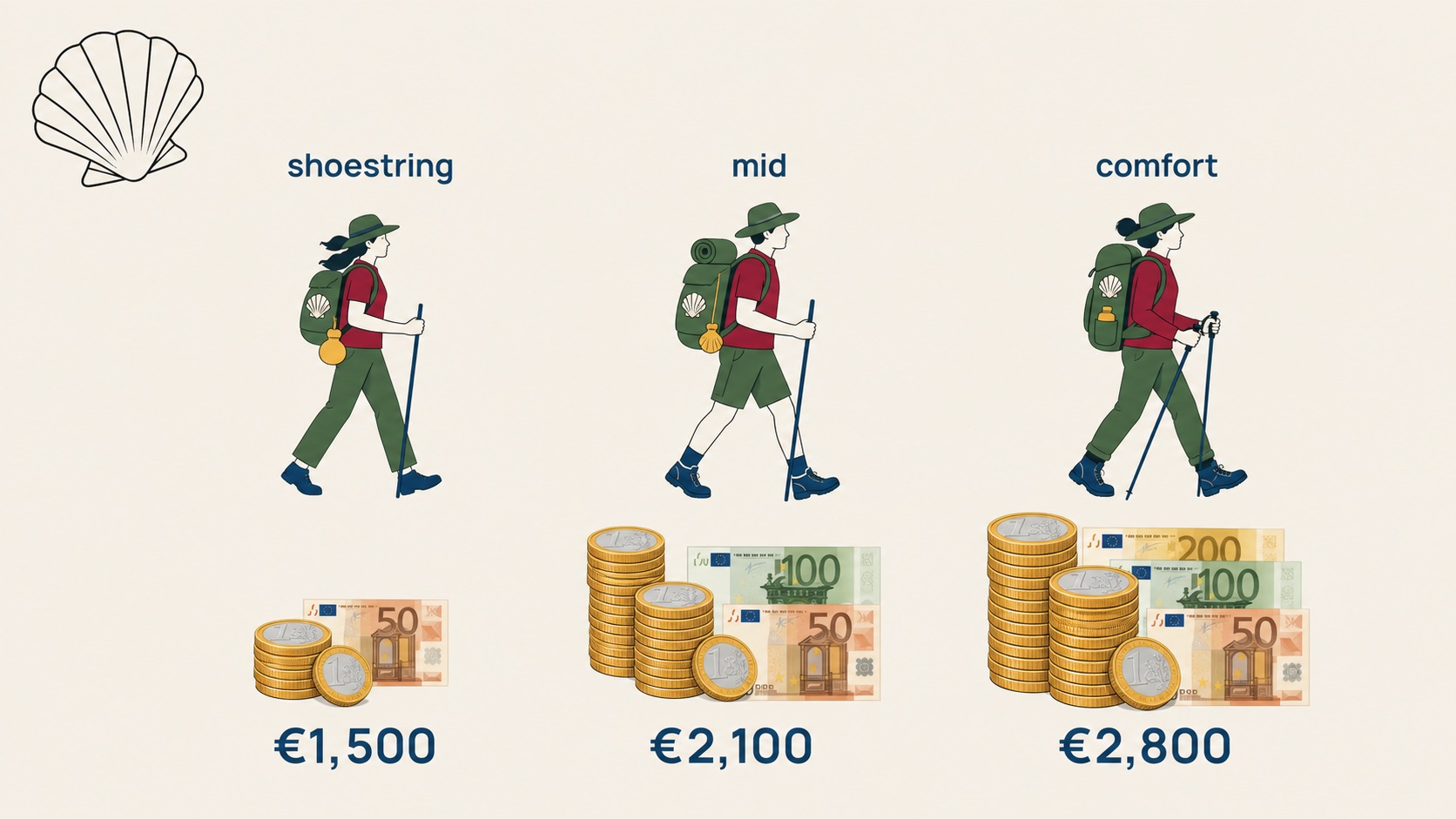
A full 30-day Camino Francés in 2026 runs €1,500–2,800 on trail for a self-organised solo pilgrim, plus €400–1,600 before departure for flights, gear, and travel insurance. The on-trail spread is real: it is the difference between sleeping in municipal albergues and cooking your own pasta versus mixing in private rooms and restaurant dinners on tired evenings. Daily averages land at €50–65 once beds, food, and the small extras pilgrims always forget are honestly priced.
The 800 km Francés is the most reliable route to budget against because its infrastructure is the densest and its price data the most public. A 30-day plan assumes one rest day per week and ordinary stage lengths of 20–25 km. Walk it in 33 to 35 days and the daily totals stay roughly the same; the trip just costs proportionally more. For the wider planning context this number sits inside — credential, training, dates — see our pillar guide on how to plan your first Camino de Santiago.
Bed prices on the Camino Francés have climbed roughly 15–25 percent between 2024 and 2026, while pilgrim menus have held closer to a 12–15 percent rise. The old €20-a-day myth no longer matches reality on any stage of the Francés, and budgeting against it is the single most common reason first-timers run out of cash in León. Most first-time pilgrims now land between €50 and €65 per day without trying.
Camino Francés bed and pilgrim-menu prices, 2020–2026
Private albergue bed
Menú del peregrino (3 courses)
Why bed prices outpaced food
Two pressures stack. Private albergue operators absorbed years of suppressed prices through 2022 and 2023, then raised in line with Spanish hospitality inflation as soon as demand returned. At the same time, the post-2024 boom in pilgrim numbers pushed peak-season occupancy past comfortable thresholds, and operators learned that a €22 bed in July fills as fast as a €17 one used to. Pilgrim menus, by contrast, are governed by long-standing local norms and small-bar margins — they move, but slowly.
Routes where the increase hit hardest
Sarria to Santiago — the last 100 km — saw the steepest bed inflation, because that stretch absorbs the biggest seasonal pulse of short-walk pilgrims. The León-to-Sarria middle third moved roughly with the Spanish hotel CPI. Saint-Jean-Pied-de-Port to Pamplona stayed flatter, partly because municipal capacity there held its prices and partly because pilgrim density drops off in the first week as people drop out or change pace.
Roughly 35 percent of daily Camino spend goes to beds, 35 percent to food, and 30 percent to the small extras pilgrims forget: laundry, luggage transfer, second coffees, blister care, and pharmacy runs. Each category has a low, mid, and comfort tier you can mix and match per day depending on weather, mood, and how your feet are holding up.
Municipal albergue prices and what they include
Public municipal albergues cost €7–12 per bed in 2026 and run on a first-come, first-served basis. You get a bunk, a shared bathroom, often a basic kitchen, and almost always a courtyard or common room. They do not take reservations, which is what keeps them affordable. Private albergues cost €15–25 per bed, take bookings, and usually add laundry, a meal option, and warmer common spaces. Private rooms in pensions land at €35–60 per night; hotel rooms on the Francés run €50–120.
Menu del peregrino price and other meal options
The classic menú del peregrino — three courses, bread, wine or water — costs €12–15 in 2026. Supermarket cooking in an albergue kitchen averages €3–5 per dinner per pilgrim if four of you share the pasta and the salad. Breakfast at a bar lands at €3–6; from a supermarket the night before, half that. The Spanish habit of a mid-morning second breakfast (a café con leche and a tortilla wedge) is a real budget item — €8–15 a day, comfortably — that first-timers underestimate until they try to cut it.
The daily extras most budgets ignore
Laundry, including a dryer, runs €6–10 per load every three to four days. Luggage transfer between stages costs €5–8 per bag if you book it the night before. Pharmacy basics — a blister kit, ibuprofen, sunscreen, electrolyte tabs — accumulate to €25–40 across a full Camino. Add €1–2 for the daily credential stamps you collect in cafés, and a votive candle or two in Santiago. None of this is large on its own. Together it is the 30 percent of your daily total that the €20-a-day myth pretends does not exist.
Plan €400–1,600 before you take a step. Round-trip flights to Madrid, Bilbao, or Santiago run €60–800 depending on origin. A starter gear kit lands at €160–280. Travel insurance for 35 days costs €70–200, and is non-negotiable even for shoestring walkers — a torn meniscus on day six without coverage is a much harder cost line than any bed.
Flights from Europe vs North America vs Asia
Flights from major European hubs to Madrid run €60–160 round-trip on low-cost carriers if you book six to eight weeks out and travel light. From North America, plan US$500–900 round-trip in 2026, with the cheaper end on shoulder-season Lisbon or Madrid routings. From South Korea and Japan, round-trip economy to Madrid via a one-stop in the Middle East or central Europe averages ₩1,500,000–2,200,000 or ¥150,000–220,000. Australian and Canadian fares track the North American band a little higher in peak summer.
A €160 gear kit that actually works
A starter kit at €160 looks like this: a 35–40 L pack on sale, trail runners broken in at home, two pairs of merino socks plus liners, a sleeping liner, a basic rain shell, two technical T-shirts, hiking shorts, a sun hat, and a small first-aid pouch. Push to €280 and you add a lighter pack, a second pair of socks, a packable down layer, and trekking poles. Most of the deeper opinions on this kit live in our packing cluster — for the route decision side of the same conversation, see our companion spoke on Camino de Santiago routes and distances.
Insurance options under €200
A 35-day pilgrim-friendly policy from a European insurer averages €70–120 for under-50s and €120–200 for over-50s, with cover for medical evacuation, trip interruption, and lost gear. North American policies cluster slightly higher and are worth checking against a credit card's built-in cover, which usually has a 30-day cap that the Francés exceeds.
Three reproducible 30-day Camino Francés budgets, on trail only: shoestring €1,200–1,500 (donativo plus cooking), mid €1,700–2,100 (mixed albergues plus pilgrim menus), comfort €2,400–2,800 (private rooms plus restaurant dinners). Add €400–1,600 pre-trip for flights, gear, and insurance. The breakdown below shows the mid-point of each tier — pick one and every number on this page follows, including the running spend in the progress bar. Start at mid and shift days up or down a tier as the trip asks you to.
Beds (30 nights)
€540
Food (30 days)
€600
Extras (laundry, transfers, pharmacy, coffee)
€360
Santiago rest day
€100
Contingency reserve
€200
€1,800
30-day on-trail total
≈ €60 per day
Realistic range: €1,700–2,100
| Category | Shoestring | Mid | Comfort |
|---|---|---|---|
| Beds (30 nights) | €240 | €540 | €1,200 |
| Food (30 days) | €360 | €600 | €900 |
| Extras (laundry, transfers, pharmacy, coffee) | €180 | €360 | €480 |
| Santiago rest day | €60 | €100 | €150 |
| Contingency reserve | €110 | €200 | €270 |
| 30-day on-trail total | €950 | €1,800 | €3,000 |
The shoestring €40 day
Municipal albergue at €9, supermarket breakfast at €2, supermarket lunch at €5, communal dinner at €4, coffee and snacks at €5, and €15 in odds. Doable, but only for pilgrims who can cook and who are comfortable walking past closed municipal beds at peak season without panicking. The shoestring tier earns its name in week four when you would happily pay €40 to not cook again, and need the discipline to say no.
The mid €60 day
Private albergue at €17, breakfast at €4, pilgrim menu at €13, second coffee and snacks at €10, laundry every fourth day, occasional luggage transfer on a hill stage. This is where most first-timers actually land — closer to €60 than the €50 they planned for. The mid budget is the realistic baseline, not the splurge.
The comfort €90 day
Private room at €45 every second night, pilgrim menu plus a glass of wine at €18, full breakfast at €7, laundry service rather than a coin machine, luggage transfer most stages. The comfort tier is what older pilgrims and recovering-from-injury weeks rebuild toward. It is not a luxury Camino; it is a Camino that prioritises sleep and feet over cost.
At June 2026 mid-market rates, the mid-tier 30-day on-trail budget of €1,800 lands at roughly US$2,050, CA$3,150, AU$3,200, ₩2,850,000, or ¥320,000. Add 25–35 percent on top for international flights and pre-trip gear if you are flying in from outside Europe, and remember that mid-market rates are not the rate you actually receive at an airport currency desk.
EUR
€1,700–2,100
USD
US$1,940–2,390
CAD
C$2,980–3,680
AUD
A$3,030–3,740
KRW
₩2,700,000–3,300,000
JPY
¥300,000–370,000
Mid tier · 30 days on trail · June 2026 mid-market rates
Conversion table for the five biggest pilgrim cohorts
| Currency | Shoestring (30-day) | Mid (30-day) | Comfort (30-day) |
|---|---|---|---|
| EUR | €950–1,500 | €1,700–2,100 | €2,400–3,000 |
| USD | $1,080–1,710 | $1,940–2,400 | $2,740–3,420 |
| CAD | C$1,660–2,630 | C$2,980–3,680 | C$4,200–5,250 |
| AUD | A$1,690–2,670 | A$3,020–3,740 | A$4,270–5,330 |
| KRW | ₩1.5M–2.4M | ₩2.7M–3.3M | ₩3.8M–4.7M |
| JPY | ¥170K–270K | ¥300K–375K | ¥430K–540K |
Why ATM withdrawals beat airport currency desks
Withdrawing €200–300 from a Spanish bank ATM with a debit card that refunds foreign-transaction fees lands closer to the mid-market rate than any airport bureau de change. Avoid the dynamic-currency-conversion prompt at the ATM ("would you like to be charged in your home currency?") — it always loses you two to four percent. Carry €100–150 in cash at all times for donativo stops and rural bars; the rest of your spend is fine on a card in towns above a thousand residents.
Set aside 10 percent of your on-trail budget as a contingency reserve before you fly. On a mid-tier budget that is €170–210 sitting in a separate account, untouched unless you genuinely need a hotel after an injury, a taxi past a closed albergue, or a pharmacy run that turns into a clinic visit. The reserve only works if it is psychologically separate — same-account "I'll just remember not to spend it" plans fail by week two.
What the reserve is allowed to cover
A taxi to the next service town when your stage is broken by a closure or a sprain. One or two hotel nights to break a bad blister cycle. A pharmacy or clinic visit. An emergency change of pack or shoes. It is not allowed to cover a tempting dinner, a souvenir, or "I just feel like a private room tonight". The Camino will offer reasons to spend it; the discipline is choosing the right ones.
Where to park it so you don't accidentally spend it
A separate savings sub-account in the same bank, accessible from your phone but not the card you carry on trail, is the simplest setup. Some pilgrims load a second prepaid card with exactly the reserve amount and leave it in their pack lining. Either works. What does not work is leaving it in your main current account where every ATM withdrawal nibbles at it without you noticing.
When a closed albergue, an injury, or weather forces a rebuild, swap albergue plus pilgrim menu (about €30) for private room plus restaurant (about €75) on the affected days. Three rebuild days adds roughly €135, comfortably inside a 10 percent contingency reserve, with no panic withdrawal. The rebuild is mechanical: identify the affected stages, slot the higher tier in, and move on. For pacing the rebuild within an overall calendar plan — how many days of buffer to hold, where to add slack — the underlying question is how long the walk takes, which a future spoke on how long it takes to walk the Camino Francés will answer.
Closed albergue: the €15 rebuild
The next pilgrim hostel is rarely more than 5–8 km further on the Francés. If you can walk on, the rebuild is the difference between municipal and private — usually €10–15. If you cannot, a taxi to the next town is €15–25, and the bed there might be slightly above your usual tier. Either way, the day costs €15–25 more than planned and the reserve absorbs it without flinching.
Injury day: the €75 rebuild
A blister or knee that asks for a rest day in town means a private room instead of a bunk, a restaurant dinner instead of a communal kitchen, and probably a pharmacy run. Budget €45 for the room, €18 for dinner, €7 for breakfast, and €5–15 for blister supplies or ibuprofen — call it €75 for the day. If two consecutive rest days are needed, the second is usually cheaper because the pharmacy bill does not recur. Anything beyond three rest days is a signal to talk to a clinic rather than to keep rebudgeting in private.
Weather day off: the €50 rebuild
Galicia and the Pyrenees both serve days where walking is technically possible but genuinely miserable. A weather day off looks like a private room at €40–50, a long lunch instead of two meals, and a quiet afternoon in a café — roughly €50 in total once you skip the pilgrim-menu dinner you would otherwise pay for. The cost is real but small, and the rest usually saves you a sicker rebuild later in the week.
What should my Camino daily budget be in US dollars?
At June 2026 mid-market rates, plan US$55–75 per day on trail for a mid-tier Camino Francés, or US$25–35 if you stick strictly to municipal albergues and supermarket cooking. A 30-day on-trail total lands at roughly US$1,650–2,250 before flights, gear, and insurance. From North America, add another US$600–1,200 for the round-trip flight and US$200–300 for a starter gear kit if you do not already own pack and shoes.
How do I rebudget my Camino if I get injured and need a hotel?
Swap albergue plus pilgrim menu (about €30) for hotel plus restaurant (about €85) for the affected days. Three to five rebuild days adds €165–275 — exactly what a 10 percent contingency reserve is sized for. Add €30–60 for a pharmacy or clinic visit if you need one. If the rebuild looks longer than five days, talk to the pilgrim's office in the next big town about pacing — they have seen every version of this and will not let you over-spend a panic week.
Do I need to bring cash on the Camino in 2026?
Yes, carry €100–150 in cash at all times. Many municipal albergues, small bars, and donativo stops accept cash only. ATMs exist in larger towns every two to three stages on the Francés. Withdraw €200–300 at a time to limit fixed fees and to avoid running dry on a small-village stretch. Use a Spanish bank ATM rather than a standalone Euronet machine where possible — the fees are noticeably lower.
Is the Sarria-to-Santiago section cheaper than the full Camino Francés?
Yes. The last 100 km takes 5–7 walking days and costs €350–700 on trail depending on style. It is the cheapest entry point and the minimum distance to earn a Compostela on foot, but it is also the most crowded section, which can push bed prices up in peak season. Booking your first night and the night in Santiago in advance is sensible from June through August.
How much extra should I budget for the rest day in Santiago?
Plan €80–150 for one night in Santiago: €30–80 for a pension or small hotel, €25–40 for a celebratory dinner, €10–20 for the Pilgrim's Mass donation and a small votive, and €15–30 for laundry, a haircut, and onward transit to the airport. Add a second night and the total roughly doubles. Most pilgrims regret booking the flight home the same afternoon they expect to arrive.
How does Camino cost compare to other European long walks?
The Camino Francés is the cheapest major European long-distance walk. Pilgrims spend €50–65 per day, against roughly €90–110 on Italy's Via Francigena and €80–100 on Scotland's West Highland Way. The price gap comes from the dense municipal albergue network and pilgrim menu culture in Spain — neither of which has a real equivalent on other routes.
For the planning context this budget sits inside, start with the pillar guide on how to plan your first Camino de Santiago — it covers credential, training, and dates that all feed back into your number. If you are still picking a route, the companion spoke on Camino de Santiago routes and distances explains why the Francés is the most predictable cost target. Two further spokes — on how long it takes to walk the Camino Francés, and a 12-month pre-departure timeline — will close the loop once they are published.
External citations
Oficina del Peregrino — official Santiago de Compostela pilgrim office
oficinadelperegrino.comAuthoritative source for annual Compostela counts, country-of-origin splits, and route popularity. Used to ground all pilgrim-volume claims in this article.
Instituto Nacional de Estadística — Spanish CPI sub-indices
www.ine.esSpain's national statistics office publishes the CPI sub-indices for hospitality in Galicia and Castilla y León. The authoritative source for year-over-year Camino accommodation price changes between 2024 and 2026.
European Central Bank reference exchange rates
www.ecb.europa.euECB mid-market reference rates against USD, KRW, JPY, CAD, and AUD. Used as the neutral anchor for the multi-currency conversion section.
La Compostela del Lector
You walked this guide to Santiago.
All 771 km, 0 stages, stamped end to end. Your plan: the Mid budget — about €1,800 for 30 days on trail.