
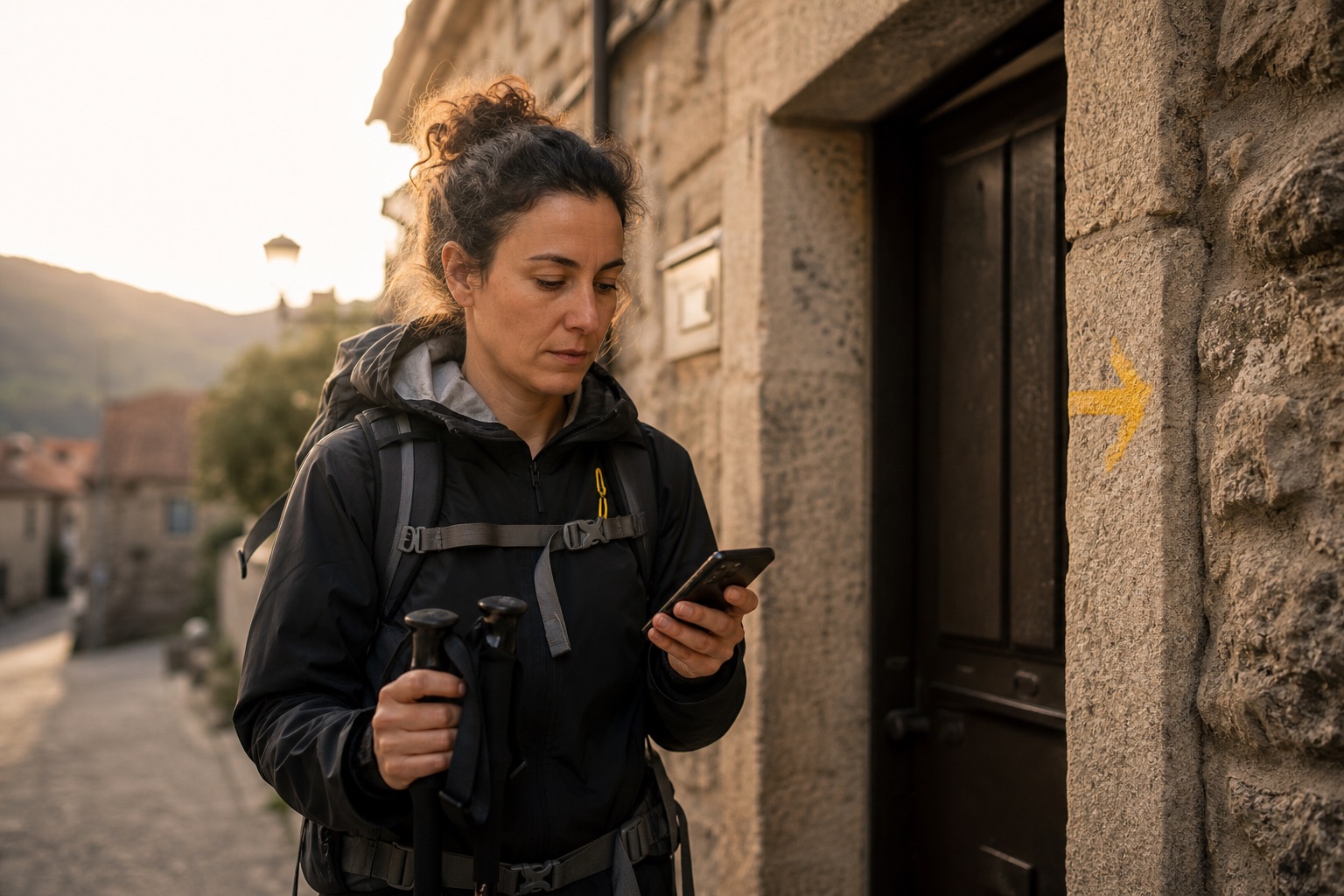
For most pilgrims on the Camino Francés outside July, August, and the final 100 kilometres from Sarria, walk-ups still work if you arrive before mid-afternoon. Book ahead when you walk in peak summer, travel as a group, need a private room, or cross the Sarria-to-Santiago stretch — the densest section of any Camino route and the one where beds vanish fastest.
Four factors decide it: route, month, group size, and stage. The Camino Francés crowds earlier and harder than the Norte, Primitivo, or Inglés. May to September puts pressure on every route; July and August are the high-pressure months. A group of three or more rarely fits into one municipal dorm without splitting up. And the last four stages of any route — the ones that qualify pilgrims for the Compostela — bottleneck regardless of the rest of the route's behaviour.
When walking up still wins: solo pilgrim, shoulder season, walking before noon, willing to split or extend the guidebook stage. When pre-booking saves the Camino: peak summer, group, private-room couple, Sarria onwards, or any night that lands on a Spanish fiesta.
Solo pilgrim, spring or autumn, Camino Francés outside the Sarria-to-Santiago stretch: do not book. Walk, arrive early, take what is available. Summer, a group of two or more, or any stage in the final 100 kilometres: book two to seven days ahead at private albergues. Municipal albergues stay first-come, first-served regardless of how famous they are — you cannot reserve them, ever.
This guide is for first-time pilgrims who have read that the Camino has "changed" and that you must book everything months ahead, and also for repeat pilgrims who used to walk up and want to know what is actually different in 2026.
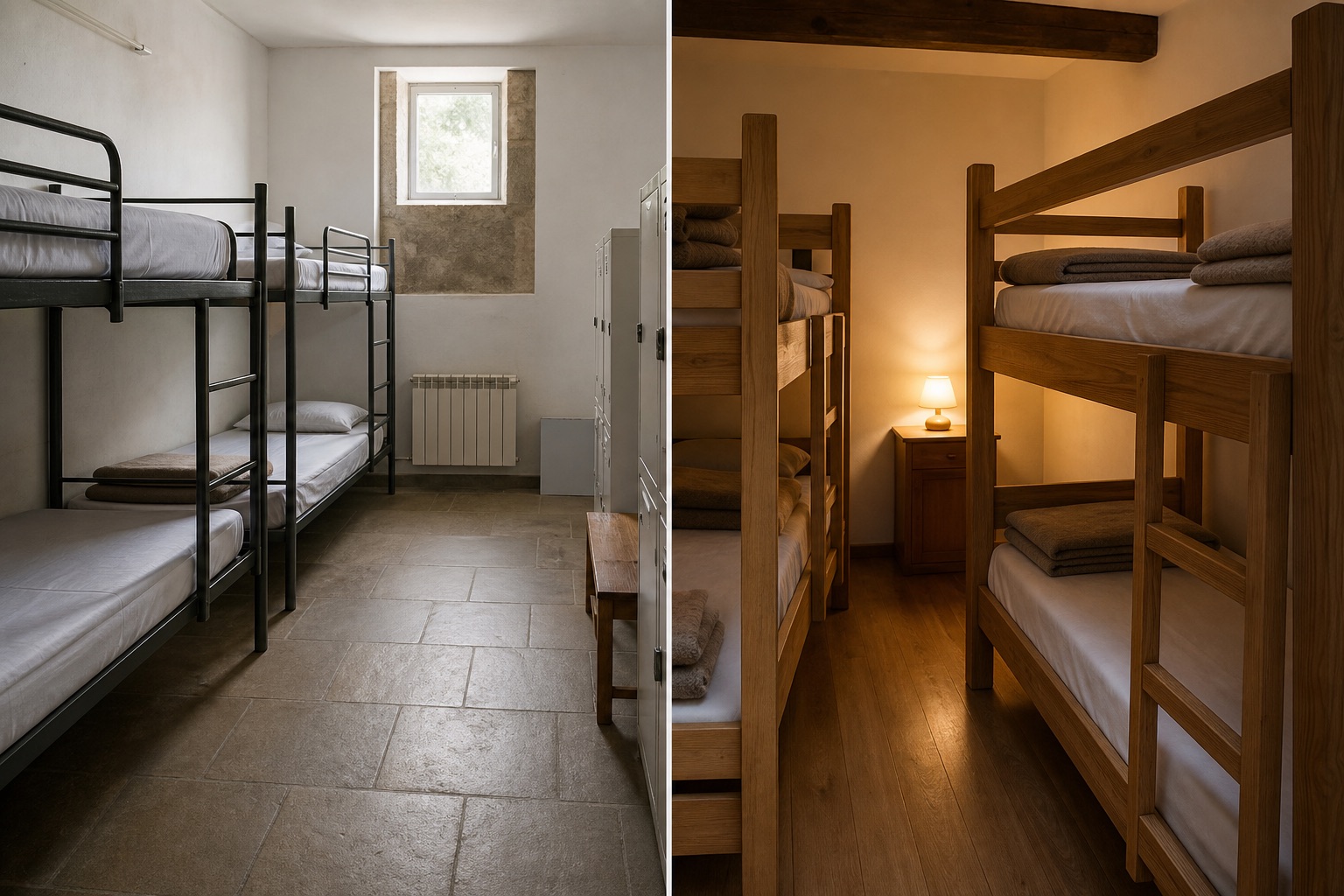
Municipal and Xunta-run albergues operate first-come, first-served and do not accept reservations. That is why they fill fastest on busy stages — they are also the cheapest beds on each stage, typically between 7 and 14 euros per night, which makes them the first option pilgrims walk toward. The rule is not negotiable: no hospitalero will hold a bed for you over the phone, and any aggregator claiming to book a municipal is selling you something else.
Private albergues take bookings by phone, WhatsApp, Booking.com, or via apps like Gronze. Prices land between roughly 15 and 30 euros per night, sometimes more for a private room. That flexibility is what makes pre-booking possible at all: when people say "I booked albergues ahead," they are talking about private albergues by definition.
Donativo albergues — donation-based, often parish-run — sit closer to municipals in spirit. Most do not take bookings. They run on trust, ask pilgrims to give what they can rather than a fixed price, and reward early arrival. Some of the most loved stops on the Francés are donativos, and they fill the same way municipals do: by who walks through the door first.
Match your route, month, and group profile against a simple grid. Camino Francés in May to September favours booking on bottleneck stages. Quieter routes like the Norte, Primitivo, or Invierno tolerate walk-ups longer into the season, partly because their albergue density is lower but their pilgrim density is lower still. The Camino Portugués Central tightens sharply after Tui, where it meets the Sarria-style crowding into Santiago. Winter pilgrims face the opposite problem: too few albergues open at all.
Camino Francés month-by-month
January to March is the off-season. Half the private albergues close; municipals run on reduced capacity. Walk-ups are almost guaranteed where beds exist, but you need to confirm openings the night before. April warms up; pilgrim numbers climb but stay manageable. May, June, and September are the sweet spot for walk-ups outside Sarria-Santiago: arrive by mid-afternoon and you almost always find a bed. July and August are the high-pressure months — book the bottleneck stages and consider booking everything from Sarria. October thins out fast after the first week. November and December are quiet but cold, with limited infrastructure.
Portugués, Norte, Primitivo, Inglés at a glance
The Camino Portugués Coastal from Porto is calmer than the Francés but tightens in July and August in the smaller coastal villages. The Portugués Central crowds hardest after Tui. The Camino del Norte runs along Spain's Atlantic coast with lower albergue density but lower pilgrim density too — walk-ups work most of the season for solo pilgrims, with the caveat that a closed albergue can mean a long walk to the next one. The Primitivo is mountainous and quiet; book the few stages with limited beds, walk up the rest. The Camino Inglés is short, increasingly popular for Compostela hunters, and the four stages from Ferrol can tighten on summer weekends.
If you are still choosing between routes, our routes and distances guide walks through the trade-offs for first-time pilgrims and explains why the Francés from Sarria and the Portugués Coastal are the standard beginner picks.
Group size and couple penalty
Pilgrims walking solo have the easiest walk-up calculus: one bed in a 60-bed dorm is almost always findable somewhere in town. Pilgrims walking as a couple who want a private room face the same booking pressure as in any small-town hotel market — there are only a handful of private rooms per stage on most routes, and they go first. Groups of three or more pay a quieter penalty: municipals rarely have three contiguous beds left by late afternoon, so the group either splits across albergues or pays for a small pension. Either way, booking ahead removes the friction.
The bottleneck stages are predictable. Saint-Jean-Pied-de-Port to Roncesvalles fills first because it is the official starting stage. Pamplona on a fiesta night (San Fermín in July, smaller fiestas year-round) overruns. The Meseta entrances and exits — Burgos, Carrión de los Condes, León, Astorga — concentrate pilgrims who time stages around city services. And every stage from Sarria onward crowds because of the 100-kilometre Compostela threshold.
In July and August, book these stages two to seven days out. In May, June, and September, one to three days ahead is usually enough. In shoulder months, a same-day morning phone call to a private albergue normally secures a bed. The pilgrim's window for same-day calls is roughly 8 AM to 11 AM, before hospitaleros get busy with arrivals.
The final four stages of any major Camino route create the worst bottlenecks because they fold together two flows: pilgrims finishing long routes and pilgrims who started at the minimum-distance city for that route. On the Francés that means Sarria. On the Portugués it means Tui. On the Inglés it means the whole route. Once you know which town is your route's "Sarria," you can treat its bed pressure as a separate planning problem from the rest of the walk.
Walk-ups work when you control three variables: arrival time, stage choice, and information. Leave the albergue by 6 AM. Target arrival by 2 PM. Split or extend the standard guidebook stage so you land in a town the rest of your start-day cohort is skipping. Carry the Gronze app offline and have three backup options queued before you start the day's walk.
The 6 AM to 2 PM rule
Arriving before mid-afternoon significantly raises walk-up success rates. By 3 PM the popular municipals on a bottleneck stage are already full. By 4 PM the private albergues in town are filling. By 5 PM you are competing with everyone for the last beds and the leftover pensiones. The pilgrims who consistently walk up successfully are the ones who leave early, walk steadily, and check in by 2 PM at the latest. They are also the ones who finish their walking day in time to enjoy the town, which is the underrated benefit.
Split-stage and skip-stage tactics
Standard guidebooks group stages around obvious end-towns. Most pilgrims follow them. Which means the obvious end-towns crowd and the smaller towns one stage earlier or later have beds. Walking 18 kilometres instead of 24, or 28 instead of 22, lands you in a village competitors skip. The trade-off is fewer services and sometimes only one albergue option, but the bed-pressure relief is significant. Even averaging 20 to 27 kilometres a day across the Francés, alternating short and long stages keeps you out of the worst bottlenecks. A future companion piece on building a realistic Camino stage plan around your own pace will go deeper into the math; for now, the rule of thumb is enough.
Tools to check live availability
Gronze is the standard reference for albergue listings on the Spanish-language Camino internet — it lists current opening status, prices, phone numbers, and stage maps. Booking.com covers pensions and the larger private albergues with live availability. No single app shows real-time municipal beds, because municipals do not accept reservations and rarely publish counts. Pair both apps with phone calls and you have the best information possible without being physically in town.
Do not panic and do not keep walking blind. Three steps, in order.
Ask the hospitalero
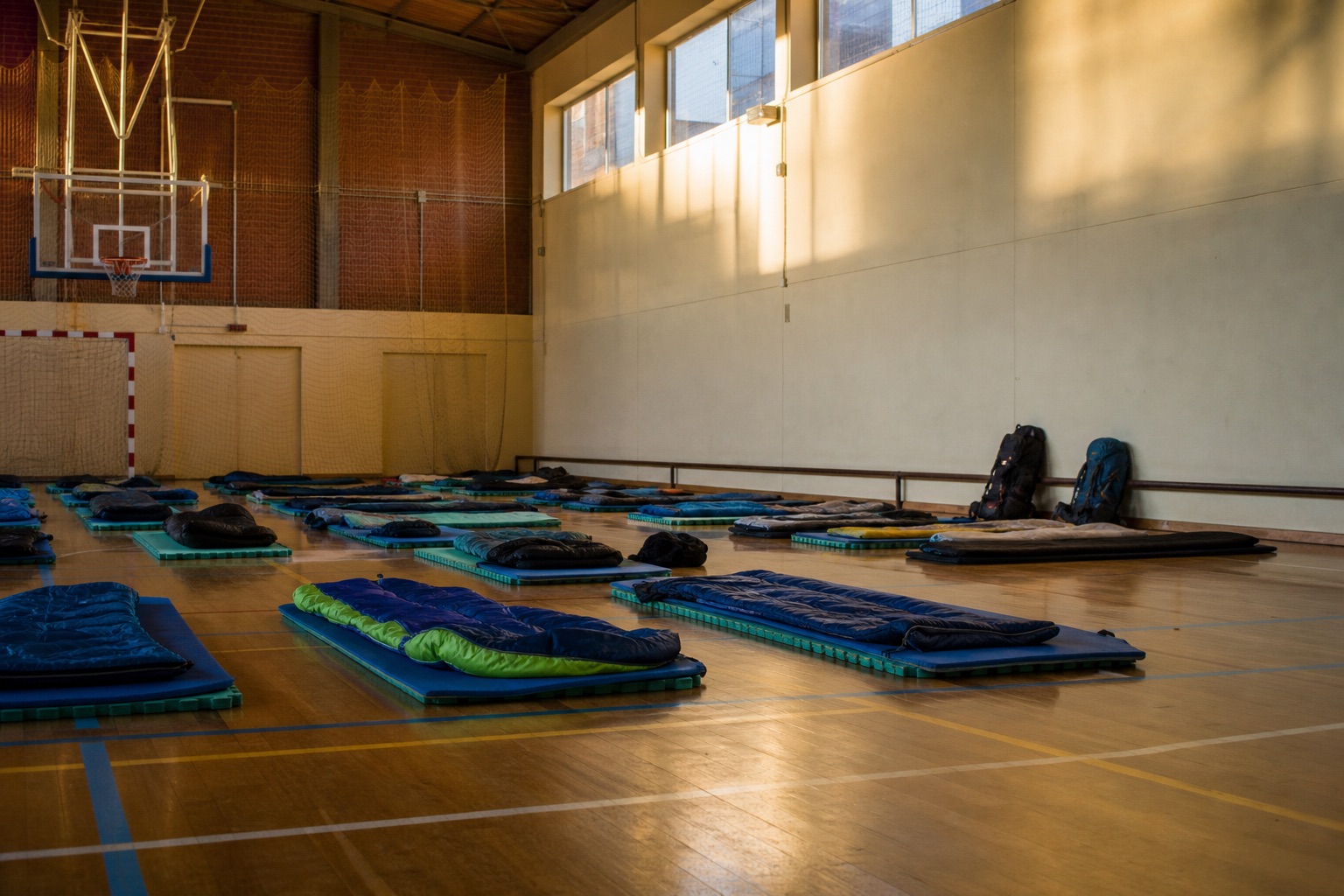
Find the hospitalero at the municipal albergue and ask about official overflow. Many towns on the Camino Francés open polideportivos, sports halls, or parish floors when beds run out. The hospitalero is the central node in the local accommodation network and knows what is available before any app does. This is the move that saves the night nine times out of ten.
Phone the next two or three villages
If the town is truly full, call private albergues in the next two or three villages along the route. Most run between 3 and 8 kilometres apart on the Francés. A short evening walk to a quieter village often works better than waiting on a list in the busy town. Carry a printed list of phone numbers as a backup — phone signal in Galician valleys is unreliable.
Pensions, hostales, taxi-skip
Check Booking.com for pensions and hostales in the same town or the next one. Prices climb but the certainty is worth it after a long day. As a last resort, take a taxi forward to a town with availability and walk that section back the next morning — purists disagree, but the alternative is sleeping rough, which helps no one. Resume from where you stopped and keep your continuous credential stamps intact.
Pre-booking buys certainty and costs flexibility. Walk-ups buy spontaneity and cost peace of mind on busy days. Most experienced pilgrims hybrid: pre-book the four or five stages they know will crowd, walk up the rest. The right mix depends on temperament more than route, once peak-season risk is handled.
| Variable | Pre-booking | Walking up | Best for |
|---|---|---|---|
| Certainty | High — bed is held | Low to moderate — depends on day | Groups, couples, peak summer |
| Flexibility | Low — stage length is locked in | High — stop where the day takes you | Solo pilgrims, shoulder season |
| Cost per night | 15–30 €+ (private albergues) | 7–14 € (municipals, donativos) | Budget pilgrims walk up where they can |
| Time spent planning | High — calls or app bookings nightly | Low — show up, check in | Pilgrims who want to think less on trail |
| Stress on arrival | None | Moderate — increases past 3 PM | Pilgrims who hate uncertainty |
| Stage-splitting freedom | None — you are locked into your town | Total — change your mind at any village | Pilgrims walking by feel |
| Cancellation risk | Deposit lost if you change plans | None | First-timers unsure of their pace |
The cost difference across a full pilgrimage on the Camino de Santiago is real but not as dramatic as it looks at first. A pilgrim averaging municipal beds spends roughly 7 to 14 euros a night; one who books mostly private spends 15 to 30 euros. Add a 12-euro pilgrim menu either way. Across 33 stages of the Francés that totals a few hundred euros of difference, not thousands. For most pilgrims, the better question is not cost but how they want the days to feel.
Phone calls in basic Spanish still beat every app for same-day bookings at small private albergues. Gronze lists phone numbers and current status by stage. Booking.com covers pensions and larger private albergues. WhatsApp is increasingly accepted at private albergues — owners often reply faster on WhatsApp than on a missed call. Avoid third-party aggregators that take large deposits up front: cancellation rules vary, refunds are rare, and many of them list rooms they do not actually control.
A Spanish phone script that works, even if it is the only Spanish you speak:
- "Buenos días, ¿tiene una cama para esta noche?" — Good morning, do you have a bed for tonight?
- "Soy peregrino, llegamos sobre las dos." — I am a pilgrim, we arrive around two.
- "¿Cuánto cuesta?" — How much?
- "Muy bien, muchas gracias." — Very well, thank you very much.
Most hospitaleros will switch to slow Spanish or basic English the moment they realise you are a foreign pilgrim. The phone call is mostly a vote of confidence, not a linguistic test.
Groups of three or more should pre-book every night in peak season. Municipals rarely have three contiguous beds free by late afternoon, which usually means splitting up the group across two albergues or paying for a small pension. Either way the planning load lands earlier than for solo pilgrims, so it is easier to bake it in.
Couples wanting a private room must book ahead almost everywhere. Private rooms are limited in supply on most stages of the Francés and even more so on quieter routes. Walking up and hoping for a private room is the most reliable way to end up in a 30-bed mixed dorm, which is fine if you both expected it and a fight waiting to happen if you did not.
Families with children and pilgrims with accessibility needs benefit from booking pensiones rather than albergues. Quiet hours, ground-floor rooms, accessible bathrooms, and predictable family logistics are all easier in a pension than in a 60-bed dorm. Build a buffer day into the plan for any of these profiles — the Camino tolerates variation in pace far better than it tolerates a missed bed.
Pets add their own constraint: most albergues do not accept dogs. The route forward is calling ahead to confirm and planning around a smaller list of pet-friendly stops, which essentially forces pre-booking.
Imagine a solo pilgrim starting Saint-Jean-Pied-de-Port on June 25. June is busy but not yet peak. The pilgrim plans to walk to Santiago in roughly 33 stages. Their booking plan, stage by stage:
- Pre-book: Roncesvalles on day one (the bottleneck stage of the route), Pamplona if a fiesta lands on their night, and every stage from Sarria onward — five stages, booked three to seven days ahead, ideally before leaving home.
- Walk up: every other stage between Roncesvalles and Sarria. Twenty-eight stages on the move. Arrive by 2 PM. Carry three backup phone numbers per day, sourced the night before from Gronze.
Expected booked nights: roughly seven to eight out of 33. Expected walk-up success on the rest: very high, given the 6 AM departure habit and the willingness to split or extend the standard stage when needed. If a town turns out full mid-route, the overflow protocol above handles it.
The same shape applies to the Portugués Coastal from Porto: pre-book Tui or the stage where the Central and Coastal merge, pre-book the final approach to Santiago, walk up everything else.
The classic errors are predictable.
The "I will just see" trap. Pilgrims who refuse to plan at all on principle. This works fine in May until it does not, and then it goes wrong on a Roncesvalles Friday night in fiesta season and colours the whole first week. The fix is small: book the four or five obvious bottleneck stages and stop worrying about the rest.
The "guidebook stage" trap. Following every stage exactly as printed. The guidebook stages are the busiest stages by definition because everyone is reading the same guidebook. Splitting one stage in two or combining two short stages into one keeps you out of the worst pressure days.
The "I booked the whole Camino" trap. Locked into a stage plan that does not survive contact with weather, blisters, or the basic human desire to stay an extra night somewhere wonderful. Pre-bookings with deposits punish flexibility. The hybrid plan is almost always better than the fully booked plan for first-time pilgrims.
And the "Sarria is the same as the rest of the Francés" trap. It is not. The 100-kilometre Compostela threshold concentrates pilgrim density on that final stretch in a way that has no equivalent earlier on the route. Treat Sarria-to-Santiago as a separate planning problem and the rest of the Francés becomes much calmer to walk.
FAQ
Which Camino Francés stages should I pre-book in summer, and how far ahead?
In July and August, pre-book Saint-Jean-Pied-de-Port to Roncesvalles, Pamplona during San Fermín, the Meseta entrances and exits, and every stage from Sarria to Santiago — roughly the final five nights. Book two to seven days ahead for these. In May, June, and September, one to three days is usually enough. Outside those windows, walk-ups work.
What do I do when every albergue in town is already full?
First, find the hospitalero at the municipal albergue and ask about official overflow — many towns open polideportivos, sports halls, or parish floors when beds run out. Second, phone the next two or three villages along the route. Third, check Booking.com for pensions and hostales. As a last resort, taxi to a town with availability and walk that section back the next day.
Can I walk the Camino Francés in October without booking anything?
Mostly yes. October is shoulder season: pilgrim numbers drop sharply after the first week, municipal albergues rarely fill before evening, and same-day calls handle the rest. Two exceptions remain — the Sarria-to-Santiago final 100 kilometres still crowds on weekends, and some private albergues close for winter, so check Gronze the night before.
What is the difference between a municipal vs private albergue when booking?
Municipal and Xunta albergues are public, cheaper, basic, and strictly first-come, first-served — no reservations, ever. Private albergues are run by individuals or small businesses, cost roughly double, and accept bookings by phone, WhatsApp, or platforms like Gronze and Booking.com. If you want to pre-book, you are booking a private albergue by definition.
Do I need to book every night in advance for the last 100 km from Sarria?
Most pilgrims should, yes. Sarria to Santiago is the densest stretch of any Camino route because it is the minimum distance for a Compostela. From June through September, book the entire five-stage section at least three to seven days ahead. In shoulder months, two days ahead is usually safe. Solo walk-ups still work in winter when many private albergues close.
Are there apps that show real-time albergue availability?
Gronze is the standard reference for albergue listings and current status, used widely by Spanish-speaking pilgrims. Booking.com covers pensions and larger private albergues with live availability. No single app shows real-time municipal beds, because municipals do not accept reservations and rarely publish counts. Carry both apps offline and pair them with phone calls.
External citations
Oficina del Peregrino — official Santiago de Compostela pilgrim office
oficinadelperegrino.comAuthoritative source for pilgrim statistics, Compostela rules, and the official final 100 km requirement that drives Sarria crowding.
Xunta de Galicia — Rede Pública de Albergues do Camiño
xacobeo.galOfficial operator of public albergues in Galicia, with rules, prices, and opening times for the most crowded section of any Camino.
Federación Española de Asociaciones de Amigos del Camino de Santiago
www.caminosantiago.orgFederation of Camino associations whose member hospitaleros run municipal and donativo albergues across Spain.
La Compostela del Lector
You walked this guide to Santiago.
All 771 km, 0 stages, stamped end to end.