
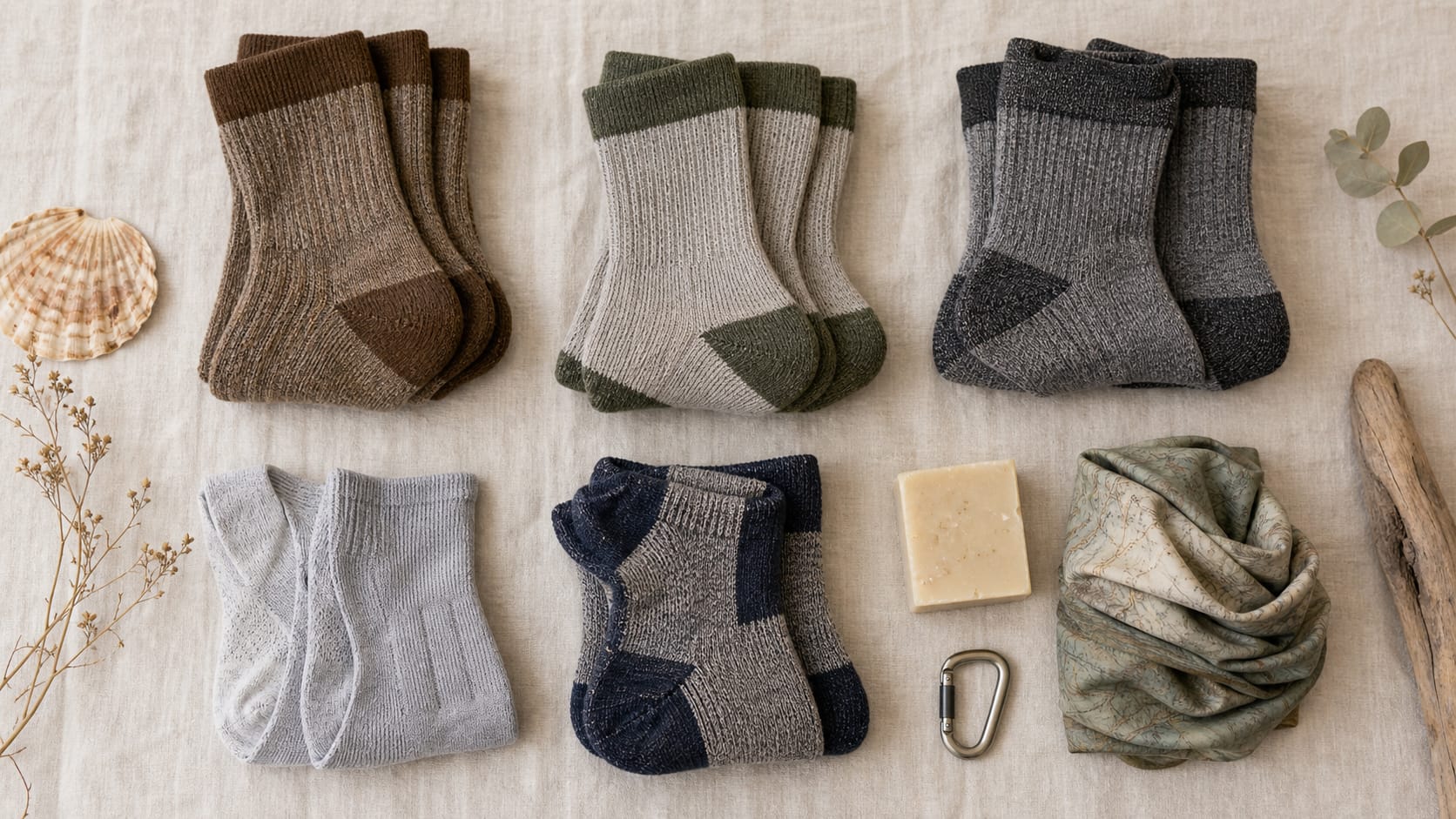
Pack three pairs of mid-weight merino-blend hiking socks plus one ultralight liner. Rotate one pair walking, one drying on your pack strap, one clean in your bag. Wash the worn pair every evening in the albergue sink and air-dry overnight, or clip it to the pack the next morning if it rained.
That kit fits the actual rhythm of a Camino Francés day: leave at dawn, walk five to seven hours, arrive at an albergue between 1 and 4 p.m., wash, eat, sleep. The liner doubles as a sleep sock in unheated dorms and as a thin under-layer on cold morning starts. If you are still working on shoes, the foot care on the Camino pillar guide ties socks into the wider system of fit, hot-spot vigilance, and rest-day calls.
The baseline and when to flex it
Three mid-weight merino-blend crew socks plus one ultralight liner. Around 250 grams total. That is the floor most pilgrims should pack and the ceiling for what one albergue evening can keep clean. Flex up to four pairs if you are blister-prone, walking the Meseta in July, or facing a forecast with three rainy days in a row. Flex down to two pairs only if you are an experienced ultralight walker who hand-washes daily and accepts damp mornings.
Blisters end more Caminos than knees or shins do, and blister risk is set by sock material and foot moisture as much as by shoe fit. A breathable, well-fitted sock keeps the skin-shoe interface dry, which is the single biggest lever for blister prevention on a 30-kilometre day.
The moisture-friction curve, and why cotton fails
Skin is most blister-prone when it is damp but not soaked. Dry skin has low friction. Soaked skin slides. The dangerous middle band, where sweat has built up but not run through, is where friction peaks and the upper layers of skin shear loose from the lower layers. A good sock keeps the skin out of that band by moving sweat away from the foot fast.
Cotton holds water against the skin. A cotton sock that starts dry at 7 a.m. is saturated by 10 a.m. on a hot stage and stays saturated until you stop. Guidebooks, pilgrim forums, and gear-review sites are unanimous: no cotton socks on the Camino.
Merino blends win on odour control, temperature regulation, and that dry feel on long sweaty days. Synthetics win on overnight dry time, durability, and price. For the Camino Francés we recommend a 50 to 70 percent merino blend with nylon and a touch of Lycra: dry enough overnight to rotate, tough enough to last 800 kilometres.
Merino content and cost per kilometre
Below 40 percent merino, the comfort advantage thins out. Above 75 percent, dry times push past one albergue evening and durability drops. The sweet spot is 50 to 70 percent merino, mid-weight (often labelled "light cushion"), in a crew height. A premium pair costs roughly fifteen to twenty-five euros and survives one Camino Francés. Cheap polyester-only socks at five euros often fail before León. The premium pair works out to about three cents per walked kilometre, which is the cheapest insurance the kit offers.
Double-layer socks like Wrightsock shift friction from skin-to-sock to sock-to-sock, which reduces blister risk on feet that have already proven blister-prone. Single-layer mid-weight merino is lighter, cooler, and dries faster, which matters more in summer heat. Choose double-layer if blisters chase you, single-layer merino if heat does.
How the third interface works, and the hybrid kit
A single-layer sock has one friction surface: skin against fabric. A double-layer sock has two: skin against inner layer, inner against outer. When the shoe moves, the two sock layers slide against each other instead of dragging the skin. The principle is well-documented in blister-prevention literature. A practical compromise for pilgrims who are unsure: pack two single-layer merino pairs and one double-layer pair, and choose by day.
Three pairs covers a walking pair, a drying pair, and a clean reserve. Two pairs works for ultralight pilgrims who wash mid-stage and accept damp mornings. Four pairs is right for blister-prone feet, the Meseta in July or August, or pilgrims who refuse to walk in a still-damp sock.
The walk-dry-clean rotation and when to add a fourth pair
Yesterday's washed pair is today's walking pair. Today's worn pair gets washed and hung in the courtyard. The clean reserve in your bag stays untouched unless rain stops the drying pair from being ready, which is exactly what it is there for. Add a fourth pair when the forecast shows three or more consecutive rain days, when the Meseta in July forces a midday change, or when training has already produced a blister.
In July and August on the Meseta, pack lighter, thinner socks with strong wicking and plan a midday sock swap. In April or October, pack a slightly heavier merino sock with a higher merino content for warmth-when-wet, plus one extra pair as a damp-day buffer.
Summer, shoulder season, and winter
In summer, lightweight (sometimes labelled "ultralight" or "no cushion") merino crew socks at 50 to 60 percent merino dry fastest and run coolest. Wash the morning pair at a cafe sink, clip it on the pack to finish drying in the sun, walk the afternoon in the dry pair.
In April, May, September, or October, a midweight merino crew at 65 to 75 percent merino holds warmth-when-wet better. Add a fourth pair so a wet stretch never leaves you without a dry sock in the bag. For December through February, shift to heavy merino plus a thin wicking liner, plan two drying pairs at all times, and size your shoes up a half size to fit the extra layer.
Darn Tough and Smartwool lead the merino-blend category in light, mid, and heavy weights. Wrightsock leads on double-layer blister prevention. Injinji is the answer if your toes blister against each other.
Darn Tough Micro Crew Cushion Hike. Made in Vermont, sold with a lifetime replacement warranty, roughly 60 percent merino. Lowest cost per kilometre in the category once the warranty is counted.
Smartwool Hike Light Cushion. Lighter than the Darn Tough cushion hike, which makes it the better default for summer Meseta heat. Wears at the heel a little sooner but rarely before Santiago.
Wrightsock Coolmesh II / Double Layer. The benchmark double-layer sock. Synthetic in both layers, no merino, which keeps dry times very short.
Injinji Trail Midweight. Toe socks. Each toe is sleeved individually, which eliminates toe-on-toe rubbing. Wear them if blisters form between or under the toes.
Each afternoon: rinse the worn pair in the albergue sink with a small drop of soap, squeeze in a towel, hang in airflow. Each morning: check both feet for hot spots before you lace up, swap to a dry pair, hang yesterday's pair on the pack to finish drying as you walk. The whole routine takes under ten minutes.
The morning hot-spot check is the foot-care lever socks alone cannot replace. The hot spots spoke covers what to look for. If a blister has already arrived, blister prevention and blister treatment on trail take over, and the broader foot care on the Camino guide frames how all of these fit together. The when to take a rest day call sits one layer up.
The towel-press trick and the morning check
Cold or lukewarm water in the sink, a drop of soap, a squeeze, a towel press, a line in the courtyard. Rolling the wet sock in a clean towel and pressing hard pulls most of the water out and cuts dry time by a couple of hours. Avoid hot water (shrinks merino) and wringing (breaks down the elastane). Before you lace up in the morning, run a thumb along the heel, the ball of the foot, the outside of the pinkie toe, and the inside of the big toe. Any patch that feels warmer, redder, or slightly raised is a hot spot. Tape it before you put the sock on, not after.
Walk at least 100 kilometres in your final shoe-and-sock combination before you fly to Spain. Buy your socks at least eight weeks out, run at least two back-to-back long walks of 20 plus kilometres in them, and replace any pair that thins at the heel before you pack. A sock that looks comfortable on a 30-minute neighbourhood walk can produce a blister on a 25-kilometre Saturday. Find that out at home, not on day three out of Pamplona. The training-for-the-camino guide covers the wider back-to-back ramp this sits inside. If a sock fails mid-route on the actual Camino, target a known stop with outdoor retail (Pamplona, Logroño, Burgos, León, Sarria) rather than counting on the next village.
| Sock type | Material | Weight class | Best for | Overnight dry time | Approx price per pair |
|---|---|---|---|---|---|
| Mid-weight merino crew (Darn Tough, Smartwool) | 50–70 % merino, nylon, Lycra | Mid (light cushion) | Default Camino sock, three-pair rotation | 8–12 hours | 18–25 € |
| Lightweight merino crew | 50–60 % merino, nylon, elastane | Light (no cushion) | Summer Meseta heat, midday swap | 6–10 hours | 16–22 € |
| Double-layer synthetic (Wrightsock) | Polyester / Coolmax, no merino | Light to mid | Blister-prone feet, wet weeks | 4–8 hours | 14–18 € |
| Toe socks (Injinji) | Coolmax / merino blend | Light to mid | Toe-on-toe blisters | 6–10 hours | 14–18 € |
Overnight dry times assume a typical albergue courtyard, mild evening, and the towel-press pre-dry step. Prices are 2026 retail in Europe and exclude warranty value, which favours Darn Tough heavily over the full route.
Frequently asked questions
How many pairs of socks do I really need for the Camino Francés?
Three pairs is the consensus answer and the one we recommend for a typical first-time pilgrim on the Camino Francés. Two pairs works only if you are an experienced ultralight walker who hand-washes daily and is fine with damp morning socks. Four pairs is right for blister-prone feet, the high Meseta heat of July and August, or pilgrims walking long stages with no afternoon to wash.
How does the best Camino sock setup change between summer heat and shoulder season?
In summer (June through August), shift to lighter, thinner merino-blend crew socks with strong wicking, plan a midday sock swap, and let the worn pair dry on your pack while you walk. In April, May, September, or October, switch to a midweight sock with higher merino content for warmth-when-wet, and add a fourth pair as a buffer for damp-morning starts after rain. The rotation logic is the same; only the weight and merino percentage change.
Are double-layer socks or single-layer merino better for Camino blister prevention?
If blisters have chased you on training walks, choose double-layer socks like Wrightsock; the third friction interface shifts shear away from your skin and there is real research behind the design. If you are blister-free in training and walking in summer, single-layer mid-weight merino is cooler, lighter, and dries faster, which matters more on the Meseta. Many pilgrims pack one pair of each and choose by day.
Should I wear sock liners on the Camino?
Most pilgrims walking single-layer mid-weight merino do fine without liners. Liners are worth it if your feet need a thin wicking layer under a heavier sock, or if you are walking in winter or persistent rain. A purpose-built double-layer sock is usually a better answer than stacking a liner under a regular sock.
How do I dry socks at an albergue when it has been raining all day?
Rinse and squeeze the wet pair, then press hard in a clean towel to pull most of the water out. Hang in the most airflow you can find: an open window, a hallway, a covered courtyard line. In the morning, clip the still-damp pair to the outside of your pack with a small carabiner. Sun and breeze finish the job within a couple of hours of walking. The third pair gives you a dry start either way.
Can I just buy more socks in Spain if mine fail?
Yes, but with friction. Larger Camino towns like Pamplona, Burgos, León, and Sarria carry hiking socks at outdoor shops and pharmacies, but small village shops will not. Plan to start the Camino with a tested kit. If a sock fails mid-route, target a known stop with outdoor retail rather than counting on the next village.
External citations
American Pilgrims on the Camino: preparation packing list
americanpilgrims.org/preparationNon-commercial pilgrim association whose packing recommendations and ten-percent-of-body-weight rule are widely cited in the Camino community, used here for the 3-pair baseline and pack-weight context.
Blister Prevention by Rebecca Rushton: double-sock systems
www.blisterprevention.com.auIndependent specialist site that summarises the available peer-reviewed and military studies on double-sock blister prevention, including the shear-mechanism explanation used in the double-layer section.
Outdoor Gear Lab: hiking sock test program
www.outdoorgearlab.com/topics/shoes-and-boots/best-hiking-socksIndependent gear lab with measured dry times, durability tests, and a transparent buy-and-test methodology that backs the merino-vs-synthetic dry-time and durability claims.
La Compostela del Lector
You walked this guide to Santiago.
All 771 km, 0 stages, stamped end to end.