
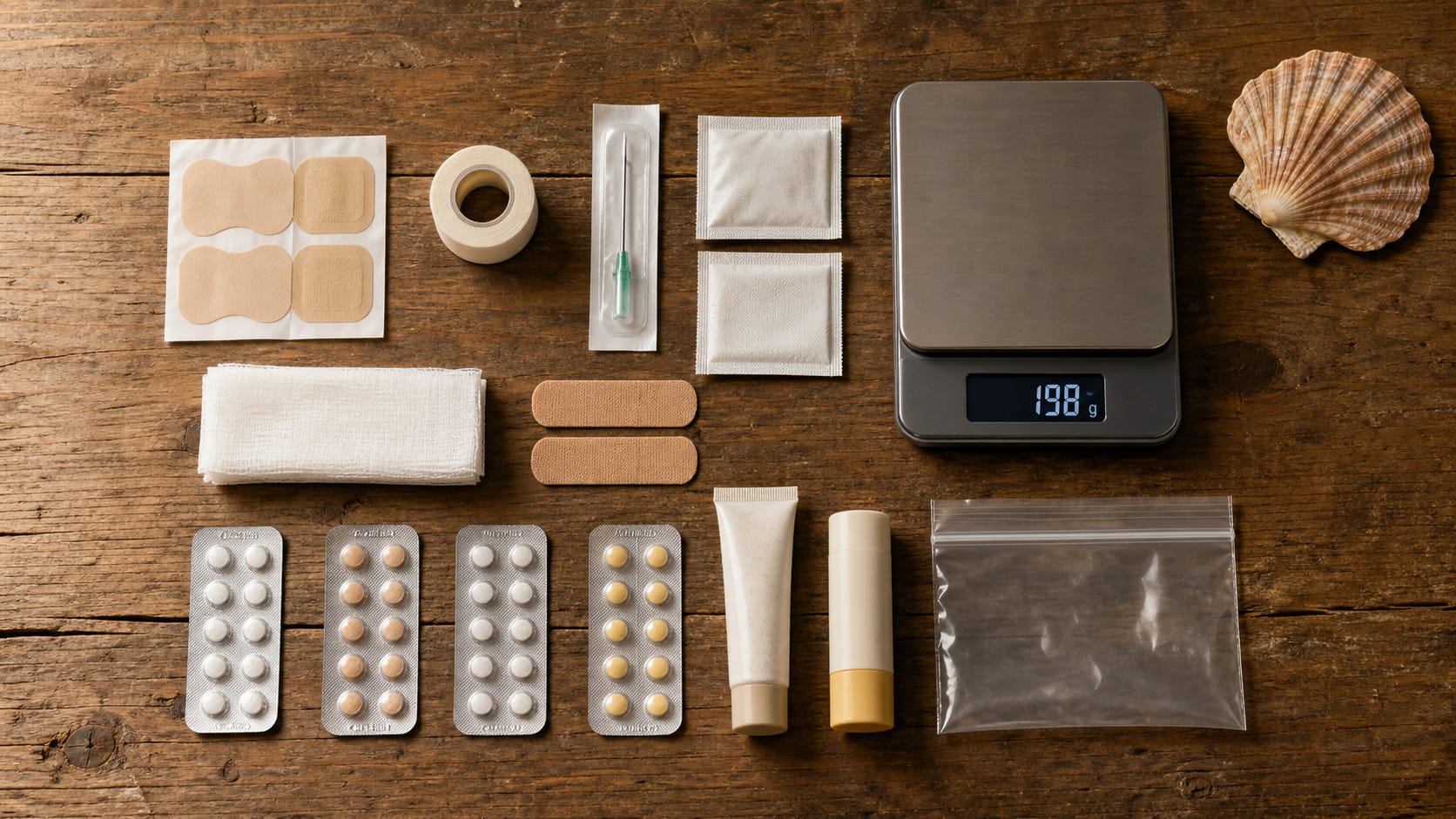
Pack four groups: blister care (hydrocolloid plasters, tape, a sterile needle), wound care (antiseptic wipes, gauze, fabric plasters), medications (ibuprofen 400 mg, paracetamol, an antihistamine, an antidiarrheal, your own prescriptions), and skin protection (SPF 30 sunscreen and an anti-chafe stick). With the zip bag, that is 14 items and 150 to 200 g total.
The weight budget matters because the kit competes with everything else on your back. Your whole pack should stay at or below 10 percent of body weight, and the backpack sizing and 10 percent body-weight rule explainer shows how tight that budget really is. An overstuffed first aid kit is one of the classic offenders: it sits at number eight on the list of items pilgrims mail home from the Camino in week one, usually 200 to 400 g heavier than it needs to be. The reason you can pack light is structural, not optimistic: a pharmacy sits in nearly every town along the Camino Francés, so Spain itself is your resupply depot. The kit is also just one category of the complete Camino packing list, and every other category deserves the same gram-by-gram scrutiny you are about to give this one.
The full kit weighs 198 g on a kitchen scale. The three heaviest items account for most of it: a 50 ml sunscreen (65 g), a roll of zinc-oxide tape (35 g), and an anti-chafe stick (20 g). Everything else, plasters, needles, wipes, gauze, four medication strips, and the zip bag, adds under 80 g combined. Weigh yours before you fly and cut anything you would not use in week one.
Foot care and blister supplies
Hydrocolloid plasters (Compeed or a generic, mixed sizes), a roll of zinc-oxide tape such as Leukotape P for pre-taping known hot spots, and two or three sterile needles in their wrapper. This trio runs the entire blister lifecycle: prevention in the morning, protection at midday, drainage in the evening. If feet are your known weak point, the deeper dive into blister prevention on the Camino is worth reading before you choose socks and shoes.
Medications and when to use each one
Ibuprofen 400 mg for inflammation days (tendon pain, swollen knees), paracetamol 650 mg for plain pain relief when your stomach needs a break from ibuprofen, one antihistamine strip for insect bites and surprise allergies, and loperamide for the bad-water day that hits most pilgrims once. Carry ten tablets of each at most. Your regular prescription medication travels in its original packaging with a note of the generic (INN) name, because Spanish pharmacies dispense equivalents faster when they can read the compound instead of a foreign brand.
Wound care, skin, and sun
Six antiseptic wipes, four sterile gauze squares, and ten fabric plasters handle scrapes, popped blisters, and the odd shaving cut. SPF 30 sunscreen is non-negotiable from May to September: the meseta offers hours of shadeless walking, and a burned neck ruins three days. The anti-chafe stick earns its 20 g on thighs and heels before the day's first kilometre.
Bring the things Spain does not reliably stock: Leukotape P, your anti-chafe stick, and any prescription medication in original packaging. Buy the commodity items en route, because Compeed, ibuprofen, sunscreen, and plasters sit on the shelf of nearly every farmacia along the Camino Francés at reasonable prices. This split keeps your day-one kit near 150 g.
| Item | Weight (g) | Bring or buy in Spain | Spanish name to ask for | Typical price (EUR) |
|---|---|---|---|---|
| Hydrocolloid blister plasters (6, mixed) | 15 | Bring a starter pack, restock in Spain | apósitos hidrocoloides / Compeed | 10–13 per 10-pack |
| Zinc-oxide tape (Leukotape P roll) | 35 | Bring from home | esparadrapo de óxido de zinc | hard to find; ~10 online |
| Sterile needles (3, wrapped) | 1 | Bring from home | agujas estériles | 1–2 |
| Antiseptic wipes (6) | 6 | Either | toallitas de alcohol | 1–2 |
| Sterile gauze squares (4) | 6 | Buy in Spain | gasas estériles | 1–2 |
| Fabric plasters (10 strips) | 8 | Buy in Spain | tiritas de tela | 2–4 |
| Ibuprofen 400 mg (10) | 10 | Buy in Spain, no prescription | ibuprofeno 400 | 2–3 |
| Paracetamol 650 mg (10) | 10 | Buy in Spain, no prescription | paracetamol 650 | 1–2 |
| Antihistamine (cetirizine, 7) | 4 | Either | cetirizina | 3–5 |
| Antidiarrheal (loperamide, 6) | 4 | Either | loperamida / Fortasec | 3–5 |
| Personal prescription meds | 10 | Bring, original packaging | generic (INN) name | n/a |
| Sunscreen SPF 30, 50 ml | 65 | Buy in Spain, restock as needed | crema solar factor 30 | 8–12 |
| Anti-chafe stick | 20 | Bring from home | stick antirrozaduras | 8–12 in sports shops |
| Zip-top bag | 4 | Bring from home | bolsa con cierre | n/a |
The tape rule surprises people most: Fixomull-type stretch tape is sold in Spanish pharmacies under the brand name Omnifix, but Leukotape P, the standard for pre-taping, is genuinely difficult to find. If pre-taping is part of your routine, the roll comes from home.
Blisters come from friction, moisture, and heat, so prevention targets all three: broken-in footwear sized up a half size, moisture-wicking or double-layer socks changed at midday, lubricant or tape on known hot spots before walking, and stages near 20 km while your feet adapt. Prevention costs grams; treatment costs days.
The scale of the problem is well documented. In a field survey at an albergue in the province of León, 61.6 percent of pilgrims had blisters on one or both feet, and the same research line associates daily stages near 20 km with less severe blisters than longer days. Footwear is the biggest lever you control before departure: the boots vs trail runners verdict settles the primary pair, and the three-pair sock rotation keeps midday moisture off your skin. The kit's job is what remains after those two decisions are made well.
Wash and dry the foot, sterilize a needle with an antiseptic wipe, drain the blister at its edge leaving the roof of skin intact, apply antiseptic, then cover with a hydrocolloid plaster or island dressing before walking on. This is the field protocol clinicians recommend for walkers who cannot simply stop walking.
Every step uses something already in the 200 g kit. The intact roof of skin is the point most first-timers get wrong: it is the best sterile dressing you own, so drain through a small hole at the edge rather than peeling it away. For dressing choices, re-draining on day two, and taping over a healing blister, the blister treatment on the trail guide covers the full decision tree. See a doctor instead of the kit for pus, spreading redness, red streaks, fever, or any foot wound if you are diabetic.
Nearly every town on the Camino Francés has a pharmacy, marked by a green cross; larger towns run a rotating 24-hour farmacia de guardia, with the current rota posted on every pharmacy door. Pharmacists on the route treat pilgrim ailments daily in season and dispense ibuprofen 400 mg, paracetamol 650 mg, and hydrocolloid plasters without a prescription. Learn a few Spanish product names before you need them.
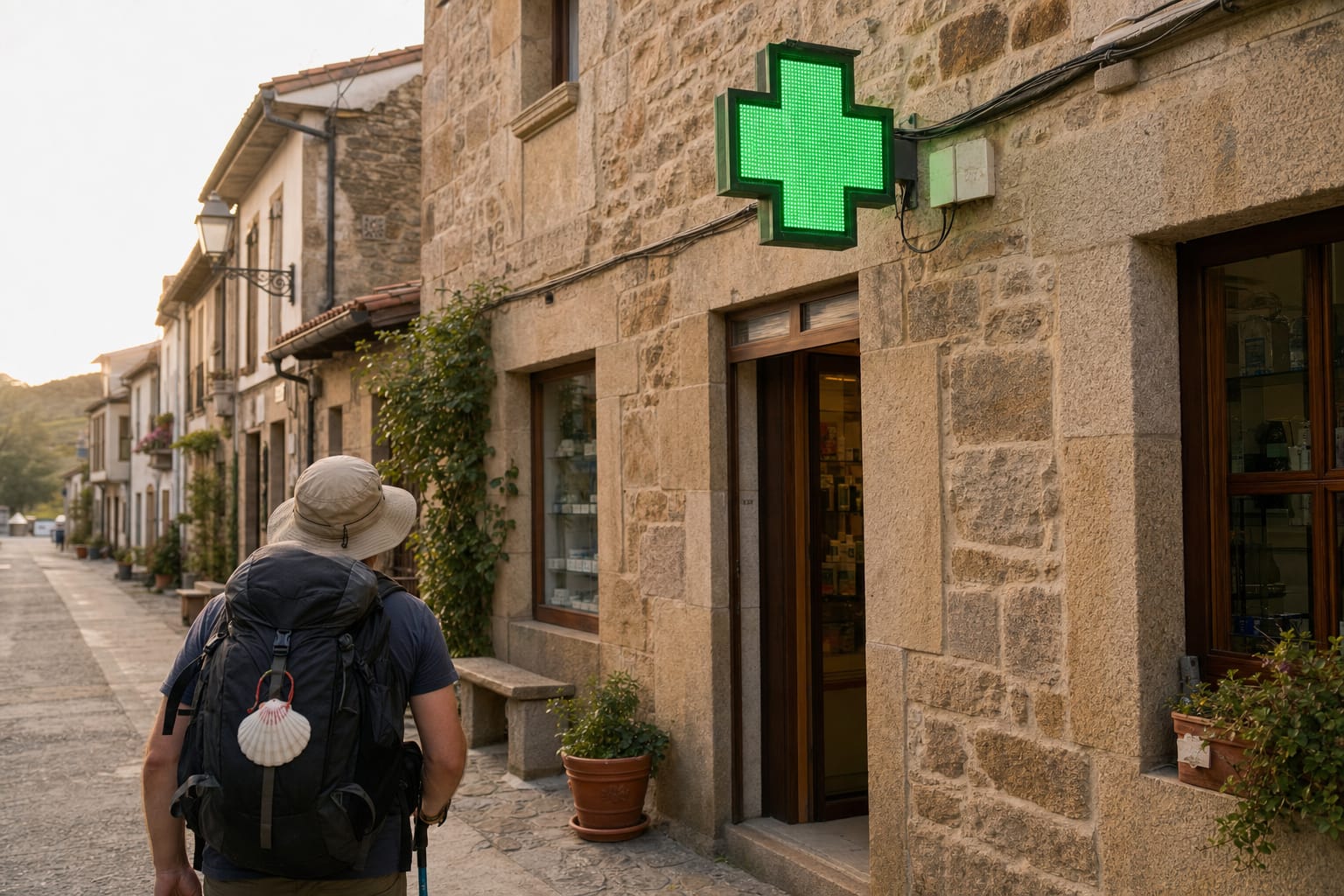
The prescription boundaries are worth knowing. Ibuprofen 400 mg is over the counter; the 600 mg strength requires a prescription. Paracetamol is over the counter at 500 to 650 mg, while 1 g tablets are prescription-only. Voltaren Emulgel (diclofenac gel) for tendon and knee pain is stocked in virtually every Spanish pharmacy. None of this is sold in supermarkets, so plan restocks around farmacia hours: roughly 9:30 to 14:00 and 17:00 to 20:30 on weekdays, mornings on Saturday.
Spanish names for Compeed blister plasters and other supplies
Say 'Tengo ampollas. ¿Tiene apósitos hidrocoloides?' (I have blisters. Do you have hydrocolloid plasters?). Compeed is a recognised brand name at Spanish counters, so asking for it directly also works, and pointing at your foot bridges any remaining gap. For tape, ask for 'esparadrapo' or the brand Omnifix; for sunscreen, 'crema solar factor 30'; for diarrhea, 'algo para la diarrea' gets you loperamide.
When to call 112 or find a centro de salud
112 is the free EU-wide emergency number and works from any phone in Spain. For non-emergencies that outgrow the pharmacy (infected blisters, a fall, fever that will not break), most route towns have a centro de salud that treats walk-ins. EU and UK pilgrims are covered in the state system with an EHIC or GHIC card; carry it physically, and everyone else should carry travel insurance details in the same zip bag as the kit.
Frequently asked questions
Should I bring blister supplies from home or buy them in Spain?
Bring a small starter set plus anything Spain rarely stocks, such as Leukotape P and toe island dressings. Buy commodity supplies like Compeed, ibuprofen, and sunscreen en route: pharmacies appear in nearly every Camino Francés town, prices are fair, and pharmacists handle pilgrim feet every day in season.
How do I ask for blister plasters like Compeed in a Spanish pharmacy?
Say 'Tengo ampollas. ¿Tiene apósitos hidrocoloides?' (I have blisters. Do you have hydrocolloid plasters?). Compeed is a recognised brand name in Spain, so asking for it directly also works, and pointing at your foot bridges any remaining gap. For tape, ask for 'esparadrapo' or the brand Omnifix.
What painkillers and medications can I buy over the counter in Spain?
Ibuprofen 400 mg, paracetamol 500 to 650 mg, Voltaren Emulgel, basic antihistamines, and antidiarrheals are all sold without prescription at any farmacia. Stronger doses, including ibuprofen 600 mg and paracetamol 1 g, require a prescription, and none of these are sold in supermarkets.
How much of my total pack weight should the first aid kit take up?
Your whole pack should stay at or below 10 percent of body weight, ideally under 5 to 6 kg. A 150 to 200 g kit is about 3 to 4 percent of a 5 kg pack, which is the right proportion: enough to handle blisters and minor illness, not enough to slow you down.
When should I see a doctor instead of treating a blister myself?
Seek care for pus, spreading redness, red streaks, fever, or any foot wound if you are diabetic. Most route towns have a centro de salud that treats walk-ins, EU and UK pilgrims are covered with an EHIC or GHIC card, and 112 is the free emergency number everywhere in Spain.
Do I need anything special for my regular prescription medication?
Carry it in original packaging with enough supply for the whole walk, plus a note of the generic (INN) name. Spanish pharmacies can often dispense equivalents, but brand names and available strengths differ, so refilling mid-route without documentation is slow and sometimes impossible.
External citations
Gracia-Sánchez et al., International Wound Journal, 2024
pmc.ncbi.nlm.nih.gov/articles/PMC11646658Peer-reviewed field data on blister incidence among Camino walkers surveyed in the province of León, grounding the 61.6 percent figure and the association between shorter daily stages and less severe blisters.
Lipman & Krabak, Wilderness Medical Society Clinical Practice Guidelines for the Prevention and Treatment of Friction Blisters
www.wemjournal.org/article/S1080-6032(16)30169-3/fulltextEvidence-based clinical guideline validating the drain-and-dress blister protocol and the friction, moisture, and heat prevention framework used in this article.
European Commission: European Health Insurance Card (EHIC)
ec.europa.eu/social/main.jsp?catId=559&langId=enOfficial documentation for the healthcare-access guidance given to EU and UK pilgrims, including EHIC coverage in the Spanish state system.
La Compostela del Lector
You walked this guide to Santiago.
All 771 km, 0 stages, stamped end to end.