
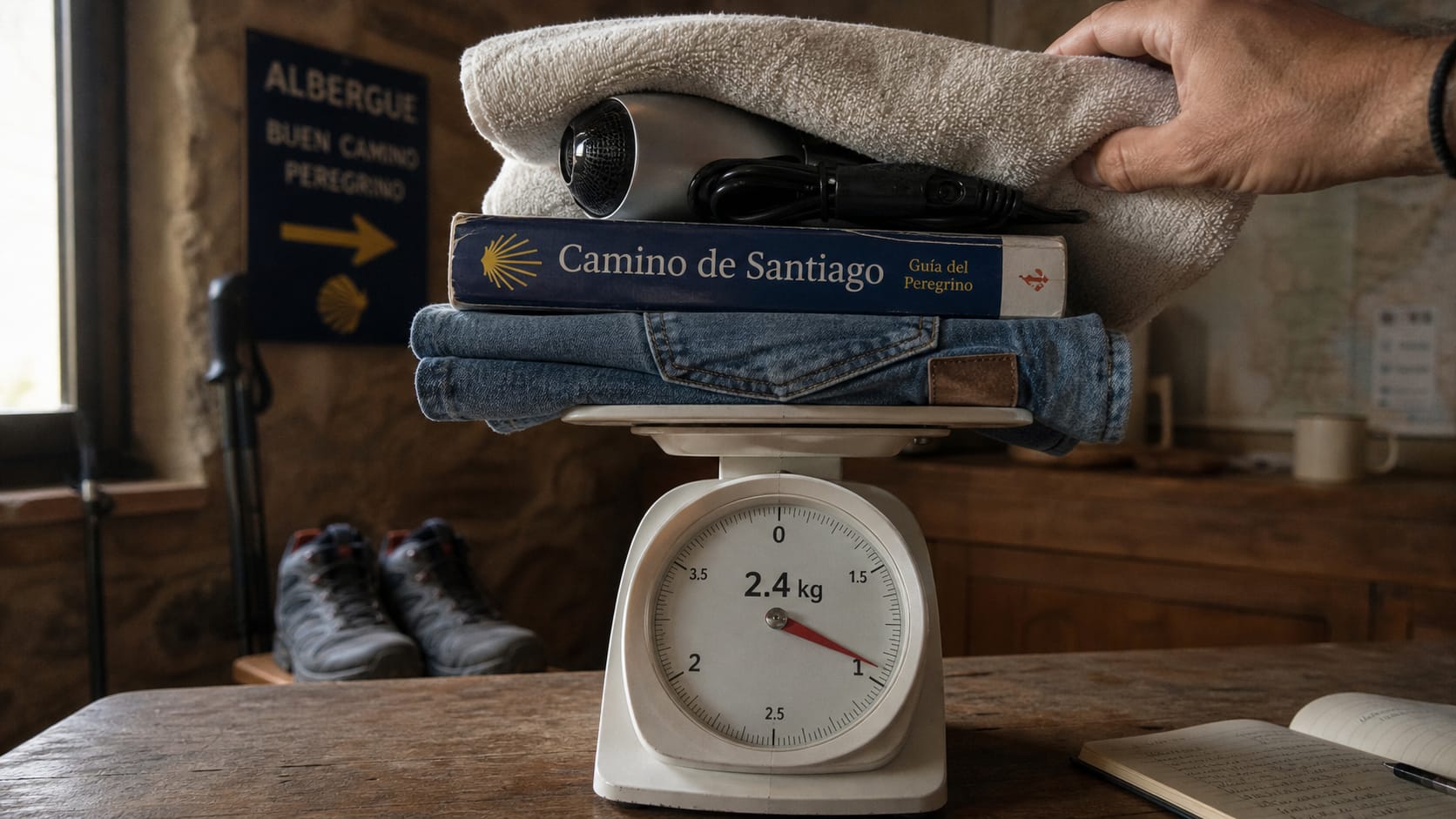
Pilgrims most consistently mail home a full three-season sleeping bag, jeans or cotton trousers, a full-size cotton bath towel, a third or fourth change of clothes, a paper guidebook, a hairdryer, a heavy camera body, a bulging first-aid kit, a backup pair of shoes, and an emergency food stash. The typical week-one ship sheds 2 to 4 kg.
The pattern repeats every season at the Correos branches in Pamplona, Logroño, and Burgos. Yellow Paq Peregrino boxes pile up with the same items because most first-timers pack for fear instead of forecast, and the trail teaches them otherwise within five days. The cure happens before you fly: build your kit around the complete Camino packing list with weights so every gram has to earn its place.
Each item shows a typical weight in grams, a lighter swap, and the first Francés town where pilgrims most often shed it. If an item saves more than 200 g and you cannot remember the last time it came out of your pack on a training walk, leave it home.
The 10 percent body-weight rule is the anchor: a 70 kg pilgrim should aim for a 7 kg base pack. Most overpacked starting packs sit at 11 to 13 kg, which is where blisters and shoulder pain compound. The backpack sizing and 10 percent body-weight rule explainer walks through how to calibrate your target.
Summer walkers (June to early September) can cut a full sleeping bag, a down jacket, and gloves. Shoulder season keeps a light bag and a thin fleece but still drops jeans, the cotton towel, and the spare shoes. Winter keeps the warm sleep system but still drops the towel, the jeans, the hairdryer, and the emergency food. The Francés has a village shop every 5 to 10 km, so emergency stockpiles never apply. None of the routes need a tent, a stove, or a cookset.
The 15 most-regretted items, ranked by how often pilgrims ship them home or dump them in albergue donation boxes.
- Full three-season sleeping bag (saves 600 to 900 g). Summer pilgrims need a 120 to 150 g silk liner, not a 800 to 1,200 g bag. Shoulder season earns a 600 g light bag. Winter is the only window where a full three-season bag belongs in the pack.
- Jeans or cotton trousers (saves 400 to 500 g). Jeans take two days to dry and chafe when wet. Convertible quick-dry trousers weigh 250 to 350 g and convert to shorts on hot meseta afternoons.
- Full-size cotton bath towel (saves 300 to 500 g). A 100 by 50 cm microfiber towel wrings out almost dry, clips to the outside of the pack, and weighs 100 to 150 g.
- Third and fourth changes of clothes (saves 800 to 1,200 g). The rule is wash one, wear one, spare one. Laundry happens every other day at the albergue.
- Hardback guidebook (saves 250 to 450 g). The same information fits in a free PDF on your phone. If you want paper, tear out the stages you are walking.
- Travel hairdryer (saves 300 to 500 g). The single most-mocked item in albergue donation boxes. Most albergues have no outlet near a mirror. A buff covers a wet head on a cold morning for 25 g.
- Heavy DSLR or full lens kit (saves 600 to 1,500 g). Modern phone cameras handle the warm light and golden-hour vistas pilgrims actually take. Hobbyists pack one compact mirrorless body and one prime; everyone else mails the kit home.
- Oversized first-aid kit (saves 200 to 400 g). A pharmacy in every town above 1,000 people sells what you missed. The Camino kit fits in a sandwich bag. The Camino first aid kit guide details the short list.
- Spare hiking boots or third pair of shoes (saves 800 to 1,200 g). One walking pair plus a 200 to 300 g pair of recovery sandals covers walking, evening, and shower duties. Cities along the Francés sell replacements when shoes wear out. The hiking boots vs trail runners verdict settles the primary pair.
- Emergency food stash (saves 300 to 600 g). Bars open at 06:30, panaderías by 07:30, and the next village is 5 to 10 km away. One 80 g protein bar is plenty.
- Down jacket outside winter (saves 400 to 700 g). Spring, summer, and early autumn evenings are handled by a 250 g fleece under your rain shell.
- Full-size toiletries (saves 300 to 600 g). Spanish supermarkets sell 100 ml refills, often cheaper than at home.
- E-reader, tablet, or paperback novels (saves 200 to 500 g). Evenings fill with shared dinners, journaling, and sleep at 21:30. A phone Kindle app covers the rare night you want to read.
- Camp pillow (saves 150 to 300 g). A stuff sack with your fleece and tomorrow's shirt inside works as well as an inflatable.
- Tent, stove, or cookset (saves 1,500 to 2,500 g). Albergue beds every 5 to 10 km and a menú del peregrino in every town for €12 to €15 leave no case for camping kit on the Francés.
Plan a deliberate weigh-and-ship checkpoint between day 3 and day 7 at a Correos post office. Most first-time pilgrims who do this shed 2 to 4 kg and report fewer blisters by the meseta.
Day 3 is the earliest the body has an honest opinion. By the descent into Pamplona, shoulders, knees, and feet have ranked every gram. Walk to a luggage scale at any sports shop, weigh the pack, and write down what you have not used.
Correos Paq Peregrino accepts pilgrim parcels up to 15 kg for around €20.95 and stores them up to 15 days at the destination post office. Mail items home if you genuinely will not need them on the trail. Forward to Santiago via Correos or Casa Ivar's storage service (up to 90 days) if you need them for the flight home but not on the walk. Every popular albergue also keeps a free donation box for items pilgrims leave behind.
Three patterns repeat. Pilgrims pack for every weather scenario instead of layering. They copy a winter blogger's list for a July walk. And they bring aspirational items that never come out of the pack.
The Camino layering system replaces three jackets with three thin layers that combine into every condition the trail throws. The Camino Francés packing list is tuned to the route and season. If you do not draw at home, you will not draw on the Camino: aspirational items are 200 to 600 g of guilt at the bottom of the pack.
Sleeping bag, jeans, full-size towel, hiking poles, and a rain poncho are the five items first-time pilgrims debate most. The short answers: a silk liner in summer and a light bag in shoulder season, never jeans, swap the towel for microfiber, take poles unless you have wrist issues, and a poncho beats a jacket on hot rainy days. The Camino rain gear guide covers the poncho vs jacket question in full.
Frequently asked questions
Do I really need a sleeping bag, jeans, or a full-size towel for the Camino de Santiago?
No to all three for most pilgrims. In summer a silk liner (120 to 150 g) replaces a sleeping bag and works with the few blankets that remain in some albergues. Jeans are universally discouraged because they dry slowly and chafe; convertible quick-dry trousers do the job at less than half the weight. A small microfiber towel replaces the full-size cotton bath towel and saves 300 to 500 g.
How much weight can I save by leaving common overpacked items at home before the Camino?
Most first-time pilgrims who apply this list save 2 to 4 kg before they fly. Dropping a full sleeping bag (around 1,000 g), jeans (around 700 g), a cotton towel (around 500 g), a guidebook (around 350 g), a hairdryer (around 400 g), and a duplicate shirt and trousers takes a typical 11 kg starting pack to roughly 7 to 8 kg, much closer to the 10 percent rule.
Where on the Camino Francés do most pilgrims mail items home for the first time?
Pamplona, Logroño, and Burgos are the three Correos branches pilgrims use most often in week one. Pamplona arrives early enough to fix mistakes from Roncesvalles, Logroño hits at the end of week one when the meseta is looming, and Burgos is the last big city before the open plains where every extra gram is felt.
Is the Camino Francés the only route where this leave-home list applies?
The list applies to every Camino route, but the priorities shift. On the Portugués Coastal and Norte you can drop the sleeping bag earlier because albergues run warmer and you finish faster in summer. On the winter Francés or the Invierno route, the down jacket and warmer sleep system come back onto the list.
What about items I forget at home, can I buy them along the way?
Yes. Pharmacies, sports shops, and supermarkets sit in every town larger than 1,000 people on the Francés. Decathlon stores in Pamplona, Logroño, Burgos, León, and Sarria carry replacement clothing, socks, ponchos, and basic gear at lower prices than airport shops. Treat anything you might maybe need as something you can buy on arrival rather than carry from home.
Should I send my whole backpack ahead and just walk with a daypack?
Some pilgrims do this with Correos Paq Mochila or private services and report a more comfortable walk, especially with injuries or age-related concerns. Purists prefer carrying their own pack. There is no rule. If you pre-book the service for the whole route and pack a sub-5 kg daypack, you can also leave several items on this list at home for the same reason.
External citations
Correos: Paq Peregrino pilgrim parcel service
www.elcaminoconcorreos.com/en/paq-peregrino.phpThe official Spanish postal service page documenting pilgrim parcel pricing, the 15 kg weight limit, and storage windows used in the week-one ship-home protocol.
American Pilgrims on the Camino: packing list and resources
americanpilgrims.org/preparing-for-your-caminoEstablished US pilgrim association whose long-standing packing guidance underpins the wash-one wear-one spare-one rule and the 10 percent body-weight target referenced throughout this article.
Federación Española de Asociaciones de Amigos del Camino de Santiago
www.caminosantiago.orgThe Spanish federation of Camino associations; authoritative on current albergue norms, including blanket availability and amenity expectations that shape the sleep-system advice.
La Compostela del Lector
You walked this guide to Santiago.
All 771 km, 0 stages, stamped end to end.