
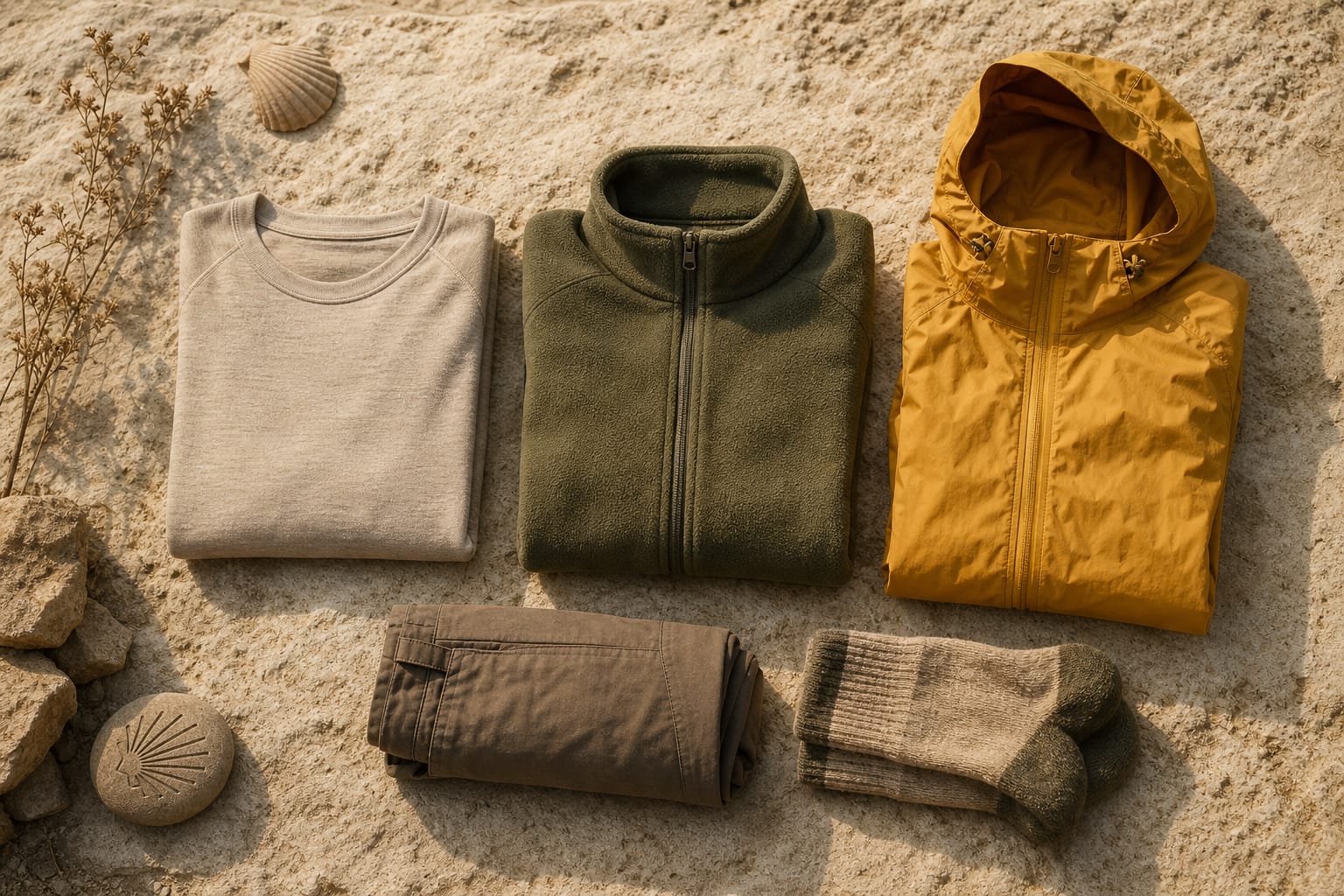
Start the day wearing all three layers: a merino base, a fleece mid, and a wind or rain shell. As you warm up walking, peel the shell within the first kilometre, then the fleece by mid-morning. By the hot afternoon you walk in the base layer alone, and you reverse the order as the sun drops.
The reason a system beats a single warm jacket is the size of the daily swing. A spring morning on the Camino Francés can start near 6°C and climb into the low 20s by early afternoon, and you cover that whole range on foot without stopping to repack. Three thin layers let you shed heat one step at a time. One thick coat gives you only two settings, on and off, and off means carrying it in your hands. The layer kit is one section of the complete Camino packing list; this is the part that decides whether you are comfortable between the albergue door and the first café.
Each layer has exactly one job. The base layer moves sweat off your skin so you never walk in a wet shirt. The mid layer traps warm air. The shell blocks wind and rain. Your warmth comes from the mid layer, not the shell, which is the point most first-timers get backwards when they buy an expensive waterproof and expect it to keep them warm.
Once you see the layers as three jobs instead of three garments, buying gets simpler. You are not looking for one miracle jacket. You are covering three functions with the lightest items that do each one well, and the table below sets the material choices side by side before we take each layer in turn.
| Layer & material | Warmth when wet | Drying speed | Typical weight | Relative cost |
|---|---|---|---|---|
| Base, merino wool | Stays warm | Moderate | 150 g | High |
| Base, synthetic | Cold when wet | Fast | 130 g | Low |
| Mid, 100-weight fleece | Stays warm | Moderate | 300 g | Low to mid |
| Mid, light synthetic fill | Warm, poor once soaked | Fast | 250 g | Mid to high |
| Shell, wind shell | Not a warm layer | Fast | 120 g | Low to mid |
| Shell, waterproof rain jacket | Not a warm layer | Slow | 325 g | Mid to high |
A merino wool base layer resists odour, so you can wear it several days between washes, and it stays warm even when it is damp. Synthetic base layers dry faster and cost less, but they start to smell after a single sweaty day. For most pilgrims, one merino short-sleeve plus one merino long-sleeve covers the whole range from a hot Meseta afternoon to a cold Galician morning.
The one material to keep off your skin is cotton. It soaks up sweat, dries slowly, and pulls heat out of you when it is wet, which is why a cotton shirt earns a place on the list of what not to pack for the Camino. Merino does the opposite: the fibre holds warmth against the skin even when it has absorbed moisture, so a merino base that is slightly damp from the morning climb still insulates rather than chilling you.
Carry two base layers, not three. You wear one and wash the other in the albergue sink on arrival, and merino resists odour well enough to stretch a third day when a wash does not dry in time. Many pilgrims split the difference and carry one merino and one synthetic short-sleeve, taking the fast drying of the synthetic on wet stretches and the odour resistance of the merino on the days without a proper wash.
Your mid layer is the warmth you add and remove fastest, so it is the piece you handle most often during the day. A 100-weight fleece suits spring and autumn and shrugs off a light drizzle; a light synthetic-fill jacket packs down smaller for genuinely cold starts and weighs a touch less. In high summer a second long-sleeve base often does the job of a mid layer on its own, which saves you carrying a fleece you would never put on.
Whatever you carry, keep it at the very top of your pack or in the outside lid. You will pull the mid layer out and stuff it back several times a day, and a fleece buried under your sleeping bag is a fleece you leave on too long. The easy-access mid layer is what makes shedding on the move quick instead of a full unpack at the side of the trail.
The shell handles weather, not warmth. A more waterproof jacket breathes less, so you sweat inside it on a climb and end up damp from the inside even when it keeps the rain out. A light wind shell suits dry, breezy mornings and weighs almost nothing; a taped-seam rain jacket or a poncho handles the sustained Galician downpours in the last week to Santiago. Choose by your season and route, not by buying the most protective shell on the rack.
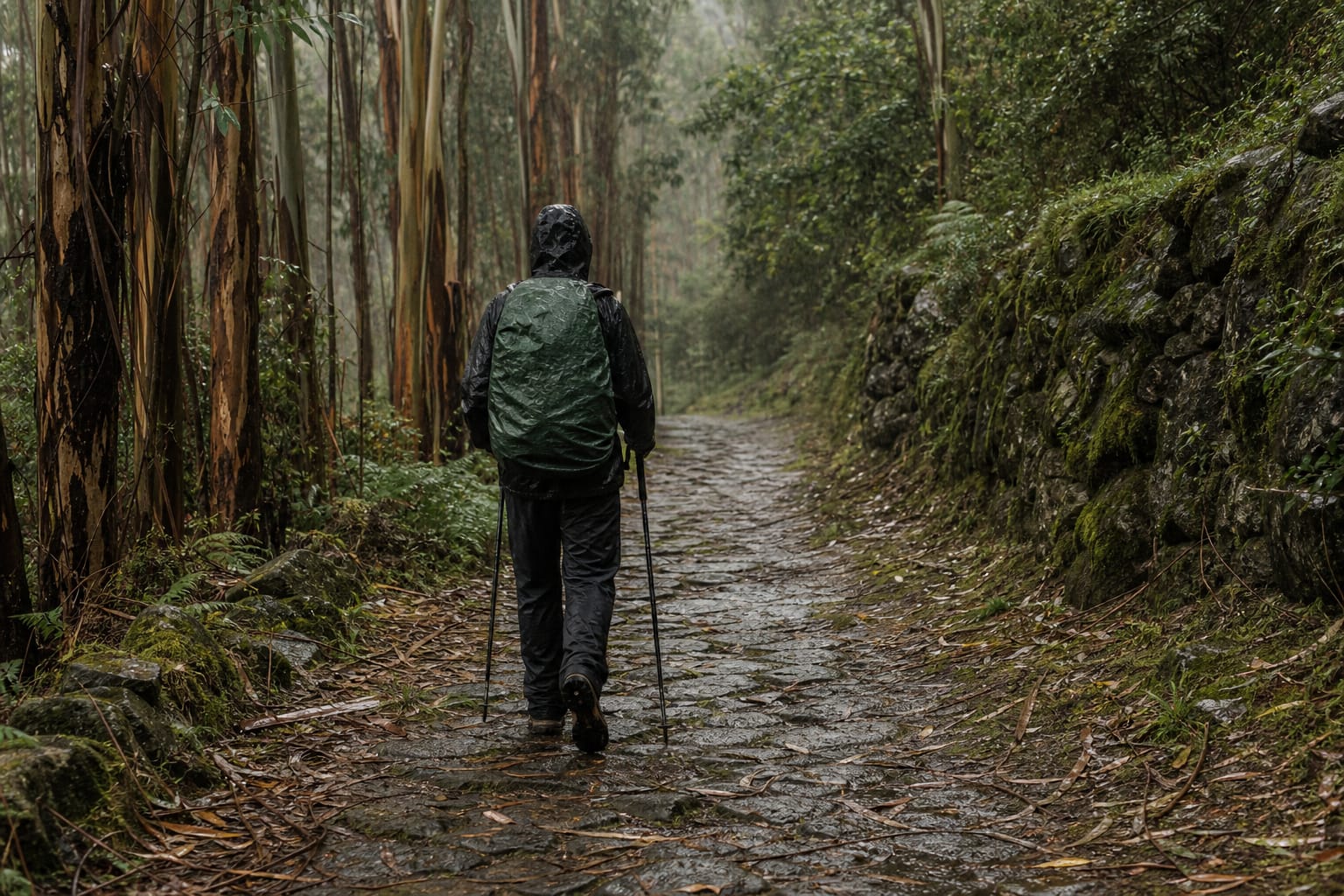
Whether a jacket or a poncho is the better shell depends on how much you climb and how heavy the rain gets, and it is worth settling that choice before you buy rather than on a wet morning in Sarria. What matters for the layering system is that the shell is a weather tool you add over your warmth, never a substitute for it. On a cold, still morning the shell does little; on a windy one it earns its place by stopping the wind from stripping the warm air out of your fleece.
Match your layers to the temperature you will actually feel, not the forecast high. Below 5°C, wear all three plus a hat and gloves. From 5 to 12°C, wear the base plus the mid. From 12 to 18°C, walk in the base and add the shell only if it is windy. Above 18°C, the base layer alone is enough.
| Felt temperature | Base | Mid | Shell | What you wear |
|---|---|---|---|---|
| Below 5°C | ✓ | ✓ | ✓ | All three, plus a hat and gloves |
| 5 to 12°C | ✓ | ✓ | — | Base and mid; shell packed |
| 12 to 18°C | ✓ | — | if windy | Base alone; add the shell only if it is windy |
| Above 18°C | ✓ | — | — | Base layer alone |
Read the felt temperature, not the number on the app. Walking generates a lot of heat, so once you are moving you feel roughly 8 to 10°C warmer than a person standing still at the same air temperature. Wind and damp push the felt temperature the other way. The forecast high also lands in mid-afternoon, hours after your cold departure, so the number that matters at 7 a.m. is the overnight low, not the day's peak.
The rule is simple: be slightly cold when you start. If you feel warm standing still at dawn, you will overheat within ten minutes of walking, and a base layer soaked with sweat chills you the moment you stop for a coffee. Stop to remove a layer before you sweat, not after, because a wet base layer takes hours to dry against your skin.
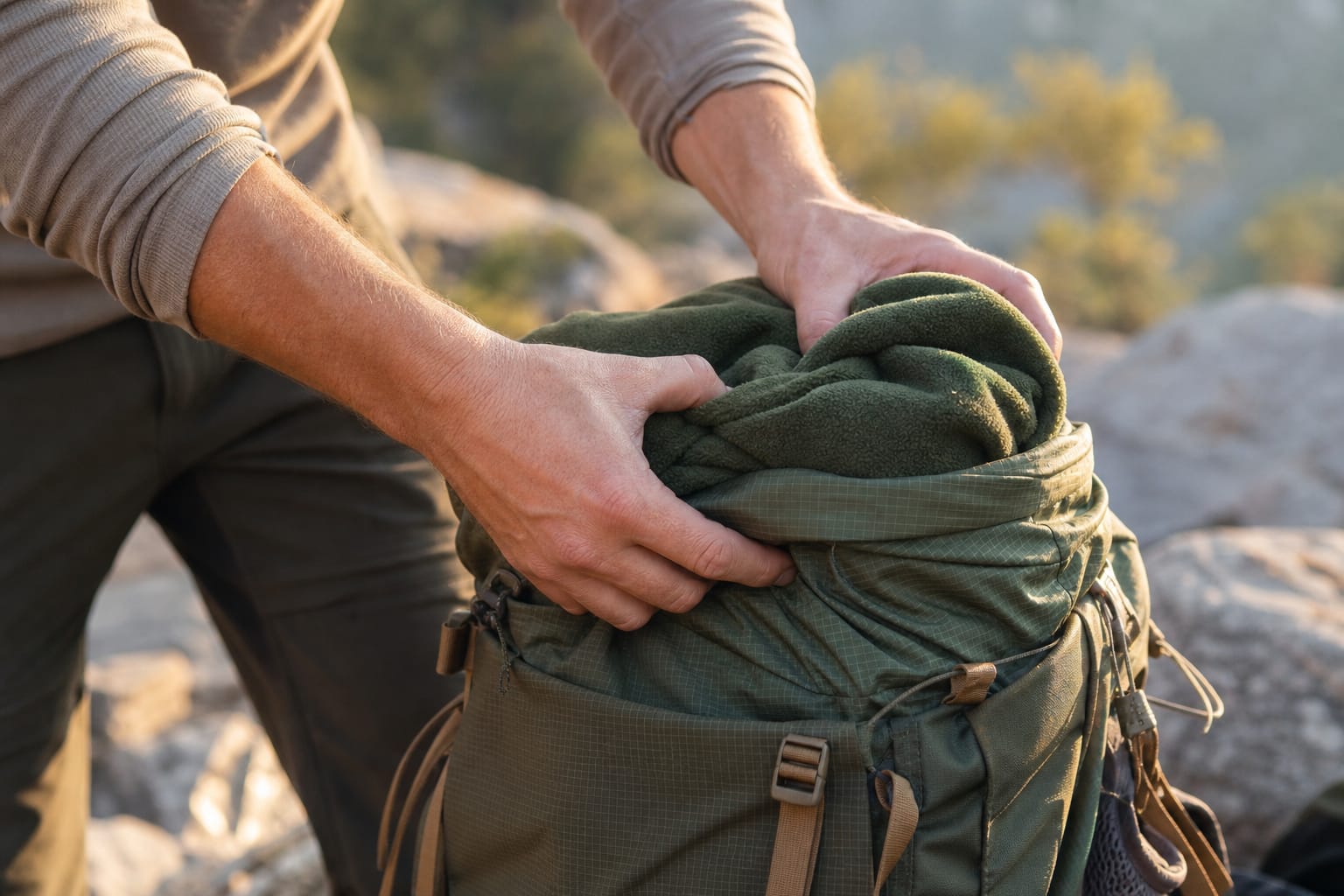
A worked morning looks like this. You leave the albergue in all three layers, a little cold. Within the first kilometre, as the climb warms you, the shell comes off and goes in the lid. By mid-morning, at the first café or the top of the first climb, the fleece follows. By the hot part of the afternoon you are down to the base layer. Before you strip a layer fully, use the small vents first: roll the sleeves, drop the pit zips if your shell has them, open the collar. Those cost no stops and often buy you another half hour before a layer has to come off.
A full three-layer Camino clothing kit weighs roughly 900 to 1,400 grams: a merino base near 150 g, a fleece around 300 g, and a rain shell between 250 and 400 g. A worked core kit with a spare base layer lands at about 925 g on the kitchen scale, and knowing each item's weight is what lets you keep the loaded pack near the 10% of body weight target.
Those grams are not free, so weigh each piece before you fly rather than trusting the label. The layer kit sits inside the same weight budget as everything else on your back, and the backpack sizing and 10% body weight rule shows how little headroom that leaves once water and the pack itself are counted. Swapping a 400 g waterproof for a 250 g wind shell and a packable emergency poncho, on a route and season that allow it, is one of the cheaper ways to drop 150 g without giving up a function.
The same three-layer system scales by season; only the weights change. Summer usually means the base layer plus a packed shell for a passing shower, with the fleece often left at home. Spring and autumn use all three most days, because that is when the morning and afternoon temperatures diverge the most. Winter keeps the three jobs but makes each layer warmer: a thermal base, a heavier mid, plus the hat and gloves that a cold dawn demands.
Because the layers stay constant and only the weights move, you do not relearn the system for each trip. The season-by-season volume this kit takes up feeds back into the master gram-by-gram list in the complete Camino packing list, and the footwear side of a cold, wet morning is covered in hiking boots vs trail runners for the Camino, where drying speed matters for the same reason it does with your base layer.
Frequently asked questions
How much should my full set of Camino clothing layers weigh?
A full three-layer set usually weighs 900 to 1,400 grams: about 150 g for a merino base, 250 to 350 g for a fleece, and 250 to 400 g for a packable shell. Add roughly 150 g for a spare base layer. Weigh each item on a kitchen scale so your loaded pack stays near 10% of your body weight.
When should I stop and take off a layer before I overheat?
Take a layer off the moment you feel warm walking, usually within the first ten to fifteen minutes, not once you are already sweating. A soaked base layer chills you as soon as you stop. Start each day slightly cold; if you feel comfortable standing still at dawn, you are overdressed to walk.
Can I wear cotton on the Camino?
Avoid cotton for anything you walk in. It soaks up sweat, dries slowly, and pulls heat from your body when wet, which causes chafing and leaves you cold on exposed stages. Keep at most one soft evening shirt for the albergue, and only if the extra weight is worth it to you.
How many base layers should I pack?
Two is enough for most pilgrims: one short-sleeve and one long-sleeve merino base. You wear one, wash the other, and it dries overnight. In winter, add a thermal long base layer. Merino resists odour well enough to wear several days between washes when a wash does not dry in time.
Do I need merino wool, or is a synthetic base layer fine?
Both work. Merino resists odour and stays warm when damp, which suits multi-day walking with few washes. Synthetic base layers dry faster and cost less but smell sooner. Many pilgrims carry one merino and one synthetic to get both sets of benefits.
How do I dry my layers overnight in an albergue?
Wash on arrival, wring hard, then roll each item in a dry towel and press to squeeze out the water. Hang it near airflow, not against a cold wall. Merino and technical synthetics usually dry by morning; a thick fleece or a wet spell may not, so keep one dry spare.
External citations
AEMET (Agencia Estatal de Meteorología) — climate values for Spain
www.aemet.es/en/serviciosclimaticos/datosclimatologicosThe official Spanish weather service's climate data grounds the morning-to-afternoon and month-by-month temperature bands the layering system is built on.
The Woolmark Company — wool benefits and moisture management
www.woolmark.com/about-wool/wool-benefitsIndependent textile research supporting the claims that merino wicks moisture, stays warm when damp, and resists odour better than cotton.
Wilderness Medical Society — Practice Guidelines on Accidental Hypothermia
www.wemjournal.org/article/S1080-6032(19)30099-4/fulltextPeer-reviewed clinical guidance behind the warning that wet cotton accelerates heat loss and raises hypothermia risk on cold, exposed stages.
La Compostela del Lector
You walked this guide to Santiago.
All 771 km, 0 stages, stamped end to end.