
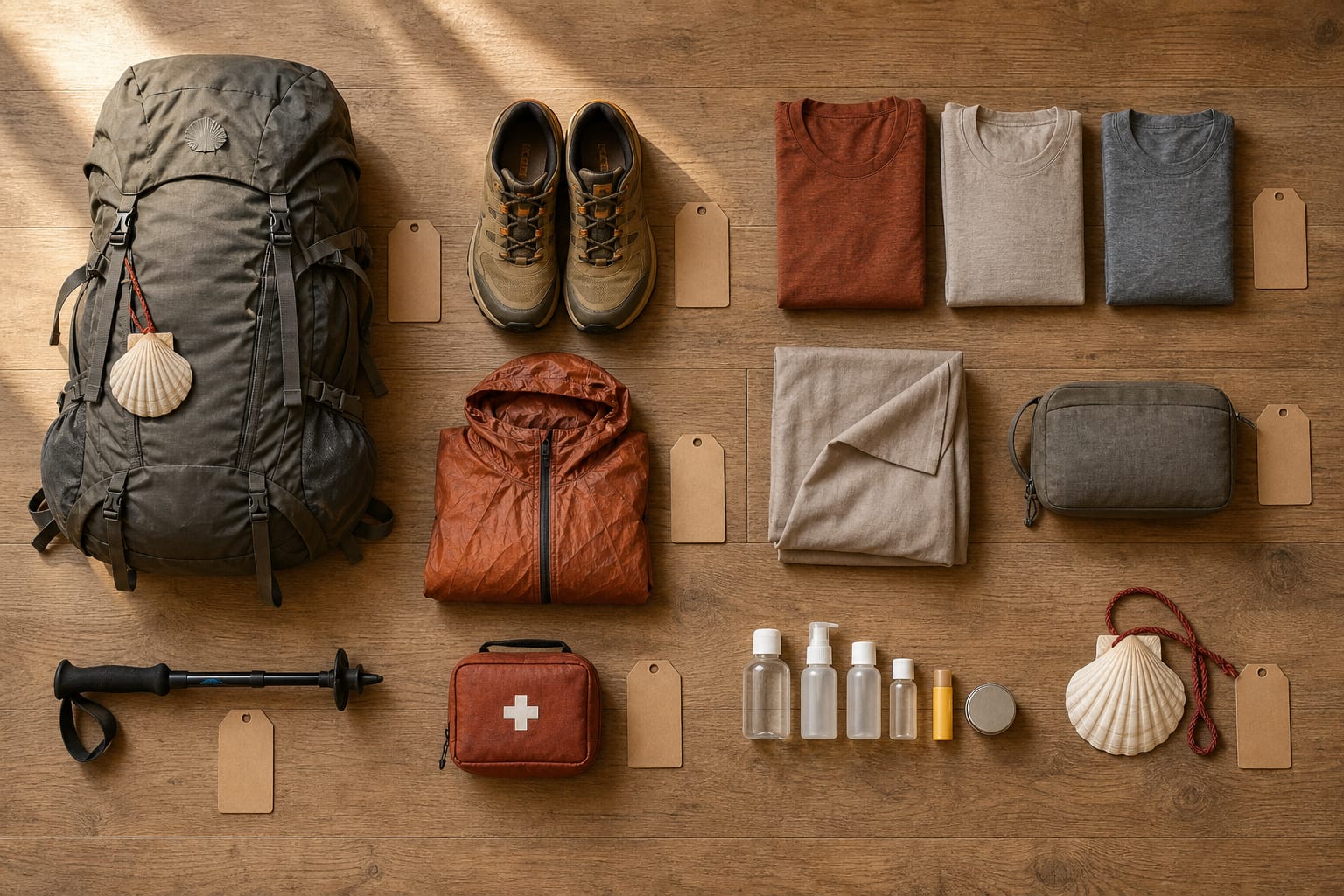
Yes. The full list below covers 35 items across seven categories, each weighed in grams and summed to a 5.9 kg summer total including the pack itself. Category subtotals let you verify your own kit against the 10% body-weight guideline, instead of trusting a checklist that never adds up.
Most packing lists you find online skip the one number that matters. They tell you to bring "a lightweight rain jacket" and "quick-dry socks" and never say what any of it weighs, so you arrive at the airport with a pack that feels fine standing still and becomes a problem by the second afternoon. A gram budget fixes that. Once every item has a weight, you can see exactly where your kilos go, and you can cut with a scale instead of a hunch.
Here is the master list. Weights are typical figures for standard, non-ultralight gear. Real items vary, so treat these as a baseline to measure your own kit against, not gospel.
| Category | Item | Weight (g) |
|---|---|---|
| Pack & carry | Backpack (35–40 L) | 1,100 |
| Pack & carry | Pack rain cover | 90 |
| Pack & carry | Dry bags / stuff sacks | 60 |
| Worn | Walking shoes (on feet, not counted) | 0 |
| Worn | Walking shirt | 150 |
| Worn | Walking shorts or trousers | 250 |
| Worn | Underwear + walking socks | 90 |
| Worn | Sun hat | 60 |
| Packed clothing | Spare walking shirt | 150 |
| Packed clothing | Spare shorts/trousers | 250 |
| Packed clothing | 2× spare underwear | 80 |
| Packed clothing | 2× spare socks | 120 |
| Packed clothing | Insulated midlayer (light fleece) | 300 |
| Packed clothing | Rain protection (poncho) | 250 |
| Packed clothing | Sleep/rest outfit (tee + leggings) | 250 |
| Packed clothing | Camp sandals | 300 |
| Footwear | Second sock system (liner + outer) | 60 |
| Sleep | Silk sleeping bag liner | 130 |
| Sleep | Inflatable pillow (optional) | 80 |
| Sleep | Eye mask | 15 |
| Sleep | Earplugs | 30 |
| Toiletries | Toiletry bag + contents | 350 |
| Toiletries | Microfibre towel | 130 |
| Toiletries | Sunscreen (travel size) | 100 |
| Toiletries | First aid & foot care kit | 250 |
| Toiletries | Toilet paper / wipes | 60 |
| Electronics | Phone (carried, not counted) | 0 |
| Electronics | Power bank (10,000 mAh) | 220 |
| Electronics | Charger + cables | 120 |
| Electronics | Headphones | 40 |
| Documents | Credencial + passport + cards | 120 |
| Documents | Wallet + cash | 90 |
| Documents | Paper stage notes | 30 |
| Water | Bottle/bladder empty | 120 |
| Extras | Trekking poles (often carried in hand) | 480 |
| Base total | Dry, without water or food | ≈5,925 |
That base total sits at about 5.9 kg. Add roughly a litre of water (1,000 g) and a snack, and you are carrying around 6.9 kg on the trail. Shoes and phone are worn or carried, so they do not count toward pack weight, a distinction that matters more than it sounds and one we come back to in the weight-math section.
How to read and adapt this list
Two rules make this list yours instead of ours. First, weigh what you already own before you buy anything; your existing rain jacket might weigh 400 g where a poncho weighs 250 g, and knowing that is worth more than any recommendation. Second, treat the category subtotals as budgets. If your clothing category creeps past 1.5 kg, you have packed a fourth outfit you will never wear. The list is a starting shape, not a shopping order.
The 10% body-weight rule translates to concrete targets: about 6 kg for a 60 kg walker, 7.5 kg at 75 kg, and 9 kg at 90 kg, including water. Because water and consumables add roughly 1 to 1.5 kg, aim for a dry base weight about 1.5 kg below your personal ceiling.
The most commonly cited guideline caps Camino pack weight at 10% of body weight, and it holds up because the cost of ignoring it shows up in your feet. Every 1% of body weight you carry makes walking roughly six seconds slower per mile, and the strain compounds over 780 km. Blisters are the most frequently reported Camino ailment, and pack weight is one of the factors that turns a hot spot into a walk-ending wound. The rule is not fussiness. It is the difference between finishing and quitting in the second week.
Worked targets for 60, 75, and 90 kg pilgrims
Run the 10% math and the targets fall out cleanly. These are ceilings including water, not goals to hit.
| Body weight | 10% ceiling (with water) | Dry base to aim for |
|---|---|---|
| 60 kg | ~6.0 kg | ~4.5–5.0 kg |
| 75 kg | ~7.5 kg | ~6.0–6.5 kg |
| 90 kg | ~9.0 kg | ~7.5–8.0 kg |
A 60 kg walker has the tightest budget and feels every extra item, which is why lighter pilgrims benefit most from the ultralight swaps later on. A 90 kg walker has more headroom but should not fill it just because it exists; the 5.9 kg base list works comfortably under a 9 kg ceiling and leaves room for water, food, and a warmer layer without any special effort.
Base weight vs total weight: what counts
Base weight is your dry kit without water or food; total weight is what is actually on your back at any moment. Only water, consumables, and worn items separate the two. Water is the big variable: a full litre is 1,000 g, and on a hot Meseta stage you might carry two. That is why a kit with a 5.9 kg base can read as anything from 5.9 kg first thing in the morning to 7.9 kg leaving a fountain. Shoes and the phone in your hand do not count against pack weight at all, which is exactly why the footwear decision is measured on your feet, not in your pack. Load-carriage research suggests weight on the feet costs about five times as much energy as the same weight on your back, so a heavier boot punishes you far more than its grams alone imply.
Seven categories account for the whole load: pack and carry system, worn clothing, packed clothing, footwear and socks, sleep system, toiletries and first aid, and electronics with documents. Clothing and the sleep system are where first-timers overpack most, so those two categories get the strictest gram budgets here.
Walking the list category by category is more useful than reading it top to bottom, because the decisions cluster. Get the clothing rotation right and you have solved half the weight problem in one move.
Backpack and carry system
Backpack, 35–40 L (~1,100 g)
The most common pack size among pilgrims is 33–40 litres, and a 35–45 L pack suffices for summer walking. One rule of thumb sizes capacity in litres at roughly half your body weight in kilograms, so a 70 kg walker lands around 35 L. Bigger is not safer; a large pack invites you to fill it.
Rain cover (~90 g) and dry bags (~60 g)
Galicia rains in every season, so a cover earns its weight. Dry bags keep your sleep clothes dry when the cover fails, which it eventually will in a real downpour.
Clothing: the wash-wear-spare rotation
The wash-wear-spare rotation means three sets of walking clothes cover a 30+ day Camino: one on your body, one drying on the back of your pack, one clean spare. Wash the day's set each evening in the albergue sink, and quick-dry synthetics or merino are dry by morning. That single system keeps packed clothing near 1.5 kg and is the biggest weight lever most first-timers never pull.
Footwear and socks
Footwear is the single heaviest wearable decision, and it does not count toward pack weight because it lives on your feet, which is precisely why it deserves the most thought. Trail runners run roughly 400–600 g lighter per pair than boots, and because foot weight costs about five times as much energy as pack weight, that gap matters far more than the number suggests. Pack a second sock system (about 60 g) so you can change socks at lunch, the simplest blister defence there is. For the full evidence-based verdict, see hiking boots vs trail runners, and for the change-at-lunch routine, the sock strategy for long-distance walking.
Sleep system: bag, liner, or neither
From late spring to early autumn in albergues, a 120–150 g silk liner is usually enough, because most albergues provide blankets or heating. A light sleeping bag earns its 700–900 g only in winter, early spring, or if you genuinely sleep cold. Pilgrims staying in hotels can skip both. The liner-versus-bag choice is one of the three that swing your total by more than a kilogram, so it gets its own comparison below.
Toiletries, first aid, and foot care
Toiletries balloon fastest because full-size bottles are heavy and pointless on a route with a pharmacy every day or two.
Toiletry bag, travel sizes (~350 g)
Decant into small bottles. You refill at any supermarket; you never need a 500 ml shampoo on the trail.
Microfibre towel (~130 g)
Packs to a fist and dries fast. A cotton bath towel is triple the weight and never fully dries in a humid albergue.
First aid & foot care kit (~250 g)
The one place not to cut to zero. Blister care, tape, painkillers, and any personal medication. The Camino first aid kit covers exactly what goes in it, and catching hot spots before they blister is the skill that keeps you out of it.
Electronics, documents, and money
Electronics are easy to over-carry. A 10,000 mAh power bank (about 220 g) covers a phone for two or three days between charges, which is plenty when every albergue has outlets. You do not need a tablet, a second charger, or a camera you will not use. For documents, the credencial, passport, and cards travel together in a small pouch (about 120 g), with cash in a separate wallet so a lost pouch is not a lost trip. Keep paper stage notes (about 30 g) as an offline fallback for the moments your phone is dead or dry.
Three choices swing your total by more than a kilogram: trail runners versus boots (roughly 400–600 g on your feet), a silk liner versus a sleeping bag (300–700 g), and a poncho versus a rain jacket set (up to 400 g). Everything else is fine-tuning by comparison. Get these three right and your pack lands in the target range almost on its own.
Trail runners vs hiking boots
Trail runners weigh 400–600 g less per pair than boots and dry far faster after a wet stage, and because foot weight costs roughly five times the energy of pack weight, that saving is amplified with every step. Boots still earn their place for heavy packs, ankle-prone walkers, and snow or deep mud. For most first-timers on the Francés in the walking season, trail runners are the lighter, cooler, faster-drying pick. The full footwear comparison walks through the cases where boots still win.
Sleeping bag vs liner
A silk liner weighs about 120–150 g against roughly 700–900 g for a light sleeping bag, a swing of up to 750 g from one decision. In albergue season, most pilgrims are warm enough with a liner and a provided blanket. Carry the bag if you walk in winter or early spring, sleep cold, or plan to stay somewhere without bedding. Everyone else saves the better part of a kilogram by leaving it home.
Poncho vs rain jacket
A single poncho (about 250 g) covers you and your pack in one piece, where a rain jacket plus a pack cover can run to 400 g or more and still leaves your legs and pack seams exposed. The poncho is uglier and flaps in wind; the jacket breathes better on a long climb. For most pilgrims chasing a low total, the poncho wins on weight and coverage. If you already own a light jacket, weigh it before assuming the poncho is worth the swap.
The same core list flexes by season. A summer kit sits lowest, shoulder seasons add an insulation layer, warmer sleepwear, and gloves for roughly 700–1,200 g extra, and winter adds another 1.5–2 kg in warmth and waterproofing. The table below shows exactly which items change and what each swap weighs.
Summer (Jun–Aug)
The lightest kit. Liner not bag, poncho not jacket, no gloves or beanie. A 35–45 L pack is plenty. Base near 5.9 kg; carry more water for the Meseta heat.
Spring & Autumn (Apr–May, Sep–Oct)
Add a warmer midlayer, gloves, a beanie, and warmer sleepwear. Roughly 700–1,200 g over summer. Still fits the same pack.
Winter (Nov–Mar)
Swap the liner for a real sleeping bag, add serious rain and cold layers. Another 1.5–2 kg on top of shoulder season, and often a 50–60 L pack.
Here is the per-category delta so you can see where the extra weight lands rather than guessing:
| Category | Summer (g) | Spring/Autumn (g) | Winter (g) | What changes |
|---|---|---|---|---|
| Pack & carry | 1,250 | 1,250 | 1,450 | Larger pack in winter |
| Worn & packed clothing | 2,000 | 2,600 | 3,400 | Add midlayer, gloves, beanie, warmer sleepwear (poncho counted under rain) |
| Footwear & socks | 60 | 90 | 180 | Warmer/thicker socks; waterproof outer |
| Sleep system | 255 | 355 | 900 | Liner → light bag → warm bag |
| Toiletries & first aid | 890 | 890 | 950 | Lip balm, richer skin care in cold |
| Electronics & documents | 620 | 620 | 620 | Unchanged |
| Rain protection | 250 | 350 | 450 | Poncho → jacket + trousers |
| Water bottle & trekking poles | 600 | 600 | 600 | Unchanged |
| Base total | ≈5,925 | ≈6,755 | ≈8,550 | +830 g, then +1.8 kg |
Summer to shoulder season adds roughly 830 g; shoulder season to winter adds another 1.8 kg or so. The pattern is consistent: warmth and the sleep system drive almost all of it, which is why winter is the one time the sleeping-bag decision flips from optional to mandatory.
Going ultralight on the Camino means questioning categories, not shaving grams off toothbrushes. Swap the sleeping bag for a liner, carry one spare outfit instead of two, move first aid to pharmacy-refill mode, and choose a frameless 28–32 L pack. Those four moves alone remove about 1.5–2 kg and drop a 6.5 kg base under 5 kg.
The mistake ultralight beginners make is optimising the small stuff, cutting a toothbrush handle to save 4 g while carrying a spare fleece they never wear. Weight lives in categories, not accessories. A dry base weight of 5–6 kg is achievable with standard gear, and a stripped summer kit can total under 4 kg including emergency food and half a litre of water. One documented full Francés kit weighed just over 13 lb, about 5.9 kg, including two litres of water. The grams are already known; the question is which categories you are willing to trim.
Liner, not bag
Save 600–750 g by trusting albergue blankets in warm months. The single biggest ultralight cut.
One spare, not two
One spare outfit plus a strict wash-every-night rotation. Removes 400–500 g of packed clothing.
Pharmacy-refill first aid
Carry blister care and personal medication only; buy anything else at the next town. The Francés has a pharmacy every day or two.
Frameless 28–32 L pack
A smaller frameless pack saves 300–500 g and physically stops you overpacking. Only works once the kit above is genuinely small.
What not to pack: the items pilgrims mail home
The fastest weight loss is the gear you never carry in the first place. Jeans, a second pair of shoes, a full-size towel, a book you will not read, and camera gear are the classic items pilgrims parcel to Santiago from the first big town. The full ranked list of what to leave home is worth 2–4 kg of savings on its own; read it before you finalise anything.
Weigh every item on a kitchen scale and log it before you buy anything new; the scale finds the hidden 500 g that opinions miss. Then walk 15–20 km with the loaded pack at least three times. If a training walk hurts, cut weight now, because Spain sells whatever you are missing.
The whole point of a gram budget is that it turns packing from an argument into arithmetic. You do not need to win a debate about boots versus trail runners in the abstract; you weigh both, log the difference, and decide with a number. Do this at your kitchen table weeks before departure, not at the airport check-in with a bag that is 2 kg over and no way to fix it.
Weigh and log everything
Put every item on a kitchen scale and write the grams next to it. Compare your totals to the category budgets above. The gap between what you assumed and what the scale says is usually 500 g to 1 kg.
Cut against the target
Take your body weight, find your 10% ceiling, and cut until your dry base sits about 1.5 kg under it. Cut categories, not accessories: one spare outfit, liner not bag, travel-size toiletries.
Test-walk it, loaded, three times
Walk 15–20 km with the full pack and the shoes you will actually wear. Blisters and pack pain show up around hour three, not hour one. If it hurts in training, it will end your Camino on trail.
Trust that Spain has shops
Under-packing is a non-problem on the Francés, where outdoor shops, pharmacies, and supermarkets appear every day or two. Carry the essentials and buy edge-case items only when the forecast actually demands them.
Once your pack is weighed, cut, and test-walked, the anxiety drops away. You will know your number, you will have carried it, and you will have proof it works on your own feet. For where this fits in the wider preparation, see how to plan your first Camino de Santiago; for what the whole trip costs, the 2026 30-day Camino budget; and to pin your season before you finalise the seasonal kit, when to walk the Camino. If you still need to buy the pack itself, backpack sizing and the 10% rule has the litre-by-body-weight table this article only summarises.
FAQ
How heavy should my Camino backpack be if I weigh 60, 75, or 90 kg?
Using the 10% guideline including water: about 6 kg at 60 kg body weight, 7.5 kg at 75 kg, and 9 kg at 90 kg. Treat these as ceilings, not targets. Most walkers are happier 0.5–1 kg under, and personal needs like medication justifiably push some people over.
How much heavier is a spring or autumn Camino pack than a summer one?
Typically 700–1,200 g more. The delta comes from a warmer sleep layer or bag, an insulation midlayer, gloves and a beanie, and slightly heavier rain protection. Winter adds a further 1.5–2 kg, which is why winter kits often need a 50–60 L pack instead of 35–45 L.
Do I need a sleeping bag on the Camino, or is a liner enough?
From late spring to early autumn in albergues, a 120–150 g silk liner is usually enough because most provide blankets or heating. A light sleeping bag earns its 700–900 g only in winter, early spring, or if you sleep cold. Hotel-based walkers can skip both entirely.
How many clothes should I pack for the Camino?
Three sets on the wash-wear-spare rotation: one on your body, one drying, one spare. With quick-dry synthetics or merino washed each evening, this covers a 30+ day walk and keeps packed clothing near 1.5 kg.
What happens if I forget something, can I buy gear on the Camino?
Yes. The Francés passes towns with outdoor shops, pharmacies, and supermarkets every day or two, so under-packing is cheap to fix while over-packing costs you every kilometre. Carry the essentials from the list and buy edge-case items only when the forecast actually demands them.
Should I use a luggage transfer service instead of carrying everything?
Transfer services move up to 15 kg between stages for a few euros per day, letting you walk with just a 20–30 L daypack. It changes the experience, since you are tied to booked stops, but it is the right call for injuries, heavier shoulder-season kits, or anyone whose carry weight is medically capped.
External citations
Oficina de Acogida al Peregrino (Pilgrim's Office) statistics
oficinadelperegrino.comOfficial pilgrim volume and seasonality data grounds claims about when people walk and why seasonal loadout variants matter.
Journal of Travel Medicine, Camino de Santiago pilgrim injuries and blisters
Peer-reviewed injury data connects pack weight to blister and overuse-injury risk, strengthening the case for gram-level packing.
Knapik et al. load-carriage research (Military Medicine / Applied Ergonomics)
Original load-carriage research substantiates the energy cost of pack-borne and foot-borne weight behind the 10% guideline.
La Compostela del Lector
You walked this guide to Santiago.
All 771 km, 0 stages, stamped end to end.