
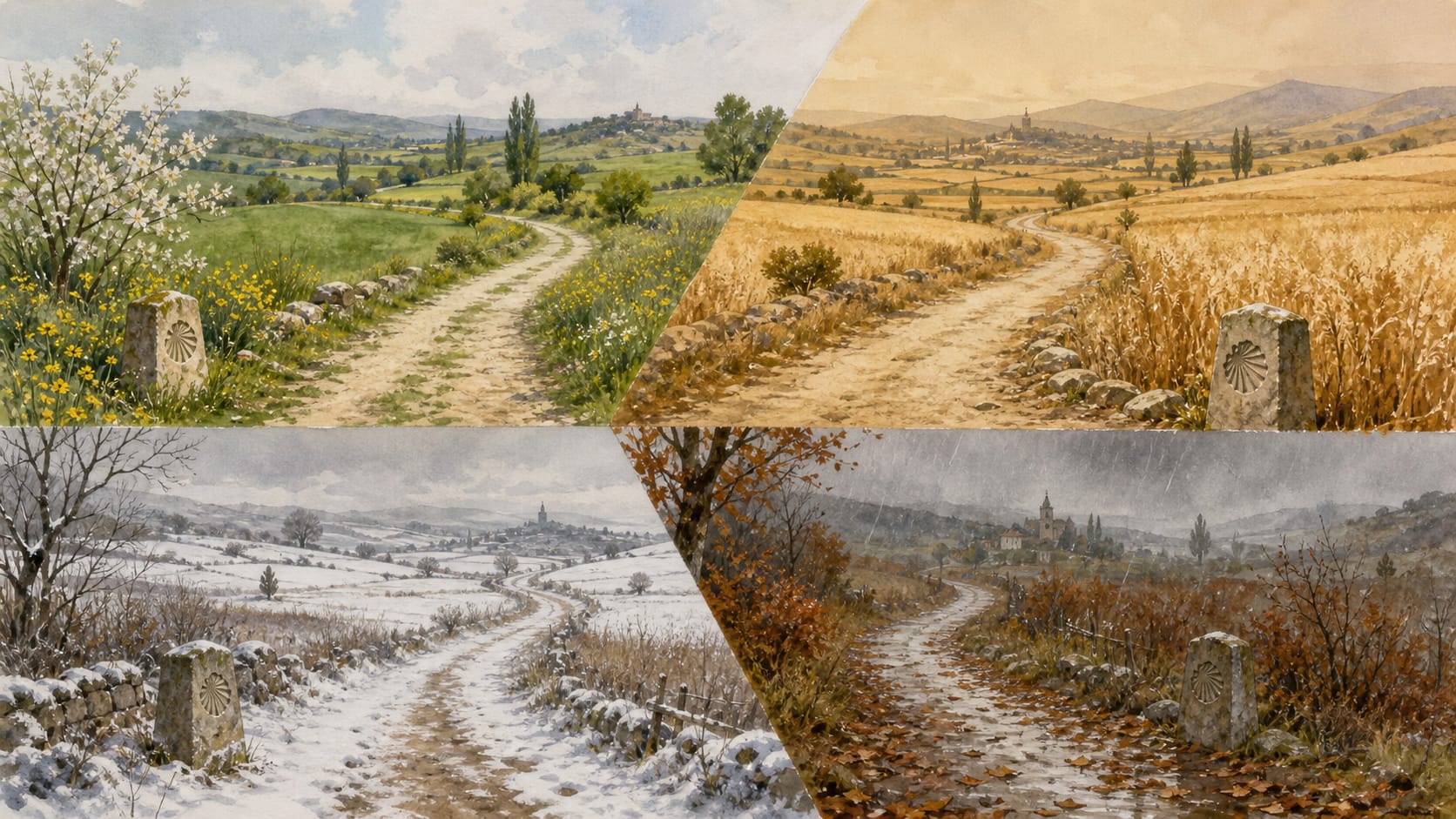
The two best windows for a first-time pilgrim on the Camino Francés are late April through mid-May and mid-September through early October. Both give you moderate days, cool but not cold nights, full pilgrim services in every village, and crowd levels you can absorb without booking the whole route ahead. Summer is the hottest and most booked stretch. Winter is walkable, but the realistic winter Camino for most first-timers is just the last 116 kilometres from Sarria.
If you have not yet locked your route, the planning pillar guide covers the full sequence (route, season, training, budget, gear) that this season-picking decision sits inside. Once you have a season, the routes and distances guide helps you pair it with the right start point.
The short answer for most first-timers
Aim for the first two weeks of May or the back half of September. May 2024 became the busiest single month on the Camino with 69,572 pilgrim arrivals, overtaking August for the first time, which tells you that the shoulder seasons are no longer a secret. They are still the right windows. The walking conditions are better than summer, the bed pressure is lower than summer, and the daylight is long enough to leave room for slow mornings.
When the short answer changes
If you cannot move your flight, the season picks itself and the planning shifts to logistics — bookings, predawn starts, gear. If you only have a week, the Sarria-to-Santiago section is open and walkable in almost any month, so you optimise for cost and crowd avoidance rather than weather. And if you are an experienced winter hiker on a quiet-Camino mission, the inverno window is real: nearly 15 percent of all Camino pilgrims now walk during the winter months.
Weather on the Camino Francés varies sharply by region, not just by month. The Pyrenees stay cold into April and turn wintry again in October. The Meseta runs hot and dry from June through August. Galicia stays milder year-round but wet, with serious rain returning by late October. Plan by region rather than by national average — the difference between Pamplona and Sarria in the same week can be 15 degrees and a change of jacket.
The Pyrenees and Navarre
The Pyrenees crossing on day one is the section most punished by date choice. Snow patches sit on the Napoleon Route into late April, and the same passes turn wintry again from mid-October. Navarre's lower valleys are walkable a few weeks earlier and a few weeks later than the high crossing, but mornings stay cold and afternoons can swing.
La Rioja and the Meseta
La Rioja is the driest, most consistent zone of the Camino Francés in September, with harvest colours in the vineyards and predictable daytime highs. The Meseta — Burgos to León — runs hottest of all. Summer pilgrims on the Meseta typically begin walking before sunrise to avoid afternoon heat that can exceed 35°C, with little shade between villages. By late September the Meseta starts cooling fast and stays comfortable until late October.
Galicia and the Atlantic shift
Galicia's oceanic climate keeps it milder than the Meseta year-round, but rainfall intensifies through autumn into winter. From mid-October onwards the rain pattern shifts: more days wet than dry, with the heavier systems landing between October 15 and October 25. Winter in Galicia is rarely freezing but reliably damp, and the short daylight matters more than the temperature.
Spring brings wildflowers, swollen rivers, snow patches on the Pyrenees, and lighter pre-Easter crowds. Autumn brings shorter days, harvest colours in La Rioja, a drier Meseta, and Galician rain near the finish. Spring rewards first-timers who trained through winter. Autumn rewards those who can leave by mid-September. Both deliver moderate days and cool nights, and both are now the two busiest shoulder windows on the route.
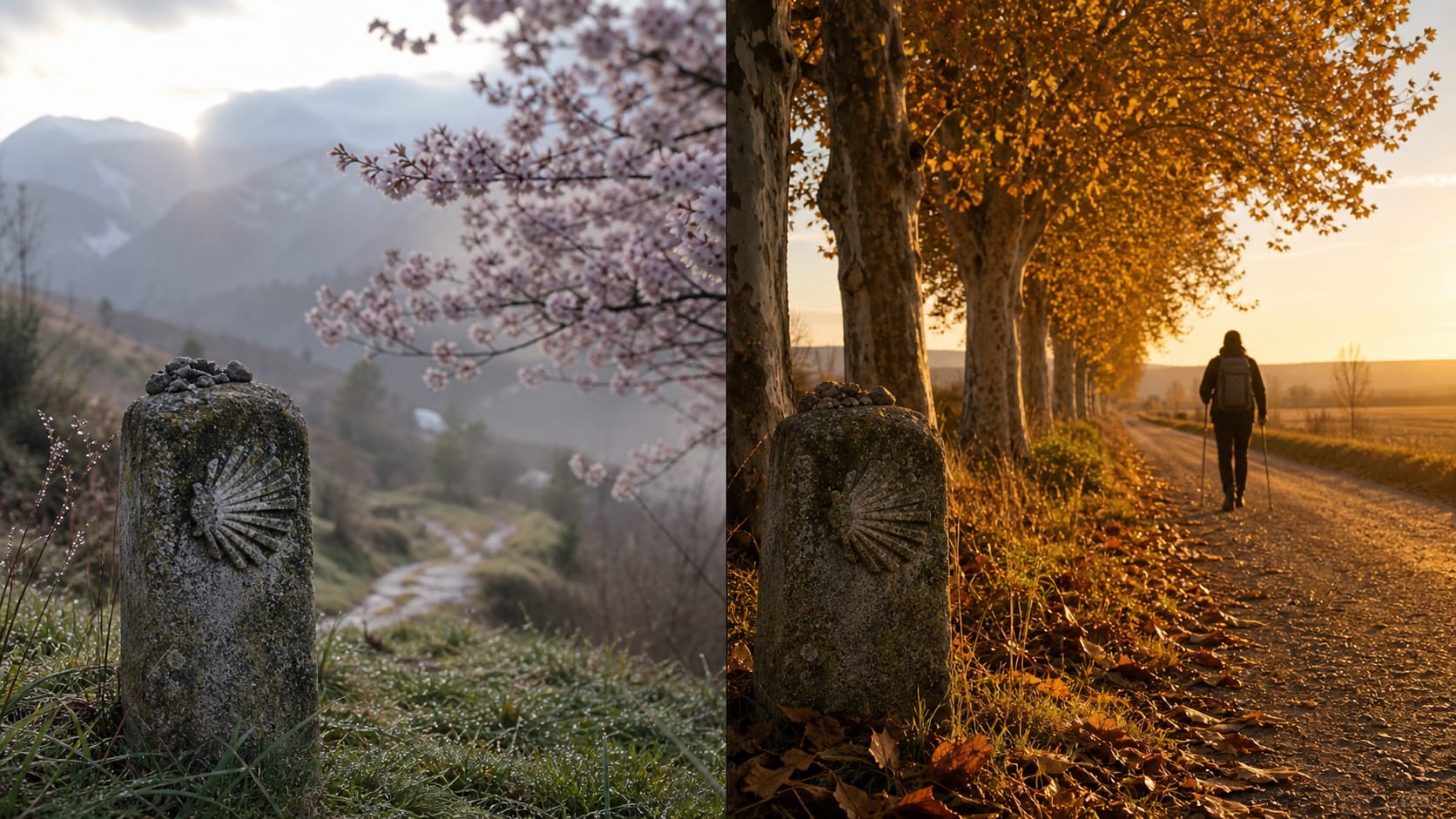
Scenery, mood, and crowd density
Spring has the louder colour — green fields, yellow broom, wildflowers under stone walls — and a quieter trail until Easter Week, when numbers jump. Autumn is grainier: vineyards in russet, fewer voices in the dorms, more shared evening meals because the dinner crowd thins down to people who chose the season on purpose. Late spring (May–June) now matches autumn (September) in crowd density on the Camino Francés, so the difference is mostly in the light, not in the bed count.
Which window fits which first-timer
If you trained through a Northern Hemisphere winter and want long days, pick the back half of April through the first half of May. If you can leave by mid-September and want drier Meseta walking, pick the second half of September. If your only window is late May or early June, that is the warmer end of spring and the Meseta will already be hot — start earlier in the day. If your only window is late October, expect Galician rain near Santiago and plan rain gear accordingly. Our rain gear comparison will be the right next read once that gear question is real.
July and August on the Meseta routinely exceed 35°C with little shade between villages. Bunk beds fill by early afternoon. Many first-timers get blisters from heat-swollen feet and end up skipping stages by bus. The crowds and heat together make summer the season with the most stage abandonments and the most reservation pressure. If you are walking in July or August, the booking-ahead decision framework becomes a daily logistics document, not a one-time read.
The predawn-start workaround
The summer Meseta is walkable, but the schedule shifts. Leave the albergue by 5:30 AM with a headlamp, finish the stage by 11 AM, eat and nap through the worst of the afternoon, and use the late afternoon for laundry and the next day's logistics. This is how Spanish summer pilgrims who actually finish do it, and it is the only honest answer to "can I walk in August."
Why summer still works for some
Summer is the easiest season to take time off work, the only season many families can move together, and the most social Camino — bigger evening meals, more shared dorms, more languages on the trail. Walked with realistic expectations and a predawn schedule, summer is fine. Walked on a shoulder-season mental model, summer breaks first-timers fast.
From late November to mid-March most Camino Francés albergues close, the Napoleon Route over the Pyrenees is officially shut, and daily logistics turn into phone calls to the next village. Sarria to Santiago remains the most reliable winter section. The Valcarlos low-altitude alternative stays open year-round, and larger towns keep hostales and pensiones running through the cold months. Northern Spain winter temperatures average 5–15°C, with Pyrenees passes dropping well below freezing.
Open routes and reliable sections
Sarria to Santiago is the most consistently open Camino Francés section through winter, thanks to lower elevation and dense services in every village. The León-to-Santiago stretch is workable for experienced winter hikers, with longer gaps between open beds. Most municipal albergues outside Galicia run on a reduced winter schedule or close entirely between roughly 24 December and 7 January for the Christmas holiday window.
Napoleon vs Valcarlos in winter
The Napoleon Route over the Pyrenees from Saint-Jean-Pied-de-Port is officially closed from 1 November to 31 March each year. The Valcarlos lower-altitude alternative stays open year-round and is the only legitimate way to cross from France into Spain in those months. A future spoke on the Pyrenees crossing will go deeper, but the headline is: in winter, the choice is not Napoleon vs Valcarlos, it is Valcarlos or nothing.
If you cannot move the flight, work backwards from the Santiago arrival window you can tolerate. Walking the standard 32-stage Camino Francés from Saint-Jean-Pied-de-Port takes the average first-timer about 33 days. A May 5 start lands around June 6 in dry warmth. A September 15 start lands around October 17 with Galician rain. June and August starts work but require predawn walking and earlier bookings to keep daily logistics calm. The budget guide covers what the extra reservations cost in practice.
| Season | Months | Pilgrim density | Weather range | Service availability | Best fits |
|---|---|---|---|---|---|
| Spring | Late Mar – May | Quiet → busy by mid-May | 5–22°C, snow risk on Pyrenees into April | Full from Easter onwards | First-timers who trained over winter, long-daylight fans |
| Summer | Jun – Aug | Highest, especially Aug | 18–38°C, Meseta heat extreme | Fully open, beds under pressure | Pilgrims tied to school holidays, social travellers, predawn walkers |
| Autumn | Sep – Oct | Busy in Sep, thinning in Oct | 8–25°C, Galician rain from mid-Oct | Full through Sep, thinning in Oct | First-timers wanting drier Meseta and fewer voices |
| Winter | Nov – mid-Mar | Lowest (~15% of annual) | -5 to 12°C, snow on passes | Sparse outside Galicia, ~24 Dec–7 Jan widely closed | Experienced winter walkers, Sarria-only Compostela seekers |
From flight date to Santiago arrival date
A useful rule of thumb: count 33 walking days plus 2 buffer days from your Saint-Jean start. Look at the Galician weather window that lands in. If the buffer pushes you past October 25, plan for hard rain on the final stages. If it pulls you before April 20, plan for snow patches above Roncesvalles.
What to shift when the flight cannot move
If the flight forces an awkward window, the easy levers are start point and route. Start in León or Ponferrada instead of SJPdP to compress a 33-day plan into 12–15 days, which sidesteps the Pyrenees timing entirely. Switch to the Camino Inglés from Ferrol if your only window is December and you still want the Compostela. Both moves preserve the certificate and trade a smaller piece of the Camino for a workable date.
Book international flights into Paris or Madrid five to seven months out for shoulder-season pricing. Reserve the Bayonne–SJPdP TER train ticket about thirty days before departure, after the Spanish operators open booking — Spanish-operator train tickets generally open for booking roughly 30 days before departure. Avoid arriving on a Sunday in winter, since the small regional line does not always run. The direct seasonal bus from Bayonne only operates roughly late March to late October.
Flight booking windows by season
For a May or September start, the sweet spot for international flight pricing into Paris or Madrid is December through February of the same year. For a July or August start, prices climb sharply after Easter, so book by March if you can. Winter flights are the cheapest of the year and the most flexible — the bottleneck moves to ground transport, not to airfare.
Train and bus quirks into SJPdP
The Bayonne–SJPdP regional line is the standard entry. Same-day connections from Paris into Bayonne work most of the year, but Sunday and holiday schedules thin out the regional leg. From late March to late October a direct seasonal bus from Bayonne to SJPdP is available, run for pilgrim demand, and bookable closer to the start date. Outside those months, plan a Saturday arrival or accept an overnight in Bayonne.
A standard 32-stage walk from SJPdP starting September 25 puts most first-timers in Sarria around October 22 and in Santiago around October 27. Galician rain typically intensifies between October 15 and October 25, so a late-September start finishes wet but not impossible. Starting after October 1 from SJPdP pushes the arrival deeper into clearly wet, shorter-daylight territory and is the date most first-timers underestimate.
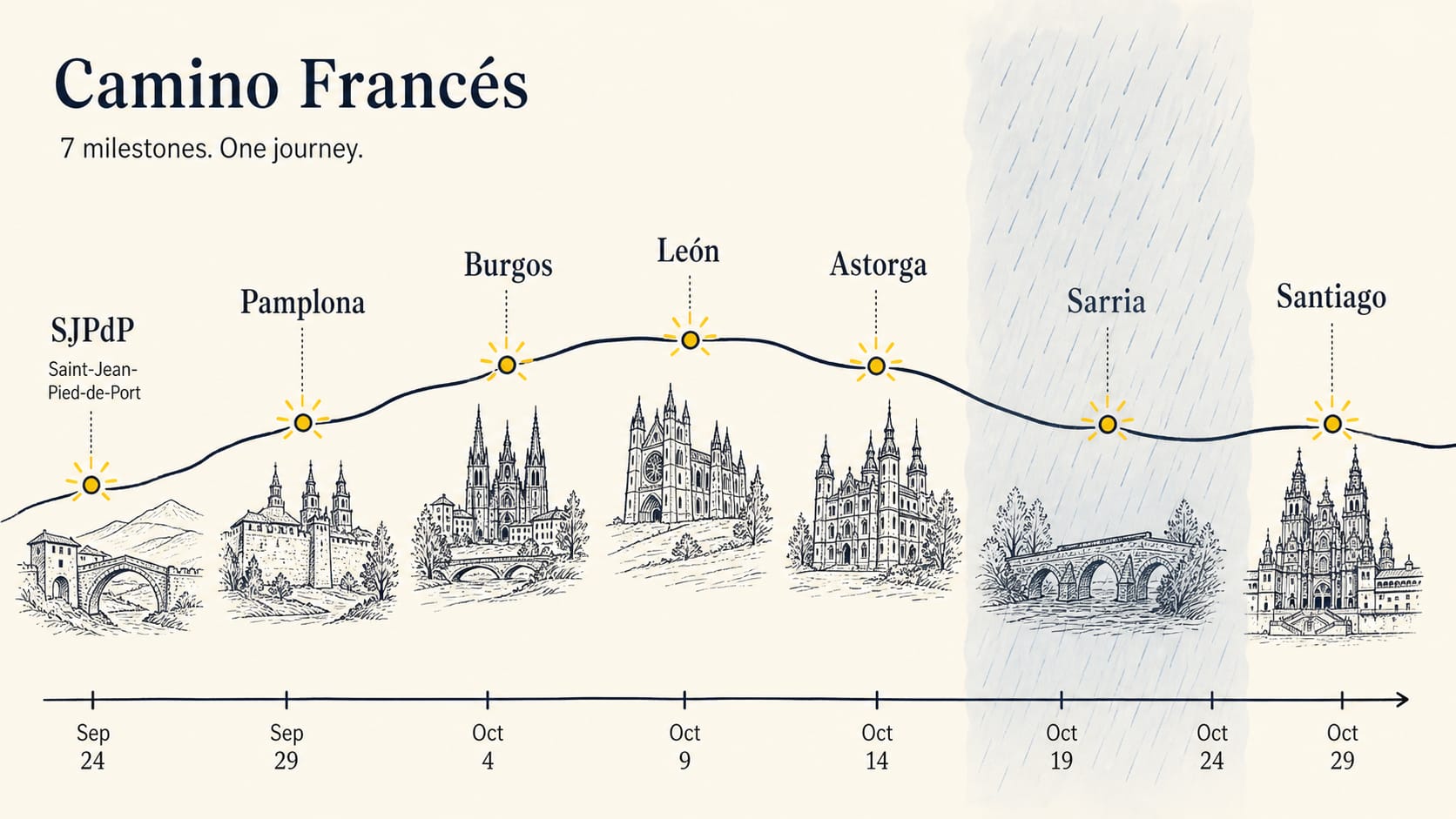
Walking 32 stages: arrival-window calculator
Start September 25 from SJPdP, finish around October 27 in Santiago. Start October 1, finish around November 2. Start October 5, finish around November 6 with shorter daylight on the final stages and a high chance of heavy rain in Galicia. The pattern is simple: each day of delay at the start shifts the Santiago arrival by exactly one day into worse Galician weather, with no compensating upside.
When the start-date math says wait
If your earliest realistic start from SJPdP is after October 5, the honest answer is to wait for spring. Or compress the trip: start in Sarria for the last 116 kilometres, finish in 5–7 days, and bank the rest of the route for a future year. The full Francés is not a one-shot decision, and sectional walks across multiple trips still earn the Compostela as long as the final 100 km is continuous on foot with two stamps a day.
Frequently asked questions
Should I walk the Camino Francés in spring or autumn as a first-time pilgrim?
Both work. Pick spring if you trained over winter, want wildflowers and longer days, and can leave by mid-May. Pick autumn if you want drier Meseta walking, smaller crowds, and harvest colours. Autumn risks Galician rain near the finish; spring risks lingering Pyrenees snow near the start.
If I start in late September, will I reach Santiago before Galicia's weather turns?
A 32-stage walk from Saint-Jean-Pied-de-Port starting September 25 reaches Santiago around October 27, which lands inside Galicia's wet shift but before the worst storms. You will get rained on but you will finish. Starting after October 1 from SJPdP pushes your arrival into clearly wet, shorter-daylight territory.
Is the Camino Francés safe to walk in February?
Yes on the Sarria-to-Santiago section, with care. The Pyrenees crossing is officially closed and genuinely dangerous. Most albergues between SJPdP and Sarria are shut, so daily logistics shift to hostales and pensiones. Most first-timers walking in February pick the last 100 km from Sarria and still receive the Compostela.
Which month has the fewest pilgrims while keeping most services open?
October. Numbers drop steadily after mid-September, summer infrastructure stays running until the end of the month, weather is still walkable across the Meseta and central plains, and bunk beds are reliably available without booking. By November, services thin sharply outside the larger towns and the calendar tips toward winter.
Do I need to book accommodations in advance for a shoulder-season Camino?
Generally no, but yes for the popular last 100 km. In April–May and September, walk-in beds in albergues stay reliable on the long-distance stages. From Sarria to Santiago, where short-distance walkers concentrate, book the night before during shoulder season and two to three nights ahead in summer. See the full booking framework for the per-stage breakdown.
External citations
Oficina de Acogida al Peregrino, Santiago de Compostela
oficinadelperegrino.com/en/statisticsOfficial monthly and annual pilgrim statistics — the canonical source for crowd density by month, route, and starting city, including the 2024 ranking that put May ahead of August for the first time.
AEMET — Agencia Estatal de Meteorología
www.aemet.esOfficial Spanish climate normals and station data for the Pyrenees, the Meseta, and Galicia. The only credible base for region-by-region temperature and rainfall claims on the Camino.
Xunta de Galicia — Camino de Santiago portal
www.caminodesantiago.galOfficial Galician route status, infrastructure availability, and seasonal alerts for the final stages into Santiago — useful for confirming which albergues stay open in winter.
La Compostela del Lector
You walked this guide to Santiago.
All 771 km, 0 stages, stamped end to end.