
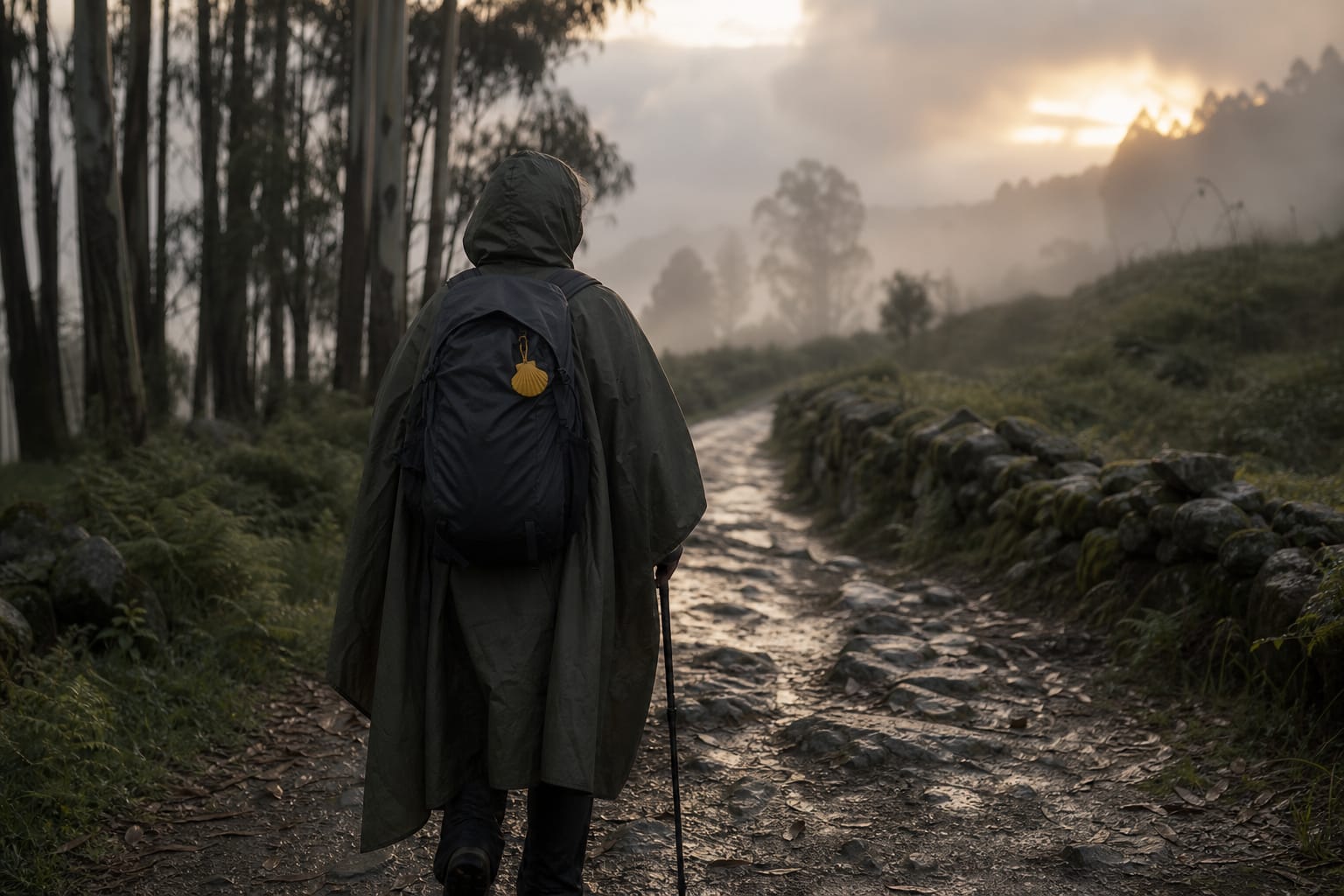
Take both, and lean on the poncho. A rated poncho is the better main shield for Galicia's frequent, sometimes all-day rain: it drapes over you and your backpack in one layer and breathes well enough that you do not cook inside it on a climb. The light packable jacket earns its place on windy ridges, at cold dawns, and in town at the end of the day. Add a pack liner so a soaked cover never matters, and you have a stay-dry system rather than a single garment you hope holds.
The reason this is a system and not a purchase is the shape of Galician weather. You are not bracing for one storm; you are managing hours of damp, day after day, on the last stretch into Santiago. A poncho alone leaves your legs bare and flaps in wind. A jacket alone traps sweat and leaves your pack needing its own cover. Carry the two together and each covers the other's weak spot. Rain gear is one line on the complete Camino packing list, and it is the line that decides whether a wet week feels like an adventure or a slog.
Ponchos win on breathability and cover your backpack in one layer; jackets seal to your body and shed wind but trap sweat and leave your pack exposed. That is the whole debate in one sentence, and how hard you sweat, how much you climb, and how strong the wind gets decide which way you should lean.
Breathability is where most first-timers get burned. A more waterproof jacket breathes less, so on a climb you end up wet from the inside even when it keeps the rain out. A poncho has a wide-open bottom hem, so warm, damp air escapes as you walk. That same open hem is its weakness: a gust gets under it, lifts it, and drives rain onto your legs. On the Camino Francés, where the wettest days come on the mostly sheltered final stages through Galicia, that trade usually favours the poncho. On an exposed coastal route in a gale, the jacket wins.
Backpack coverage is the quiet advantage that decides a lot of buying. A pack-length poncho covers your bag as part of covering you, no separate cover to buy or lose. A jacket stops at your waist, so your pack rides naked unless you add a cover, and a cover fails first in wind-driven rain and leaves the back panel wet against your spine. Weight and packability roughly cancel out: a rated poncho and a light hard-shell both land in a few hundred grams, so pick by how you walk, not by the scale.
It soaks you slowly, not dramatically. Galicia sits at the wet end of Spain, and the rain here is frequent rather than violent: drizzle that turns paths to mud, a eucalyptus canopy that keeps dripping long after the cloud has passed, and a damp cold that creeps in even in July. Staying dry is about managing hours of wet, not surviving one downpour, which is why breathability and pack coverage matter more here than a headline waterproof rating.
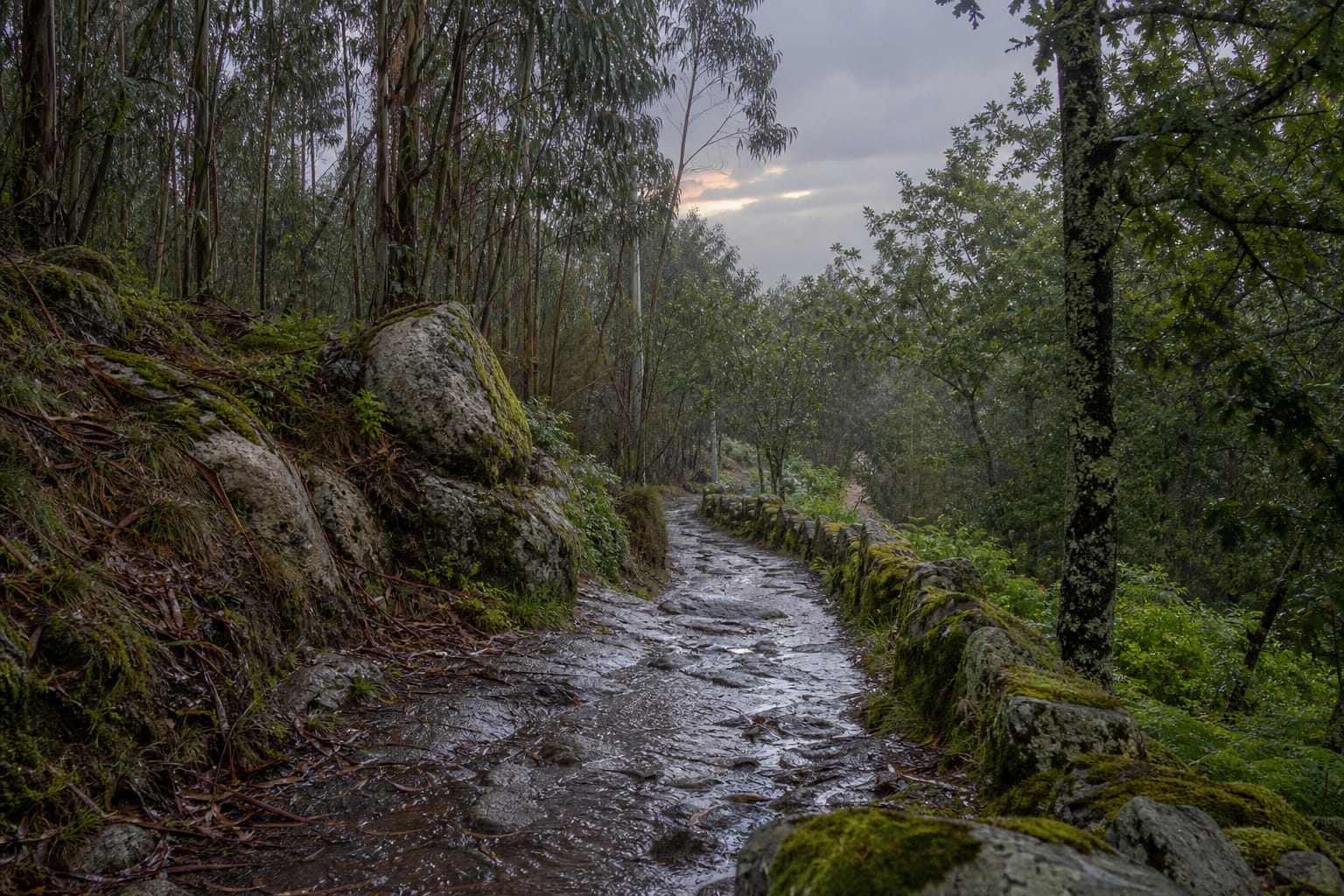
The local reputation is earned. Galicia's annual rainfall rivals some of the wettest cities in Europe, on a par with Bergen in Norway, and there is a running joke that the region has more than seventy words for rain. Much of it falls in short bursts rather than steady downpours, though genuine all-day rain still turns up, and the final 100 km from Sarria into Santiago runs through some of the wettest terrain on the whole route. Warm rain in high summer is the easy version; a cold, wind-driven day in October is the one your gear is really for.
Santiago records around 140 rain days a year, with the heaviest odds from October through April and the driest window in July and August. Even peak-summer walkers meet rain, so no month is a safe bet against it. Plan your gear for the wettest month you will actually walk, not the average across the year.
The pattern splits cleanly. Autumn and winter carry the highest rain probability, with frequent rain and a cold that makes staying dry a comfort-and-safety issue rather than a nuisance. May, June, and September are milder but still damp. July and August are the driest yet never rain-free, so a summer pilgrim who packs nothing waterproof is gambling. Route matters too: the coastal Camino del Norte and the Portugués catch more rain than the inland Francés, and the northern routes like the Norte and Primitivo see far higher rain probability than the southern variants.
Treat staying dry as a system with four parts, not one garment. Shield your body with the poncho or jacket, line your pack so the contents stay dry no matter what the outside does, protect your feet, and seal one dry set of clothes for the albergue each night. Get the pack right and a soaked shell stops being a problem.
Keeping your pack contents dry is the step competitors skip, and it is the most important one. Do not trust the pack cover alone; it fails in wind-driven rain and leaves the back panel wet. Line the inside of your pack with a waterproof liner or a simple bin bag, then pack your sleeping bag and dry clothes in separate dry bags inside that. Now the outside of the pack can soak through and your dry set stays dry.
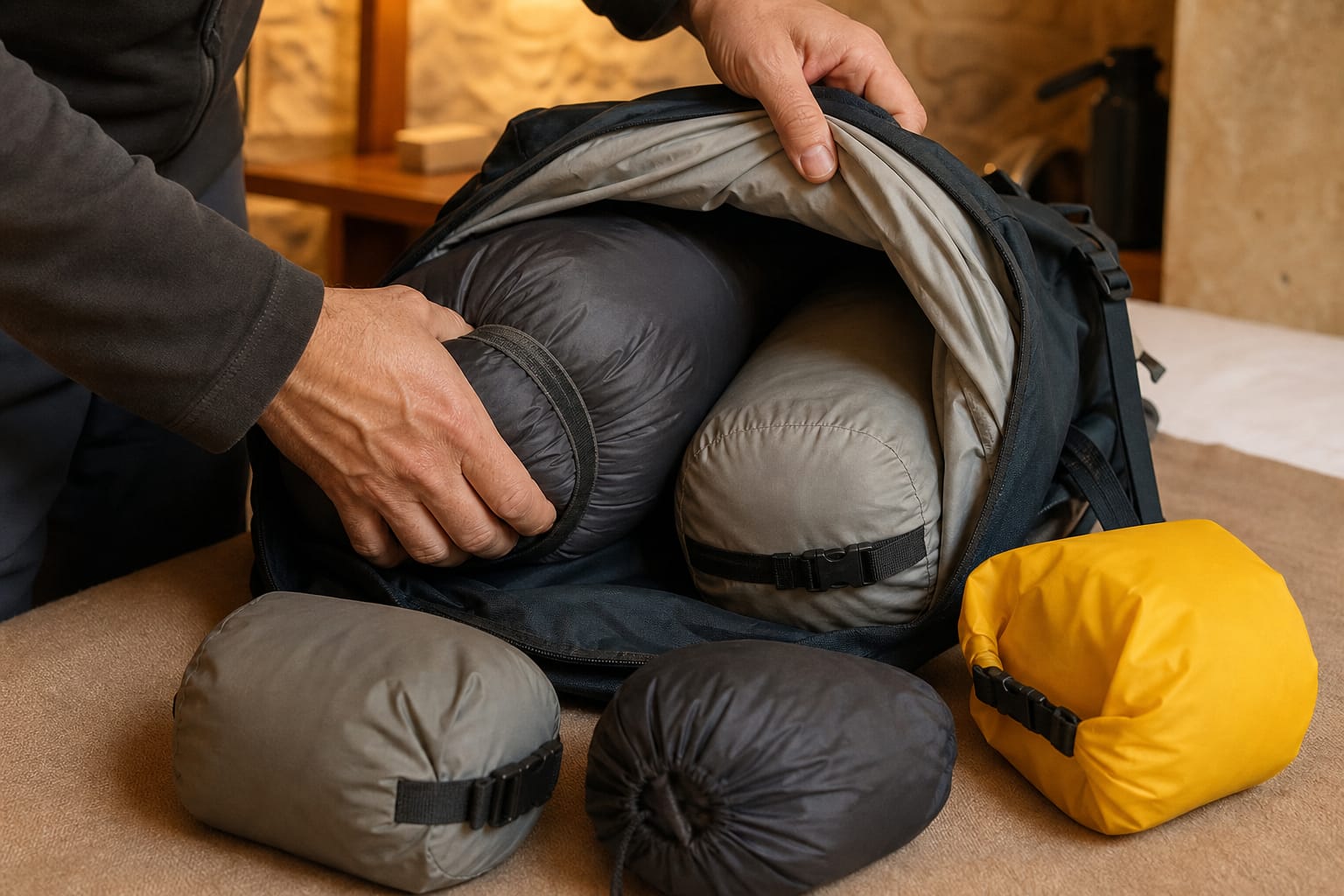
Feet and overnight drying finish the system. Wet feet are the other half of rain misery, and the shoe choice that dries fastest is covered in hiking boots vs trail runners for the Camino; the short version is that mesh trail runners drain and dry overnight while soaked boots take days. For drying gear in an albergue, wring hard, roll each piece in a dry towel and press, then hang near airflow rather than against a cold wall. A rain shell and a poncho both drip-dry fast; the thing that will not dry by morning is anything cotton, which is one more reason it does not belong in your pack.
For most summer Camino Francés walkers, no. Legs dry fast once you are moving, and rain pants trap so much heat that many pilgrims sweat more inside them than they would have got wet without them. In warm rain, plenty of walkers simply let their legs get wet and dry off as they go. Pack rain protection for your lower half only if you walk shoulder season, take the wetter northern routes, or feel the cold quickly.
When you do want lower-body cover, a rain skirt or kilt is the lighter answer. A rain kilt weighs roughly 50 to 80 grams against 200 to 385 grams for a pair of rain pants, and it vents freely so you do not steam inside it. If you go for full rain pants instead, ventilation zips are the single feature that most reduces overheating, so choose a pair that has them. Either way, a poncho already sheds most of the rain that would hit your thighs, so the lower-body layer is a shoulder-season and northern-route addition, not a summer default.
There is no single right answer, so match the spec to your budget and route. A rated pack-covering poncho runs roughly 200 to 500 grams; a packable hard-shell adds wind protection at a higher price; a rain skirt weighs under 90 grams and covers the gap a poncho leaves. Aim for a minimum 5,000 mm water column rating for light rain and 10,000 to 15,000 mm for the sustained rain you will meet in Galicia.
| Option | Typical weight | Water column rating | Pack coverage | Wind performance | Best for |
|---|---|---|---|---|---|
| Rated hiking poncho | 200 to 500 g | 5,000 to 10,000 mm | Full, covers the pack | Poor in strong gusts | Sustained Galician rain, summer walkers who run hot |
| Packable hard-shell jacket | 200 to 400 g | 10,000 to 20,000 mm | None, needs a cover | Sheds wind well | Wind, cold mornings, town evenings, exposed routes |
| Poncho plus jacket | 450 to 700 g | Combined | Full via the poncho | Jacket handles gusts | Shoulder season and rain-prone northern routes |
| Rain skirt or kilt | Under 90 g | 5,000 mm and up | Lower body only | Vents freely | Adding leg cover without the heat of rain pants |
A word on cost per day. A thin disposable poncho tears at the seams and shreds in wind within days, so it is false economy for anything longer than a wet afternoon. A quality rated poncho can last multiple Caminos, which spreads its price across hundreds of walking days and makes it the cheaper choice in the end. Skip the reproofing sprays as a fix, too: DWR spray gives minimal lasting benefit compared with the garment's base rating, so buy the rating you need rather than hoping to spray your way to it.
Choose for the wettest, windiest day you expect, not the average one. Summer Francés walkers who run hot do well with a poncho alone and a pack liner. Shoulder-season pilgrims, anyone on the wetter northern routes, and anyone who feels the cold fast are better with the jacket plus a poncho or a rain skirt. This matches how most pilgrims actually pack: in one hiker survey, 88 percent named a rain jacket as their primary rain gear, but a Camino through Galicia is exactly the case where adding a pack-covering poncho pays off.
The rain shell also only works over the right layers underneath, which is why it sits inside the wider Camino layering system rather than standing alone. A shell keeps the rain off; your warmth still comes from the base and mid layers beneath it. Get the layers, the shell, and the pack liner working together and a wet week into Santiago becomes a comfortable one.
Frequently asked questions
Do I need rain pants or a rain skirt on the Camino, or just a poncho?
On a summer Camino Francés, a poncho alone is usually enough, because bare legs dry quickly and rain pants overheat. For shoulder season, the wetter northern routes, or if you run cold, add a light rain skirt (under 90 g) or ventilated rain pants for the lower legs a poncho misses.
How rainy is Galicia month by month on the Camino de Santiago?
Santiago sees roughly 140 rain days a year. October through April are the wettest, with frequent rain and cold; May, June, and September are milder but still damp; July and August are the driest yet never rain-free. Whatever month you walk, pack for rain you will probably meet at least once.
Can I just use a hiking umbrella instead of a poncho or jacket?
An umbrella works well for steady, windless drizzle and keeps you cooler than any shell, which is why many pilgrims carry one. It fails in Galician wind and leaves your pack and legs exposed, so treat it as a third tool alongside a poncho or jacket, not a replacement for either.
How do I keep my backpack and its contents dry in heavy rain?
Do not rely on the pack cover alone; it fails in wind-driven rain and leaves the back panel wet. Line the inside of your pack with a waterproof liner or a bin bag, then pack your sleeping bag and dry clothes in separate dry bags. Your contents stay dry even if the pack soaks through.
Is a cheap disposable poncho good enough for the Camino?
For a single wet afternoon, yes, but thin disposable ponchos tear at the seams and shred in wind within days. A rated reusable poncho lasts multiple Caminos and covers your pack, so it costs less per walking day and performs far better in sustained Galician rain.
Should I carry both a poncho and a rain jacket?
Carrying both adds a few hundred grams but gives real flexibility: the poncho for sustained rain and pack coverage, the jacket for wind, cold, and town evenings. Most pilgrims on rain-prone routes find the redundancy worth the weight; ultralight summer walkers can usually drop one.
External citations
AEMET (Agencia Estatal de Meteorología) — climate normals for Santiago de Compostela
www.aemet.es/en/serviciosclimaticos/datosclimatologicosThe official Spanish state weather service grounds the roughly 140 rain-day count and the wettest-month figures with authoritative station data.
MeteoGalicia — regional precipitation records
www.meteogalicia.gal/observacion/rede/redeIndex.actionThe Galician meteorological service publishes station-level, month-by-month rainfall that supports the route-specific figures behind the Francés, Norte, and Portugués comparison.
ISO 811 — hydrostatic head (water column) test standard
www.iso.org/standard/5292.htmlDefines how the millimetre water-column ratings are measured, so a poncho and a jacket can be compared on a like-for-like waterproofing basis.
La Compostela del Lector
You walked this guide to Santiago.
All 771 km, 0 stages, stamped end to end.