

About 530,000 pilgrims collected a Compostela in 2025. Every year since 2022 has set a new record, and 2025 came in roughly six percent above 2024. So yes, the Camino is growing, and it has been growing almost without interruption for forty years.
That number needs one qualification. It is not a count of people who walked the Camino. It counts people who walked far enough, finished in Santiago de Compostela, queued at the Pilgrim's Office and asked for a certificate. To qualify you need the last 100 kilometres on foot, or the last 200 by bicycle, with two stamps a day in your credential. Everyone else is invisible to it, including people who walked six weeks and skipped the queue.
So the honest version is this. Around 530,000 is the number of certificates. The number of walkers is larger, and nobody knows by how much. The rest of this page works through what the count does measure, well enough to plan against.
Every figure here was read from the Pilgrim's Office on 2 September 2026. That date matters, and the next section explains why.
Look up the 2025 total and you will not find one number. You will find at least seven, and all of them have been published in good faith.
| Published 2025 total | Where it appears |
|---|---|
| 530,723 | The office's own statistics dashboard, read 2 September 2026 |
| 530,730 | Spanish Federation of Camino associations, January 2026 |
| 530,772 | Wikipedia |
| 530,882 | Spanish press, attributed to the office |
| 530,919 | American Pilgrims on the Camino |
| 530,987 | Most English-language coverage |
| 530,992 | Smaller Spanish outlets |
The spread is 269 pilgrims, five hundredths of one percent. It will not change a decision you make. It matters because of what causes it.
The Pilgrim's Office has not published a full annual report since 2019. Everything from 2020 onward lives in an interactive dashboard on its statistics page, with no downloadable table and no export. That dashboard is live, and the office keeps revising it for months after a year closes. Every figure in the table above is a snapshot of the same dashboard taken on a different date, and the office has been revising 2025 steadily downward. The same thing happens to every sub-figure: Sarria's 2025 count has been published as 162,076 and as 162,040, and reads 161,922 today.
The office also disagrees with itself across channels. Its historical PDF and its dashboard differ on 2010 by 568 pilgrims. For 2020 and 2021 the disagreement is not a rounding matter at all: the dashboard shows 41,217 and 131,117, while almost every published source carries 54,144 and 178,912. That is a gap of a quarter. We could not reconcile it, and we are not going to pretend otherwise.
The practical rule, and the one this page follows: pick one source, name the date you read it, and do not quote a total to the exact pilgrim as though it were fixed. Anyone publishing a single unqualified figure for 2025 is showing false precision.
The office's registry begins in the mid-eighties with a few hundred pilgrims a year. It reaches about 530,000 in 2025. The line is not a smooth curve, and its shape tells you more than any single year.
A note on where the chart starts. The office records 1985 and 1986 as one combined entry of 2,491 pilgrims. The familiar split of 690 in 1985 and 1,801 in 1986 comes from a later academic reconstruction, not from the registry, and American Pilgrims instead labels the whole 2,491 as 1986. Both cannot be right, so the chart starts at 1987, the first year with an unambiguous official figure.
Three things break the line.
Holy Years. A Holy Year, or Año Santo Jacobeo, falls whenever 25 July, the feast of Saint James, lands on a Sunday. It brings extra pilgrimages, church-organised groups and coach travel. The effect is unmistakable: 1993 jumped to 99,436 from 9,764 the year before, then fell back to 15,863 in 1994. The same spike and drop repeats in 1999, 2004 and 2010. Comparing a Holy Year against the year on either side measures the calendar, not the trend.
2020. Arrivals collapsed by roughly 88 percent against the 347,578 recorded in 2019.
The overshoot. The Holy Year of 2021 was extended into 2022 because the pandemic had swallowed most of it, so both years count as Holy Years. The recovery ran far past the old peak, reaching 437,589 in 2022, more than a quarter above the pre-pandemic record. It has climbed every year since.
Two milestones are worth knowing. 2017 was the first year above 300,000. 2022 was the first above 400,000. Growth is real but less dramatic than it is usually described: between 2015 and 2019 the year-on-year increases ran between about six and eight percent, not the double digits many summaries claim, and the 2022 and 2023 jumps are pandemic rebound rather than new demand.
The next Holy Year is 2027. Expect the line to spike, expect the coverage to call it a surge, and remember what 1994 looked like.
The Camino Francés is still the biggest route by a wide margin. Its grip on the network, though, is loosening fast.
In 2016 the Francés carried 63.4 percent of all arrivals. In 2025 it carried 45.6 percent. That is eighteen points of share in nine years. The route did not shrink: it grew from 176,075 to 241,999 pilgrims. It simply grew more slowly than everything around it.
The Coastal Portuguese is where most of that share went. It ran at 0.94 percent of arrivals in 2016 and 16.9 percent in 2025, a thirty-four-fold rise in absolute numbers, and it was still growing at almost twenty percent year on year in 2025 while the Francés managed two.
| Route | Pilgrims (2025) | Share | Change vs 2024 | Share in 2016 | Practical crowding note |
|---|---|---|---|---|---|
| Camino Francés | 241,999 | 45.6% | +2.4% | 63.4% | Quiet for weeks, then heavy from Sarria on |
| Portugués Central | 100,804 | 19.0% | +5.6% | 17.8% | Busy from Tui; calm south of Porto |
| Portugués Coastal | 89,503 | 16.9% | +19.7% | 0.9% | Fastest-growing route; beds tight in summer |
| Camino Inglés | 30,201 | 5.7% | +7.6% | 3.5% | Short and popular; few albergues |
| Camino Primitivo | 27,867 | 5.3% | +13.9% | 4.4% | Hard terrain keeps numbers down |
| Camino del Norte | 21,481 | 4.0% | +0.3% | 6.2% | Spread out; coastal towns fill in August |
| Vía de la Plata | 8,833 | 1.7% | −2.2% | 3.3% | Genuinely empty for long stretches |
| Camino de Invierno | 2,758 | 0.5% | −3.8% | 0.1% | Almost no through-traffic |
| Muxía–Finisterre | 2,381 | 0.4% | +5.5% | 0.3% | Walked after Santiago, not to it |
Two routes are losing ground in both share and absolute numbers: the Vía de la Plata and the Camino de Invierno. If you want an empty trail, that is where the data points.
If you are choosing your Camino route, read this table as a crowding forecast rather than a popularity contest. The Francés is busy in one specific place. The Portuguese routes are busy in a different one.
September is now the peak month, ahead of both May and August.
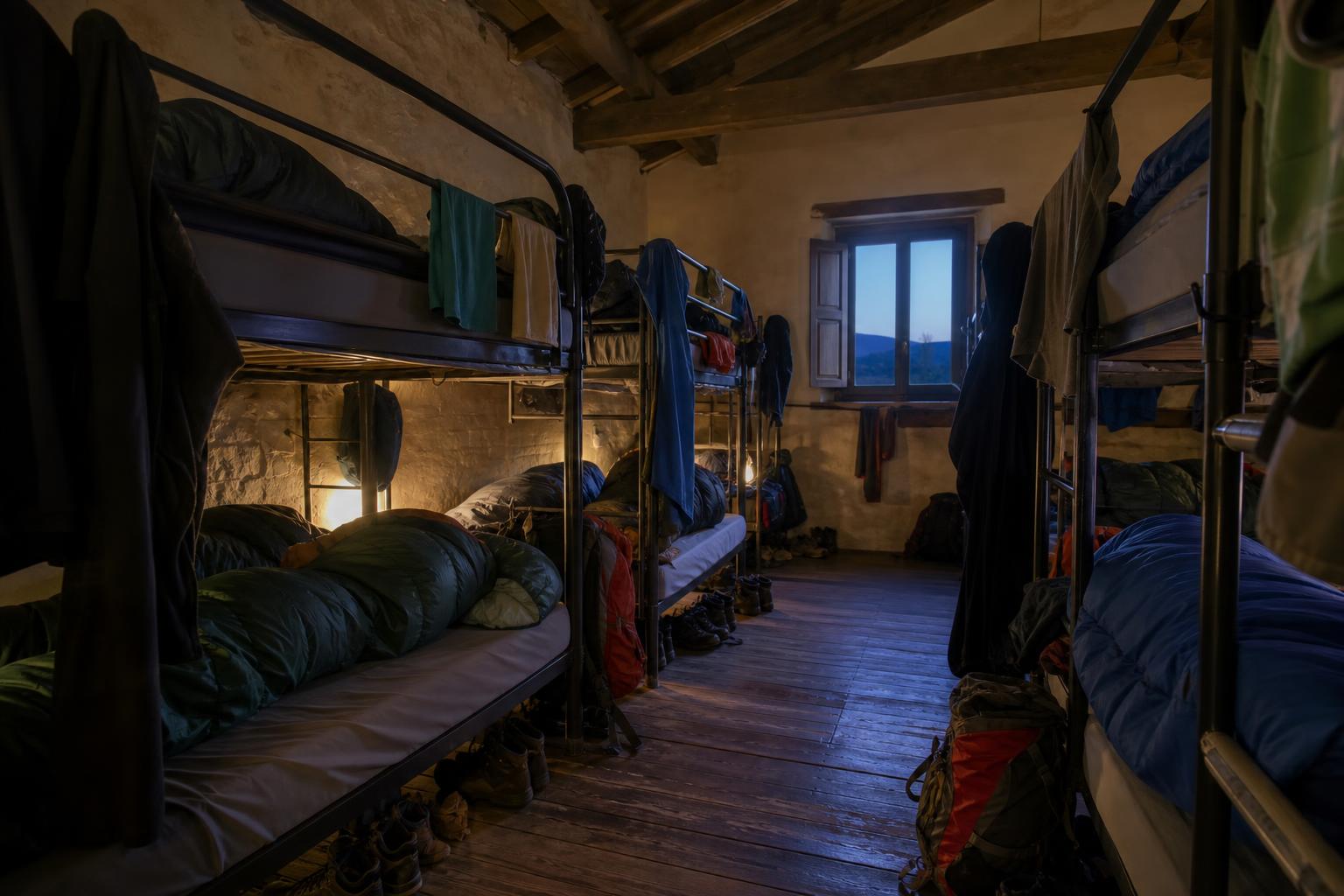
The old advice was to walk the shoulder season for a quieter trail. Enough people took it that the shoulders became the peak. September carried 81,535 arrivals in 2025, May 78,650 and August 77,095. The top three months are within 4,500 pilgrims of each other, so in practice there is no longer a quiet month inside the main season at all.
May through October accounts for 83 percent of the year. The remaining six months share the other seventeen, and they are not evenly split either: January, February and December each carry well under one percent. The trade-off in winter is real, with short daylight, genuine cold on the Pyrenees and the Meseta, and a large share of albergues closed. Among comfortable walking months, late April and early October are the two that still sit meaningfully below the peaks.
One claim to retire while we are here. You will read that May 2024 was the busiest month ever recorded, at 69,572 pilgrims. The office's own table puts May 2024 at 72,708, and it was only the third busiest month of its own year, behind August and September. We could not source 69,572 anywhere.
If you want the seasonal decision rather than the arithmetic, when to walk the Camino works through the weather and services trade-off month by month.
The single most useful statistic on this page is not the annual total. It is this one: 161,922 pilgrims started in Sarria in 2025, which is 30.5 percent of everybody.
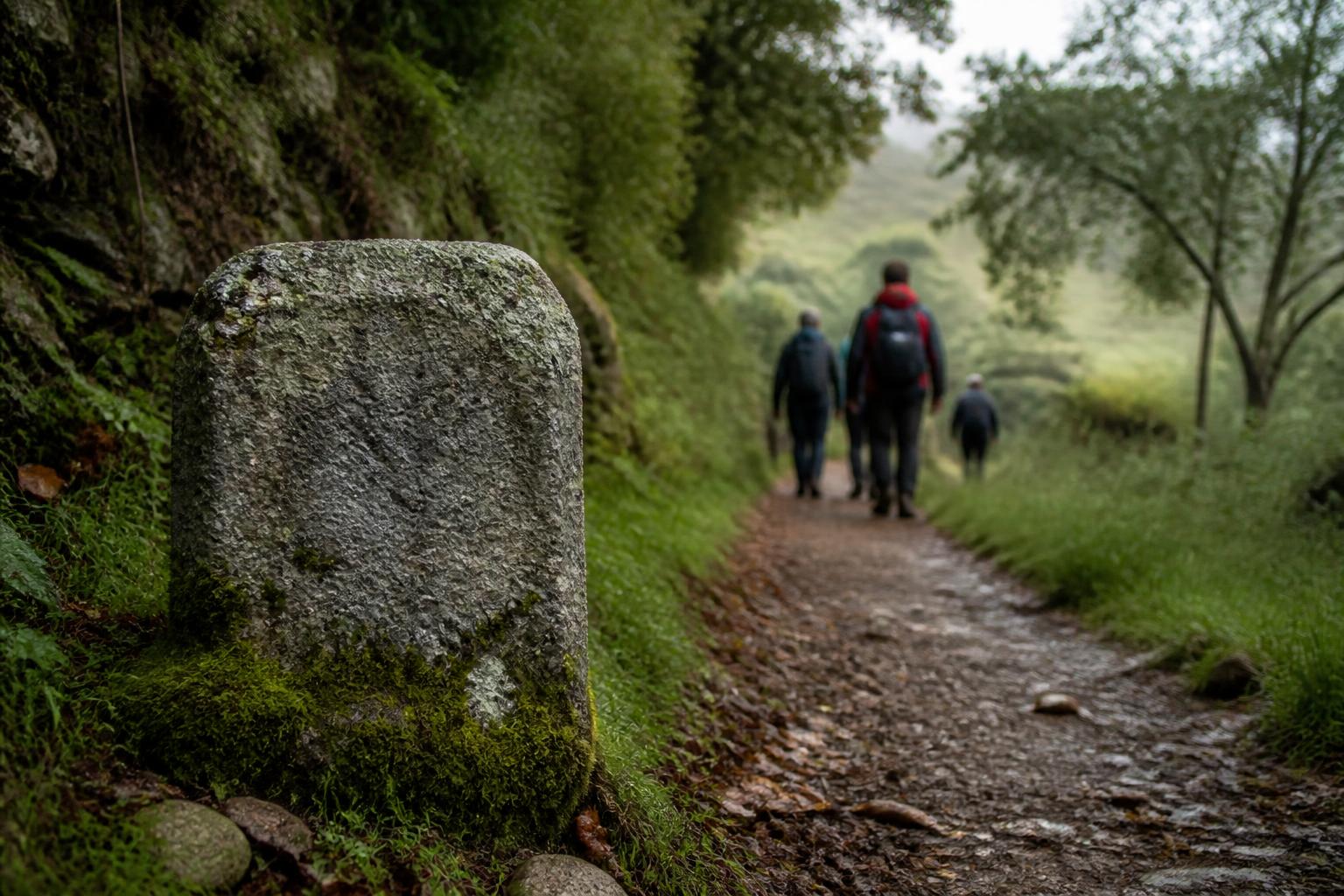
Sarria is the closest convenient town to the 100-kilometre line on the Francés. Start there and you qualify with about five days of walking. Every other large starting point follows the same logic.
| Starting point | Pilgrims (2025) | Share | Approx. distance |
|---|---|---|---|
| Sarria | 161,922 | 30.5% | 111 km |
| Tui | 41,643 | 7.9% | 115 km |
| Saint-Jean-Pied-de-Port | 30,338 | 5.7% | 771 km |
| Ferrol | 28,883 | 5.4% | 118 km |
| Vigo | 18,678 | 3.5% | 100 km |
| Valença do Minho | 18,121 | 3.4% | 118 km |
| Oviedo | 15,353 | 2.9% | 313 km |
| León | 7,725 | 1.5% | 301 km |
| O Cebreiro | 6,267 | 1.2% | 152 km |
Sarria, Tui, Ferrol, Vigo and Valença are all within 120 kilometres of Santiago. Together they account for 269,247 pilgrims, or 50.7 percent of the total. Just over half of everyone who reaches Santiago started inside the final week.
That concentration, not the headline total, is what makes the Camino feel crowded. Roughly three in ten people on the entire network are walking the same five days of the same route.
The shift over time is just as striking. In 2016 Sarria supplied 25.8 percent of pilgrims and Saint-Jean-Pied-de-Port supplied 12.1 percent. Sarria has since gained five points while Saint-Jean has more than halved. The Camino is not only getting busier, it is getting shorter.
The corollary is the useful part. If you walk a full route, most of your days are quiet. The Meseta and the first week out of Saint-Jean carry a small fraction of the traffic the Sarria stretch does. You will walk for weeks in near solitude and then join a river of people for the last five days. Knowing that in advance is the difference between a nasty surprise and a plan, which is also why booking ahead on the busy stretches matters far more in the final hundred kilometres than anywhere else.
Spain supplied about 43 percent of pilgrims in 2025. Foreign pilgrims made up the other 57 percent, and 2025 was the third year running in which they outnumbered Spaniards.
The largest foreign contingents were the United States at roughly 44,000, then Italy at about 26,700, Germany at about 24,400 and Portugal at about 22,800. Between January and July 2025 the office recorded pilgrims from 183 countries and territories, a figure often rounded up to "nearly 200" in coverage.
Korean pilgrims on the Camino de Santiago. South Korea recorded 7,481 pilgrims in 2025, about 1.4 percent of the total and down roughly five percent on the previous year. That still makes it comfortably the largest non-Western source country, ahead of every Latin American nation and most of Europe. Korea's presence is genuinely disproportionate to its population, and it traces to a wave of Korean-language books and television coverage in the 2000s. You will see a figure of around 14,800 quoted on some English-language sites. It is not supported by the office's own tables.
Japanese pilgrims. Japan recorded 1,648 pilgrims in 2025, about 0.31 percent. This is the number most English-language roundups omit entirely. The figure you will occasionally find quoted, 1,197 at 0.46 percent, is from 2015 and circulates undated, which is how a decade-old number ends up presented as current.
Women are a consistent small majority. In 2025 the split was 53.45 percent women to 46.55 percent men, and it has sat close to that for years.
About nine in ten pilgrims arrive on foot. Roughly four percent come by bicycle, and the remainder, on horseback, by wheelchair or by boat on the Ría de Arousa, together make up well under one percent.
On age, be careful with what you read elsewhere. The Pilgrim's Office changed its age bands, and the widely repeated claim that pilgrims aged 30 to 60 make up about 61 percent uses a scheme that has been retired. The current bands are under 18, 18 to 45, 46 to 65, and over 65. The 18-to-45 group is the largest, at a little under 40 percent, with the 46-to-65 group close behind. The broad picture holds even where the old number does not: this is a middle-aged crowd more than a young one, and the over-65 share is far from trivial.
Age also varies by starting point in a way the national figures hide. The short qualifying routes from Sarria and Tui skew older and more group-organised. The Primitivo and the Norte skew younger.
This is the part most statistics pages leave out, and it is worth more than another table.
Whether you will be among first-timers. The Pilgrim's Office arrival form does not ask whether you have walked before. There is no official first-timer percentage and there never has been. A 2025 survey of more than 5,000 people is often cited to fill the gap, but it cannot: the respondents came from a tour operator's own customer list, and 99 percent of them had already walked a Camino. A sample of past customers cannot tell you what share of pilgrims are new. Any site quoting a firm first-timer percentage is over-claiming.
How many people actually walk. The Xunta de Galicia runs passive mobile-signal sensors on Galician sections of the trail. At a tourism forum in November 2025, the director of the Galician tourism agency, Xosé Manuel Merelles, said that about 200,000 walkers should be added to the roughly half a million who collected a Compostela in 2024. That is where the widely repeated "40 percent undercount" comes from. Two caveats travel badly and usually get dropped: the sensors are in Galicia only, and the estimate covered the Francés, Primitivo and Norte rather than the whole network. In the same address Merelles also said there are 1.7 walkers for every certificate, which implies a seventy percent gap rather than forty. The Xunta's own figures do not agree with each other, so treat "substantially more than the certificate count" as the finding and any specific multiplier as contested.
You will also see a claim that 1.5 million people walk the Camino each year, sometimes credited to the Pilgrim's Office. The office publishes no such figure. The claim traces to a Spanish news item asserting that only a third of walkers collect a Compostela, attributed to unnamed experts, and it contradicts the Xunta's own sensor-based ratio, which would put the total nearer 900,000. We are not repeating it as fact.
How many people start and stop. The pilgrim office in Saint-Jean-Pied-de-Port logged around 54,100 people in 2025. Santiago recorded 30,338 pilgrims declaring Saint-Jean as their starting point. It is tempting to read the difference as 23,000 people quitting, and it is often reported that way, but the two offices are not counting the same thing. Saint-Jean counts visitors to a welcome desk. Santiago counts a self-declared starting point among people who finished and asked for a certificate. The gap contains people who stopped, people who finished without collecting a Compostela, people who declared a different start, and people who visited the desk and never walked. It shows that the two counts measure different populations. It does not measure a dropout rate.
Everything about the experience. No official data exists on how many pilgrims walk alone, how many quit and come back another year, or how many finish. The form does not ask.
Three decisions the data actually settles.
Pick your month against the real peak, not the old one. September, May and August are now within a few thousand pilgrims of each other. If you want a genuine balance of decent weather and fewer people, late April and early October sit just outside all three and still have services open. Do not choose September because you read it is the quiet alternative to August. That stopped being true two years ago.
Start earlier than Sarria if you want space. Three in ten pilgrims begin in one town, and half begin within 120 kilometres of the cathedral. Starting even a few days further back, in Ponferrada or O Cebreiro, drops you into a fraction of that density for most of your walk, and you still finish with a Compostela. If your schedule only allows the last hundred kilometres, Ferrol and Vigo are far quieter than Sarria at the same qualifying distance.
Book ahead for the last week and relax about the rest. The crowding is concentrated almost entirely in the final stretch and the peak months. On the Meseta in June, or anywhere on the Vía de la Plata, walking in and finding a bed is still normal. From Sarria in September it is not. Plan the two halves of your walk differently, because the data says they are different trips.
The honest summary of every number here: the Camino is busier than it has ever been, the growth is real, and almost none of the crowding sits where a first-time pilgrim expects it.
How many Korean and Japanese pilgrims walk the Camino de Santiago?
South Korea recorded 7,481 pilgrims in 2025, about 1.4 percent of the total and down roughly five percent year on year, which keeps it the largest non-Western source country by a clear margin. Japan recorded 1,648, about 0.31 percent. The Japanese figure is the one most English-language roundups omit; where it does appear it is usually 1,197, which is a 2015 number circulating without a date. Both countries appear only in the Pilgrim's Office nationality tables, which since 2020 have been published through an interactive dashboard with no downloadable export.
What percentage of Camino pilgrims are walking it for the first time?
Nobody knows, and any site quoting a firm number is over-claiming. The Pilgrim's Office arrival form does not ask whether you have walked before, so no official figure exists. The 2025 survey most often cited cannot fill the gap either: its respondents came from a tour operator's own customer list and 99 percent of them had already walked at least one Camino, so it describes returning customers rather than the pilgrim population. Treat the first-timer share as genuinely unmeasured.
Is the Camino too crowded now?
It depends almost entirely on where you start and when. Sarria, Tui, Ferrol, Vigo and Valença together supply 50.7 percent of all pilgrims, and Sarria alone supplies 30.5 percent, so the last hundred kilometres carry crowd levels the Meseta or the first week out of Saint-Jean never see. Walking a full route means most of your days are quiet and only the last five are busy. Walking only the qualifying stretch in September means every day is busy.
Which month has the fewest pilgrims on the Camino?
January and February are the emptiest by a wide margin, with December close behind. Each carries well under one percent of the year's arrivals, against about 15 percent for September. The trade-off is cold, short daylight and a large share of albergues closed for the season. Among genuinely comfortable walking months, late April and early October now sit below the May, September and August peaks, which are themselves within a few thousand pilgrims of one another.
Why do pilgrim numbers jump in a Holy Year, and when is the next one?
A Holy Year, or Año Santo Jacobeo, falls whenever 25 July lands on a Sunday, and it brings extra pilgrimages, church-organised groups and coach travel. In 1993 arrivals jumped from 9,764 to 99,436, then fell back to 15,863 the following year. The next Holy Year is 2027. When comparing years, remember that 2021 and 2022 were both treated as Holy Years, because the pandemic swallowed most of 2021, which lifts both totals against the surrounding trend.
Do the official statistics count people who walk only part of the way?
Only if they finish in Santiago and request a Compostela, which requires the last 100 kilometres on foot, or 200 by bicycle, with two stamps a day. Anyone who walks a section and goes home, walks without a credential, or skips the certificate queue is invisible to the count. That is the main reason the official figure understates real trail traffic, and it is why the Xunta de Galicia's sensor estimates come out substantially higher than the certificate total.
The count on this page is really a count of certificates, so it helps to know exactly what the credential, the Compostela and the distance certificate each are and what they require. Once the seasonality data has pointed you at a month, when to walk the Camino turns it into a start date, and choosing your Camino route weighs the factors the route table cannot show. If your dates land in the peak, booking albergues in advance is the practical response to the Sarria concentration.
External citations
Oficina de Acogida al Peregrino, Santiago de Compostela
oficinadelperegrino.com/estadisticasThe only primary count of arrivals in Santiago, and the source every other site quotes second-hand. Annual PDF reports cover 2004 to 2019; everything from 2020 lives in an interactive dashboard with no downloadable table, which is why totals differ between compilers. All figures on this page were read on 2 September 2026.
American Pilgrims on the Camino — statistics
americanpilgrims.org/statisticsThe one English-language source that triangulates the Compostela count against Saint-Jean-Pied-de-Port starter logs and its own credential issuance, and that states the undercount problem plainly. Source for the 530,919 variant and for the Saint-Jean comparison.
Axencia Turismo de Galicia — trail sensor programme
www.turismo.galThe Galician tourism agency's passive mobile-signal sensor network on the Camino, and the origin of the estimate that real trail traffic runs well above the certificate count. Its published ratios are inconsistent with each other and cover Galician sections of three routes only.
La Compostela del Lector
You walked this guide to Santiago.
All 771 km, 0 stages, stamped end to end.