
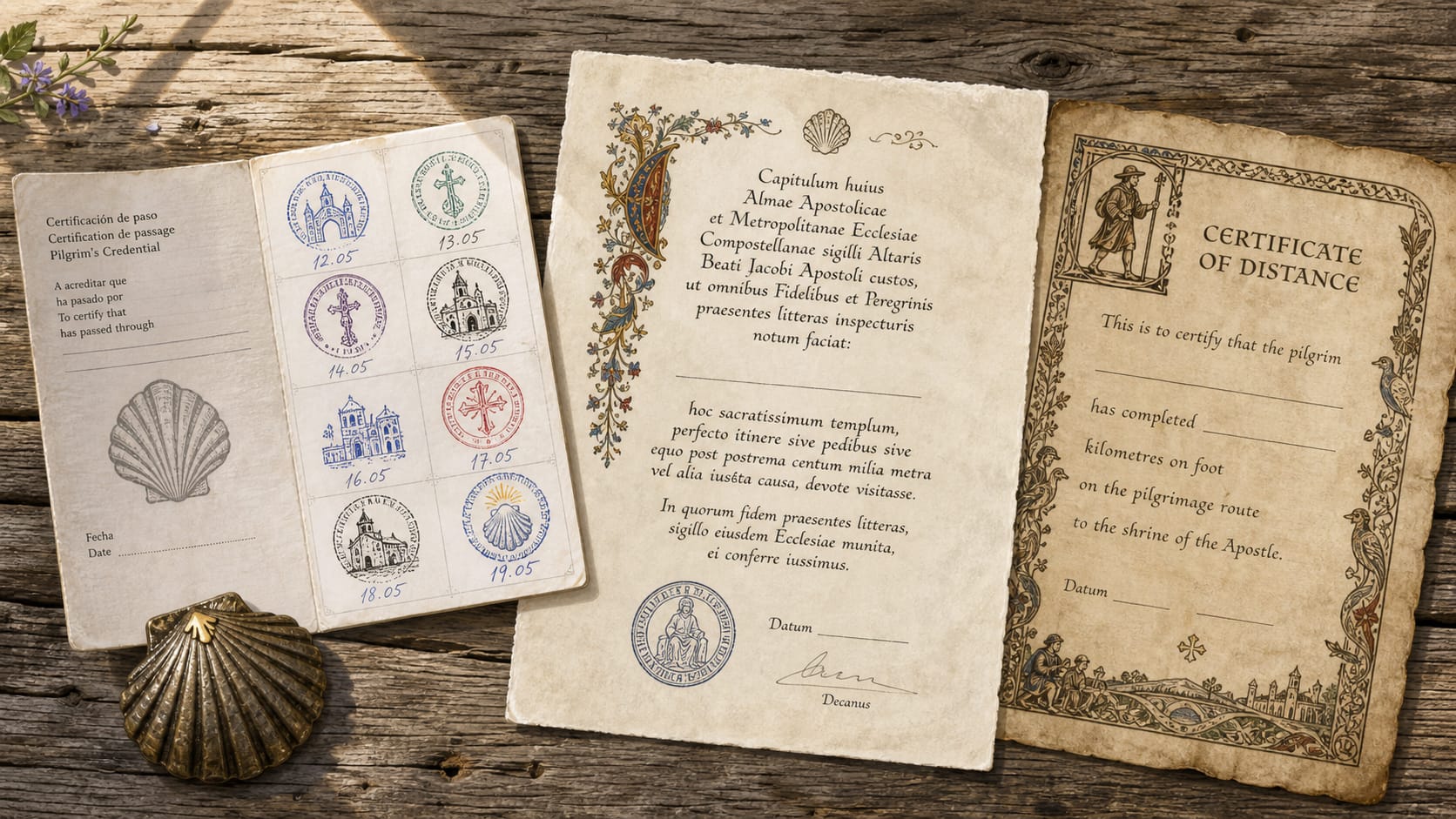
What is the difference between the pilgrim credential, the Compostela, and the distance certificate?
Three Camino documents share the same shelf in pilgrims' rucksacks and get confused constantly. The credencial del peregrino is the stamped passport you collect on trail. The Compostela is the cathedral's free Latin certificate, given to walkers who finish the last 100 kilometres on foot (200 on a bicycle) and declare a religious, spiritual or sincere personal motive. The Certificate of Distance is a €3 parchment from the cathedral chapter that records your exact starting city, total kilometres and route, with no motivation requirement.
If you are still mapping out the bigger picture, the planning pillar guide walks through the full sequence (route, season, training, budget) that this documents decision sits inside. The routes and distances guide covers how each official Camino feeds into the 100 km Compostela rule.
The credencial is a folded card passport that you stamp twice a day at albergues, churches, cafés and town halls along the route. It is the only document the Pilgrim's Reception Office in Santiago accepts as evidence that you actually walked. Without a stamped credencial, no Compostela and no Certificate of Distance.
Where to order one before you fly
Most pilgrims order a credencial four to six weeks before departure from a national confraternity (American Pilgrims on the Camino in the US, the Confraternity of Saint James in the UK, Deutsche Sankt-Jakobus-Gesellschaft in Germany and equivalent bodies elsewhere) or pick one up in person at the pilgrim office of their starting city. The walk-through of postal lead times and the cheapest pickup options lives in our dedicated pilgrim credential guide.
How sello collection actually works
You need two different stamps per walking day from the moment you leave home, not only across the final 100 km. Use the albergue stamp in the evening and a café, church or town-hall stamp at midday. Same source twice on the same day is the most common reason credentials get queried at the desk.
The Compostela is a Latin certificate of completed pilgrimage, issued free of charge by the Pilgrim's Reception Office in Santiago. It rewards a 100 km walk on foot (200 km cycled, on a traditional bicycle) and asks the pilgrim to declare a religious, spiritual or sincere personal motivation. From 2025 the two-stamps-per-day rule applies to the entire journey on file, not only the final 100 kilometres.
Who qualifies under the 2025 rules
You qualify if every walking day shows two distinct stamps, the last 100 km were continuous on foot or horseback, and you state one of the three accepted motives. E-bikes have been excluded since 2024; only traditional bicycles count toward the cycling minimum. Children with their own stamped credencial qualify too, as long as they can speak to the meaning of the pilgrimage at the desk.
Pre-registration and the QR queue
Pre-register online at the Pilgrim's Reception Office website before you arrive in Santiago. You get a QR code and a queue slot; the desk processes most pilgrims within about thirty minutes during shoulder seasons. In peak summer the queue can stretch into hours, but the QR window still beats the walk-in line.
The Certificate of Distance is a €3 parchment introduced by the Chapter of the Cathedral in 2016 to recognise pilgrims whose motivation falls outside the religious frame. It records your starting city, the exact kilometres walked and the route you took, with decoration drawn from a phrase in the Codex Calixtinus. There is no motivation question and no minimum-distance requirement beyond what the credencial proves.
How to request it in Santiago
Ask for the certificado de distancia at the same desk that issues the Compostela. The staff print it on the spot from your credencial details, take the €3 in cash or card and roll it into a tube. Most secular walkers request both certificates together; the desk is happy to issue them as a pair.
Why it costs three euros
The fee covers the parchment, the print run and the cardboard tube. The Compostela stays free because it has been issued as a free spiritual certificate for centuries; the distance parchment is treated as a souvenir document, hence the small charge.
At the desk in Santiago you tell the staff which certificates you want. The Compostela is free but assumes religious, spiritual or sincere personal motivation. The Certificate of Distance is €3 and has no motivation question. You can request both at the same time, and many non-religious pilgrims do — the Compostela for the Latin keepsake, the parchment for the exact-kilometre record. The Cathedral office also issues two onward certificates, the Finisterrana and the Muxiana, for pilgrims who continue past Santiago to Fisterra or Muxía.
The three documents serve different purposes and you may end up with all three in your rucksack on the train home. The credencial is collected during the walk; the Compostela rewards a 100 km religious or spiritual journey; the Certificate of Distance is a paid parchment open to every pilgrim. The table below compares purpose, cost, eligibility, motivation and how each is issued.
| Document | Purpose | Eligibility | Cost | Motivation required | Issued by |
|---|---|---|---|---|---|
| Credencial del peregrino | Stamped pilgrim passport carried on trail | Any walker, cyclist or rider | ~€3 (varies by issuer) | None | National confraternities, pilgrim offices, some parishes |
| Compostela | Latin certificate of completed pilgrimage | 100 km on foot or horseback, 200 km by traditional bike, two stamps per day | Free | Religious, spiritual or sincere personal | Pilgrim's Reception Office, Santiago |
| Certificate of Distance | Parchment recording exact distance walked | Any pilgrim with a valid stamped credencial | €3 | None | Chapter of the Cathedral, Santiago |
If you lose your credencial mid-route, ask the next albergue or the closest pilgrim office for a replacement and a written note explaining the gap. Collect new stamps from the day you continue walking onwards. The Pilgrim's Office in Santiago accepts dated lodging receipts and meal receipts as supporting evidence when sellos are missing, illegible or covered by the loss period.
Replacing a credencial mid-route
Municipal albergues, large parishes and most pilgrim associations carry blank credentials and will issue a replacement on the spot. Ask the hospitalero to date and sign a short note describing where the original was lost. That note is what the Santiago desk reads first when the kilometres on file don't match a single continuous credential.
When stamps go illegible or damaged
A stamp smudged by rain or a soaked credential page is not a reason to panic. Keep walking, keep stamping, and bring any receipts and photos from the affected days to Santiago. The Pilgrim's Office sees rain damage every week and processes it without drama, as long as the surrounding evidence lines up.
Since the SES Hospedajes rules took effect, every lodging in Spain, including municipal albergues, must register guests in a national system. On arrival you hand over your passport (or national ID for EU citizens) and the hospitalero completes a short check-in form. The check usually takes a couple of minutes and is separate from the credencial stamp, which still happens the same way it always did.
How registration works at check-in
The hospitalero scans or types your passport details into a tablet that uploads to the SES system. You sign once and you are done; there is no app to install and no QR for you to scan. For non-Spanish speakers, having the passport open at the photo page and your date of birth ready in writing is the fastest way through the desk.
Frequently asked questions
If I'm not religious, should I get the Compostela or the distance certificate?
The Compostela asks you to declare a religious, spiritual or sincere personal motivation, which some secular pilgrims find uncomfortable. The Certificate of Distance is open to everyone, records your exact kilometres and route, and costs €3. If you walked for any non-religious reason, the Certificate of Distance is the cleaner pick, and you can request both at the same desk if you would like a record of either.
What do I do if I lose my pilgrim credential or my stamps go missing?
Report at the next albergue or pilgrim office, where you can usually be issued a replacement credencial and a short written note explaining the loss. To rebuild evidence for the missing days, collect stamps from churches, town halls or cafés near the towns you stayed in, and keep dated lodging and meal receipts. The Pilgrim's Office in Santiago accepts these as supporting proof when sellos are missing or illegible.
Can I receive the Compostela and the Certificate of Distance together?
Yes. Both are issued at the Pilgrim's Reception Office in Santiago. Tell the staff which ones you want at the desk: the Compostela is free; the Certificate of Distance is €3 and gives you a parchment with your exact starting city, total kilometres and route.
Where do I order a credential before I leave home?
Many pilgrims order one online from national confraternities (American Pilgrims on the Camino in the US, the Confraternity of Saint James in the UK, Deutsche Sankt-Jakobus-Gesellschaft in Germany and similar bodies elsewhere) or pick one up at the pilgrim office of their starting city in Spain or France. Allow two to four weeks for international postal delivery.
Do children need their own credential to receive a Compostela?
Yes. Children who understand the spiritual or religious meaning of the pilgrimage qualify for a Compostela, and each child needs their own stamped credencial. Parents or guardians accompany them through the Pilgrim's Office process and answer the staff's questions about the journey.
Are e-bikes accepted for the Compostela?
No. Since 2024 the cathedral office has excluded e-bikes from Compostela eligibility; only traditional bicycles count toward the 200 km cycling minimum. E-bike riders can still request the Certificate of Distance, which records kilometres independent of method.
External citations
Oficina de Acogida al Peregrino, Santiago de Compostela
oficinadelperegrino.com/enPrimary source for current Compostela eligibility rules, the Certificate of Distance price and content, and the QR-based pre-registration procedure pilgrims use before queueing in person.
Cathedral of Santiago de Compostela — 2025 stamping rule update
catedraldesantiago.esOfficial source for the 2025 change that requires two stamps per walking day across the entire route on file, not only the last 100 kilometres.
American Pilgrims on the Camino
americanpilgrims.orgWidely cited confraternity that ships credentials to international pilgrims and documents the current claim process at the Pilgrim's Reception Office.
La Compostela del Lector
You walked this guide to Santiago.
All 771 km, 0 stages, stamped end to end.