
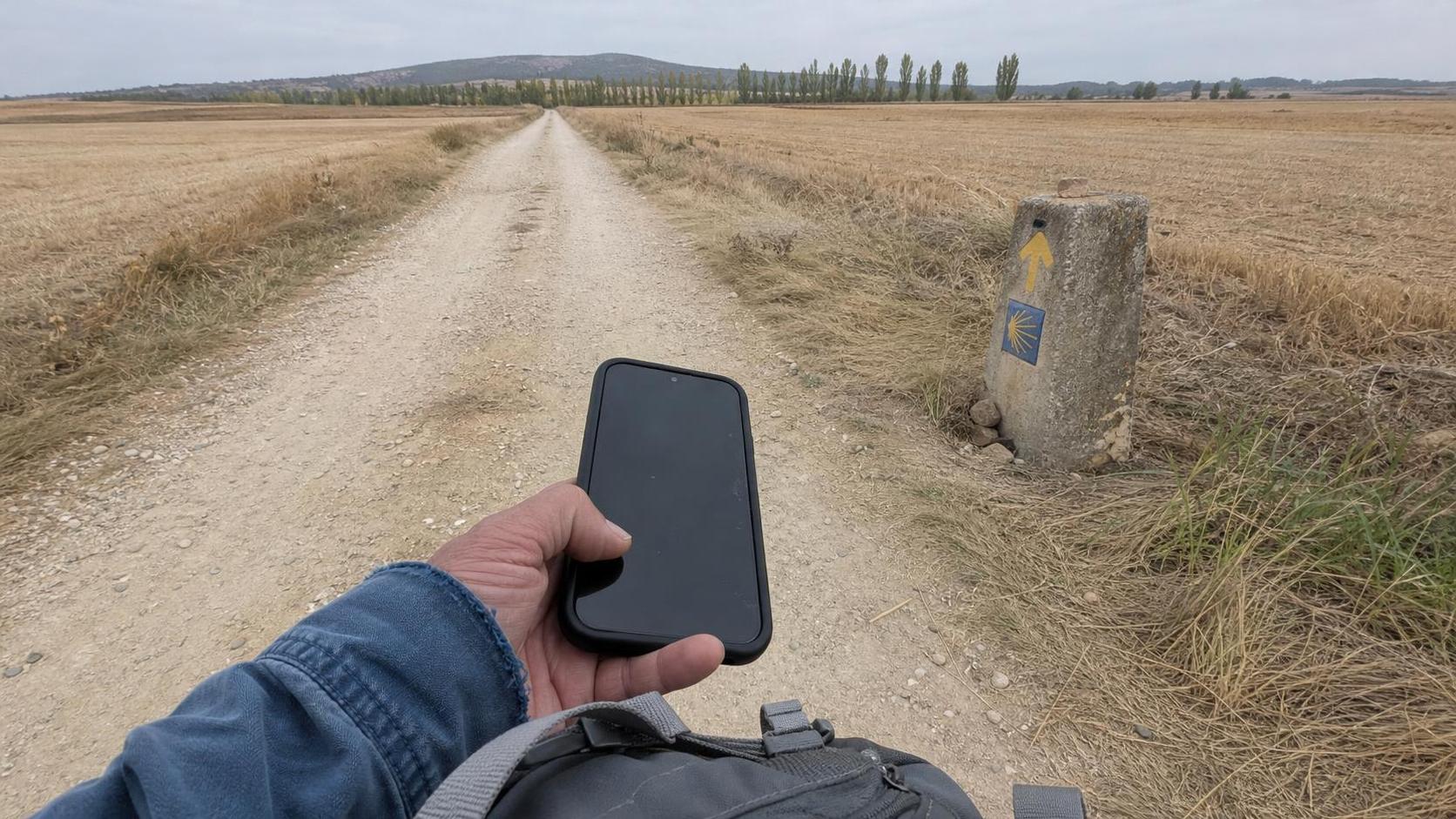
A first-time pilgrim needs one main Camino app and one general offline map, not ten apps. The main app carries the stages, distances, elevation and the villages with beds and services. The map app is the backup for when the main app's line and the painted arrows disagree. Translation and weather apps are extras, not the core.
Most Camino apps are guidebooks on a phone, and they overlap more than their store pages suggest: the same stages, the same towns, mostly the same beds. What separates them is what happens once you start walking and your days stop matching the book. That is the difference this comparison looks at.
On the Camino Francés, the Portugués Central or the Camino Inglés with an iPhone, Camino Mío is the most complete choice: everything the guide apps show, plus a walk mode that keeps your own plan, bookings and reminders in one place. On other routes or on Android, Buen Camino is the safest free guidebook, with around 50 routes and nine languages. Wise Pilgrim, now free, is a good second source for English readers. Gronze has the best albergue data but needs a connection. Camino Assist and CaminoTool are free but thinner.
| App | Price | Works offline | App languages | Routes covered | Best for |
|---|---|---|---|---|---|
| Camino Mío | Free | Yes, except the map background | English, German, Spanish | 3 | Guide, plan and walk in one app |
| Buen Camino | Free, pay what you like | Yes, after map download | 9, incl. Korean and Chinese | About 50 | A guidebook for almost any route |
| Wise Pilgrim All Caminos | Free | Yes | English (store listing) | 26 | A second opinion on stages |
| Gronze Maps | Free | No | Spanish, English | About 30 | Checking beds the night before |
| Camino Assist | Free, with ads | Stage maps only | 6 | Spanish routes, by region | The SOS button |
| CaminoTool | Free, no ads | Yes | 6 | 27 | Android users |
| Organic Maps | Free, open source | Yes, incl. search and routing | Dozens | Any (general map) | The offline backup map |
Store and developer data read on 8 October 2026. Prices and route counts change often, so check the store page before relying on one figure.
We build Camino Mío, so read this section as the makers' account, limits included. For its three routes, the Camino Francés, the Portugués Central and the Camino Inglés, it does what the guide apps below do. Then it carries on where they stop, at your own days.
The guide part
Every stage comes with its distance, climb, walking time, difficulty, elevation profile and a few notes worth knowing. The route sits on a real map, with a satellite view, and each village shows what it has: albergue, hotel, pharmacy, cash machine, shop, bar, restaurant, doctor, bus or train, luggage transfer. Villages are marked as stage stops, walk-through villages or places with limited or no services, so you can see at a glance where a day can end. An explore view adds each route's highlights, from cathedrals and mountain passes to the best sunrises.
Walk mode: where it goes beyond a guide
Once you start, walk mode opens on today: the village you left, the one where the day ends, the kilometres done and still to go, and each village in between with its distance. Tap a village as you reach it, or let the app mark it when you walk through, if you allow location. The map shows how far ahead each village is.
Your plan is a list of days you can reshape on the spot. Stay in the village you stopped in, and the rest moves to the next day. Push a stop to tomorrow, add a rest day, take it out again. A day longer than your limit is flagged, with a hint to split it. At the top sit the day you reach Santiago and how many days of buffer you still have before your flight, or how many you have run over.
Each bed you book goes into the plan with its place, date and a note for the reservation number. Nights without a bed are marked, and a booking that no longer matches its day after a change is flagged to check. The app reminds you to book a day or two ahead, how many is your choice. It also watches for services: the next village with a pharmacy, a cash machine or a shop, and how far it is. A daily reminder helps with the two stamps a day the Compostela asks for on the last 100 km, and the stamps themselves can be photographed into the app, cut out from the paper and kept with their place and day.
Before you go: plan mode
Plan mode sets it all up: route, starting point, start date, a pace down to the kilometre and rest days, and from them the date you reach Santiago, next to your flight home. It also keeps a trip budget, a packing list that adds up its own weight, and a to-do list from the credencial to travel insurance and both flights. On the day you start, the plan moves into walk mode with you.
Where it stops
Camino Mío is free, on iPhone only, with no Android version yet. It covers three routes, in English, German and Spanish. It shows which villages have an albergue or a hotel, but not individual beds, prices or phone numbers, so for those you still look at Gronze or Buen Camino. It is young, so it has few App Store ratings so far.
Buen Camino calls itself the most used Camino app, with over a million downloads by its publisher's count and a 4.8 rating from about 2,400 ratings on the US App Store. Editorial Buen Camino has been making pilgrim guides for over twenty years, and the app carries stages, elevation, services and albergues for every town.
It covers 51 routes by the publisher's count (the US App Store still says 45), across Spain, Portugal and France. Of the Camino guide apps here, it is the only one with a Korean interface, alongside Simplified Chinese and seven European languages. Its maps work offline once downloaded. Live alerts and weather still need a signal.
What the free version includes
The route guides, maps, stage profiles and the albergue and service listings. No ads.
What the in-app purchases add
Buen Camino runs on pay what you want: the store says you decide how much to pay and can choose not to pay at all. The publisher suggests about 9 euros a year, and US payment options start at $4.99. Paying adds no listed features; it supports the people who keep the data current.
Wise Pilgrim All Caminos covers 26 routes in Spain, Portugal and France, with offline maps, elevation profiles and services in every town. It used to charge $0.99 a route or $4.99 for the lot. It is now free, and its store subtitle reads "Completely free." It holds a 4.7 rating on both the App Store and Google Play.
Its store listing names English only, although the developer says the app now has more languages, so check the settings before you count on yours. When two guide apps agree on tomorrow's distance, you can stop checking.
Gronze is the Spanish reference for albergues, prices, opening months and stage notes, and our guide to booking albergues in advance leans on it for phone numbers. Gronze Maps is free, in Spanish and English.
The catch is the connection. Gronze says the app currently works only online and shows a no-signal message without one. Use it on the albergue Wi-Fi the night before, not as your only map on the trail.
Camino Assist is a free guide app in six languages, with offline stage maps, a pilgrim diary and an SOS button that calls 112, the Spanish emergency number. It carries ads, and on the US App Store it has almost no ratings yet.
CaminoTool is a free, ad-free map of 27 Jacobean routes with GPS position and an offline mode, in six languages. Its iPhone version has left the App Store, and the Android version was last updated in May 2025. Both apps carry thinner service listings than Buen Camino.
Organic Maps is a free, open-source map app built on OpenStreetMap, with no ads, no tracking and no account. Download the regions of Spain you need once, and search and route-finding run fully on the phone. It passed 6 million installs in December 2025.
It has no stages and no albergue notes, and that is why it works as the backup: when a guide app's line and the yellow arrows disagree, or a flooded track sends you onto a road, it shows where you are on a real map and how to get back.
First-timers have four jobs to cover: plan the stages, follow the route, find a bed, and talk to people. Every guide app helps you follow the route and find a bed. Camino Mío also does the planning, before you leave and every time a day changes, and keeps your bookings in the same place. Google Translate with the Spanish pack downloaded covers talking to people, and its camera mode reads menus offline.
Camino app for beginners: the minimal setup
- Camino Mío as the main app, if you walk the Francés, the Portugués Central or the Inglés with an iPhone. Otherwise Buen Camino, with the maps for your route downloaded.
- Organic Maps with northern Spain downloaded, as the backup.
- Google Translate with Spanish downloaded for offline use.
- Optional: AlertCops, the free Spanish police app, which is available in English. Its SOS button sends an alert with your location to the nearest police station.
All free. Next to Camino Mío, add Gronze when you want bed prices and phone numbers, and Wise Pilgrim if you want a second source on distances.
Camino stage planner app: when plans change on the trail
Guide apps show the standard stages well and get weaker once you leave them. A short day after a blister or a rest day in León shifts every remaining stage, and the arrival date with it. That recalculation is what Camino Mío's walk mode does each time you change a day, with your bookings and your flight date checked against the new plan. For the arithmetic before you go, our Camino Francés stage calculator also works in the browser.
Install and test every app at home, on Wi-Fi. Download the offline maps and route data for your whole Camino, plus the Spanish pack for translation. Then switch the phone to flight mode and check that the offline maps, your position and the stage list still load. Fix gaps before you leave, not in Roncesvalles.
Battery and storage: what to expect
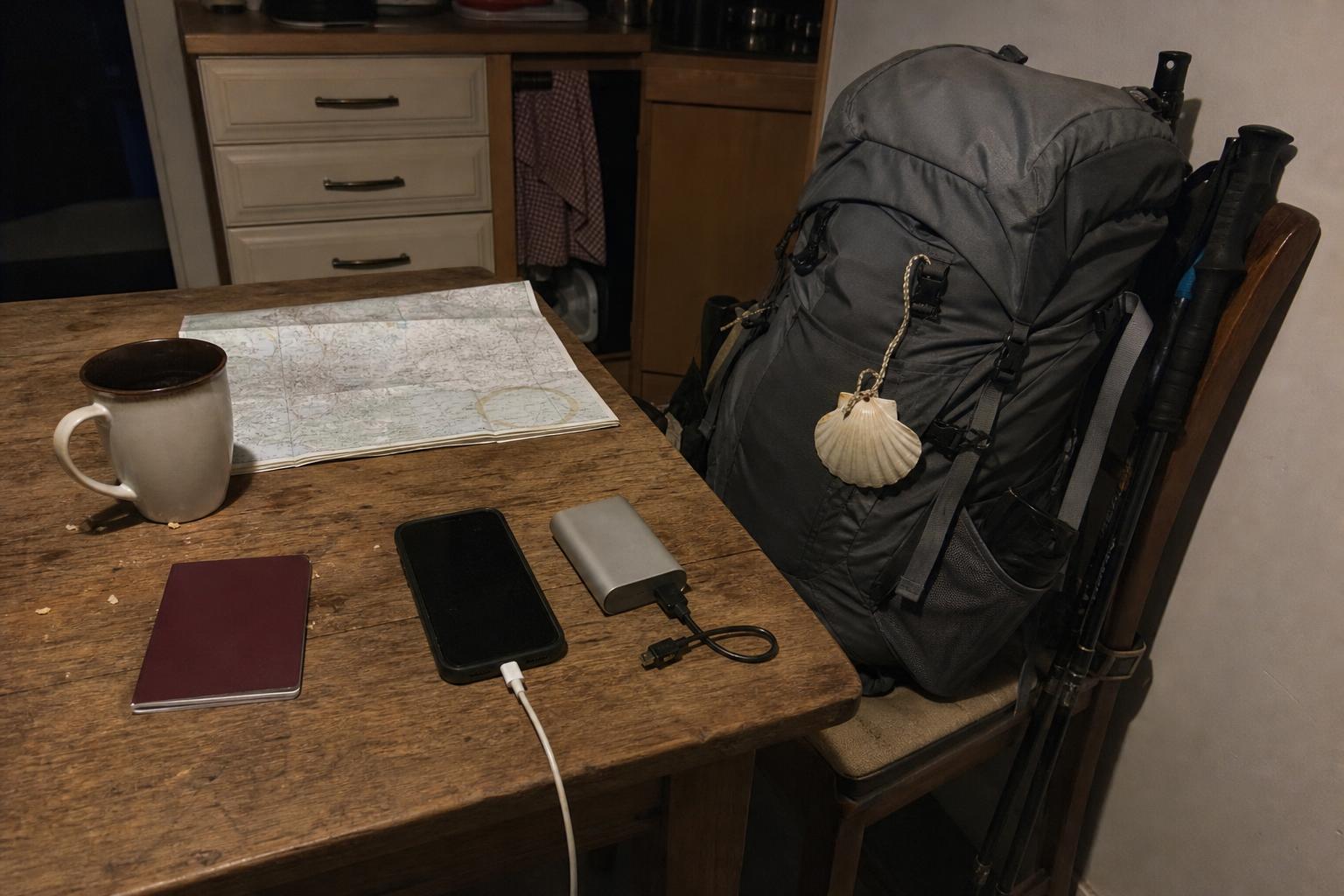
On iPhone, Camino Mío takes about 74 MB, Buen Camino about 105 MB and Wise Pilgrim about 162 MB, and every offline map region you download adds more. All-day GPS tracking drains a battery fastest. A 10,000 mAh power bank, about 220 grams, covers a phone for two or three days, which is why it is on our complete Camino packing list.
Which Camino apps actually work offline, and what still needs a signal?
Buen Camino, Wise Pilgrim, CaminoTool and Organic Maps work offline once you download their maps, and Camino Assist has offline stage maps. Camino Mío keeps your stages, plan and bookings without a signal, but its map background needs one. GPS position works without a signal. Gronze Maps needs a connection, and booking beds, live weather and messaging always need data or Wi-Fi.
Which Camino app does more than a guidebook?
Camino Mío, which we build. Next to the stages, map and village services, it plans your days from start date to Santiago, reworks every date when you change a day, keeps your bed bookings, and reminds you about beds, services and stamps. It covers the Francés, the Portugués Central and the Inglés, on iPhone.
Is there a Camino app in Korean or Japanese for non-English speakers?
Buen Camino has a Korean interface, plus Simplified Chinese and most major European languages. None of the Camino guide apps compared here lists Japanese. Japanese walkers can pair Buen Camino in English or Spanish with Google Translate's camera mode, which works offline once the Japanese pack is downloaded.
Do I need a Camino app at all, or are the yellow arrows enough?
On the Camino Francés the yellow arrows are good enough to walk without any app. An app earns its place in planning: distances, elevation, the next bed and water, and what to do when a stage changes. Most first-timers still find one main app worth the space.
Is it worth paying for a Camino app?
Not for most first-timers. Camino Mío, Wise Pilgrim All Caminos and Gronze Maps are free, and Buen Camino is pay what you want. Paying Buen Camino supports the people behind its data; it lists no extra features for it. Paying for more than one guide app rarely adds anything.
Will Camino apps drain my phone battery?
Constant GPS tracking drains a battery fastest. Check your position when you need it instead of tracking all day, keep the phone in flight mode between checks, and carry a small power bank.
The rest of the preparation is in how to plan your first Camino de Santiago. If you have not settled on a route yet, choosing your Camino route comes first. And for how many people will walk beside you, around 530,000 in 2025, see our Camino de Santiago statistics.
External citations
Camino Mío on the App Store
apps.apple.com/us/app/camino-de-santiago-camino-mio/id6780242781The price, the app size and the iPhone-only availability, read on 8 October 2026.
Buen Camino on the App Store
apps.apple.com/us/app/buen-camino-de-santiago-app/id858222947The download claim, the 4.8 rating, the pay-what-you-want model and the in-app purchase prices, read on 8 October 2026.
Editorial Buen Camino — the Camino de Santiago app (Spanish)
www.editorialbuencamino.com/app-del-camino-de-santiagoThe publisher's own route count, its nine languages, offline map downloads and the suggested yearly payment.
Wise Pilgrim All Caminos on the App Store
apps.apple.com/us/app/wise-pilgrim-all-caminos/id6444294028The 26 routes, the free price and the English-only language listing.
Gronze Maps (Spanish)
www.gronze.com/gronze-mapsGronze's own statement that the app currently works only with an internet connection.
Organic Maps
organicmaps.appThe developer's own description of offline search and routing, the privacy model and the install count.
La Compostela del Lector
You walked this guide to Santiago.
All 771 km, 0 stages, stamped end to end.