
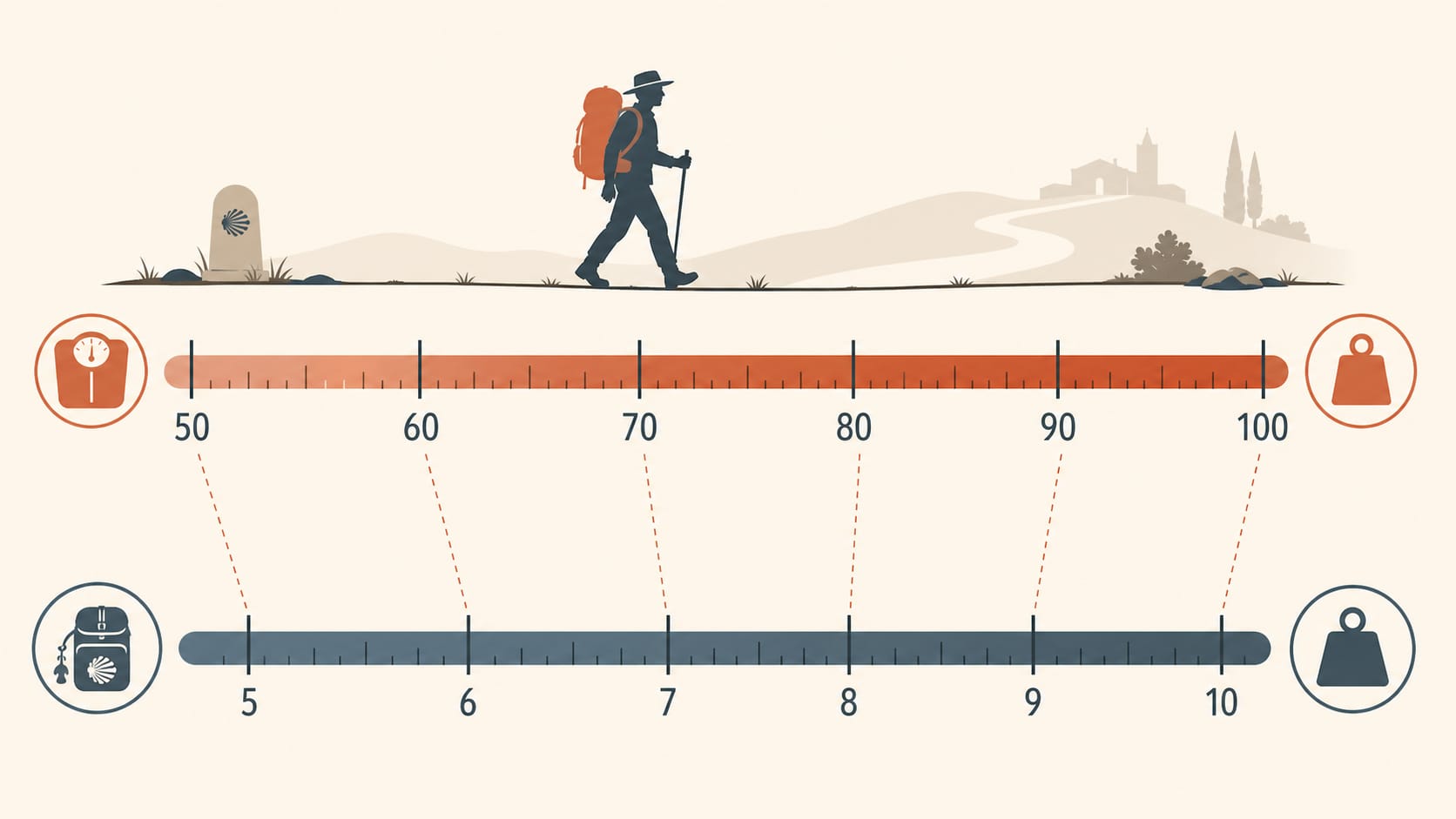
A first-time Camino pilgrim should pick a 30 to 40 litre pack matched to a measured torso length, and keep the fully loaded weight at or below 10% of body weight, with a practical ceiling near 10 kilograms. A 50 kg walker targets 4 to 5 kg in 28 to 32 litres. A 60 kg walker targets 5 to 6 kg in 32 to 36 litres. An 80 kg walker targets 6.5 to 8 kg in 34 to 40 litres. The lower number in each range is the better daily target; the upper number is the winter or shoulder-season allowance.
These ranges hold because the Camino is a hostel-to-hostel walk, not a backcountry trek. No tent, no stove, no two-day water carry. The bag exists to move three changes of clothes, a sleep system, light toiletries, and a rain layer between municipal albergues. Anything bigger invites stuff that never comes out of the pack. The companion to this sizing decision is the per-item weight list in our complete Camino packing list, which is where the kilograms actually get assembled.
Fit comes before brand. The torso length on the pack has to match the torso length on your back, or the hip belt cannot hold the load. A wrong size code in the right model carries worse than a budget pack in the right size.
The 10% rule comes from 1950s US Army load-carriage research on trained 20-year-old soldiers walking long distances day after day with rifle, water, ration, and shelter. It approximated a load they could carry sustainably without injury accumulating across weeks. The number stuck in outdoor culture and now floats free of its origin, applied uniformly to every walker on every trail.
Three things make it a rough approximation on the Camino. First, the original studies measured trained soldiers, not first-time pilgrims in their fifties. Second, the rule does not scale linearly above roughly 80 kilograms of body weight, where 10% lands at a number heavier than the route ever asks anyone to carry. Third, the Camino removes the loads the rule was built around. There is no camping, no food carry beyond a sandwich, and no water carry beyond a litre or two between fountains.
Treat the 10% number as a ceiling rather than a target. The real working number for most pilgrims sits closer to 7 to 8% of body weight, which is what falls out of a well-edited packing list anyway. Where the 10% rule still earns its keep is as a stop sign at the bathroom scale: if the loaded bag clears that line, something heavy needs to go.
The table below pairs each 5 kilogram body-weight band with a target pack weight, the 10% ceiling, and a recommended litre range. The target column is what you aim at. The ceiling column is the line you do not cross. The volume column is the bag that holds the kit at that weight without inviting overflow.
| Body weight | Target pack | 10% ceiling | Recommended volume | Add for winter |
|---|---|---|---|---|
| 50 kg | 4.0 – 5.0 kg | 5.0 kg | 28 – 32 L | +2 L |
| 60 kg | 5.0 – 6.0 kg | 6.0 kg | 30 – 36 L | +2 L |
| 70 kg | 6.0 – 7.0 kg | 7.0 kg | 32 – 38 L | +3 L |
| 80 kg | 6.5 – 8.0 kg | 8.0 kg | 34 – 40 L | +3 L |
| 90 kg | 7.5 – 9.0 kg | 9.0 kg | 36 – 40 L | +4 L |
| 100 kg | 9.0 – 10.0 kg | 10.0 kg (cap) | 38 – 42 L | +4 L |
Two numbers in the table eat into the budget before you start packing. One litre of water weighs one kilogram, so a full 2 L bladder is two of your six kilograms. And the pack itself is not free: a framed 35 litre pack weighs roughly 1.5 to 2 kilograms empty, an ultralight frameless model closer to 900 grams. For a 60 kg pilgrim aiming at 6 kg, the pack and water alone can claim 3.5 kg before a sock goes in.
Torso length, not height, decides which manufacturer size code (XS, S, M, L) you order. Two pilgrims of the same height can carry the same litre rating in different size codes because spine length varies independently of leg length.
Measure it in 60 seconds. Tilt your head forward and find the bony bump at the base of your neck, the C7 vertebra. Put your hands on top of your hip bones with thumbs pointing back along the iliac crest. Have a partner measure straight down the spine between those two points in centimetres. Under 41 cm picks small, 41 to 46 cm picks medium, over 46 cm picks large. Charts vary by a centimetre or two between brands, so check the spec of the pack you are buying.
Women's-fit packs add narrower shoulder straps and a shorter back panel cut for a higher iliac crest. Read the women's chart with the same centimetre bands, not your dress size. If the load will not sit on the hips during a loaded test walk, the torso length is wrong before the pack model is.
Both numbers matter, but they fail in different ways. Volume drives temptation. Weight drives injury. Each extra 5 litres of capacity tends to attract 300 to 500 grams of optional gear that never comes out of the bag. Weight is the variable your knees feel; volume is the variable your discipline controls.
Pick the smallest volume that fits your kit dry, then chase weight inside it. A 35 litre pack at 7 kg outperforms a 45 litre pack at 8 kg on every kilometre of the route. If you cannot get the kit into the smaller volume, the kit is wrong, not the bag. The single most effective edit, before you adjust the size code, is the list in what NOT to pack on the Camino.
Add roughly 2 to 4 litres of capacity for winter or shoulder-season walks to fit a warmer sleep system and an extra mid-layer; the layering choices behind those litres are in our Camino layering system. Subtract 2 to 3 litres for July and August walks where you carry no insulation and dry clothing overnight at the albergue.
Trip length above ten days does not move the recommendation. Beyond about a week, laundry happens every other day in albergue sinks no matter how far you are walking, so a two-week pilgrim and a five-week pilgrim carry the same clothing volume. Route-specific gear adjustments live in the Camino Francés packing list, and the season-by-season volume tweaks above feed back into the master gram-by-gram list in the complete Camino packing list.
Load the demo pack with weighted bags equal to your target kilograms, then walk for 20 minutes outside the shop. A pack that fits in the aisle can still fail in the first kilometre. The hip belt should carry 70 to 80% of the load. Shoulder straps should rest on the shoulders without bearing weight.
If the load will not sit on the hips, change the torso size, not the brand. If two checkpoints fail, the size code is wrong. Three or more, the model is wrong for your back. Never buy a pack you cannot return after a loaded test walk at home; the relationship between footwear and pack weight on long descents is covered in hiking boots vs trail runners for the Camino, where toe-box fit and pack weight stack into the same comfort verdict.
Frequently asked questions
How heavy should a fully loaded Camino backpack be for a 60 kg woman?
For a 60 kg woman the 10% ceiling is 6 kg fully loaded, including water and snacks. Aim for a dry weight (pack, sleeping bag, clothes, toiletries) of about 5 kg so a half-litre bottle and a sandwich do not push you over. Choose a 32 to 36 litre women's-fit pack with a short torso panel, weigh every item, and treat 6 kg as a ceiling not a target. Many 60 kg pilgrims walk comfortably at 5 to 5.5 kg loaded.
How do I measure my torso length at home and pick the matching backpack size?
Tilt your head forward and find the bony bump at the base of your neck (the C7 vertebra). Put your hands on top of your hip bones with thumbs pointing back along the iliac crest. Have a partner measure straight down the spine between those two points in centimetres. Under 41 cm is small, 41 to 46 cm is medium, over 46 cm is large. Match that to the manufacturer's torso chart and pick 30 to 35 litres for a small torso with lightweight kit, or 35 to 40 litres for medium and large torsos.
Does trip length change which backpack size I should buy?
Not above ten days. Beyond about a week of walking, you do laundry every other day in albergue sinks no matter how far you are going, so a two-week and a five-week walker carry the same clothing volume. Season changes pack size more than duration does.
Should I prioritise volume or pack weight when they conflict?
Pick the smaller volume first, then chase weight inside it. Each extra 5 litres of capacity tends to attract 300 to 500 grams of optional gear that never comes out of the bag. A 35 litre pack at 7 kg outperforms a 45 litre pack at 8 kg every day of the trip.
Does the 10% rule still apply above 80 kg of body weight?
Cap your loaded pack at about 9 to 10 kg regardless of body weight. The 10% rule was built for sustainable carry by trained soldiers and does not scale linearly above 80 kg, especially for first-time long-distance walkers. The Camino has no camping or food carries, so a heavier walker does not need more pack.
How much does the empty pack itself weigh against my budget?
An ultralight frameless 35 litre pack runs about 900 grams, a mid-weight framed pack runs about 1.5 to 2 kilograms. That is up to one kilogram of a 6 to 7 kilogram budget gone before a sock goes in. Always check the empty pack weight in the product spec before buying.
External citations
American Pilgrims on the Camino — packing list
americanpilgrims.org/packing-listThe non-profit Camino organisation's canonical packing list, cited for the 10% body-weight target widely repeated by US pilgrim associations.
American Pilgrims on the Camino — prepare for Camino
americanpilgrims.org/prepare-for-caminoThe companion preparation guide that frames the pack-weight target alongside training, footwear, and credential advice for first-time pilgrims.
Knapik J et al. — Soldier load carriage: historical, physiological, biomechanical, and medical aspects, Military Medicine (2004)
pubmed.ncbi.nlm.nih.gov/14964502Peer-reviewed review of the US Army load-carriage literature behind the 10% rule, used to explain why the number was built for trained soldiers rather than first-time pilgrims.
La Compostela del Lector
You walked this guide to Santiago.
All 771 km, 0 stages, stamped end to end.