
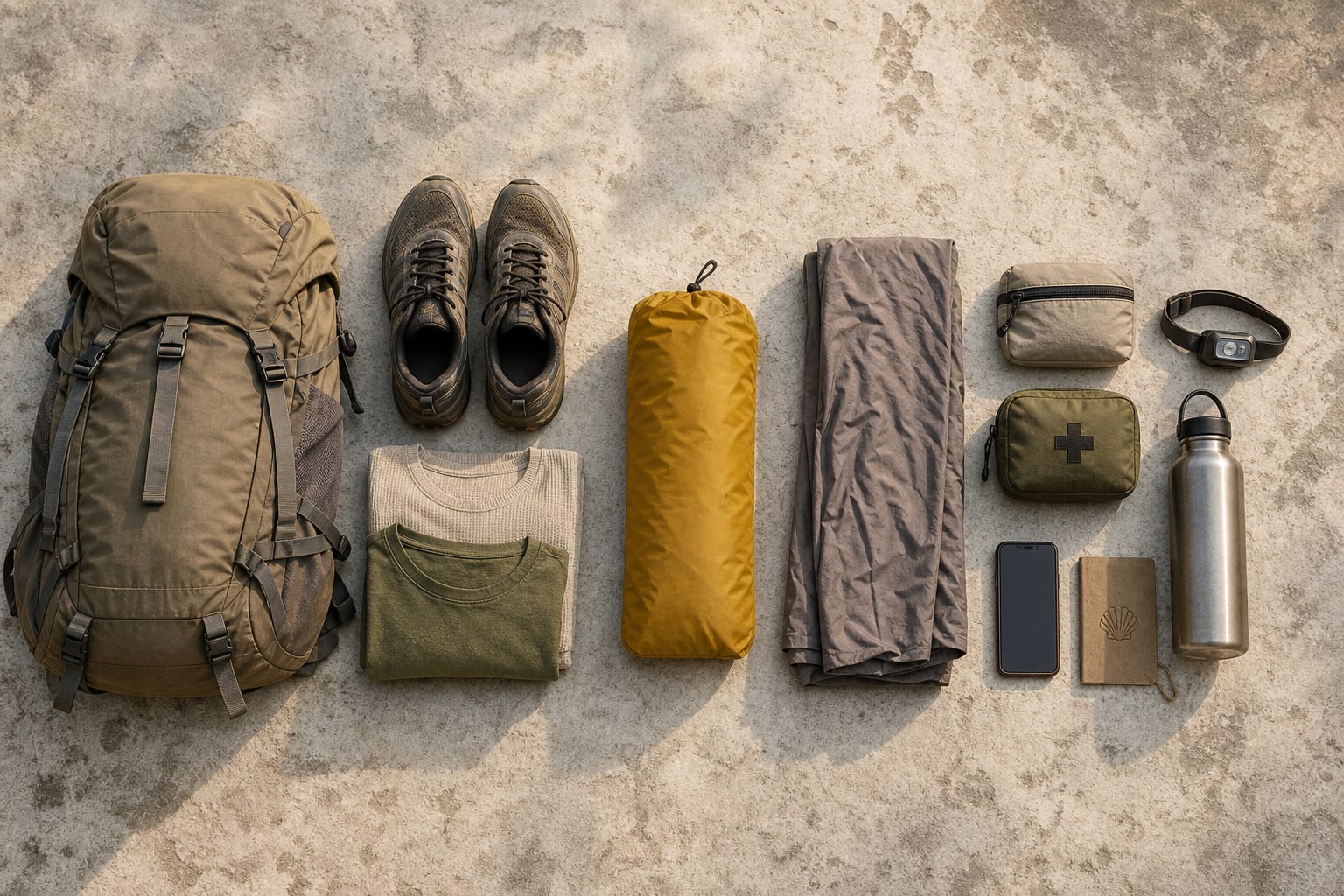
A 30 to 40 litre backpack, kept under 10% of your body weight, carrying nine categories of gear: the pack itself, footwear and socks, three clothing layers, sleeping gear, rain protection, toiletries, a first-aid and foot-care kit, electronics, and your documents. From Saint-Jean you also carry Pyrenees-ready layers for a cold, exposed first day over the mountains.
The Francés earns a packing list of its own, separate from the complete Camino packing list, for two reasons. Its dense albergue network lets you carry less than the wilder northern routes, so you can lean on a liner instead of a full sleeping bag through most of the year. And its opening stage climbs straight into the Pyrenees, cold and exposed, before dropping onto the shadeless Meseta later on. Those two facts pull the list in opposite directions, and the sections below work through each category with what to bring, how many, and why it earns the weight.
At or below 10% of your body weight, water excluded, which lands most pilgrims between 6 and 8 kg. A 60 kg walker aims for 6 kg; an 80 kg walker has room to 8 kg. Cross that line and the strain on your shoulders, knees and feet compounds with every one of the 780 km between Saint-Jean and Santiago.
The number that matters is base weight: everything on your back except the water and food you consume and refill through the day. Water alone adds 1.5 to 2 kg once your bottles are full, so if your base weight already sits at the ceiling, a full day's water pushes you over it. That is why the target is a base weight comfortably under 10%, not exactly on it. A worked kit lands around 6.5 kg base for a 65 kg pilgrim, which leaves headroom for a full bottle and a day of snacks.
Most of the grams hide in two places: your clothing and the pack itself. A heavier pack with a rigid frame can weigh more than all your clothing layers put together, so a lighter 35 litre pack is often the single biggest saving available. After that, the savings come from cutting duplicates rather than shaving individual items, which is why the backpack sizing and 10% body weight rule is worth reading before you buy anything else.
Nine categories cover everything you carry. The table lists each one with a sensible count and the reason it is on the list, then the notes below add the detail that a single row cannot.
| Category | What to bring | How many | Why |
|---|---|---|---|
| Backpack | 30 to 40 L pack with hip belt and rain cover | 1 | Carries the load on your hips, not your shoulders |
| Footwear and socks | Broken-in trail shoes, merino socks, camp sandals | Shoes ×1, socks ×3, sandals ×1 | Dry, well-fitting feet prevent most blisters |
| Clothing and layers | Merino base, fleece mid, wind or rain shell, trekking trousers, underwear | Base ×2, mid ×1, shell ×1, trousers ×1–2 | Covers cold dawns and hot afternoons in one system |
| Sleeping gear | Silk or microfibre liner; light bag in colder months | Liner ×1 | Albergue blankets do the rest for most of the year |
| Rain protection | Poncho or taped-seam jacket, pack cover | 1 | Northern Spain sees rain in every month |
| Toiletries and hygiene | Travel soap, small towel, sun cream, blister tape | 1 set | Small refills beat full-size bottles for weight |
| First aid and foot care | Blister kit, painkillers, antiseptic, tape, plasters | 1 kit | Foot problems end more Caminos than anything else |
| Electronics | Phone, charger, power bank, short cable, headlamp | 1 each | The headlamp earns its place on dark dawn starts |
| Documents and money | Credential, passport or ID, bank card, some cash | 1 set | The credential is required for albergues and the Compostela |
A few notes the table cannot hold. Keep cotton off your skin entirely: it soaks up sweat, dries slowly, and chafes, which is why a cotton shirt heads the list of what not to pack on the Camino. Buy trail shoes a half to a full size larger than your street size, because feet swell over a long walking day and a snug toe box bruises toenails within a week. Carry three pairs of merino socks rather than cotton, which holds moisture against the skin and raises your blister risk. And the credential, the credencial, is not optional paperwork: you need it to sleep in albergues and to collect your Compostela in Santiago, so it travels in the driest pocket you have.
For footwear specifically, the choice between shoes and boots deserves its own look. Most Francés pilgrims are better served by trail runners than by heavy boots on this well-graded, mostly smooth route, and the boots versus trail runners verdict walks through when the heavier option still wins.
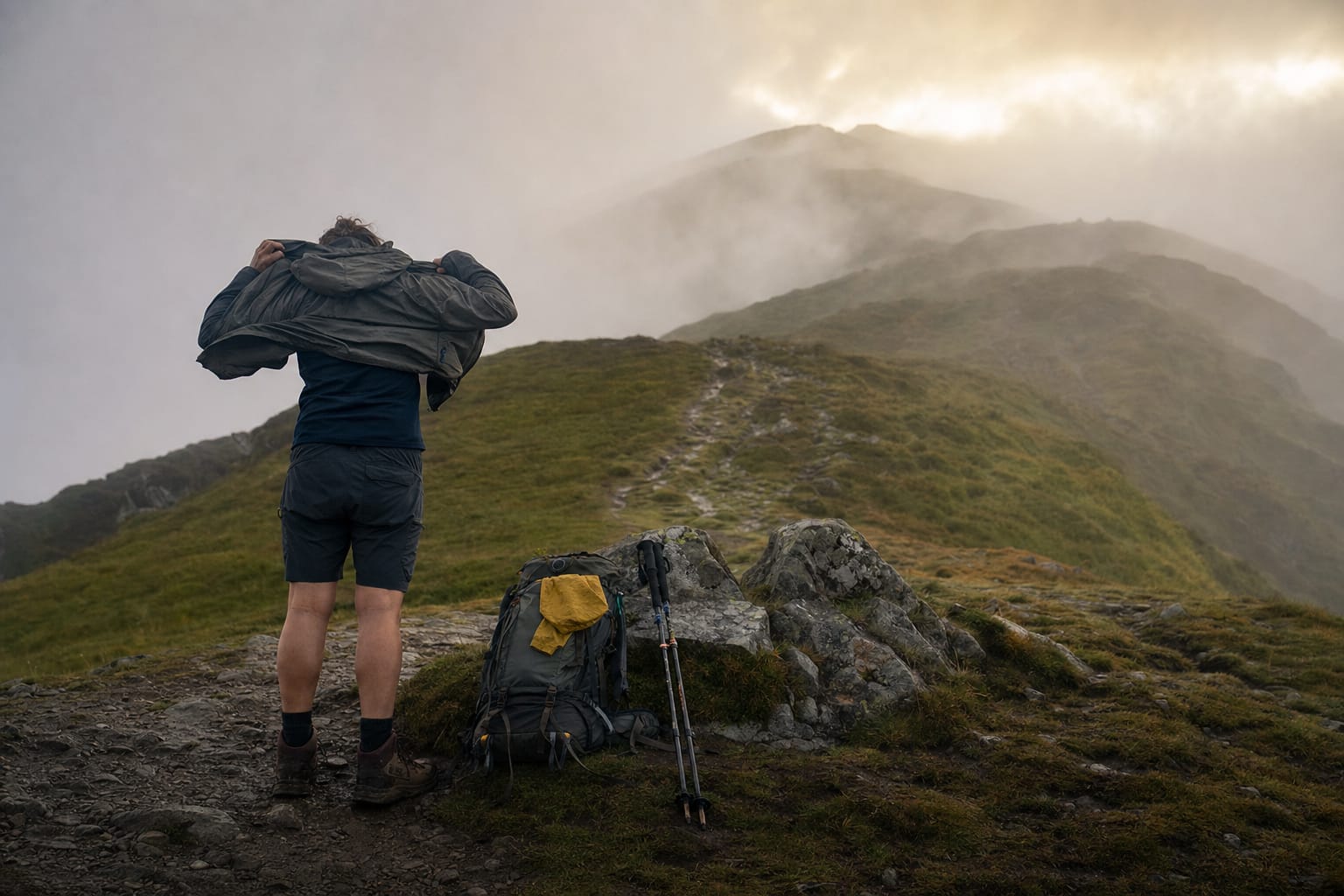
Day one climbs more than 1,200 m from Saint-Jean over the Napoleon route to the Col de Lepoeder before dropping to Roncesvalles. The col runs about 10°C colder than the town below and sits fully exposed to wind, so even in July you carry a warm hat, gloves, a windproof layer, 1.5 to 2 L of water and a headlamp. There is no shop for roughly 20 km, so you also carry the day's snacks out of town.
Two routes leave Saint-Jean. The Napoleon route is the classic high crossing, spectacular and hard, and it closes in bad weather and through winter because pilgrims have died of exposure on it. The lower Valcarlos route follows the valley, stays open year-round, and asks far less of your gear. If you take Napoleon, the day-one add-ons are not a summer luxury; the weather at the col has no relationship to the weather in the car park where you started.
Season changes roughly 2 kg of your load, and it swaps items rather than reinventing the list. Spring, April to June, needs a rain shell and warm layers for wet, changeable weather. Summer, July and August, drops the fleece for many pilgrims and adds sun protection and extra water capacity. Autumn, September and October, mirrors spring but with earlier darkness. Winter, November to March, is the heavy season: insulation, a waterproof shell, warm boots and a proper three-season sleeping bag.
Northern Spain gets measurable rain in every month, lowest in July and August, so a shell of some kind travels with you year-round even in high summer. The two extremes to plan hardest for are the shadeless Meseta heat between Burgos and León, where sun cover and 2 L of water capacity matter more than anywhere else on the route, and a winter crossing of the Pyrenees, where the day-one gap between town and col is at its most dangerous. Between those, spring and autumn are the forgiving seasons: mild days, cool mornings, and fewer pilgrims than the summer crowds.
Less sleeping gear and lighter footwear than the Norte or Primitivo, but more water capacity and sun cover than any coastal route. The Francés's frequent albergues mean a liner over a bag suffices for most of the year, and its smooth, well-marked final 100 km from Sarria is kind enough for light trail shoes. The Camino del Norte, by contrast, runs longer at around 803 km with far more climbing, which pushes its packing list toward sturdier gear.
Where the Francés asks more is the Meseta and the mountains. The long shadeless stretches between Burgos and León demand 2 L of water capacity and real sun protection that coastal routes, with their sea breezes and tree cover, rarely need. And the Pyrenees crossing on day one calls for windproof layers most other routes' opening stages do not. Trekking poles, optional elsewhere, earn their keep on the steep Pyrenees descent and the rocky drop into Molinaseca later on.
Two ways to carry the whole list past the point where you close this page. A printable checklist works without a signal, and the interactive packing list recomputes your total weight as you add or remove items and switch season or luggage-transfer options. Tick gear off as you pack at home, then re-check it the night before each stage on the trail.
One weight worth planning around before you fly: luggage-transfer services will carry a bag up to about 15 kg between stages, so pilgrims who want to walk with a light daypack can send the rest ahead each morning. If that is your plan, your packing list splits into a daypack and a transfer bag, and the daypack still needs the day-one Pyrenees layers, water and snacks in it.
Frequently asked questions
How does my Camino Francés packing list change between spring and autumn?
Spring and autumn share mild days but differ in the details. Spring is wetter with longer daylight, so lean on a rain shell and quick-dry layers. Autumn brings earlier darkness and colder mornings, so add a warmer midlayer, a headlamp and light gloves. Both need less insulation than winter and more than summer.
What gear does the Camino Francés need that other Camino routes don't?
Its frequent albergues let you carry lighter sleeping gear and footwear than the Norte or Primitivo. The Meseta stages, though, demand 2 L of water capacity and sun protection for shadeless heat, and the day-one Pyrenees crossing calls for windproof layers most other routes' starts do not.
How much should I budget to buy or replace gear along the Camino Francés?
Outdoor shops in Pamplona, Logroño, Burgos and León cover most needs. Budget roughly 15 to 40 EUR for socks or a poncho, 30 to 80 EUR for shoes, and 20 to 60 EUR for a fleece. Mailing unwanted items home through Correos costs only a few euros per kilogram.
Do I need trekking poles on the Camino Francés?
Poles are optional but reduce knee load on the steep Pyrenees descent to Roncesvalles and the rocky drop into Molinaseca. Many pilgrims use one or two. If you fly with them, pack poles in checked luggage, since most airlines ban them from the cabin.
What should I not pack for the Camino Francés?
Skip jeans, cotton towels, heavy books, spare shoes, full-size toiletries and 'just in case' extras. These are the items pilgrims most often mail home in week one. Aim to cut 2 to 4 kg before you fly, since every kilogram compounds over 780 km.
Is there an offline or printable Camino Francés packing list?
Yes. A printable version works without a signal, and an interactive checklist recomputes your total weight as you add items or change season and luggage-transfer choices. Set it up before you fly and re-check it the night before each stage.
External citations
AEMET (Agencia Estatal de Meteorología) — Spain's official weather service
www.aemet.es/en/serviciosclimaticos/datosclimatologicosMonth-by-month temperature and rainfall data for northern Spain grounds the seasonal packing swaps and the year-round need for rain protection.
Oficina de Acogida al Peregrino (Pilgrim's Reception Office, Santiago)
oficinadelperegrino.com/enThe official source confirming that the credencial is required to stay in albergues and to receive the Compostela, which the documents section depends on.
Confraternity of Saint James — csj.org.uk
www.csj.org.ukA long-established nonprofit reference for the Camino Francés stages and the Napoleon versus Valcarlos choice for the Pyrenees crossing.
La Compostela del Lector
You walked this guide to Santiago.
All 771 km, 0 stages, stamped end to end.