
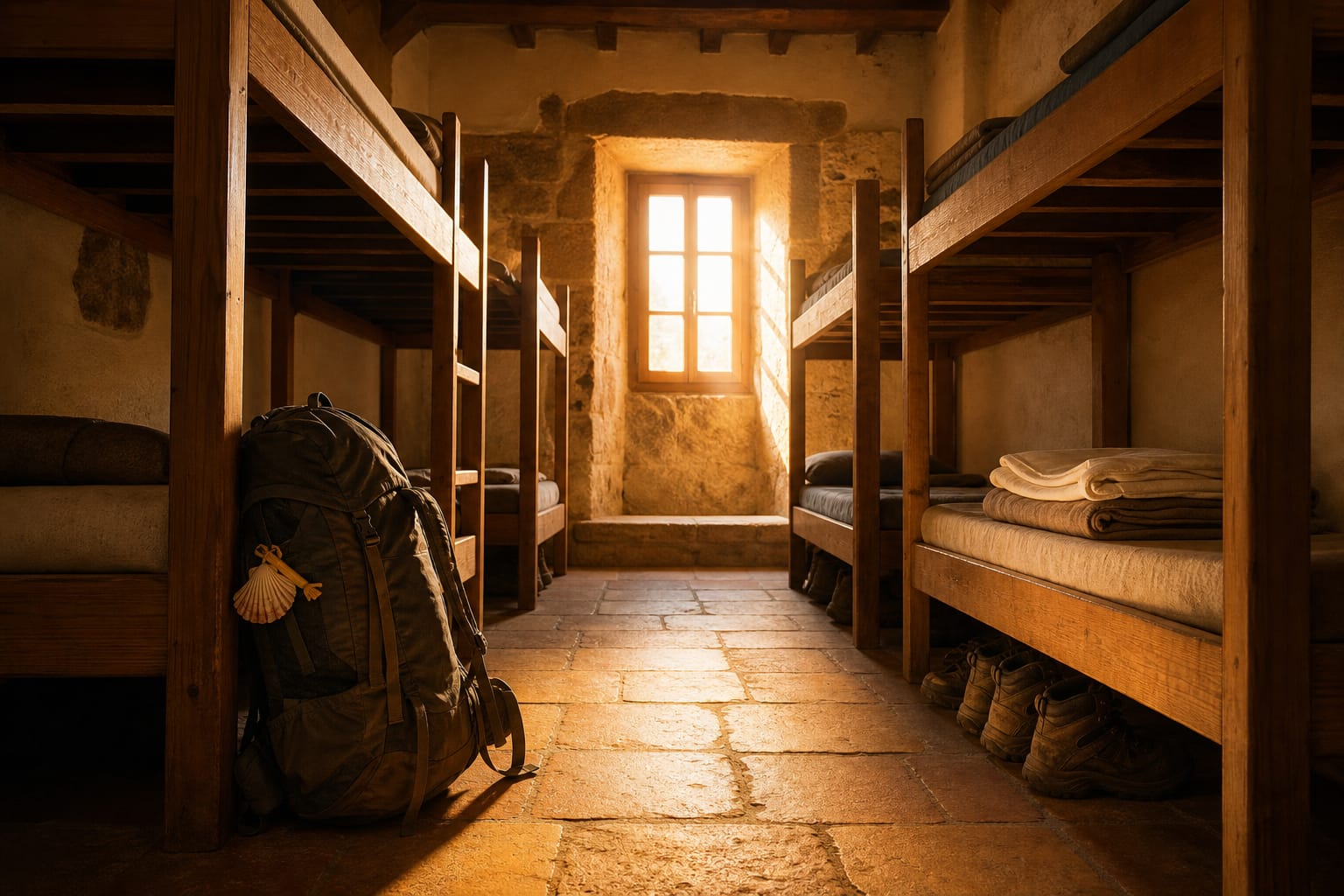
Albergues are pilgrim-only hostels along the Camino. You show a stamped credencial at check-in, pay in cash, and get a dorm bunk for one night. In 2026, Xunta-run public albergues in Galicia charge €10, other municipals €8–12, private albergues €15–27, and donativos accept a fair donation.
That is the whole system in one paragraph, and it stays true for almost every bed on the route. The Camino Francés alone has more than 450 albergues, spaced roughly 8 to 12 km apart, with a maximum gap of about 17 km between beds. You are rarely far from the next one. What trips up first-timers is not finding a bed; it is not knowing the small rituals that surround it, so the first night feels like a test you did not study for.
There is no test. Walk in during the afternoon, put your credencial and some cash on the counter, and the hospitalero (the person who runs the albergue, often a volunteer) does the rest. They stamp your credencial, point you to a bunk, and tell you where the showers are. You will do this dozens of times before Santiago, and by the third afternoon it feels like second nature.
The one number worth internalising early: a dorm-based day on the Camino costs roughly €30 to €40 once you add a bunk, a pilgrim dinner, breakfast, and snacks. Over a week that is €210 to €280. Everything below is really just the detail behind those two figures, plus the handful of moments where knowing the system in advance saves you a bad afternoon.
The credencial del peregrino is a paper passport that identifies you as a pilgrim. Albergues require it at check-in and stamp it nightly, and the Pilgrim's Office in Santiago requires those stamps for your Compostela. It costs about €2, and you buy it from a Camino association at home or at your starting point.
Without a credencial you are not, in the eyes of an albergue, a pilgrim. It is the single document that opens the whole network of cheap pilgrim beds, and it is also your keepsake at the end: an accordion-folded strip covered in the inked stamps (sellos) of every town you slept in. First-timers sometimes treat it as an afterthought and then scramble for one at the start line. Sort it before you fly if you can.
Where to get your credencial before you fly
You have four reliable sources, and any of them works:
A national Camino association
Friends-of-the-Camino associations in most countries issue the credencial by post, free or for a small donation. This is the calmest option because it arrives before you leave home.
The Pilgrim's Reception Office in Santiago
At Rúa Carretas 33, the same office that later issues your Compostela sells the credencial for about €2. Useful if you finish and start again, less so for a first walk.
Parish churches and albergues along the route
Many albergues, monasteries, and parish churches at common start points sell them on the spot for a euro or two.
Your starting-point pilgrim office
If you begin in Saint-Jean-Pied-de-Port, Sarria, or another hub, the local pilgrim office hands them out first thing in the morning.
For the difference between the credencial, the Compostela, and the distance certificate, our guide to the pilgrim credential walks through each one, and a side-by-side comparison sorts out which document proves what.
Stamps, the one-night rule, and your Compostela
Every albergue stamps your credencial when you check in, so a night's stay and a sello arrive together. In the final 100 km from Sarria, the Pilgrim's Office wants at least two stamps per day, not one, so add a second from a cafe, church, or shop midway through the day. That final stretch is exactly where forgetting the second stamp turns into an argument at the cathedral, so build the habit early.
The credencial also enforces the one-night rule quietly. Municipal and Xunta albergues limit stays to a single night, except for genuine illness or injury, so nobody parks in a cheap bunk for a week. Walkers get priority over cyclists, who often can only claim a bed later in the afternoon. None of this needs memorising; the hospitalero manages it. But it explains why you cannot phone a municipal to hold your bunk for tomorrow, and why the cheapest beds are always a same-day, first-come arrangement.
Municipal and Xunta albergues are the cheapest at €8–12, run first-come-first-served, put walkers before cyclists, and hold you to one night. Private albergues cost €15–27, take reservations, and add smaller dorms plus extras like laundry and dinner. Donativo albergues run on donations and often include a communal meal, so pay what the stay is genuinely worth.
Those three types cover almost every bed you will meet, and the trade-off between them is the same every afternoon: money against certainty and comfort. Cheaper beds mean you queue and take your chances; pricier beds mean you can book ahead and sleep in a smaller room. Neither is the "right" choice. Most pilgrims mix them, leaning on municipals to keep the budget down and booking a private when they want a guaranteed bed or a quieter night.
Xunta and municipal albergues
Xunta de Galicia runs the public network inside Galicia: roughly 70 hostels with about 3,500 beds, all charging a flat €10 per person in 2026. Municipal albergues outside Galicia are run by town councils and cost €8–12. Both are basic and honest: bunk rooms, hot showers, a kitchen or microwave, and not much else. They do not take reservations. You arrive, you queue, you get a bed if beds remain. In shoulder season that is a non-issue; in July on the Sarria stretch it means arriving by early afternoon.
Private albergues
Private albergues (€15–27) are the flexible option. They take reservations, often by a quick WhatsApp message with no prepayment, so you can lock in a bed the night before. Rooms are usually smaller, four to eight bunks rather than twenty, sometimes with curtains for a scrap of privacy. Many add a laundry service, a bar, breakfast, or a menú del peregrino dinner. When you want to be sure of a bed on a busy stage, or you simply want to sleep better, a private is worth the extra €5 to €15.
Donativo and parish albergues
Donativo albergues, many of them parish- or association-run, ask for a donation instead of a set price. There is no fixed number on the wall, which unsettles some first-timers into leaving too little. The honest guideline: pay what the stay was genuinely worth to you, usually at least what a municipal would have charged, and more if there was a shared meal and someone cooked it. These places often run a communal dinner where everyone eats together, and they are, for many pilgrims, the warmest nights on the whole route. Treating the donation box as a way to sleep cheap misses the point and starves the next pilgrim of the same welcome.
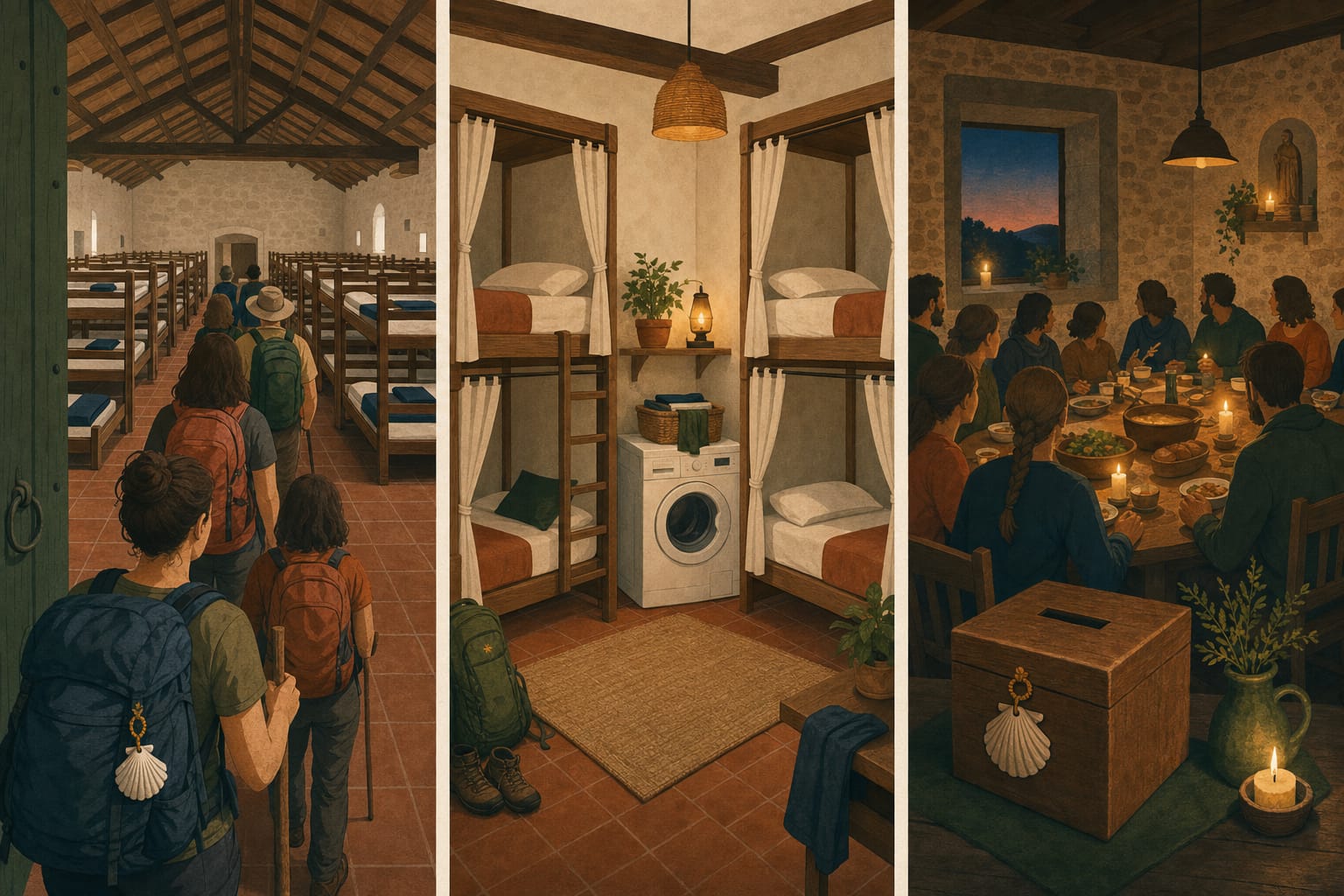
Expect €10 for Xunta albergues, €8–12 for municipals, €15–27 for privates, and €10–15 for a pilgrim menu dinner. A realistic dorm-based 2026 budget is €30–40 per day, or €210–280 per week, with the occasional €40–60 private room booked as a planned recovery night.
Here is how the four types you actually meet on the Camino Francés compare across the things that matter at the door:
| Albergue type | 2026 price per night | How to book | Key rules | Typical facilities | Best for |
|---|---|---|---|---|---|
| Xunta / municipal | €8–12 (€10 flat in Galicia) | No booking; first-come, walkers before cyclists | One night only, arrive same day, cash | Large dorms, hot showers, kitchen or microwave | Keeping the budget low, spontaneous pilgrims |
| Private | €15–27 | WhatsApp or Booking.com, often no prepayment | Reservations held, house rules vary | Smaller dorms, sometimes curtains, laundry, bar, dinner | A guaranteed bed and a quieter night |
| Donativo | Donation (give a fair amount) | Walk up; rarely bookable | One night, respect the shared space | Communal meal, simple bunks, strong community | Pilgrims who want the traditional, social night |
| Parish | Donation or a few euros | Walk up | One night, often a shared prayer or meal | Basic bunks, communal dinner, volunteer hosts | A quiet, traditional stop with hospitaleros who care |
Budget math: a week in dorms vs mixing in private rooms
A pure-dorm week is the cheapest way to walk. Bunk plus a menú del peregrino plus breakfast and snacks lands at €30–40 a day, so seven days is €210–280. If you book a €10 Xunta bed most nights and cook a couple of dinners in the albergue kitchen instead of eating out, you drift toward the bottom of that range.
Most first-timers do not walk a pure-dorm week, and that is fine. Plan for one paid comfort night every four or five days: a €40–60 room in a pensión, guesthouse, or casa rural where you get a door that locks, your own shower, and a full night without a snorer two bunks over. Slot those in deliberately rather than caving to them mid-panic and they stay cheap. Hotels start around €80 and are the exception, not the rhythm. For the full month-level picture, our 30-day Camino budget for 2026 breaks down every line, and if you are still choosing when to walk, the best-time-of-year guide covers how season shifts both price and crowding.
Most albergues open between 13:00 and 15:00. You queue, show your credencial, pay, claim a bunk, shower, and hand-wash laundry by late afternoon. Dinner runs 19:00 to 21:00, doors and lights close around 22:00, the dorm starts stirring from 06:00, and everyone must be out by 08:00.
The rhythm is the same across the whole route, which is oddly reassuring: once you have done it once, you know the shape of every evening ahead.
13:00–15:00 — Check-in opens
Doors open in the early afternoon. On busy stages a small queue forms before opening; on quiet ones you walk straight in. Credencial and cash on the counter, name and passport number in the book, and you are done.
Mid-afternoon — Bunk, shower, laundry
Claim your bunk, unroll your liner, shower while there is still hot water, and hand-wash the day's clothes so they dry on the line before dark. This is the quiet, satisfying part of the day.
19:00–21:00 — Dinner
Either a menú del peregrino at a bar (€10–15 for three courses, usually with wine) or a communal meal cooked in the albergue. Communal dinners are where the friendships form.
22:00 — Lights out
Doors lock and lights go off, often on a hard schedule. Late arrivals can find themselves shut out, which is another reason not to cut the afternoon fine.
06:00–07:00 — The dorm wakes
Someone's alarm goes at six, then the rustle of dry-bags and Velcro. Pack the night before to spare everyone the 06:00 zip symphony.
08:00 — Checkout
You must be out, bunk cleared, by eight. Municipals are strict about it; the bed is being turned for tonight's pilgrims.
Book ahead for May to September on the Camino Francés, especially the last 100 km from Sarria, where summer beds sell out days early; reserve that stretch three to four months out. Off-peak, or away from the guidebook stage-end towns, walking up before 14:00 still reliably finds a bunk.
The instinct to book every night from home is understandable and usually wrong. Over-booking locks you into a schedule the trail will not respect, and it strips out the flexibility that makes the Camino work. The skill is knowing the few places and dates where booking genuinely pays, and staying loose everywhere else. Our deep dive on booking versus walking up works through the trade-off stage by stage; the short version follows.
Reservation channels compared: WhatsApp, Booking.com, or walk-up
- Walk-up. The only way into a municipal or Xunta albergue, which almost never take reservations. Arrive before 14:00 on a busy stage and you are near the front of the queue.
- WhatsApp. Many private albergues take a booking by message, often with no prepayment. Send a quick note the night before or that morning and they hold a bed. This is the sweet spot for peak season: certainty without committing to a rigid itinerary.
- Booking.com. Lists only a subset of private albergues, sometimes at commission-inflated rates. Handy when you cannot reach anyone by phone, but you will pay for the convenience, and municipals never appear there.
Peak-season timelines by route segment
The pressure is not spread evenly. It concentrates on the last 100 km, because Sarria is where most pilgrims start. In 2025, 162,040 pilgrims began there, about 32% of all arrivals, on a Camino that saw a record 530,919 Compostelas in total (a 6% jump on 2024), with 242,058 of those walking the Francés. All those Sarria starters funnel onto one short, crowded stretch.
You can complete any albergue check-in with your credencial, cash, and three phrases: 'Hola, una cama, por favor' (hello, a bed, please), '¿Cuánto cuesta?' (how much?), and 'Un sello, por favor' (a stamp, please). Hospitaleros handle non-Spanish speakers every day, and pointing at the credencial and the price list works everywhere.
Language anxiety keeps some first-timers from even starting. It should not. The transaction is short, physical, and the same every time: paper, money, bunk. A translation app covers anything the phrases below miss, and the price is usually written on a board you can point at.
Ten check-in phrases with pronunciation
Hola, una cama, por favor
OH-lah, OO-nah KAH-mah, por fah-VOR. Hello, a bed, please. This one sentence starts almost every check-in.
¿Cuánto cuesta?
KWAN-toh KWES-tah. How much does it cost? Pair it with pointing at your wallet.
Un sello, por favor
oon SEH-yoh, por fah-VOR. A stamp, please. Hold out your credencial as you say it.
¿Hay camas?
eye KAH-mahs. Are there beds? The first thing to ask when you fear a place is full.
¿Dónde está la ducha?
DON-deh es-TAH lah DOO-chah. Where is the shower?
Gracias / De nada
GRAH-see-ahs / deh NAH-dah. Thank you / You're welcome. Used constantly.
¿Se puede lavar ropa?
seh PWEH-deh lah-VAR ROH-pah. Can I wash clothes here?
¿Hay cena?
eye SEH-nah. Is there dinner? Ask early so the cook can count you in.
Soy vegetariano / vegetariana
soy veh-heh-tah-ree-AH-noh / -nah. I am vegetarian. Say it at check-in, not at the table.
¿A qué hora se cierra?
ah keh OH-rah seh see-EH-rrah. What time do you close? Good to know before the 22:00 lock-out.
What actually helps Korean and Japanese pilgrims
For pilgrims flying in from Korea or Japan, the largest non-European cohorts on the Camino (7,481 South Korean pilgrims alone completed it in 2025), the real gap is not spoken Spanish but a written fallback. Keep the three core phrases saved as text you can show the hospitalero, load an offline translation app before you lose signal in rural Galicia, and carry a note of your name and passport number in Latin letters so the check-in book goes quickly. Hospitaleros are used to Korean and Japanese walkers and will meet you halfway; the credencial and a smile do most of the work.
Ask the hospitalero to phone ahead first, because they know which nearby albergues still have beds. Then check private albergues, pensiones, and casas rurales in the same town, walk or taxi to the next village where beds off the stage-end towns free up fastest, and treat a €40–60 room as the paid backstop.
It happens to almost everyone once: you arrive, and the word is completo. On the Camino Francés this is an inconvenience, not a crisis. Nobody ends up sleeping outside. Work the options in order and a bed appears, usually within a few kilometres.
Ask the hospitalero to call ahead
The person at the full albergue knows the local bed situation better than any app. Ask them to phone the next places. This one move solves most full-albergue nights.
Check private beds in the same town
Private albergues, pensiones, and casas rurales often have space when the municipal is full. A quick loop of the town, or a WhatsApp message, turns up a bed.
Move to the next village
Beds away from the guidebook stage-end towns empty last. Walk on 3 to 5 km, or take a short taxi, and you land where the crowd is not.
Take the paid backstop
A €40–60 pensión room is the reliable fallback. It is a more expensive bed for one night, not a failure. The Compostela never asks how you slept.
If
Beds likely nearby
If
Town is genuinely full
Pack earplugs, an eye mask, and a silk liner, because snoring is guaranteed in a 20-bed dorm. Pilgrims with mobility needs should target newer private albergues with ground-floor beds and reserve ahead. For dietary restrictions, tell the hospitalero at check-in, not at the dinner table, and most communal cooks adapt with notice.
A dorm is a shared room, and the small kit and courtesies below are what make it a good night rather than an endured one.
On accessibility, the older municipal and stone-built albergues can mean stairs and upper bunks, so pilgrims with mobility needs do best in newer private albergues, which more often have ground-floor beds, and should reserve ahead to secure them. On diet, the default pilgrim menu leans meat-heavy, but communal cooks and menú del peregrino kitchens usually adapt with a few hours' notice, so flag "soy vegetariano" or a gluten issue at check-in rather than at the table. Carry a backup of nuts, fruit, or a slice of tortilla de patatas for the stops that cannot help. One more rule that catches people out: dogs are not allowed in the vast majority of albergues, public or private, so a walk with a dog needs a very different lodging plan.
If this is your first Camino and the accommodation piece is only one of many open questions, our complete first-Camino planning guide pulls the whole trip together, and the routes-and-distances overview helps you pick where to walk in the first place.
FAQ
How do I check into a Camino albergue if I don't speak Spanish or English?
Hand over your credencial and cash; that covers most of the check-in. Learn three phrases: 'una cama, por favor' (a bed, please), '¿cuánto cuesta?' (how much?), and 'un sello, por favor' (a stamp, please). Hospitaleros check in non-Spanish speakers every day, so pointing at the price list and using a translation app fills any gap. Write your name and passport number clearly; that is all the paperwork needs.
What should I do if every albergue is full when I arrive on the Camino?
Ask the hospitalero at the full albergue to call ahead, since they know which nearby places still have beds. Check private albergues, pensiones, and casas rurales in the same town, then walk or taxi 3 to 5 km to the next village, where beds away from guidebook stage-ends empty last. A €40–60 pensión room is the reliable paid backstop; on the Camino Francés, nobody ends up sleeping outside.
Do I need to book albergues in advance in 2026?
On the Camino Francés between May and September, yes for private albergues, and three to four months ahead for the Sarria-to-Santiago stretch in peak summer. Municipal and Xunta albergues cannot be booked at all, so arrive before 14:00 to be near the front of the queue. In shoulder season and winter, walking up works almost everywhere.
Are Camino albergues open in winter?
Only around 40% of albergues stay open year-round. Municipal and Xunta albergues are the most likely to remain open, while many private and donativo albergues close from November to March. Winter walkers should plan each stage around a hostel confirmed open that week, since the next bed can be a full stage away.
Can I get vegetarian or gluten-free food at albergue communal dinners?
Usually, if you say so at check-in rather than at the table; most communal cooks and menú del peregrino kitchens adapt with a few hours' notice. The default pilgrim menu is meat-heavy, so carry a backup like nuts, fruit, or the widely available tortilla de patatas. Albergues with a guest kitchen plus a supermarket in town give you full control.
How do I avoid bedbugs in Camino albergues?
Use a silk liner, keep your backpack on the floor or a rack rather than the mattress, and check mattress seams for dark spots before claiming a bunk. If you get bitten, tell the hospitalero immediately so the bed can be treated, and run your clothes and liner through a hot dryer at the next town's lavandería.
External citations
Pilgrim's Reception Office, Santiago
oficinadelperegrino.comPrimary source for 2025 arrival numbers (530,919 Compostelas, the route and nationality splits, and the Sarria starting figure) that anchor every demand and booking-pressure claim here.
Xunta de Galicia — official Camino portal
Authoritative source for the public albergue network in Galicia, its house rules, and the €10 nightly price.
Pilgrim's Reception Office — the credencial
Official documentation of how the credencial is obtained and stamped, backing the acquisition walkthrough and the two-stamps-a-day Compostela requirement.
La Compostela del Lector
You walked this guide to Santiago.
All 771 km, 0 stages, stamped end to end.