
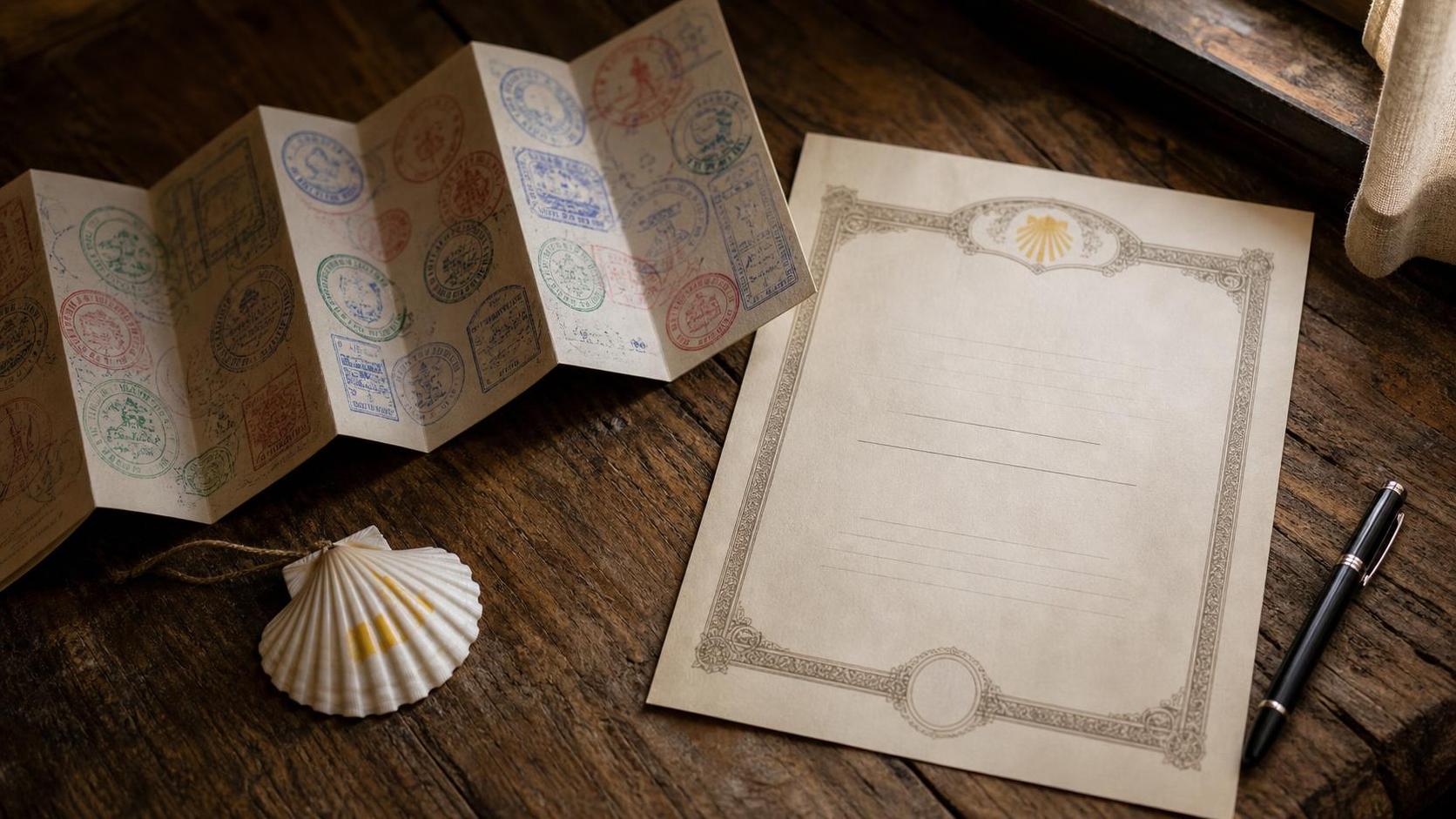
The Compostela is the Cathedral of Santiago's Latin certificate confirming you completed the pilgrimage. To qualify you need at least 100 kilometres on foot or horseback, or 200 by bicycle, a stamped credencial with two stamps a day on the qualifying stretch, and a religious or spiritual motive.
The Cathedral is direct about who it is for: the award "is limited to those who come to the tomb of the Apostle for religious and/or spiritual reasons." It is not a fitness record and not proof of distance: it does not print your kilometres at all. If a number is what you want, that is the other document, further down.
The Pilgrim's Office issued 530,919 of them in 2025, six percent up on 2024 and roughly double the 262,458 issued in 2015. Ninety-three percent of recipients walked, and almost a third started in Sarria. Collecting the certificate is one errand on a crowded arrival day, and the rest of that day is in our guide to the days after you reach Santiago.
The credencial is a folded paper passport you carry from the first day, and the only evidence the Pilgrim's Office reads. It has to be issued by the Church or a body the Church authorises, which is why souvenir versions from tourist shops sometimes get turned away. Where to buy one, what it costs, and how long a postal order takes are all in our guide to getting your pilgrim credential.
Stamps come from albergues, churches, monasteries, hotels, town halls and cafés. The office says they are "available in many places along the routes, particularly in the last 100 km," and plenty of bars on that stretch keep a sello by the till. Two things make a stamp count: a date, and a place on your route where you actually were that day. A second stamp from the same albergue on the same day adds nothing.
Here the guides and the Cathedral part company, so this section quotes the Cathedral.
You need 100 continuous kilometres in the direction of Santiago on one recognised route, and "the final stage must include at least, the last one leading into Santiago's Cathedral." Cyclists cover 200 kilometres on the same conditions. There is a sailing category the English page omits: 100 nautical miles, then the rest on foot from the port where you landed. Start outside Spain and at least 70 of the kilometres have to be inside it.
Two widely repeated claims are not in the official text. The first is that since 2025 the qualifying 100 kilometres may sit on any recognised section rather than the last one. The page says the opposite, and its English summary is blunter still: "at least the last 100 kilometres on foot." The second is a minimum length for the final stage, usually quoted as 20 kilometres walking or 50 cycling. That figure appears nowhere official. "At least" refers to the stage immediately before arrival, so it is a rule about position, not distance.
E-bikes are the other unsettled point. Most guides say they are excluded, but the Cathedral's page says only that other forms of travel are excluded "except in the case of the disabled," and that the Cabildo "reserves the right to grant the Compostela in special and exceptional cases." If you are riding one, write to the office before you go.
Two dated stamps a day on the counting stretch is what to plan for. The Cathedral words it as a stage rule rather than a daily one: "you must always get your Credencial stamped at the start and end of each stage, including the corresponding date." Walk one stage a day and those are the same instruction.
Sarria to Santiago in the usual five days is about 115 kilometres and costs you ten dated stamps. Tui to Santiago on the Portugués runs about 120 kilometres and splits the same way. Before the counting stretch, one stamp a day is enough.
Rest days and transfers are where credenciales go wrong. Stop for a day and you still want a stamp carrying that date. Kilometres covered by bus or taxi do not count.
The Compostela is free and asks for a religious or spiritual motive. The Certificate of Distance costs 3 euros, is printed on parchment paper, and records "the day and the starting point of the pilgrimage, the kilometres covered, as well as the day of arrival and the route." It asks nothing about why you walked, and it can be requested years later for a Camino you already finished. Most people take both, and a cardboard tube costs a couple of euros more.
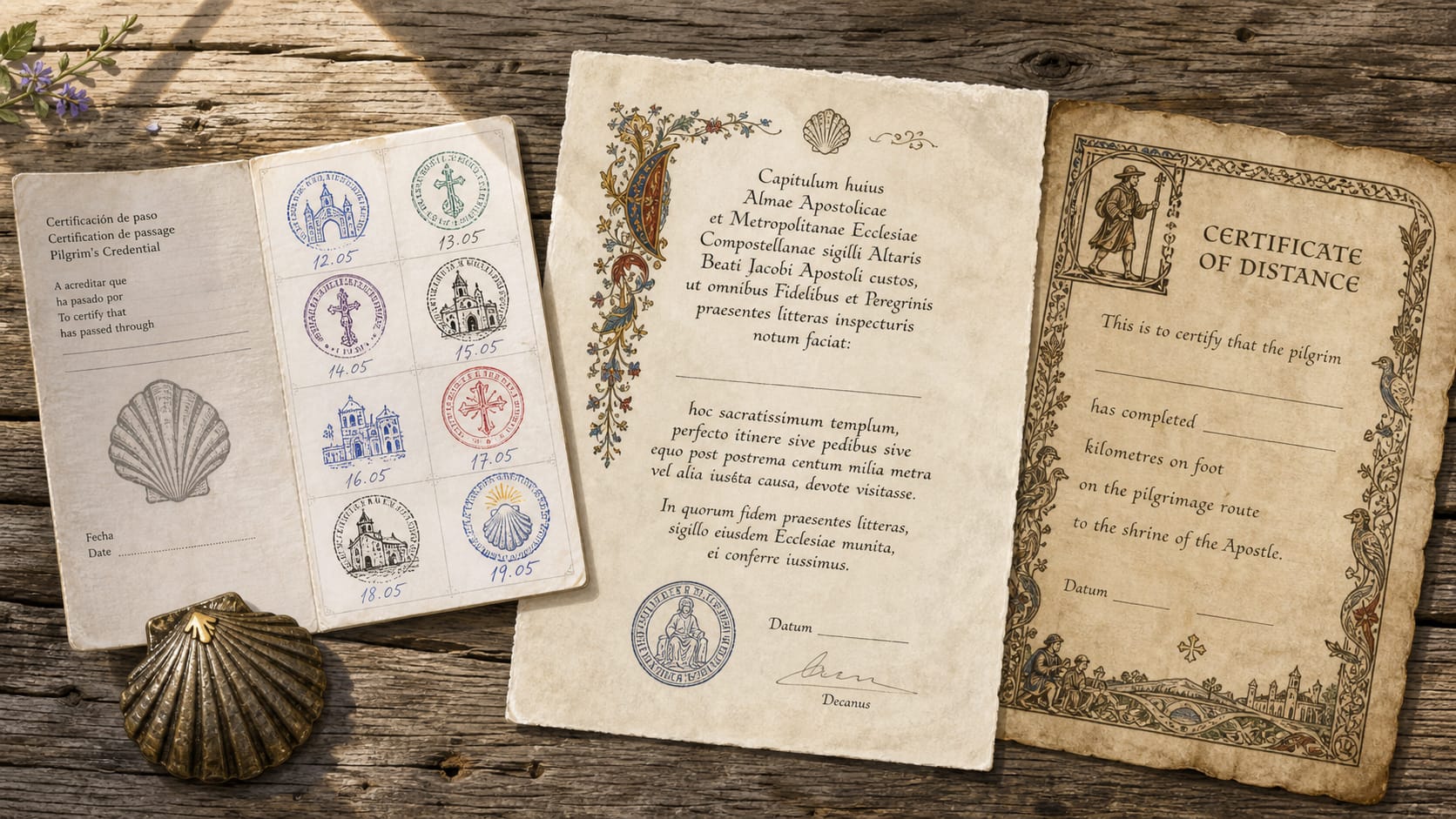
If the motivation question makes you uncomfortable, take the Distance certificate alone. All three documents are set side by side, with costs and eligibility, in our guide to the credencial, the Compostela and the distance certificate. The Fisterrana and the Muxiana are separate again, issued by the councils on the coast.
The office is at Rúa das Carretas 33, about 300 metres downhill from the Obradoiro, open 09:00 to 19:00 every day except 25 December and 1 January.
Fill in the pilgrim registration
Registration is a web form you reach by scanning a QR code, and you can fill it in from the trail or standing outside the door. It asks your details, your starting point and your motive.
Write your code on the credencial
An alphanumeric code comes back by email. Staff ask for it and for the date you registered, so copy it into the space provided on the credencial.
Take a queue ticket
Inside, you exchange the registration for a printed ticket carrying a number and a second QR code. Scanning that one shows your live position, so you can leave and come back.
Hand over the credencial
A screen sends you to a desk. A volunteer reads the credencial stamp by stamp, checks the dates against the distance you claim, and prints the Compostela with your first name in Latin. Ask for the Certificate of Distance at the same time if you want it.
A lost credencial is not the end of the walk. Buy a replacement at the next albergue or parish, ask them to date and sign a note about the gap, and keep every dated receipt from the days you lost. The desk sees ruined pages every week and judges them case by case. Our guide to replacing a credencial mid-route covers the practical side.
One missing or smudged stamp is usually survivable. A pattern of them is not, because the pattern is what the check looks for.
Arriving after 19:00 costs you a night and nothing else: the credencial does not expire, the office reopens at 09:00, and the first hour is the quietest of the day. An early flight is the real problem, and the fix is a spare day at the end of the trip, as our guide to the days after Santiago sets out.
The certificate is written in Latin and your first name is Latinised on it. In the Cathedral's own translation, the Chapter recognises that the named pilgrim "has devotedly visited this most sacred temple having done the last hundred kilometers on foot or on horseback or the last two hundred by bicycle with Christian sentiment (pietatis causa)." No speed, no fitness. A record that you came, and why.
Pilgrims once proved themselves with a scallop shell bought in Santiago, until forgers set up stalls at the city gates. The shells gave way in the thirteenth century to cartas probatorias, evidentiary letters, and those are the direct ancestor of the paper handed over today. The name is unsettled too: the romantic reading is campus stellae, field of the star, while linguists mostly prefer compositum, an old word for a burial ground.
Frequently asked questions
How many stamps do I need, and what if a day's stamp is missing?
Plan on two dated stamps for every walking day on the qualifying stretch, and at least one per day before that. A single missing stamp is usually not fatal: bring dated receipts, albergue tickets, or photos and explain it at the counter, where each case is judged individually. The Cathedral phrases the rule as a stage rule, requiring a dated stamp where each stage starts and where it ends.
What is free and what costs money at the Pilgrim's Office in Santiago?
The Compostela itself is free. The Certificate of Distance costs 3 euros, and a protective cardboard tube is a couple of euros more. Your credencial is bought before you start, usually for a few euros, from an albergue, cathedral, or pilgrim association. Nothing else at the counter carries a price.
Can someone else collect my Compostela, or can it be posted to me?
No. The Cathedral grants it in person and individually, never to third parties, and it cannot be arranged by phone or online or sent by post. Every member of a group queues separately.
Do I still qualify if I am not religious?
The Compostela asks for a religious or spiritual motive. If that does not describe you, ask for the Certificate of Distance instead: it costs 3 euros, records your exact route and kilometres, and carries no motivation requirement.
Does walking to Finisterre or Muxía count toward the Compostela?
No. Those walks lead away from Santiago, and the rules require the last stage to end at the Cathedral. They earn their own certificates, the Fisterrana and the Muxiana. Collect your Compostela before you set off west.
Can I walk the Camino in stages across several years?
Yes, as long as the stages run in chronological and geographical order and the last one ends at the Cathedral. Get a dated stamp where each stage stops and another where the next one starts, so the sequence is readable.
External citations
Pilgrim's Reception Office — the Compostela
oficinadelperegrino.com/en/pilgrimage/the-compostelaThe Cathedral's own eligibility rules, plus the Latin text and its translation.
Oficina de Acogida al Peregrino — la Compostela (Spanish)
oficinadelperegrino.com/peregrinacion/la-compostelaThree rules the English translation drops: sailing, no mixing routes, in-person only.
Pilgrim's Reception Office — certificate of distance
oficinadelperegrino.com/en/pilgrimage/certificate-of-distanceThe official price and content of the Certificate of Distance.
American Pilgrims on the Camino — statistics
americanpilgrims.org/statisticsCurrent issuance figures: 530,919 Compostelas in 2025 and the 93 percent arriving on foot.
La Compostela del Lector
You walked this guide to Santiago.
All 771 km, 0 stages, stamped end to end.