
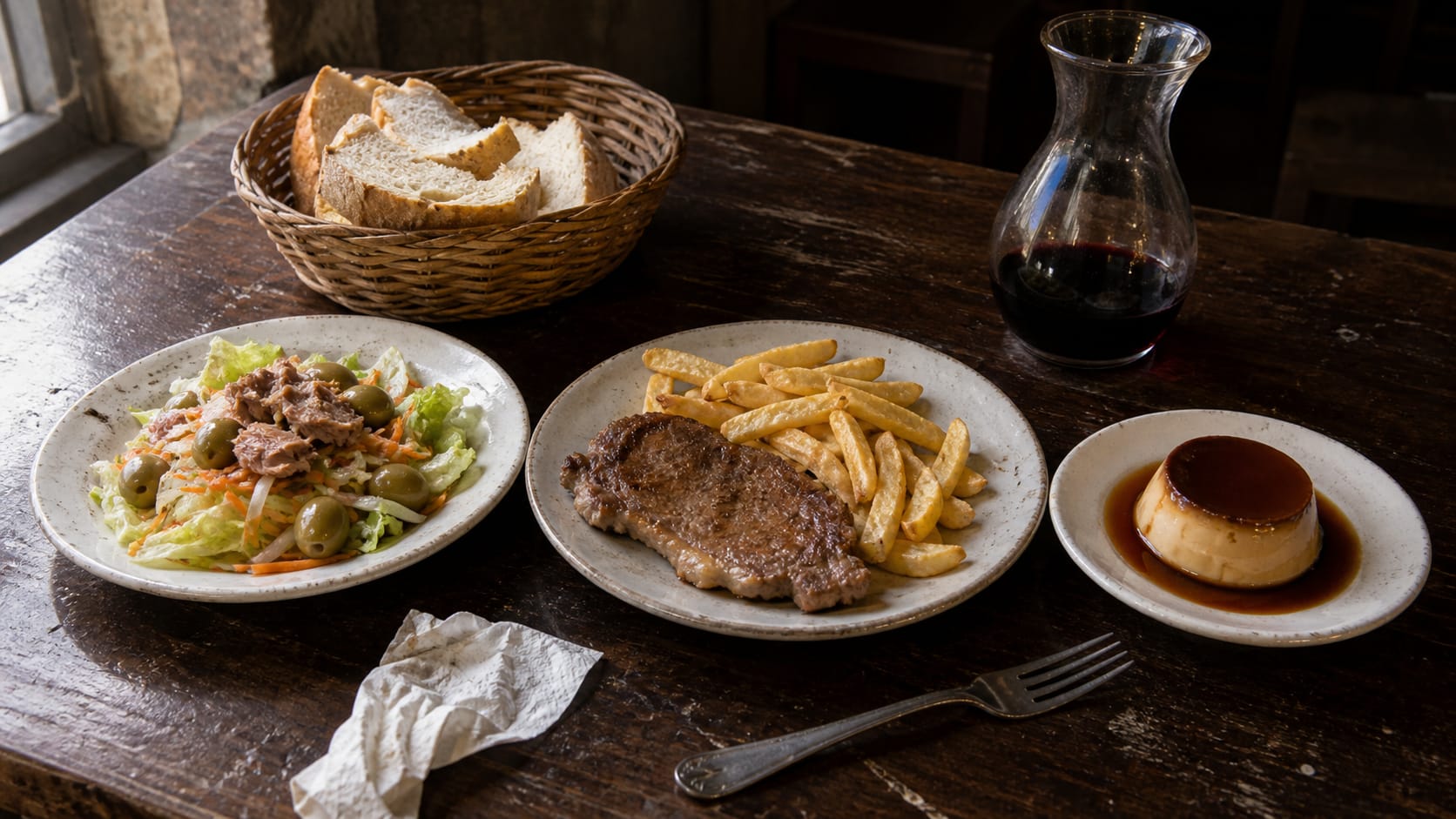
The menú del peregrino is a fixed-price meal built to refuel a walker: one starter, one main, one dessert, bread, and a drink, all for a single figure chalked on a board by the door. In 2026 that figure sits between about 10 and 15 euros across the main routes. It is good value for calories and for the fact that it appears without effort at the end of a long stage. It is weak on choice, and the cooking is average by design.
You will find it wherever pilgrims sleep, which means village bars with four tables as often as proper restaurants. The City of Pamplona, which publishes an official description of the offer, defines it as two dishes plus a drink and a dessert, and says the credencial is what gives access to it. In practice most bars on the Camino Francés serve anyone who asks and charge the board price, but the credencial in your pocket is the reason the offer exists at all.
The honest verdict: order it on the nights you are too tired to think, and treat it as fuel rather than as dinner. If you are still costing the whole trip, our 30-day Camino budget for 2026 puts food beside beds and transport, and the first-Camino planning guide covers where the pilgrim menu sits in a walking day.
Three courses arrive in a fixed order, and you pick one dish from each list. The primero is a salad, a soup, a pasta or a plate of lentils. The segundo is pork, chicken, fish or a stew, almost always with chips. The postre is flan, ice cream, yoghurt or a piece of fruit. Bread lands on the table without being asked for, and wine or water is usually inside the price.
| Course | What it means | What is usually offered | The pick after a long stage |
|---|---|---|---|
| Primero | Starter, served as a full plate | Ensalada mixta, sopa de verduras, macarrones, lentejas, sometimes a Riojan potato stew | Lentils or the potato stew: salt, starch and something that is not fried |
| Segundo | Main course | Pork loin, chicken, hake or another white fish, a bean or meat stew, nearly always with chips | Fish if it looks fresh, stew if the bar has a kitchen rather than a fryer |
| Postre | Dessert | Flan, ice cream, industrial yoghurt, fruit, occasionally a slice of tarta de Santiago | Fruit if you want to sleep, flan if you want the sugar |
Do not read "starter" as a small plate. The primero is a full portion, and two of them make a perfectly respectable dinner if the segundo does not appeal. Bread is white, cut, and endless enough that nobody counts. Wine usually means a carafe or an open bottle of house red left on the table for one or two people to share, which surprises pilgrims from countries where a set menu means a single glass. Water is always an alternative and costs nothing extra, though bottled water is sometimes charged separately.
Published 2026 breakdowns put the menú del peregrino at 10 to 12 euros on the Camino Francés, 10 to 15 euros on the Camino Portugués, and 12 to 15 euros where the price is quoted for the full three courses with wine included. Galicia and the larger cities sit at the top of the band. Small villages with one bar sit at the bottom, and occasionally below it.
| Where you are | Typical 2026 price | What moves the number |
|---|---|---|
| Camino Francés, villages and small towns | €10–12 | Starter, main, bread and a drink; dessert sometimes counted separately |
| Camino Portugués, both sides of the border | €10–15 | Three courses with bread, water and a drink; Portuguese towns often cheaper than Galician ones |
| Galicia and the last 100 kilometres | €12–15 | Demand from Sarria onwards, and menus written for a crowd that will pay |
| Cities on any route | €12–15 | Rent, and the fact that a city bar has customers other than you |
Old numbers travel further than they should. Undated English-language guides still quote 8 to 17 euros for the pilgrim menu against 12 to 20 for the menú del día, and 2019 posts reporting full multi-course pilgrim meals under 10 euros describe a band that has closed. One 2026 estimate puts pilgrim-menu inflation at roughly 12 to 15 percent between 2024 and 2026, modest next to the 15 to 25 percent rise in albergue beds over the same period. Food is also the smaller half of your day: a municipal albergue runs 10 to 12 euros a night in 2026 and a private one 18 to 25, so the bed usually costs more than the dinner. The guide to Camino albergues covers that side of the ledger.
The menú del día is Spain's weekday lunch institution: three courses for locals, roughly 8 to 14 euros, served from about 13:30 to 16:30. The menú del peregrino is its evening, pilgrim-facing cousin. Same structure, narrower choice, lower quality, because the kitchen is cooking for people who will not be back tomorrow. If you can eat your main meal at lunch, order the menú del día.
The two price bands overlap, and that confuses people. The 8-to-14-euro figure for the menú del día is a nationwide average, while the 10-to-15-euro pilgrim menu band is drawn from the Camino, where rural demand and a captive audience push the floor up. What matters is the comparison inside a single bar: where one place offers both, the pilgrim menu is usually the cheaper board, and the menú del día is usually worth the one to three euros more.
Both descend from the same piece of law. The fixed-price Spanish set menu began as the menú turístico, created by the Orden de 17 de marzo de 1965 under Franco's Ministry of Information and Tourism, at a moment when Spanish visitor numbers had climbed from 2.9 million in 1959 to 11.1 million in 1965 and the state wanted a predictable, cheap, non-negotiable plate for tourists. The order fixed the shape that survives today: one dish from each group, plus roughly 80 grams of bread and a quarter-litre of local wine included in the price. A quarter-litre is a third of a standard bottle, which is why a carafe still lands on your table sixty years later. The legal obligation lapsed after 1975; restaurants kept the format because it works.
Spanish dinner rarely starts before 21:00, and most albergues lock the door and turn out the lights at 22:00, some private ones at 22:30. Pilgrim-facing kitchens solve that collision by opening early: from about 18:30, with 19:30 to 20:00 the most common sitting. Ask the hospitalero for the curfew when you check in, then ask the bar what time they start serving before you commit to it.
| Time | What is happening around you |
|---|---|
| 14:00–16:00 | La comida, the main Spanish meal, and the hour the menú del día is served |
| 16:00–18:00 | The siesta gap: kitchens closed, shops shut, nothing hot on offer |
| 18:30–20:00 | Pilgrim-facing kitchens serve the menú del peregrino |
| 21:00 onwards | Spanish dinner proper, in restaurants that were never aiming at you |
| 22:00 | Lights out in most albergues, door locked |
| 08:00–09:00 | You are expected to be gone, which is why the evening ran early |
The gap in the middle catches people out. You arrive at 15:00, shower, go looking for food at 17:00, and the village has closed. Buy what you want for the afternoon before the shops shut, and if the only restaurant in town opens at 20:30, make the supermarket your dinner plan rather than your fallback. Eating in the albergue means eating around other people's sleep, so the quiet-hours rules in our albergue etiquette guide apply to the kitchen as much as to the dorm.
Walk in and ask "¿Tienen menú del peregrino?" The waiter will either point at a chalkboard or read the day's options aloud, usually fast, usually once. Choose one dish per course, say "vino tinto" or "agua", and that is the whole transaction. Nobody expects fluency, and pointing works.
| Say this | It means | When |
|---|---|---|
| ¿Tienen menú del peregrino? | Do you have a pilgrim menu? | Walking in, before you sit down |
| ¿A qué hora empiezan a servir? | What time do you start serving? | Before you commit, so you make the curfew |
| De primero, la ensalada mixta | For my first course, the mixed salad | Ordering, course by course |
| De segundo, el pollo | For my main, the chicken | Ordering, course by course |
| Agua del grifo, por favor | Tap water, please | If you would rather not be charged for a bottle |
| ¿Lleva gluten? ¿Lleva carne? | Does it contain gluten? Does it contain meat? | Before you order, never after |
Two things you cannot do. You cannot rebuild the menu: the kitchen cooks a fixed list each day, and swapping the segundo for something off the board usually gets a polite no. Ordering two primeros instead of a primero and a segundo is the one accepted exception, and it is how most vegetarians eat. You also cannot count on a written menu existing. In small bars the options are spoken, so listen for the three groups and ask the waiter to repeat the segundos.
Vegetables are the first casualty. A salad starter and chips with everything is the standard shape, and after a week of it your body notices. Restaurants typically offer three alternatives per course, one of which is usually vegetarian, so vegetarians manage; vegans and coeliacs have a much thinner time outside cities. Portions are generous but unbalanced, which matters more than it sounds when you are walking every day.
The arithmetic explains why. Walking with a loaded pack burns roughly 400 to 600 calories an hour, so four to six hours over a 20 to 30 kilometre stage puts most pilgrims somewhere in a 2,000 to 3,000 calorie burn before basal needs are counted. A three-course pilgrim menu covers a good share of that, and it does so almost entirely with white bread, fried potatoes and pork. Fruit at the postre, an extra salad, and the food you carry during the day are what keep the balance from tipping. So is water: pilgrim menus are salty, and our guide to hydration and water sources covers what a walking day actually asks of you.
Coeliacs should treat a village bar as unsafe unless the staff confirm otherwise. Spain has better general gluten awareness than most of Europe and good supermarket gluten-free ranges, and FACE, the Spanish coeliac federation, certifies restaurants and trains kitchens. But reports of genuinely gluten-free pilgrim menus on the trail are anecdotal, and a shared fryer is a shared fryer. Vegans should expect the standard fallback of salad, chips and bread outside cities, and should shop rather than hope.
Skip the pilgrim menu when you want vegetables, when the bar is visibly reheating rather than cooking, or when three or four of you can cook a supermarket dinner in the albergue kitchen for a few euros each. Raciones shared between two, a communal albergue meal, or a couple of good tapas all beat a bad set menu, and cost the same or less.
| Option | 2026 price per person | When it is served | What you get | Best for | Where it fails |
|---|---|---|---|---|---|
| Menú del peregrino | €10–15 | 18:30–20:00 | Three courses, bread, wine or water | Late arrivals, tired legs, villages with one bar | Narrow choice, few vegetables, repetitive by week two |
| Menú del día | €8–14 | 13:30–16:30 | Three courses aimed at locals, wider choice | Anyone who can eat their main meal at lunch | Gone by dinner time, and a heavy lunch slows the afternoon |
| Albergue communal dinner | €10–12, or donativo | Usually 19:00–20:00 | One home-cooked meal, everyone at one table | Solo walkers, and the best evenings on the Camino | Only some albergues run one, and you eat what is cooked |
| Supermarket dinner in the albergue kitchen | €3–5 when four share | Whenever you cook it | Whatever you want, vegetables included | Rest days, groups, and pulling the budget down | Needs a working kitchen; shops shut for siesta and close early |
Sharing is the trick that makes the alternatives cheap. A ración is a full sharing plate and a media ración is half of one, so two pilgrims ordering two raciones and a salad eat better than either would alone from a fixed menu. Communal dinners are worth planning around: they usually cost 10 to 12 euros or run on a donation, and they sit at the heart of donativo culture. If you are staying somewhere without a kitchen, the trade-offs are covered in our guide to hostels, pensions and private rooms.
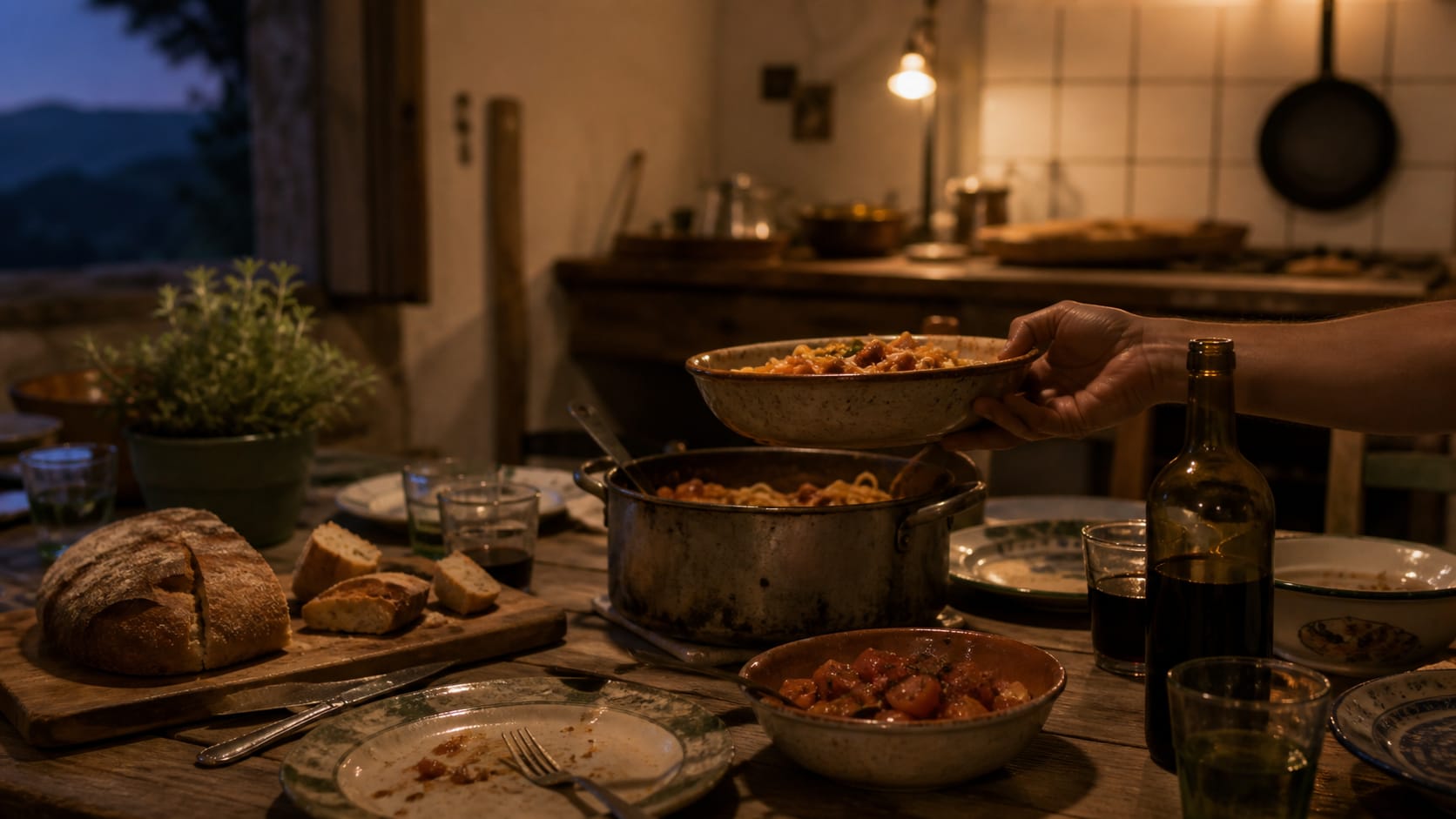
Most pilgrims settle into a rotation rather than a rule after the first week: pilgrim menu on the long days and in the small villages, menú del día when the stage ends before four, supermarket dinner when there is a kitchen and company, and the communal table whenever an albergue offers one. That mix eats better than any single option and costs less than most of them.
Frequently asked questions
Should I order the menú del peregrino or the menú del día on the Camino?
If you are eating at lunch and the bar offers both, order the menú del día. It is aimed at locals rather than walkers, so the kitchen is held to a higher standard and the choice per course is usually wider, for one to three euros more. Order the menú del peregrino in the evening, when the menú del día is no longer served, or in villages where it is the only fixed-price option on offer.
How do I eat dinner on the Camino before my albergue curfew?
Ask the hospitalero for the curfew time when you check in, since most albergues lock the door around 22:00. Then find a bar advertising a menú del peregrino and ask what time they start serving; pilgrim-facing kitchens open from about 18:30, well before the Spanish norm of 21:00. Sitting down at 19:00 gives you a comfortable two hours. If the only restaurant in town does not open until 20:30, buy supermarket food in the afternoon instead, because shops close for the siesta and reopen late.
Do I need my credencial to get the pilgrim menu price?
In practice, rarely. Most bars on the Camino Francés serve anyone who asks, and the chalkboard price is the price. Officially it is different: the City of Pamplona describes the credencial as what gives access to the offer, and some establishments do ask for it. Carry it anyway, since you need it for albergues, but do not expect to be turned away without it.
Is the wine really included, and how much do you get?
Usually yes, and usually more than you expect. A carafe or an open bottle of house red left on the table for one or two people is common, and the 1965 legal template the format descends from specified a quarter-litre per diner, a third of a standard bottle. The quality is functional rather than good. Water is always an alternative and costs nothing extra, but bottled water is sometimes charged separately, so ask for agua del grifo if you want tap.
What can vegetarians, vegans and coeliacs actually order from a pilgrim menu?
Vegetarians usually manage: most menus now carry one meat-free option per course, and ordering two primeros instead of a primero and a segundo is an accepted move. Vegans have a harder time outside cities, where the standard fallback is salad, chips and bread. Coeliacs face the thinnest ground of all. Spain has good general gluten awareness and strong supermarket gluten-free ranges, and FACE certifies gluten-free kitchens, but reports of genuinely gluten-free pilgrim menus on the trail are anecdotal, so treat a village bar as unsafe unless staff confirm otherwise.
Why is the pilgrim menu the same everywhere, and can I ask for substitutions?
The kitchen cooks a fixed list each day for a fixed price, so the whole economics depend on not customising it. Substitutions are generally refused, and asking to swap the segundo for a second salad usually gets a polite no unless the menu already offers it. The upside is speed and predictability. The downside is that by the second week you can recite the options before the waiter speaks.
How much should I budget per day for food on the Camino in 2026?
Around 20 to 28 euros covers a bar breakfast, a mid-morning coffee and snack, and one pilgrim menu, based on 2026 Spanish budget breakdowns. Mixing in supermarket dinners cooked in albergue kitchens pulls that towards 12 to 15 euros on the days you self-cater. Add the bed, 10 to 12 euros for a municipal albergue and 18 to 25 for a private one, and a typical all-in day lands near 35 to 60 euros.
External citations
Ayuntamiento de Pamplona, El menú del peregrino
www.pamplona.es/en/caminodesantiago/caminofrances/menuperegrinoThe city council's official description of what a pilgrim menu must contain, the role of the credencial, and its warning that some establishments pass off a discounted set lunch as one.
Boletín Oficial del Estado, Orden de 17 de marzo de 1965 (ordenación turística de restaurantes)
www.boe.es/buscar/doc.php?id=BOE-A-1965-6262The legal instrument that created the menú turístico and fixed the three-course format, the 80 grams of bread and the quarter-litre of wine that the pilgrim menu still copies.
FACE, Federación de Asociaciones de Celíacos de España
celiacos.orgThe national coeliac federation, which certifies gluten-free products and trains restaurant kitchens, and is the reliable ground under any gluten-free plan in Spain.
La Compostela del Lector
You walked this guide to Santiago.
All 771 km, 0 stages, stamped end to end.