
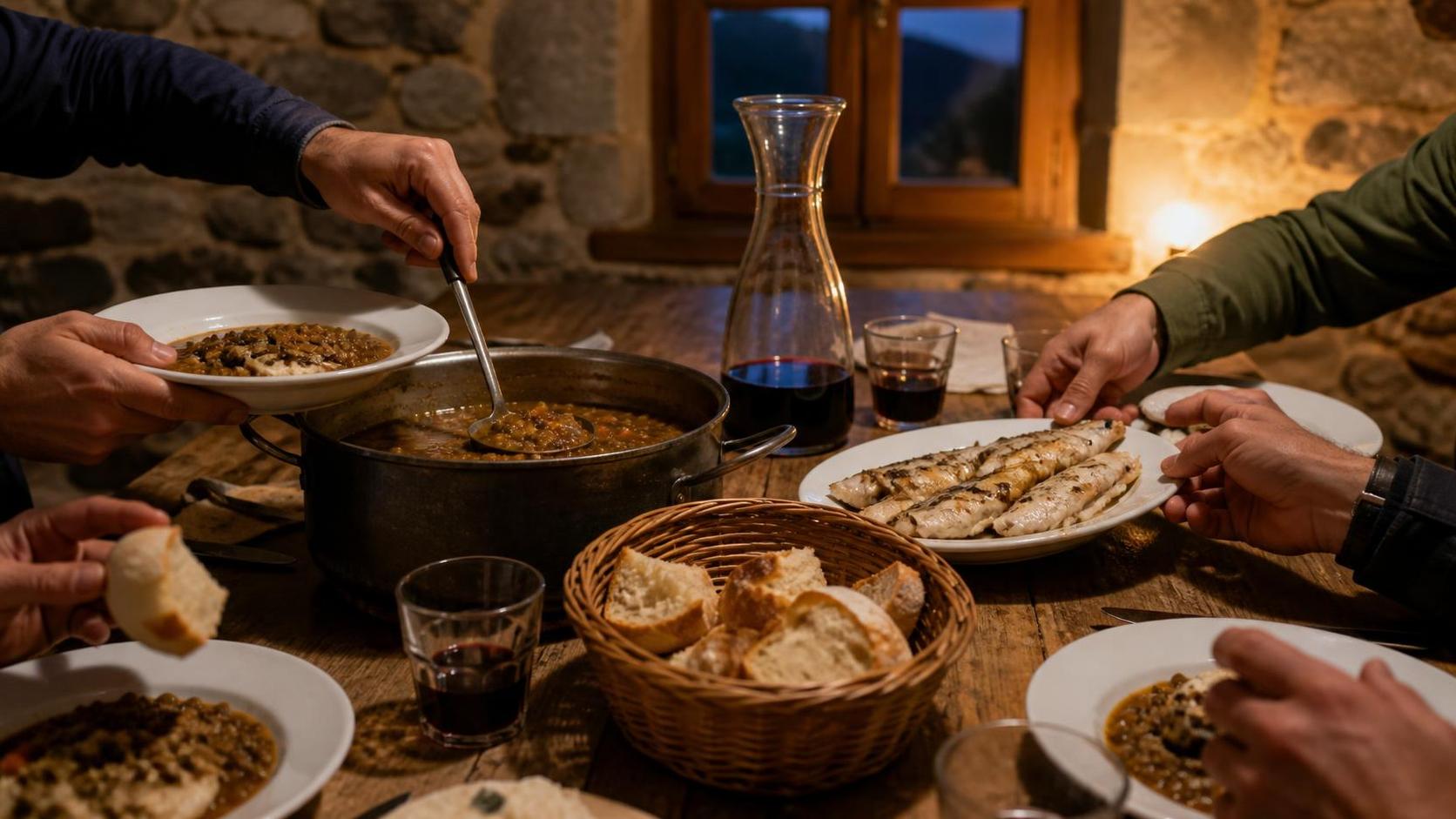
Most pilgrims eat four times a day on the Camino de Santiago: a light breakfast before walking, a mid-morning coffee with a slice of tortilla or a bocadillo, a sandwich or piece of fruit at lunch on the move, and a three-course pilgrim dinner in the early evening. Plan on roughly €18–35 a day for food in 2026, depending on whether you cook from supermarkets or eat every meal in a bar.
The number that trips people up is the old €20-a-day figure, and food is where it quietly breaks. Beds have climbed faster than plates since 2024, but a full eating day, done entirely in bars, is closer to €28–35 than to €20 now. The good news is that food is the one line you control almost completely. Sleep where the stage ends and you pay what the town charges; eat what you carry and cook, and you set your own price. This guide walks the food day in the order you meet it, then puts real 2026 numbers on it. For where food sits inside the whole trip, our 30-day Camino budget for 2026 puts it beside beds and travel, and the first-Camino planning guide covers where meals fall in a walking day.
A Camino day has four eating moments rather than the three most people arrive with. Breakfast is deliberately light because you walk on it. A second breakfast lands 8–10 km in, when the first coffee finally opens. Lunch is portable and eaten standing up or on a wall. Dinner, taken early by Spanish standards, is the one real sit-down meal and the social heart of the day.
Breakfast, before you set off
Coffee and toast, a croissant, or a pastry, usually taken standing at a bar as it opens, or grazed from the night before if you leave in the dark. Most pilgrims walk the first stretch on almost nothing and eat properly at the second stop. A café con leche and a tostada run about €3–4.
Second breakfast, 8–10 km in
The meal that matters. Somewhere around mid-morning the first open bar appears and everyone stops at once: coffee, a wedge of tortilla de patatas, or a bocadillo built on a split baguette. This is where the real fuel goes in, and where you meet the same faces day after day.
Lunch, on the move
Rarely a sit-down. A bocadillo bought that morning, fruit, nuts, cheese and chorizo, or whatever came out of a supermarket the night before, eaten on a wall with your boots off. Long, service-free stretches make lunch a thing you carry, not a thing you find.
Dinner, from around 19:00
The big meal, and it starts early because you do. Pilgrim-facing kitchens open from about 18:30, hours before Spain eats at 21:00, so you can be fed and back before the albergue locks at 22:00. This is where the three-course pilgrim menu earns its place, or where a shared albergue kitchen turns into the best evening of the week.
The rhythm is worth learning before you go, because it is not the one you eat at home. Two of the four moments happen before noon, and the biggest sit-down meal happens at an hour most visitors would call late afternoon. Pilgrims who try to keep their home schedule end up hunting for dinner at 21:30 in a village where the one kitchen closed an hour ago. That first meal is the hardest to get right, because the pre-dawn start means most bars are still shut when you leave, and it earns its own deep-dive later in this cluster on Camino breakfast options.
The menú del peregrino is a fixed-price, three-course pilgrim dinner: a starter (primero), a main (segundo), a dessert (postre), with bread on the table and a bottle of wine or water inside the price. In 2026 it costs about €10–15 across the main routes and is served from roughly 18:30 in most Camino towns, earlier than standard Spanish dinner. It is honest fuel at the end of a long day, not fine cooking, and you can recite the options by the second week.
The shape almost never changes. The primero is a salad, a soup, a plate of pasta, or lentils. The segundo is pork, chicken, or a white fish, nearly always with chips. The postre is flan, ice cream, yoghurt, or fruit. You choose one dish per course; you cannot rebuild the menu, though ordering two primeros instead of a primero and a segundo is the accepted move and how most vegetarians eat. Bread arrives unasked, and the wine is usually a carafe of house red left on the table to share, which surprises pilgrims from places where a set menu means a single glass.
Two things are worth carrying in your head. First, not every "pilgrim menu" is one: a real board lists alternatives per course and includes bread and a drink, while a single fixed plate with a euro knocked off is a discounted set lunch wearing a costume. Second, the pilgrim menu is fuel, not nutrition. It leans hard on white bread, fried potatoes, and pork, so the fruit at the end, an extra salad, and what you carry during the day are what keep the balance from tipping. The full breakdown, with 2026 prices by route and when to skip it, is in our guide to the menú del peregrino.
You buy food in four places on the Camino, and each does a different job. Village bars sell coffee, tortilla, and the pilgrim menu, and double as the day's meeting point with a toilet and wifi. Restaurants serve the sit-down meals. Small supermarkets and village tiendas are where self-caterers shop. Albergue kitchens, where they exist, turn that shopping into the cheapest good dinner on the route. Knowing which is open when is half the skill.
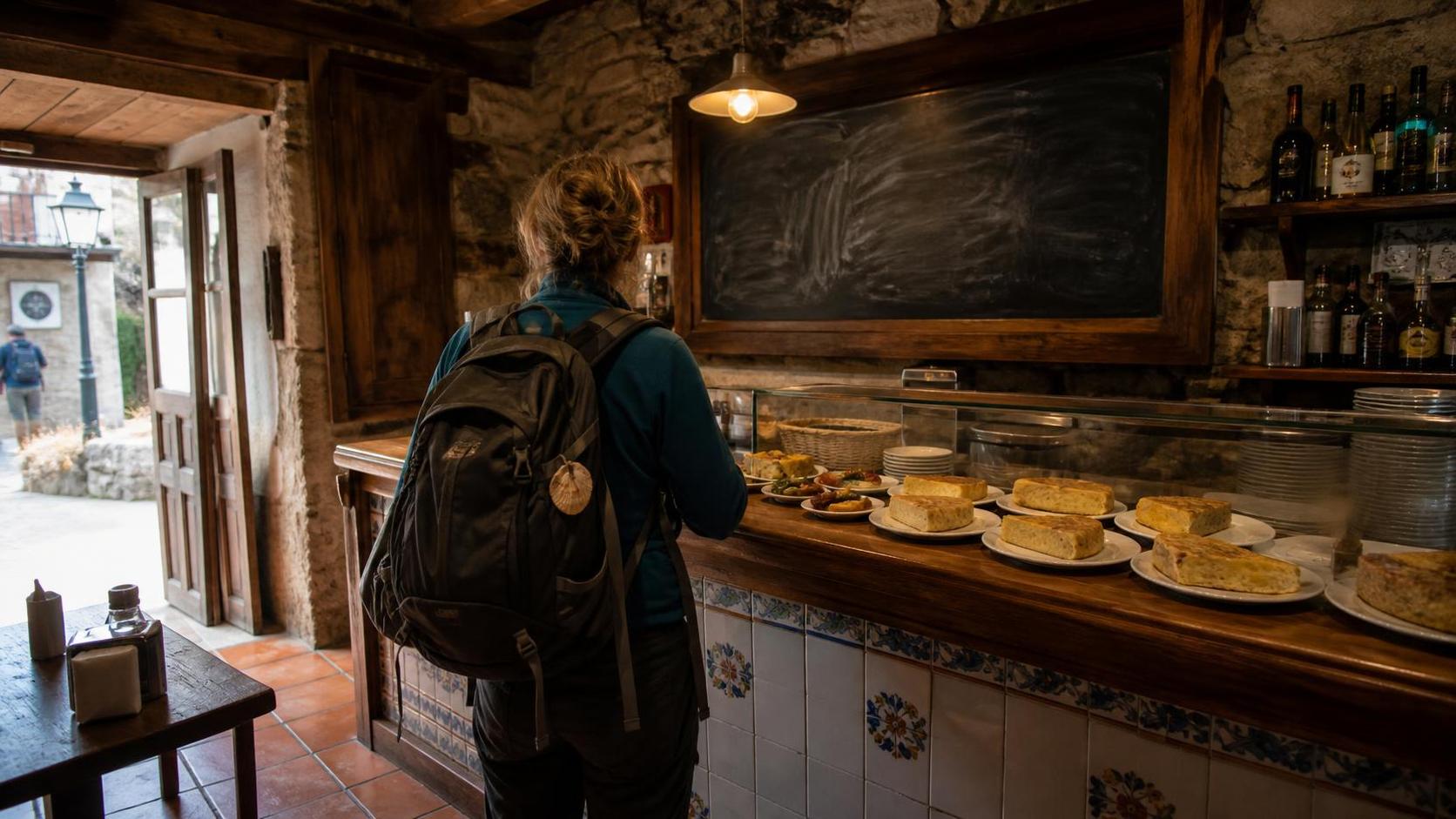
The bar is more than a place to eat. On the Camino Francés it is the village's front room, the spot where pilgrims regroup, dry out in the rain, charge a phone, and read the same weather off the same faces. Order at the counter, pay when you leave, and do not wait to be seated in a small one. The chalkboard by the door is the menu, the prices, and the opening hours all at once, so read it before you sit.
Cooking is where the budget really moves. Many albergues provide a communal kitchen, though often an under-equipped one, so plan simple food: pasta, a tin of lentils warmed through, eggs, salad, bread. Four pilgrims sharing a supermarket dinner eat well for a few euros each and have one of the better nights of the trip doing it. The catch is that kitchens are not guaranteed and gear varies wildly, so confirm there is one before you count on it, and shop before the siesta closes the only tienda in town. Timing the tienda on thin stretches is a skill in itself, and a dedicated Camino supermarket strategy guide follows in this cluster to cover it.
Your food budget per day falls into three honest tiers in 2026. Self-catering from supermarkets runs about €12–18. A mixed day, one pilgrim menu plus café and coffee stops, runs €20–28. Eating every meal in a bar or restaurant runs €30–40. Where you are on the route moves the number too: the Basque Country and the northern coast cost noticeably more than Galicia or the Meseta.
The table below is a single day, priced three ways. Nobody holds the bottom line for four weeks and nobody needs the top one, so most pilgrims live somewhere in the middle and drop to the cheap column on rest days and in towns with a good kitchen.
| Budget tier | Daily food cost | Breakfast | Lunch | Dinner | Trade-off |
|---|---|---|---|---|---|
| Self-catering | €12–18 | Supermarket bread, fruit, coffee made in the kitchen | Bocadillo and fruit carried from the shop | Pasta or lentils cooked in the albergue, shared | Cheapest and often healthiest, but needs a kitchen and a shop that is open |
| Mixed | €20–28 | Bar café con leche and a tostada | Bocadillo, a second coffee, a piece of fruit | One three-course pilgrim menu | The realistic middle: sociable, warm food, no cooking, but repetitive over weeks |
| Eating out | €30–40 | Full bar breakfast | Sit-down lunch or menú del día | Restaurant dinner or à la carte, a glass of wine | Most comfortable and varied, but doubles the cheap day and adds up fast over 30 days |
A few numbers anchor the columns. A bar café con leche and tostada runs about €3–4; buying that breakfast from a supermarket the night before roughly halves it. The pilgrim menu holds at €10–15. Self-catering two or three dinners a week is the single easiest way to pull the food line down without eating badly. Region matters as much as habit: the same mixed day costs more in Saint-Jean or Bilbao than in a Galician village, so budget for the expensive end early on the northern routes and the cheaper end across the Meseta. Set against the bed, food is usually the smaller half of the day, which is why it is also the easier half to cut when money gets tight.
You can eat well on the Camino with almost any diet, but the further you get from a meat-and-potatoes default, the more you plan. Vegetarian options turn up on most menus. Vegan, gluten-free, and allergy-safe eating need clear communication and, outside cities, a supermarket you control rather than a kitchen you hope about. A few Spanish phrases, or a written card, cover the gap where a translation app fails.
Sin gluten (gluten-free)
Spain has strong general gluten awareness and good supermarket gluten-free ranges, and FACE, the national coeliac federation, certifies kitchens. But a genuinely gluten-free pilgrim menu on the trail is rare and a shared fryer is a shared fryer, so treat a village bar as unsafe unless the staff confirm otherwise.
Soy vegetariano/a (I'm vegetarian)
Manageable almost everywhere. Most menus carry a meat-free option per course, and ordering two primeros in place of a primero and a segundo is the standard move. Lentils, salads, tortilla, and pasta are your reliable backbone.
Soy vegano/a (I'm vegan)
Harder outside cities, where the fallback is salad, chips, and bread. Shop rather than hope: supermarkets carry the range that rural kitchens do not, and a self-catered dinner removes the guesswork entirely.
Soy alérgico/a a… (I'm allergic to…)
Carry a written allergy card in Spanish for busy bars where the waiter reads the options aloud once and fast. Ask before you order, never after, and in larger towns lean on supermarkets where you can read every label yourself.
The ordering itself is short. Walk in and ask "¿Tienen menú del peregrino?", choose one dish per course from the board or the options read aloud, and say "vino tinto" or "agua". If you want tap water rather than a charged bottle, ask for "agua del grifo". Nobody expects fluency and pointing works, but the two questions that actually protect you are "¿Lleva gluten?" and "¿Lleva carne?" (does it contain gluten, does it contain meat), asked before the plate arrives. This section is the overview; the full picture for coeliacs, vegans, and serious allergies gets its own dedicated guide to dietary restrictions on the Camino later in this cluster.
Food planning has to recompute the moment reality moves. A bar you counted on is shut, a stage runs longer than the guidebook said, or you change your destination and land somewhere with no kitchen and no open shop. The fix is the same each time: carry a fallback, check the next town's services before you leave, and keep something you can eat when nothing is open. On the Meseta and other thin stretches, that is not caution, it is the plan.
Carry a day's fallback, always
A bocadillo made that morning, a handful of nuts, a piece of fruit, and a full water bottle. It weighs almost nothing and turns a closed village from a crisis into a shrug. Refill water at bars, albergues, and public fountains marked agua potable.
Check the next town before you set off
Confirm the next stop actually has an open bar or shop, not just a name on the map. Sunday closures, seasonal shutters, and one-bar villages that are shut on the wrong afternoon are the usual traps. If the stretch ahead is long and empty, buy dinner before you walk into it.
Recompute when your stage or albergue changes
If you push on to a further town or your booked bed falls through, confirm whether the new stop has a kitchen or a nearby open bar before you commit, so you are not left choosing between a vending machine and going hungry. Where a route recomputes the day, food has to recompute with it.
This is the part of eating on the Camino that no menu prepares you for, and it is exactly where the walk stops being about restaurants and starts being about logistics. The Meseta between Burgos and León is the classic teacher: long, flat, and famous for stretches with nothing open for hours. Water is the sharper version of the same problem, because it runs out faster than food and matters more, so read the dry-stretch plan in our Camino water sources guide before you take on the empty days. Keep a day's food and a full bottle on you and the closed bar becomes a story rather than a problem.
FAQ
How do I order gluten-free or vegetarian food on the Camino in Spanish?
Learn a few key phrases: "sin gluten" (gluten-free), "soy vegetariano/a" (I'm vegetarian), "soy vegano/a" (vegan), and "soy alérgico/a a…" (I'm allergic to…). Carry a written allergy card in Spanish for busy bars where the options are read aloud once and fast, and ask "¿Lleva gluten?" or "¿Lleva carne?" before you order rather than after. In larger towns, shop the supermarkets where you control the ingredients and can read every label yourself.
What do I do about food when a stage or albergue changes last-minute?
Recheck the next town's services before leaving, carry a fallback snack and a full water bottle, and keep emergency food for service-free stretches like the Meseta. If your albergue changes, confirm whether the new one has a kitchen or a nearby open bar so you are not left without dinner. On thin stretches, buy your evening meal before you walk into the empty stage rather than hoping something is open at the far end.
How much should I budget for food per day on the Camino?
Plan €12–18 a day if you self-cater from supermarkets, €20–28 for a mix of one pilgrim menu and café stops, and €30–40 if you eat every meal out. Northern regions like the Basque Country cost more than Galicia or the Meseta, so budget the higher end early on the route. Self-catering two or three dinners a week is the easiest way to hold the food line down without eating badly.
What is the pilgrim menu and is it worth it?
The menú del peregrino is a €10–15 three-course meal with bread and wine or water included, served from around 18:30. It is reliable, filling fuel for walkers and often the social centre of the evening, but the choice is narrow and it turns repetitive over weeks. Order it on long days and in one-bar villages, and mix in the menú del día, tapas, or a self-catered dinner to keep some variety.
Is tap water safe to drink on the Camino?
Yes, tap water across most of the Camino Francés is safe, and public fountains, the fuentes, are common. Galician tap water is almost universally potable. Avoid only the fountains marked "agua no potable", and refill your bottle at bars, albergues, and fountains to save money and weight. Because pilgrim menus run salty and the walking is long, plan your water around the known dry stretches rather than assuming a tap is always near.
Can I eat cheaply by cooking in albergues?
Yes, and it is the single biggest lever on your food budget. Many albergues have communal kitchens, and shopping at small supermarkets can cut food costs to €12–18 a day, especially when three or four pilgrims share a dinner. Kitchens are often under-equipped, so plan simple meals like pasta or lentils, confirm a kitchen exists before you count on it, and shop before the siesta closures, roughly 14:00 to 17:00.
External citations
Ministerio de Sanidad, Real Decreto 3/2023 (aguas de consumo)
www.boe.es/buscar/act.php?id=BOE-A-2023-1010Spain's drinking-water regulation, the official basis for treating tap water as safe and for how non-potable sources must be marked.
Turismo de Galicia / Xacobeo, official Camino de Santiago resources
www.caminodesantiago.gal/en/inicioThe regional tourism authority's town-by-town documentation of Galician food, public fountains, and services along the route.
FACE, Federación de Asociaciones de Celíacos de España
celiacos.orgThe national coeliac federation, which certifies gluten-free kitchens and products and is the reliable ground under any gluten-free plan in Spain.
La Compostela del Lector
You walked this guide to Santiago.
All 771 km, 0 stages, stamped end to end.