
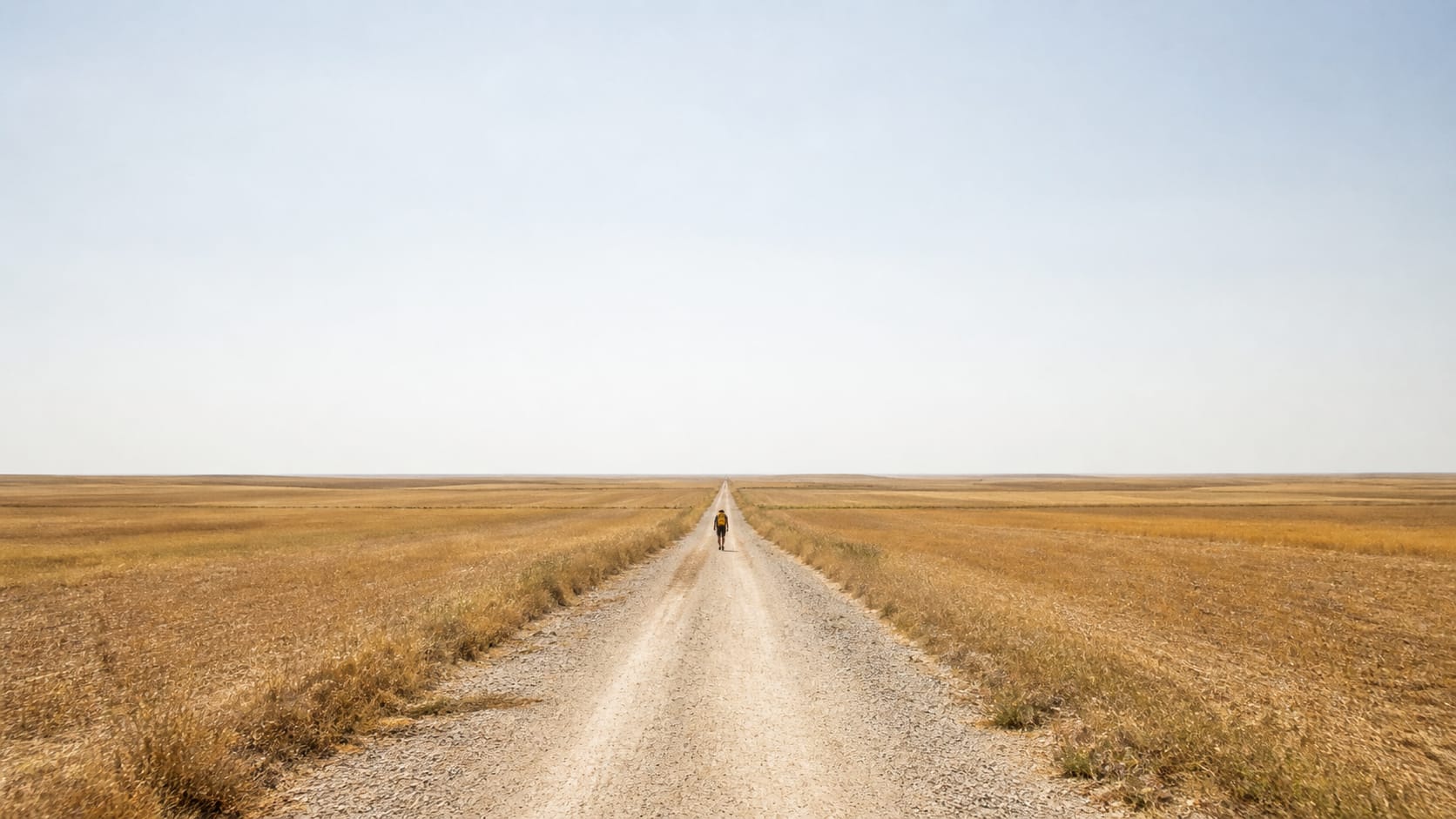
Four stretches of the Camino Francés have no water at all: Orisson to Roncesvalles on the Napoleon route, 16.6 km; Villamayor de Monjardín to Los Arcos, 12.2 km; Villafranca Montes de Oca to San Juan de Ortega, 12.0 km; and Carrión de los Condes to Calzadilla de la Cueza, 17.2 km, the longest serviceless run on the route. Carry 1.5 litres on those four, 2 litres on the Carrión run, and 2.5 litres in summer heat.
Everywhere else, one litre is plenty. A village with at least one service, a bar or a food shop, appears every 5.6 km on average across the route's 141 serviced populations, and there is roughly one albergue every 2.9 km. The Camino Francés does not have a water problem. It has four gaps, and the skill is knowing where they start.
If you are still shaping the walk, how to plan your first Camino de Santiago sets the stage lengths that decide how often you pass a tap, and when to walk the Camino decides how hard those gaps hit.
Water on the Camino comes from three things, and they fail in three different ways. A public fuente in a village square is fed by the municipal mains and runs year round unless the council switches it off. A bar tap depends on opening hours. A shop sells bottles only when someone is behind the counter. Plan around the fuente and treat the other two as bonuses.
The distinction matters because guidebooks list services rather than water. A village marked with a bar symbol may have one bar that closes on Mondays and stays shut all winter. A village marked with nothing may still have a working fountain by the church. Serviced and watered are not the same word, and that gap is where pilgrims get caught out. Streams, troughs and hillside pipes are a fourth category, and not one to drink from.
Read the four gaps in route order. Each has a last refill point you can rely on, a fixed distance, and a specific reason it catches people out: an unreliable mountain spring, an open vineyard plateau, a wooded hill, and the Meseta's longest serviceless run. Fill up at the village named in the table, not the one before it.
| Stretch | Distance with no water | Last reliable refill | Carry: mild / hot | What goes wrong here |
|---|---|---|---|---|
| Orisson to Roncesvalles (Napoleon route) | 16.6 km | Orisson, km 7.8 out of Saint-Jean-Pied-de-Port | 1.5 L / 2.5 L | The Fuente de Roldán near km 16.5 is a spring, not mains, and runs dry in hot summers |
| Villamayor de Monjardín to Los Arcos | 12.2 km | Villamayor de Monjardín | 1.5 L / 2.5 L | Open vineyard, no villages, no fountains, no shade |
| Villafranca Montes de Oca to San Juan de Ortega | 12.0 km | Villafranca Montes de Oca | 1.5 L / 2.5 L | A climb into oak woods with nothing on top and no bail-out |
| Carrión de los Condes to Calzadilla de la Cueza | 17.2 km | Carrión de los Condes | 2 L / 2.5 L | The longest serviceless run, dead straight across the Meseta |
The Pyrenees crossing is the one people underestimate. Orisson at km 7.8 is the last dependable service out of Saint-Jean-Pied-de-Port, and the only water after it is the spring-fed Fuente de Roldán near the border, which in a dry August runs to a trickle or nothing. Treat Orisson as the refill.
Carrión de los Condes to Calzadilla de la Cueza is the one to respect: 17.2 km of Roman road where summer afternoons regularly pass 35 degrees, with no tree, no wall and no bar between the two towns. Most other Meseta stages put a fountain every 10 to 15 km; this one does not. Galicia inverts the problem: villages sit close together from O Cebreiro on, but Spanish-language pilgrim forums report most trail fountains out of order, so plan it around bars and albergues.
Agua potable means tested and safe. Agua no potable, and the softer agua sin garantía sanitaria, both mean leave it alone however clean the water looks. An unmarked fuente in a village square is almost always on the mains and fine. An unmarked pipe on a hillside is spring runoff and is not. Judge by placement first.
| What you see | Where | What it means | What to do |
|---|---|---|---|
| Agua potable, auga potable, edateko ura, eau potable | Spanish, Galician, Basque, French | Mains supply, tested under national rules | Fill up |
| Agua no potable, auga non potable, eau non potable | Village and trailside fountains | Not drinkable, usually irrigation or livestock | Walk on |
| Agua sin garantía sanitaria | Older rural fountains, Navarra and Castilla | Untested, council takes no responsibility | Treat as not drinkable |
| No plate, fountain in a square or by a church | Villages all along the route | Almost certainly mains, and a maintenance gap | Fill up |
| No plate, pipe or trough on the trail | Hillsides and field edges | Untreated spring or irrigation water | Leave it |
Real Decreto 3/2023 sets Spain's technical and health criteria for drinking water and obliges the operator to label outdoor fountains that supply it. So an unlabelled village fountain reads as a missing plate, not a warning: were the water unfit, the same rule would require it to say so.
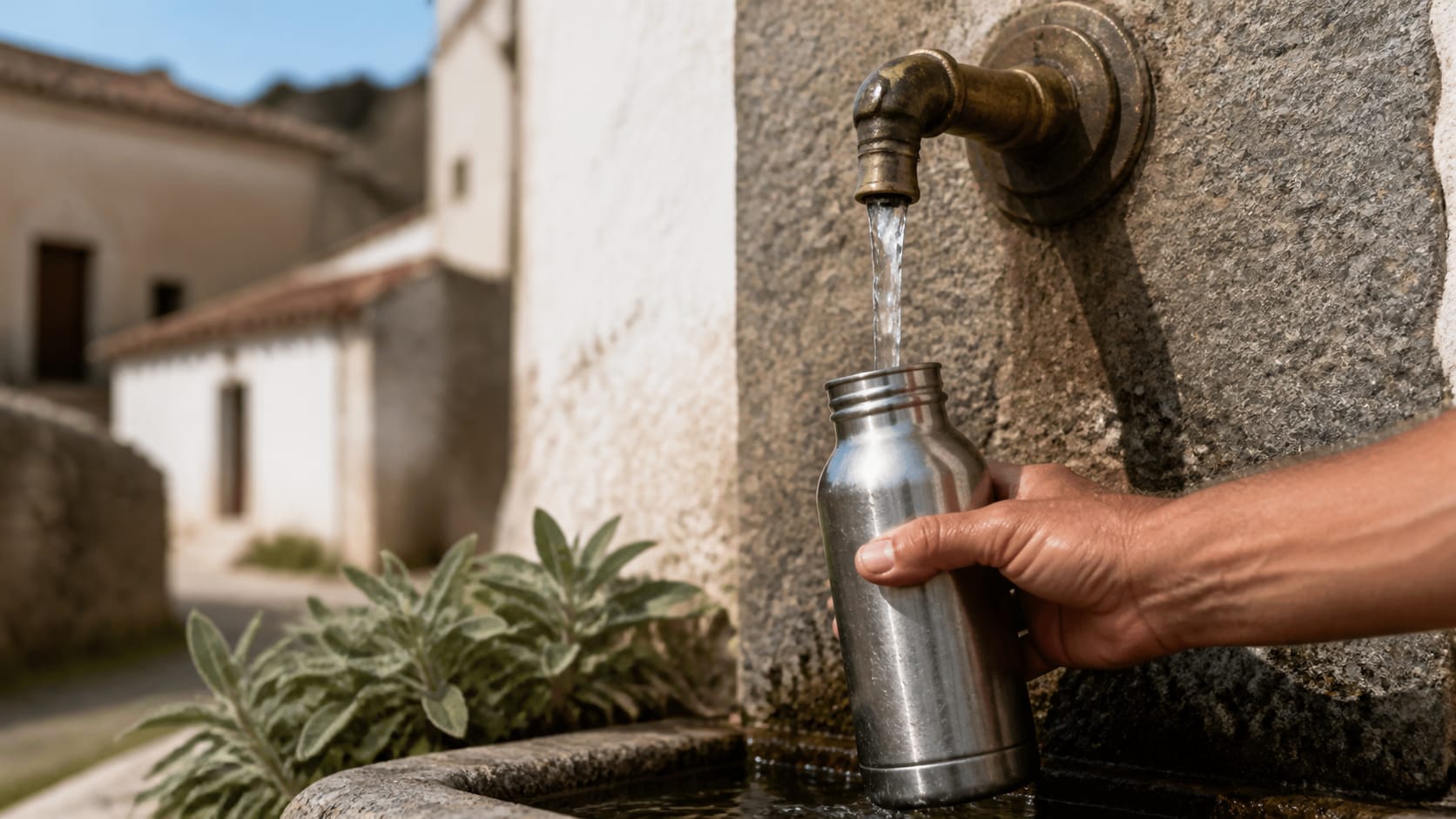
Yes. Spanish mains water is regulated under Real Decreto 3/2023, and 99.3 percent of the national analysis bulletins were rated fit for human consumption in 2024. Every albergue tap, bar tap and mains-fed village fuente on the route is drinkable. Taste changes region to region with the level of chlorination, which is a preference question, not a safety one.
Spain had 10,867 active supply zones in 2024, covering 83.3 percent of the census population. Compliance runs at 99.5 percent across the distribution network and 98.15 percent at consumer taps, the lowest sampling category and still far above the level at which bottled water for a month makes sense. The evidence thins out in the small rural zones the Camino passes through, which report far fewer samples than a city network. That is why a labelled fountain beats an unlabelled one, not a reason to change what you drink.
Water weighs one kilogram per litre, so every extra litre is roughly ten percent of a light pilgrim pack. Carry one litre on normal stages where villages sit five to six kilometres apart, add half a litre for every hour of expected gap, and add another half litre when the forecast passes 30 degrees. Two kilograms on a pack you have worked to keep near ten percent of your body weight is not a rounding error, which is why the backpack sizing and the 10 percent rule math is worth doing before you leave.
Measure the gap, not the stage. At a loaded pace of four kilometres an hour a 12 km gap is three hours, so 1.5 litres before any heat adjustment. Inland routes regularly pass 30 degrees in July and August while coastal routes sit at 22 to 26, which puts the four dry stretches at 2 to 2.5 litres in high summer.
Timing is the other half of the answer, and it is free. A first-light start that finishes by early afternoon cuts the water you need more than any bottle upgrade, and spares your feet more than a Camino first aid kit can.
Sports and wilderness medicine bodies now recommend drinking to thirst rather than to a fixed schedule, because sweat rates vary from roughly 0.5 to over 2.0 litres an hour with the person, the pace and the heat. Rigid schedules are what produce exercise-associated hyponatremia, blood sodium below 135 mmol per litre. On a Camino stage, thirst is a better instrument than a timer.
The stomach absorbs only around 1.2 litres an hour, so the highest sweat losses cannot be replaced while you are still walking. The American College of Sports Medicine position stand treats 0.4 to 0.8 litres an hour as optimal during hard endurance activity, well below what "drink constantly" implies. The risk is not theoretical: in one study cited by the Wilderness Medical Society, 67 percent of 15 ultramarathon runners tested during a race were hyponatremic.
Electrolytes have a narrower job than the sachet packaging suggests: they replace what long sweaty days deplete, and they do not license you to drink more. If you are walking hard in August and finishing on a salty pilgrim menu, most of that replacement already happens at dinner.
A bladder makes you drink more, because the hose sits at your shoulder and you sip without breaking stride. A bottle lets you see what is left, the only number that matters when you decide whether to start a 12 km gap. Both arguments hold, which is why most long-distance pilgrims carry one of each.
The setup that survives four weeks is a half-litre bottle in a pocket you can reach without taking the pack off, plus a collapsible litre bottle that stays rolled up and weightless in the lid except on the four dry stretches. Sip from the small one, refill it at every fountain, and fill the big one only when the table above says to. The complete Camino packing list puts that weight in context.
For the Camino Francés, no. You are drinking municipal mains water from village fountains and bar taps, not backcountry streams, so a filter treats a risk that is largely absent here. National monitoring puts compliance above 99 percent, and an albergue tap in Astorga draws on the same system as a tap in Madrid.
Two exceptions are real. A walker with a genuinely fragile stomach may want the insurance, and 100 grams over 33 days is a defensible trade. Anyone drinking untreated spring water needs treatment, though the better answer is not to drink it. Those 100 grams are usually better spent on your feet: blisters end far more Caminos than stomach bugs do, and foot care on the Camino is where the attention belongs.
Download an offline map before you leave the albergue wifi, because coverage on the Meseta and in the Montes de Oca is patchy exactly where you want it. Wise Pilgrim plots fountains as points of interest on downloadable topographic maps, and OpenStreetMap-based apps show tagged drinking water taps. Treat every mapped fountain as a maybe, and name the next village with a bar as your fallback.
Fountains go off for four ordinary reasons: drought restrictions, winter frost protection, legionella control, since Spanish municipalities chlorinate and disinfect public fountains through the summer and sometimes switch one off while they do, and a valve nobody has fixed. This is why the last reliable refill point matters more than the number of fountains drawn on a stage.
If
You are in a village
If
You are between villages
If
It is high summer and you are short
The bar fallback is stronger than most pilgrims realise. Article 18.3 of Ley 7/2022 requires Spanish hospitality establishments to offer customers free unbottled water, so a refill is a right rather than a favour. Infrastructure is catching up elsewhere: an EU LIFE project installed 28 treated drinking points along 143 km of the Camino Inglés, one every 6 km, at a cost of 761,000 euros across 18 Galician municipalities. Nothing like it exists on the Francés, so the table above is still the plan. And if a hot stage has emptied you out, the fix is rest rather than more water: when to take a rest day covers reading that signal early.
Frequently asked questions
Should I drink from a Camino fountain that has no sign at all?
Usually yes, with one distinction that matters more than the sign. An unmarked fuente in a village square, beside a church, or outside an albergue is almost certainly on the municipal mains and safe. An unmarked pipe, trough or spring out on the trail between villages is untreated water and should be left alone. Spanish rules require the operator to label fountains supplying drinking water, so an unlabelled village fountain is usually a maintenance gap rather than a warning. If it has no proper tap, sits in a field, or looks abandoned, walk on to the next village.
What do I do if a Camino fountain is switched off or broken?
Assume this will happen at least once, and plan a named fallback rather than a hope. Councils shut fountains for drought, for winter frost protection, for summer legionella control, or because nobody has fixed the valve. Spanish pilgrims report most trail fountains in Galicia out of service. Work down this ladder: the next bar, which is legally obliged to give you free tap water, then a food shop, then an albergue, then the next village fuente. This is why the last reliable refill point matters far more than the total number of fountains on a stage.
Do I need a water filter for the Camino Francés?
No. Village fountains on the Camino Francés draw on treated municipal supply, not on backcountry streams, so a filter solves a problem that mostly does not exist on this route. National monitoring puts Spanish drinking water compliance above 99 percent. A filter or purification tablets are worth the 100 grams only if you have a genuinely fragile stomach and want the insurance, or if you intend to drink from untreated springs, which this guide recommends against.
How do I ask a Spanish bar to refill my water bottle?
Say: "¿Me puede rellenar la botella de agua, por favor?" For a glass at the counter, "un vaso de agua del grifo, por favor." You are not asking a favour. Article 18.3 of Ley 7/2022 requires Spanish hospitality establishments to offer customers free unbottled water. Bars along the Camino are used to the request and will normally fill a bottle without you buying anything, but buying a coffee makes it a warmer transaction.
Is a hydration bladder or a bottle better on the Camino?
A bladder increases how much you drink, because the hose is at your shoulder and you sip without stopping. A bottle shows you how much you have left, which is the number that decides whether you can safely start a twelve kilometre gap. The practical answer is both: a half-litre bottle in a hip-belt pocket for constant sipping, and a collapsible one-litre bladder or soft flask that stays empty and weightless except on the four dry stretches.
Can you drink too much water on the Camino?
Yes, and it is the risk nobody warns first-time pilgrims about. Forcing fluid on a schedule in hot weather can push blood sodium below 135 mmol per litre, a condition called exercise-associated hyponatremia, and salt tablets do not prevent it if the total volume is too high. Wilderness and sports medicine guidance has moved to drinking to thirst. On a Camino stage, that means carrying enough to cover the gap, then letting thirst set the pace.
How much water should I carry on the Meseta in summer?
Two to 2.5 litres on the exposed Meseta stages in July and August, and 2.5 litres for the 17.2 km run from Carrión de los Condes to Calzadilla de la Cueza. Daytime temperatures regularly pass 35 degrees with almost no shade. The other half of the answer is timing: leaving at first light and finishing by early afternoon cuts the water you need more than any bottle upgrade does.
External citations
Boletín Oficial del Estado, Real Decreto 3/2023
www.boe.es/eli/es/rd/2023/01/10/3The Spanish regulation that defines drinking water quality criteria and obliges operators to label outdoor fountains supplying drinking water.
Ministerio de Sanidad, Calidad del agua de consumo en España
www.sanidad.gob.es/areas/sanidadAmbiental/calidadAguas/aguasConsumoHumano/publicaciones/home.htmThe annual SINAC technical reports, source of the national compliance percentages and the supply-zone and population coverage figures quoted here.
Wilderness Medical Society, Clinical Practice Guidelines for the Management of Exercise-Associated Hyponatremia
pubmed.ncbi.nlm.nih.gov/32044213The clinical basis for the drink-to-thirst recommendation, the 135 mmol per litre definition, and the warning that sodium intake does not offset excessive drinking.
La Compostela del Lector
You walked this guide to Santiago.
All 771 km, 0 stages, stamped end to end.