
We build Camino Mío, so read this page as the makers' comparison. Every claim about Buen Camino comes from its App Store listing or its publisher's own page, and the sections below say plainly where Buen Camino is the better choice.
For most first-timers on the Camino Francés, the answer comes down to one question: do you want a reference book or a personal plan? Buen Camino is a free, encyclopedic guide to around 50 routes in nine languages. Camino Mío is a free iPhone app that builds your own day-by-day plan and reworks the rest of it when a day changes.
A reference app answers "what is in the next village?" A planning app answers "where am I sleeping on Thursday, now that I stopped early today?" Both questions come up on a five-week walk. Which one you ask more often decides which app you open first.
Buen Camino covers far more ground: around 50 routes on foot and by bike, nine languages, Android and iPhone, and daily incident alerts. Camino Mío covers three routes, runs on iPhone only, and focuses on one job: planning your own days, tracking your beds, and adjusting the plan while you walk. Both cost nothing to download.
| Feature | Buen Camino | Camino Mío | Who it matters for |
|---|---|---|---|
| Routes | 51 by the publisher's count (45 on the US App Store), walking and cycling | 3: Francés, Portugués Central, Inglés | Anyone walking a less common route |
| App languages | 9, incl. Korean, Chinese and Polish | English, German, Spanish | Pilgrims who read neither English, German nor Spanish |
| Platforms | iPhone and Android | iPhone only (iOS 16.4 or later) | Android users |
| Price | Pay what you want, including nothing | Free | Nobody, really: both cost nothing to start |
| Stage planner | Yes, rebuilt in 2026 | Yes, tied to your dates, beds and reminders | First-timers whose days won't match the book |
| Packing list | Not in the store listing | Yes, with a weight goal | Anyone worried about pack weight |
| To-do list before you go | Not in the store listing | Yes, with a countdown to your start date | First-timers with weeks of preparation ahead |
| Bed bookings and reminders | Not in the store listing | Tracks each booking, flags nights without a bed, nudges you to book | Pilgrims who book ahead in busy months |
| Stamp reminders | Not in the store listing | Daily reminder for 1 to 3 stamps, plus a stamp gallery | Anyone walking the last 100 km |
| Live incident alerts | Yes, updated daily by its editors | No | Everyone, especially in summer and after storms |
Store and publisher data read on 17 October 2026. Route counts and in-app prices change often, so check the store page before relying on one figure.
Buen Camino calls itself the most used Camino app, with over a million downloads across platforms by its store listing and more than 1.5 million by its publisher's count. Editorial Buen Camino, where journalist and pilgrim Carlos Mencos leads the team, updates the route notes and alerts every day. You get maps with the variants, elevation profiles, lodging and services for every town, and a 4.8 rating from about 2,500 ratings on the US App Store.
45 routes, nine languages, live alerts
The US App Store listing says 45 guides for as many routes; the publisher's own page says 51 and adds new ones each year. They cover Spain, Portugal and France, on foot and by bike. The interface comes in Spanish, English, German, French, Italian, Portuguese, Polish, Korean and simplified Chinese. The real-time alerts cover detours, closures and changes on the trail, written by the editorial team, and they are the feature we would miss most if Buen Camino disappeared from our own phones.
The pay-what-you-want model
The store text says it directly: you decide how much to pay, and you can choose not to pay at all. The publisher suggests about 9 euros a year, and the US in-app options run from $4.99 to $99.99. The app carries no ads, and the publisher says no lodging pays for a better placement. Paying adds no listed features; it funds the people who keep the data current.
Where it falls short for planning
Breadth has a cost. With around 50 routes in one app, the screens are built to describe the network, not your particular trip. Buen Camino added a customizable stage planner years ago and rebuilt it in 2026 as a simpler, clearer tool, but its store listing describes no packing list, no to-do list and no tracking of your bed bookings. If you want those, you keep them somewhere else.
Camino Mío is built around your own Camino, not the whole network of routes. It follows the trip in three modes. Explore shows each stage with its distance and elevation. Plan sets your start date, pace, rest days, packing list and a to-do list for the weeks before you go. Walk shows today, your next stop, your bookings, the beds you still need and the services ahead.
Explore, Plan, Walk: one app for the whole trip
Explore is the guide part: stages with distance, climb, villages and highlights, on a real map since version 1.3.2, with your position if you allow location. Plan is the months before you fly. Walk takes over on the morning you start, opening on today's village, the kilometres done and still to go, and each village in between.
Route planning: your stages, pace and rest days
You set the route, the starting point, the start date and a daily pace, add rest days where you want them, and the app gives you the day you reach Santiago. Change the pace and the arrival date moves with it. The Camino Francés stage calculator on this site does the same arithmetic in a browser, if you want to try the idea before you install anything.
Packing list with a weight goal, and a to-do list before you go
The packing list adds up the weight you carry against a goal you set, tells you how far over or under you are, and lets you tick items off as packed. The "To-do before you go" list runs next to a countdown to your start date, with suggested tasks, from the credencial to getting some euros in cash, and room for your own.
Reminders on the route: book a bed, collect a stamp, find an ATM
On the trail, Camino Mío can nudge you to book a bed for every night that has none, from the same day up to seven days before, as you choose. It can remind you daily to collect one, two or three stamps. And you pick the services to watch for, such as a cash machine, an albergue, a pharmacy or a grocery, and the app shows the next village ahead that has them and how far away it is.
Bed bookings and the Need Attention list
Each bed you book goes into the plan with its place, date and a note for the reservation number. Nights without a bed are marked. A booking whose date no longer matches its day after a change is flagged "check date". The Need Attention list on the walk screen gathers what is open today: the bed still to book, today's stamp, the next service you asked for.
Collecting sellos in the app
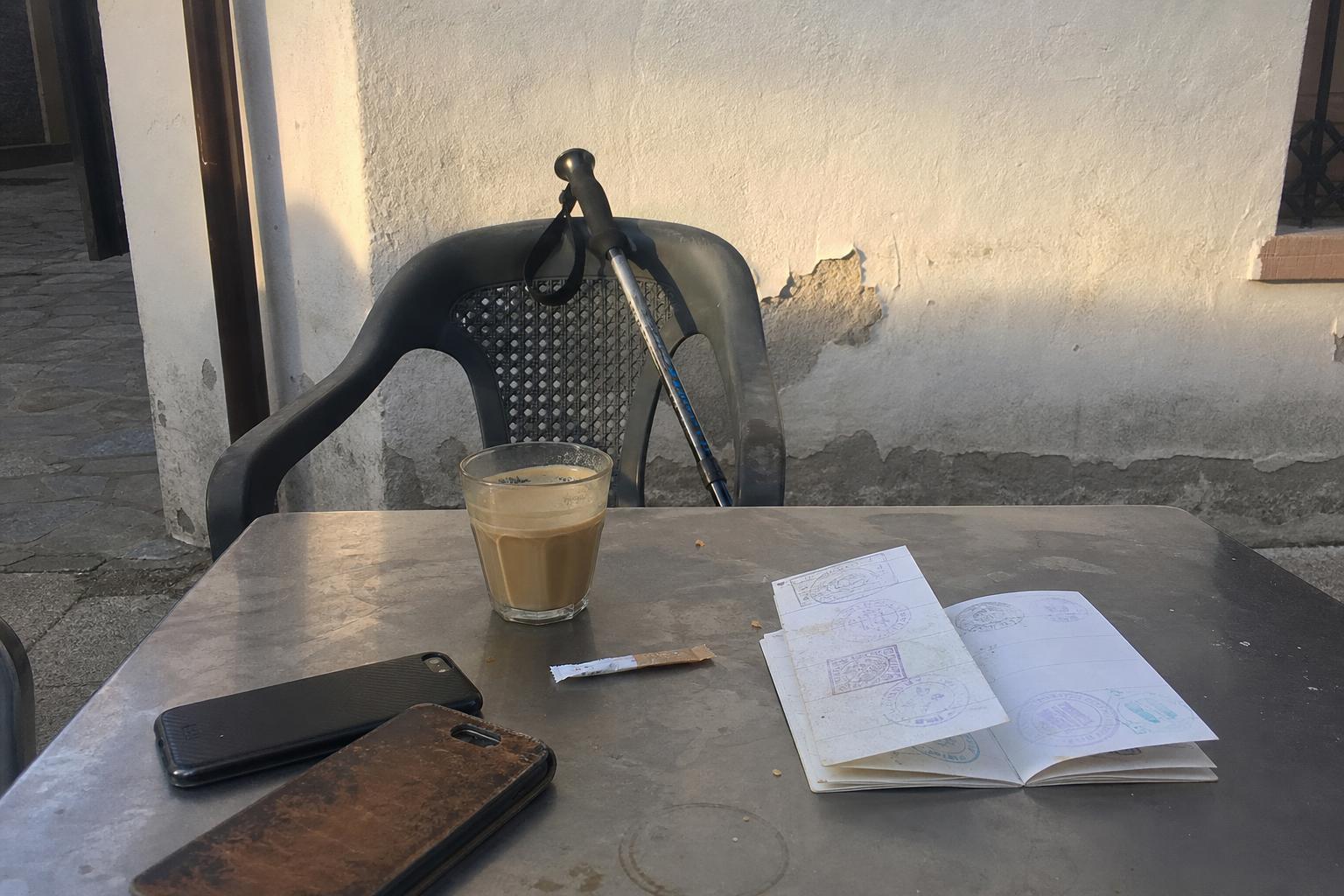
Photograph a stamp in your credential and the app crops it, cuts out the background and files it with the place and the day you earned it. By Santiago you have a gallery of every stamp next to the paper original.
Say your knee gives out before Los Arcos and you stop early. In both apps you can change your stages. The difference is what happens next: in Camino Mío you tell the app to stay in the village where you stopped, the rest of the day moves to tomorrow, and your arrival date, your booked beds and the nights still without a bed update with it.
Camino app stage planner: how each one handles a changed day
In Camino Mío the steps are short. On the plan, tap the village where you stopped and choose "Stay here". Everything after it moves to the next day, and every later day shifts with it. If tomorrow is now far longer than your daily limit, the app marks it and suggests splitting it; you can add a day or a rest day, or take one out. At the top of the plan the day you reach Santiago updates, so you can see how much buffer you still have before your flight. The bed you had booked for tonight in Los Arcos now sits on the wrong day and is flagged "check date", and the night you just created shows up as "no bed" with a reminder to book.
In Buen Camino you adjust your days in its stage planner. That works, and the 2026 version is easier than the old one. What it does not do, by its store listing, is hold your bookings or remind you about them, so after a changed day you check your reservations yourself. If you only book a night or two ahead, that is no burden. If you booked a week of beds before a holiday weekend, it matters.
Camino Mío is young and narrow. It covers three routes: the Camino Francés, the Camino Inglés and the Camino Portugués Central. It runs on iPhone only, the app speaks English, German and Spanish, and it has no live incident alerts, no cycling routes and no turn-by-turn navigation. Buen Camino wins on breadth.
It also has too few App Store ratings to show an average yet, so you are trusting a new app rather than one with a decade of reviews. Its village pages show which services a village has, such as an albergue or a hotel, but not individual beds, prices or phone numbers; for those you still open Buen Camino or Gronze.
Pick Buen Camino if you read Korean, Chinese, Polish or Portuguese, use Android, walk a route beyond these three, or want a deep reference on every village. Pick Camino Mío if you walk the Francés on an iPhone and want one plan that holds your pace, rest days, beds and packing list. Many pilgrims carry both.
Best Camino Francés app if you want a reference
Buen Camino. It has the most routes, the most languages and the daily alerts, and it costs nothing unless you choose to support it. If you only install one app and you are not on an iPhone, this is it.
Best Camino Francés app if you want your plan to adapt
Camino Mío. It keeps your days, beds, packing and prep in one plan, and when a day changes it moves the rest of the plan and tells you what to book. Pair it with Buen Camino for the alerts and the lodging details, and you have both jobs covered.
Other options: Wise Pilgrim vs Buen Camino, and Camino Ninja
Wise Pilgrim All Caminos covers 26 routes in English. It is free to download; its US store listing still shows in-app purchases of $4.99 for all routes or $0.99 for one, so check before you pay. Camino Ninja is free, with a stage planner and stage notes, and holds a 4.7 rating on the US App Store. For the full field, including Gronze and a backup map, see our guide to the best Camino de Santiago apps for first-time pilgrims. A closer look at Wise Pilgrim and its rivals is in Wise Pilgrim alternatives for Camino planning.
Which Camino app lets me replan my remaining stages when a day goes wrong?
Several apps have a stage planner: Buen Camino, Wise Pilgrim and Camino Ninja all let you set your daily stages. Camino Mío is built around changing them mid-walk. You can stay where you stopped, move stops between days, add a day and insert or remove rest days, and the app updates your arrival date, flags bookings that no longer match their day and marks the nights that still need a bed.
Is the Buen Camino app really free, and what do the paid tiers add?
Yes. Buen Camino uses a pay-what-you-want model: you choose how much to pay, including nothing. The US App Store lists in-app options from $4.99 to $99.99, and the publisher suggests about 9 euros a year. Paying adds no listed features. The app carries no ads, and the publisher says no lodging pays for placement. Check the current store page before you rely on the prices.
Does Camino Mío work on Android?
No. Camino Mío is an iPhone app today. If you use Android, Buen Camino and Wise Pilgrim are both on Google Play. You can still use the stage guides and planning tools on camino-mio.com in any browser.
Which Camino app is better if English is not my first language?
Buen Camino covers more languages: Spanish, English, German, French, Italian, Portuguese, Polish, Korean and simplified Chinese. Camino Mío's app speaks English, German and Spanish. Neither offers Japanese at the time of writing, so Japanese pilgrims should check each listing before they leave. Our Camino app for international pilgrims page lines up the languages of four apps and covers phone data from abroad.
Can I use Buen Camino and Camino Mío together?
Yes, and many pilgrims run two apps to cross-check information. A common split is Buen Camino as the reference for villages, lodging details and live alerts, and Camino Mío as the personal plan for pace, rest days, beds and packing.
Wise Pilgrim vs Buen Camino: which is better for the Camino Francés?
Forum users split between the two. Wise Pilgrim is praised for a clean design and covers 26 routes in English. Buen Camino covers around 50 routes in nine languages, works on a pay-what-you-want basis and adds daily incident alerts. Try both before you fly and keep the one you open more.
External citations
Buen Camino on the App Store
apps.apple.com/us/app/buen-camino-de-santiago-app/id858222947The 45 store-listed routes, the languages, the 4.8 rating, the download claim, the stage planner, the live alerts and the in-app payment options, read on 17 October 2026.
Editorial Buen Camino: the Camino de Santiago app (Spanish)
www.editorialbuencamino.com/app-del-camino-de-santiagoThe publisher's own route and download counts, the suggested yearly payment, the 2026 stage planner, the daily alerts and the no-ads, no-paid-placement policy.
Camino Mío on the App Store
apps.apple.com/us/app/camino-de-santiago-camino-mio/id6780242781The price, iPhone-only availability, the iOS 16.4 requirement and the version 1.3.2 map release.
Wise Pilgrim All Caminos on the App Store
apps.apple.com/us/app/wise-pilgrim-all-caminos/id6444294028The 26 routes, the English-only listing and the in-app purchase prices.
La Compostela del Lector
You walked this guide to Santiago.
All 771 km, 0 stages, stamped end to end.