
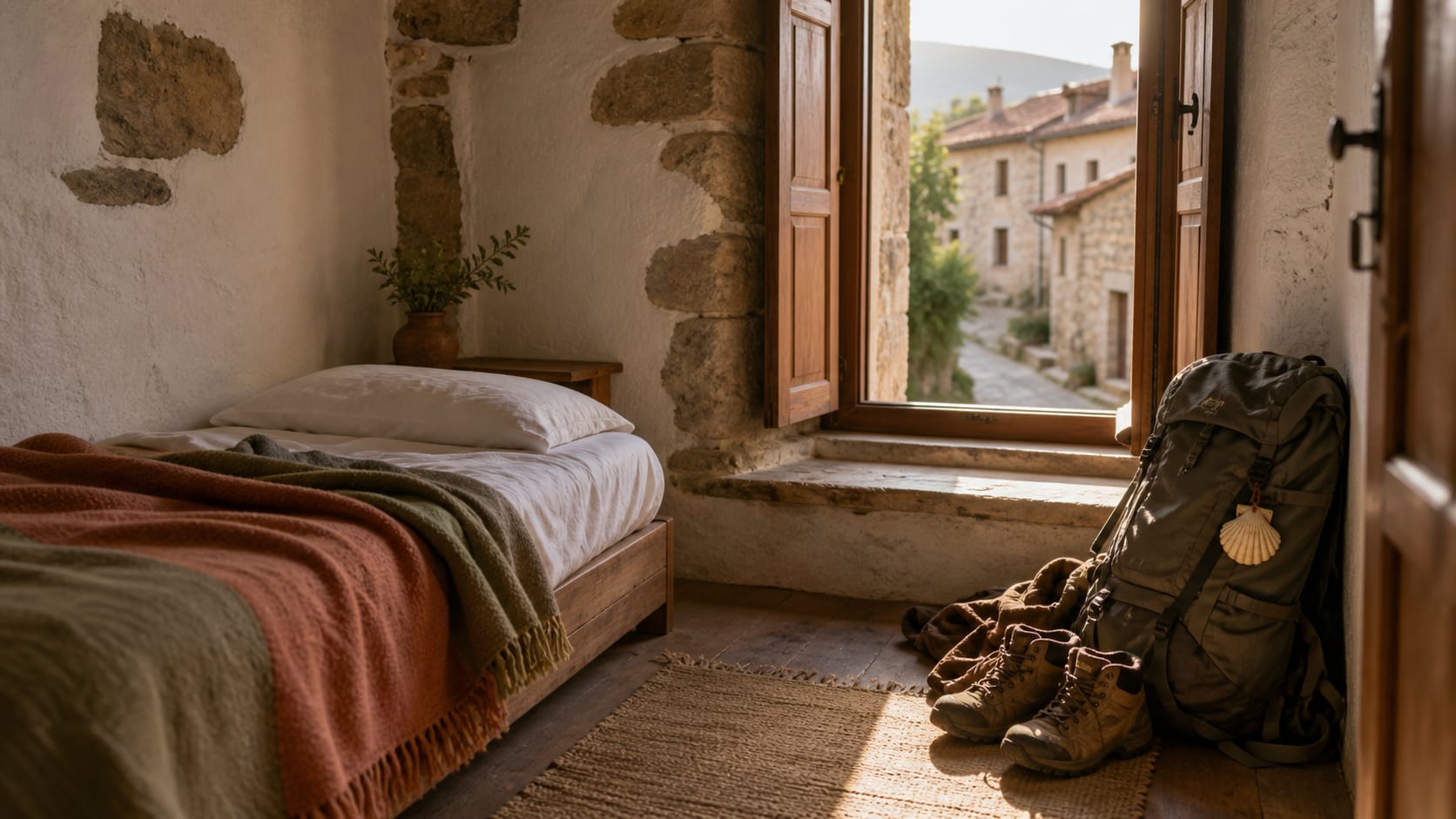
The alternatives to albergues are private rooms, and there are more of them than most first-time pilgrims expect. From cheapest to dearest: pensiones and hostales run about €35 to €70 a night, casas rurales €55 to €150, hotels €65 to €180, and paradores, the state-run hotels in old castles and monasteries, €200 and up. All of them give you a private room, most have an en-suite bathroom, and nearly all take reservations online or by phone.
Who each one suits is simple enough. A pensión or hostal is for pilgrims who want privacy on a budget. A casa rural is for those who value quiet and character over being right on the trail. A hotel is for anyone who wants a predictable room and bathroom every night. A parador is a once-in-a-trip splurge. You do not have to choose one and stick with it. The Camino Francés can be walked entirely in private rooms, but most pilgrims who book them mix a private night in among dorm nights when they want a proper rest.
The Camino has six main lodging types, and they stack into a clear ladder. Knowing the rungs makes every guidebook listing and booking page legible.
At the bottom sit the municipal and donativo dorms, the cheapest beds on any stage. Above them are private albergues, still dorm beds but often with a few private rooms tucked upstairs. Then come pensiones, hostales, and fondas, the budget private rooms. Next are casas rurales and ordinary hotels, offering more comfort and quiet. At the very top are the paradores, a state-run chain of more than 90 hotels across Spain, several of them directly on Camino routes.
The line that trips people up runs between the second and third rungs: public albergues are first-come, first-served and cannot be reserved, while everything from pensiones upward is bookable ahead. That single fact is why "booking accommodation" on the Camino almost always means booking a private room. For the full picture of the dorm rungs, see our complete guide to Camino albergues and the breakdown of the different types of albergues.
Here is the source of the most common Camino accommodation confusion. A Spanish hostal is not a dorm hostel. It is a budget hotel with private rooms, graded one to three stars by the regional tourism board. A pensión is a smaller, often family-run guesthouse in the same price band. Both give you your own room, frequently with a private bathroom, from around €35 to €70 a night. In a small village off the tourist track, a single room can drop to €20 to €30.
This rung is the workhorse alternative to the dorm. It costs more than an albergue bed but far less than a hotel, and it turns up in almost every town on the Francés. If the idea of a private room on the Camino sounds expensive, the pensión is the answer that says otherwise.
A casa rural is a refurbished rural house run as a bed and breakfast, and it is the most characterful rung on the ladder. Think stone walls, home cooking, a garden, and a host who has lived in the valley their whole life. Rooms run roughly €55 to €150 depending on the region and the season. Galicia and Navarra have particularly good ones.
The trade-off is location. Casas rurales often sit a short walk off the marked route rather than on the main street, so you swap convenience for quiet. For a pilgrim who wants one restful night away from the pack, or a couple marking a special stage, that trade is usually worth making. Book these ahead, because the good ones are small and fill fast in the busy months.
You can walk the Camino Francés staying only in hotels, and a fair number of pilgrims do. Ordinary hotels run about €65 to €180 a night and give you the full package: private room, private bathroom, quiet, and a proper bed after a long stage. On the Francés they exist in every city and most mid-sized towns, so a hotel-only itinerary rarely leaves a gap.
The trade-offs are real, though. Cost is the obvious one. The quieter loss is the on-site self-service laundry, the shared kitchen, and the evening pilgrim table that albergues throw in for free. Hotels give you rest and privacy; they take away the built-in pilgrim community of the albergue. Many walkers split the difference and book a hotel every fourth or fifth night, treating it as a reset rather than the default.
Skipping the dorm entirely is more doable than the albergue reputation suggests. Book a pensión, hostal, casa rural, or hotel, and remember that many private albergues also keep a handful of private rooms alongside their bunks, which are often the cheapest private option on a given stage. In small towns those rooms can run as little as €20 to €30.
If
You just want a door that locks, cheaply
If
You want quiet and character over convenience
If
You want a predictable room and bathroom
Privacy on the Camino is not reserved for big budgets. The pensión rung makes a private room affordable, and the winter months make it easier still: when public albergues close for the season, private rooms are often both cheaper and simpler to secure than in high summer.
Here is the whole ladder in one view. Prices are per night and typical for the Camino Francés; quieter routes and off-season stays tend to run lower.
| Accommodation type | Price per night | Private room? | Book ahead? | Comfort |
|---|---|---|---|---|
| Municipal albergue | €7–14 | No, dorm bunk | No, first-come | Basic |
| Private albergue | €15–30 | Sometimes, a few rooms | Yes | Basic to fair |
| Pensión / hostal | €35–70 | Yes, often en-suite | Yes | Comfortable |
| Casa rural | €55–150 | Yes | Yes, fills fast | Characterful |
| Hotel | €65–180 | Yes, private bath | Yes | High |
| Parador | €200–250 | Yes | Yes, well ahead | Luxury |
The pattern to take from the table: a private-room budget runs roughly double a dorm budget. Where a budget dorm bed costs about €15 to €21 a night, private lodging averages closer to €23 to €50 per person once you factor in the shared and single rooms across a whole walk. Doubling your bed budget, not multiplying it by five, is the honest headline.
Booking private rooms on the Francés is easy, because most of them list online and take reservations days ahead. The practical sequence is short.
Find the listings
Use Gronze for stage-by-stage accommodation, including pensiones and hotels alongside albergues, and Booking.com for pensiones, hostales, and larger hotels with live availability.
Filter for private rooms
Set the room type to a private single or double. Remember that a Spanish "hostal" result is a private room, not a dorm.
Reserve early in the peak months
May, June, and September carry the most booking pressure, and July and August more still. On busy stages and on the last 100 kilometres, reserve several days out. In shoulder season a day ahead is usually enough.
Mix, don't lock everything
Book a private room every few nights for a proper rest and walk up to albergues on the rest. A fully pre-booked trip removes the flexibility that makes the Camino forgiving. For the full booking-versus-walking-up calculus, see when to book albergues in advance.
One more note on paradores, since they are the rung people ask about most. There are more than 90 across Spain, and the one in Santiago, the Hostal dos Reis Católicos on the cathedral square, was funded by Queen Isabella in 1499 as a hospital for pilgrims. It now claims to be one of the oldest hotels in the world. A night there is a fitting close to a long walk, and worth booking well ahead if you want it.
Frequently asked questions
Can I walk the whole Camino Francés staying in hotels instead of albergues?
Yes. The Francés has hotels and pensiones in every city and most mid-sized towns, so you can book a private room for every stage. Budget roughly €65 to €180 a night for hotels, less for pensiones, and reserve ahead in cities and on the last 100 kilometres. The main thing you give up is the albergue's shared kitchen, self-service laundry, and evening pilgrim table.
What are my options for a private room on the Camino instead of a dorm?
Pensiones and hostales (about €35 to €70), casas rurales (€55 to €150), hotels (€65 to €180), and paradores (€200 and up). Many private albergues also keep a few private rooms, often the cheapest private option on a stage. In small towns a single room can drop to €20 to €30.
What is the difference between a hostal, a pensión, and a hostel?
A Spanish hostal is a budget hotel with private rooms, rated one to three stars. A pensión is a smaller, often family-run guesthouse in the same price band. A "hostel" in the backpacker sense, with dorm bunks, is what the Camino calls an albergue. So a hostal and a pensión both mean a private room; a hostel means a dorm.
What is a casa rural?
A casa rural is a refurbished rural house run as a bed and breakfast, usually with home cooking, a garden, and a handful of private rooms. They run about €55 to €150 a night and often sit a short walk off the marked route, so you trade convenience for quiet and character. Book them ahead, because they are small and fill fast in summer.
How much more does it cost to avoid dorms on the Camino?
Roughly double. A budget dorm bed runs about €15 to €21 a night; averaged across single and shared private rooms, private lodging works out closer to €23 to €50 per person. So a private-room trip costs about twice a dorm-only trip, not five times as much. Mixing the two lands you in between.
Do I need to book non-albergue accommodation in advance?
Usually a few days is plenty, and often less. Pensiones, hostales, hotels, and paradores all take reservations, unlike municipal albergues. Book several days ahead in May, June, and September, more in July and August, and on the last 100 kilometres from Sarria. In shoulder season and winter a day ahead, or even same-day, generally works.
External citations
Paradores de Turismo de España
www.parador.esOfficial network of state-run paradores, including the historic Hostal dos Reis Católicos in Santiago, with current room categories and prices.
Gronze — stage-by-stage accommodation listings
www.gronze.comThe standard Camino reference, listing pensiones, hostales, hotels, and albergues per stage with prices, phone numbers, and opening status.
Turismo de Galicia — official lodging categories
www.turismo.galRegional tourism board defining the official hostal, pensión, casa rural, and hotel categories that grade Camino lodging.
La Compostela del Lector
You walked this guide to Santiago.
All 771 km, 0 stages, stamped end to end.