
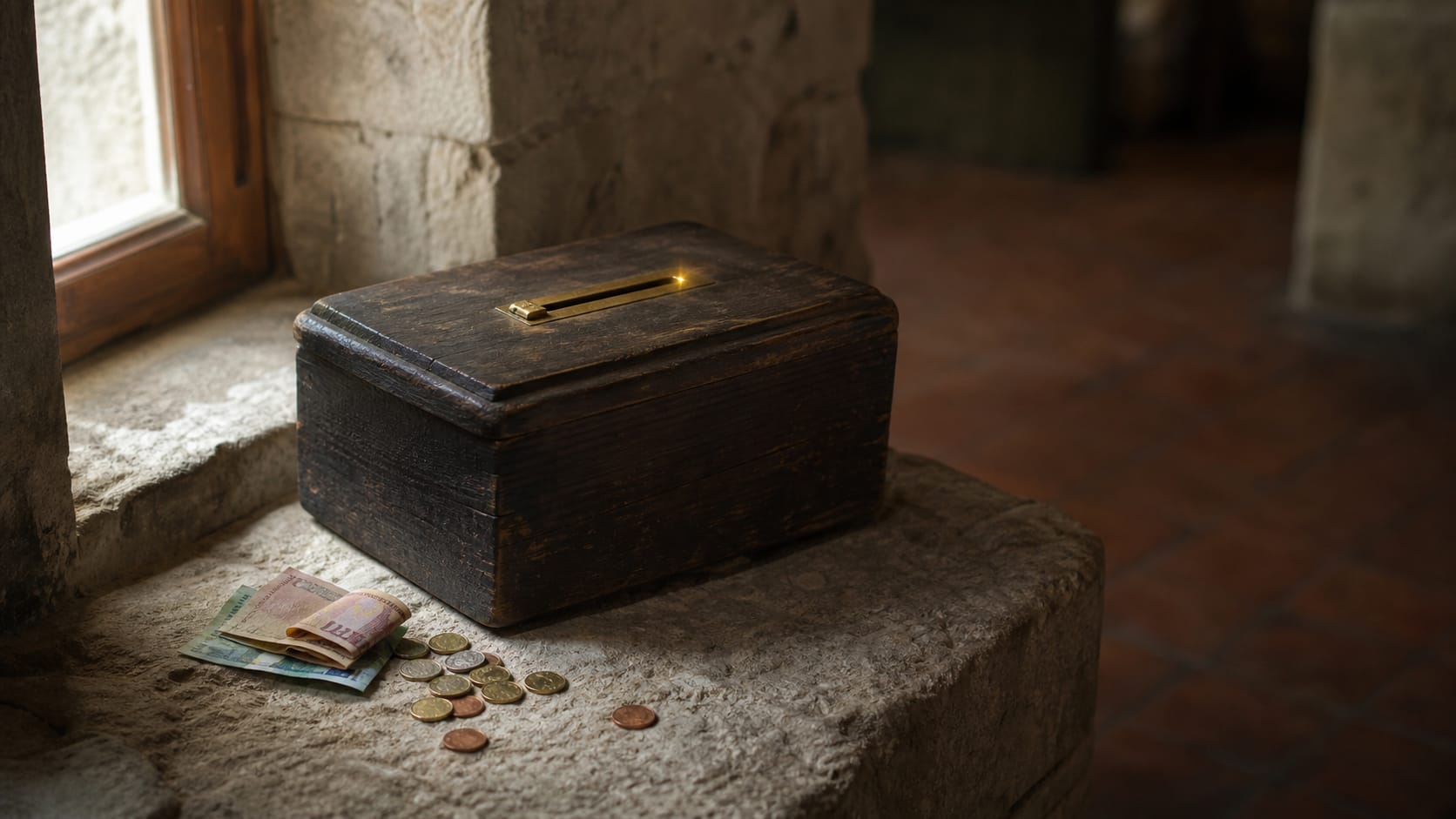
A donativo albergue is a pilgrim hostel on the Camino that runs on voluntary donations rather than a fixed nightly fee. Volunteer hospitaleros keep it open, often giving about two weeks of their own time and paying their own way to be there. It is not free, and treating it as free is the fastest way to close one. A fair donation is at least 10 euros for a bed and shower, 15 to 20 euros when a communal dinner, breakfast, or laundry is included, and 25 to 35 euros when you can afford to keep the place solvent for the pilgrims walking behind you.
The donation box near the door is the whole system in one object. No rate is posted above it, and no one watches what you fold inside. That trust is the point, and it only holds if pilgrims read the box as a real cost rather than a polite suggestion. If you want the wider map of who runs which beds, our complete guide to Camino albergues sets out how donativos sit alongside municipal, private, and Xunta hostels.
Donativo is Spanish for donation, and the difference from free is the whole story. You decide the amount, and no one hands you a bill. Leaving nothing is technically allowed, and a hospitalero will never chase you for it, but it empties the arrangement of its meaning. Your donation is not settling your own night in isolation. It covers the bed you slept in, the water and electricity you used, and the food stocked for the pilgrim who arrives tomorrow with a lighter wallet than yours.
Because there is no cashier, the responsibility shifts onto you. A pilgrim who would never dream of walking out on a paid albergue bill can still, without meaning to, underpay a donativo simply by dropping a couple of coins and moving on. The model asks you to picture the real cost of the night and give against that, not against how little you can get away with.
What you leave should track what you actually received. A bunk and a shower cost the house less than a bunk, a shared dinner, breakfast, and a run of laundry. Match your donation to the stay and you will rarely be far off.
| Stay type | What's included | Suggested donation | Equivalent paid price |
|---|---|---|---|
| Bed only | A dorm bunk, a hot shower, shared kitchen and bathrooms | ~10 € | 5–15 € at a standard municipal or private bed |
| Bed + communal meal | The bed plus a shared dinner, breakfast, sometimes laundry | 15–20 € | 20–30 € for a bed plus a pilgrim menu |
| Generous gift | The same stay, given at the level that sustains the house | 25–35 € | No paid equivalent; this is the model working |
As a planning rule, budget 12 to 15 euros a night for donativo stays. That keeps your giving close to what the night actually costs the house and leaves room to be generous where a place clearly runs on a shoestring. For a fuller look at how donativos compare with pensiones, hostels, and hotels along the way, see our guide to hostel and hotel alternatives on the Camino.
The donativo runs on a simple exchange across time: today's pilgrims pay for tomorrow's. The 12 euros you leave does not buy your bed after the fact; it stocks the pantry and pays the water bill for the walker who has not arrived yet, the same way an earlier pilgrim covered you. Volunteer hospitaleros hold the whole thing together, giving their time for free and usually covering their own travel and food to be there.
It works because of reciprocity and trust rather than accounting, which is also its weakness. When enough pilgrims treat a donativo as a free bed, the box stops covering costs, and the volunteers who staff it end up subsidising strangers out of their own pockets. Under-donation does not break the model in a single night. It bleeds it slowly, one undervalued stay at a time.
Donativo hospitality is old. It descends from the medieval monastic tradition of sheltering pilgrims, the root of the Latin word hospitale, and for centuries the whole point was to house those who could not pay. Monasteries and church-run refuges fed and bedded walkers as an act of charity, not commerce.
The modern volunteer-hospitalero movement is younger, revived roughly 25 years ago, with Hornillos del Camino often cited as an early seed. Today the tradition survives mostly in parish and association albergues, where volunteers commit around 15 days at a stretch, unpaid, to keep the door open. It is one of four broad albergue types alongside municipal, private, and Xunta-run hostels, and the parochial ones are the most likely to be genuine donativos. If you want that fuller taxonomy, our guide to the types of Camino albergues walks through each.
Not every place that calls itself donativo is one. A genuine donativo posts no price and lets you fill an unstaffed box privately, on your way in or out. A for-profit imitation borrows the warm word but behaves like a business: it quotes a fixed figure, asks for payment at check-in, or lists a set nightly rate online. Some venues advertised as donativo quietly charge a flat 4 to 20 euros, which makes them a cheap private albergue wearing a nicer label.
If
Signs it is genuine
If
Signs it is a fixed-fee bed
If
Either way
Giving at a donativo should be quiet. The whole design spares you a transaction, so there is no need to announce the amount or hand it to anyone. Fold your notes, place them in the box yourself, and carry on. The etiquette overlaps with the wider courtesies of shared pilgrim housing, which our guide to albergue etiquette covers in full.
True donativos are shrinking, and chronic under-donation is part of why. When the box stops covering the water, the food, and the upkeep, a parish has two options, and both cost pilgrims something. It can close beds, or it can convert to a fixed fee and stop being a donativo at all. There are only around 25 donation-based albergues left on the Camino Francés, out of the 300-plus hostels along the popular routes that price anywhere from donation to about 20 euros a night. Our complete guide to Camino albergues sets that whole range of bed types and prices in context.
None of this asks you to overpay. It asks you to pay fairly. Leaving 12 to 15 euros where you slept, more when you were fed, keeps the door open for the next pilgrim who arrives with an empty wallet and no other place to go. That, and not the bargain, is the reason the donativo is worth protecting. If you are also weighing when to book ahead versus walk up, note that most donativos take no reservations at all, a point our guide to booking albergues in advance returns to.
Frequently asked questions
How can I tell a real donativo from a mislabeled for-profit one?
A genuine donativo posts no price and lets you fill an unstaffed box in private, usually at a parish or association albergue. A mislabeled one quotes a fixed figure, asks for payment at check-in, or lists a set nightly rate online. If anyone names the number, you are paying a fee, not making a donation.
How does the donativo pay-it-forward economy keep pilgrim hostels running?
Today's pilgrims pay for tomorrow's. Your donation stocks food and covers utilities for the walker who has not arrived yet, the way an earlier pilgrim covered you. Volunteer hospitaleros give their time for free to run the house. The system works on trust, so it holds only while pilgrims keep giving fairly.
Are donativo albergues really free?
No. Donativo means donation, not free. There is no fixed price and no one hands you a bill, but the bed, the shower, the utilities, and any meal all cost the house money. Leaving nothing is allowed and misses the point. A fair donation is at least 10 euros, more when you are fed.
What if I run out of cash before a donativo albergue?
Say so plainly to the hospitalero rather than dropping a token coin and moving on. Most will not mind, and many will welcome a hand with cooking, cleaning, or the washing-up in place of a donation. The one thing to avoid is a silent zero that pretends nothing was owed. Carry small notes so it rarely comes to this.
Can I book a donativo albergue in advance?
Almost never. Most donativos take no reservations and run first-come, first-served, rewarding early arrival like municipal albergues do. Plan to walk up and arrive by mid-afternoon rather than counting on a held bed. If you need certainty, a private albergue that accepts bookings is the better tool for that night.
Roughly how much should I budget per night for donativo stays?
Budget 12 to 15 euros a night. That keeps your giving close to what the stay actually costs the house: around 10 euros for a bed and shower, 15 to 20 when a meal or laundry is included, and 25 to 35 as a generous gift where you can afford it. Carry it in small notes and coins.
External citations
American Pilgrims on the Camino — hospitalero training program
americanpilgrims.orgRuns volunteer-hospitalero training for the English-speaking world and documents the unpaid, time-committed service that keeps donativo albergues open.
Federación Española de Asociaciones de Amigos del Camino de Santiago
www.caminosantiago.orgFederation of Camino associations whose member volunteers staff many of the parish and association donativos across Spain.
Oficina del Peregrino — official Santiago de Compostela pilgrim office
oficinadelperegrino.comAuthoritative source for annual pilgrim statistics that frame how many walkers the albergue network, donativos included, shelters each year.
La Compostela del Lector
You walked this guide to Santiago.
All 771 km, 0 stages, stamped end to end.