
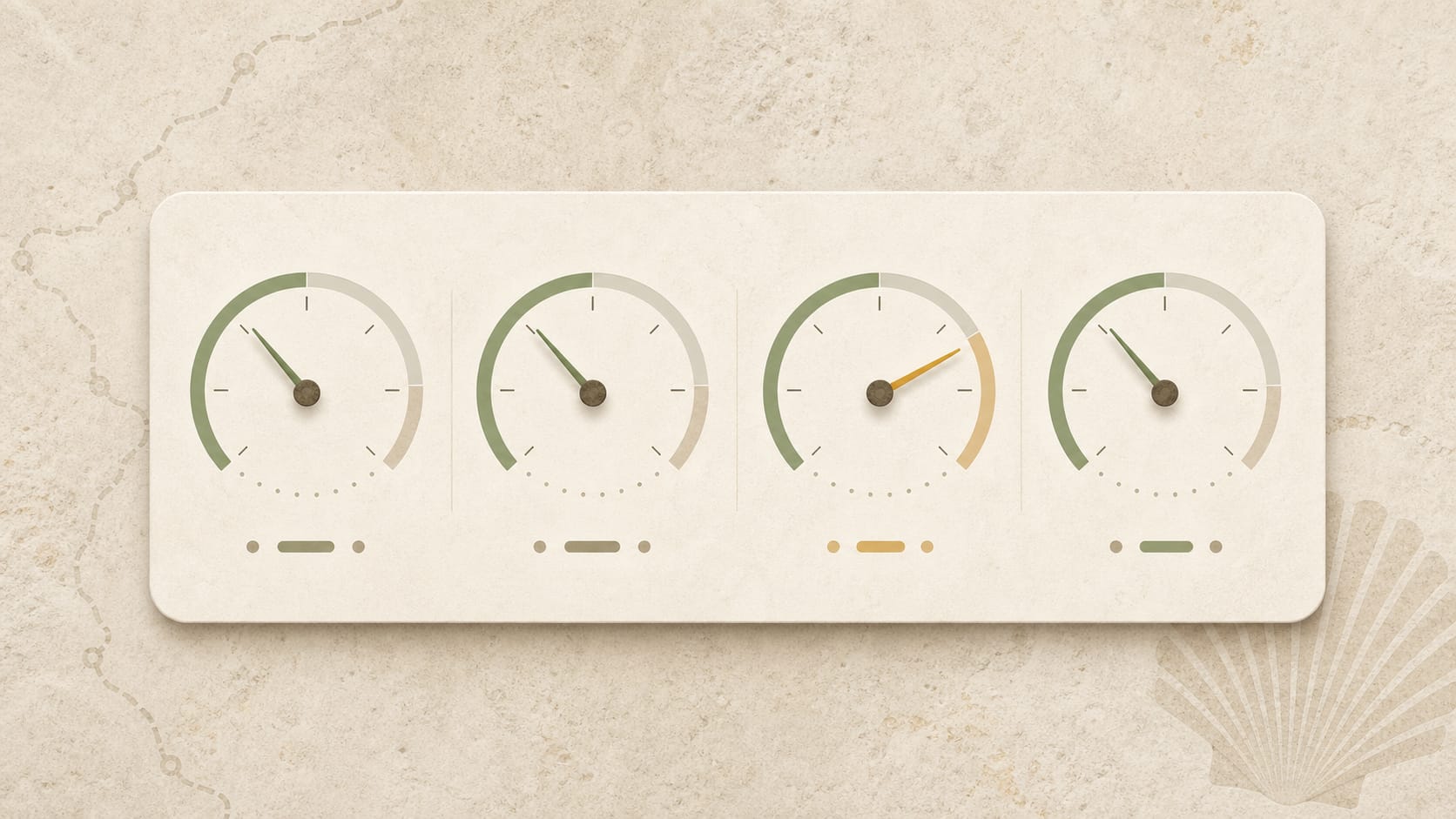
Four, and each one tests something a flat training walk hides. By departure you should be able to walk about 20 km on two consecutive days and recover overnight, hold a 60-second front plank, balance 30 seconds per leg while wearing a loaded pack, and descend hills or stairs without knee pain carrying roughly 10 percent of your body weight. Distance is only the first of the four. Feet, core stability, and the ability to carry weight downhill all fail on their own timelines, and any one of them can end a stage early.
The point of testing before you fly is that the Camino gives you no gentle on-ramp. On the Camino Francés you settle into 20 to 25 km a day, day after day, often starting with a mountain crossing. Most untrained pilgrims meet blisters, shin splints, or plain exhaustion by day three or four, not because the distance is extreme but because their feet and core were never loaded the way daily walking loads them. A checklist turns that vague worry into a score you can act on. This readiness check is one piece of how to plan your first Camino; if you want the full week-by-week plan that closes any gap these tests expose, the training principles for the Camino walk you through building the fitness the benchmarks call for.
Run every test twice: once roughly six to eight weeks out, and again about two weeks before you fly. Score each item pass, borderline, or not-yet. A pass means you meet the benchmark comfortably, with something in reserve. Borderline means you scrape it while tired or on the second attempt. Not-yet means you fail it outright. Two or more not-yet results is your signal to change something, either your training or your route, rather than hope it sorts itself out on the trail.
| Score | What it means | What to do |
|---|---|---|
| Pass | You meet the benchmark comfortably, with reserve | Keep training; you are on track |
| Borderline | You scrape it while fatigued or on the second try | Repeat weekly; expect a pass by departure |
| Not-yet | You fail the benchmark outright | Add targeted work, or adjust the route |
The two test dates matter as much as the tests. The six-to-eight-week check tells you what to train; the two-week check tells you what you actually walk in on. Do not skip the second one because the first went well. Feet and legs that pass on fresh legs can still fail once your weekly mileage has ramped up and left you carrying accumulated fatigue, which is exactly the state you arrive at the airport in.
Feet fail first on the Camino, so test loading, not just mileage. Three tests cover it. First, single-leg calf raises: aim for 20 or more per side, slow and controlled. Second, controlled step-downs off a knee-high stair on one leg with no knee pain. Third, a skin check: walk 15 km in the actual boots and socks you will travel in and finish with no hot spots. These predict blister and tendon resilience far better than distance on flat ground, because they load the exact tissues that give out on descents and long days.
The calf raise is a tendon test in disguise. Your calves and Achilles absorb the push-off on every step and the braking on every descent, and 20 clean single-leg raises show they can do it thousands of times a day without failing. The step-down is a descent rehearsal: going downhill loads your knees at several times body weight, more than climbing does, so a controlled lower off a stair without pain is a decent proxy for how your knees will handle a long drop like the descent off the Pyrenees. The skin test is the one people skip and regret. Boots need roughly 100 km of break-in before a long walk, and a 15 km session in your real kit is where you find the seam that rubs or the sock that bunches, while you can still change something.
A weak core is why a loaded pack pulls you into a slouch by mid-morning, and a slouched spine fatigues your lower back long before your legs give out. Three tests cover core and balance. Hold a 60-second front plank with a flat back and level hips. Hold a 45-second side plank on each side. Then balance for 30 seconds on each leg while wearing your loaded pack. That last one is the test most people have never tried, and it is the most revealing.
If your balance collapses the moment you add the pack, the limit on your daily distance is your stabilising muscles, not your legs. Those small muscles around the hips and ankles are what keep you upright over uneven ground and roots for hours, and they tire in a way a treadmill never trains. The plank numbers are widely used core-endurance benchmarks: 60 seconds front and 45 seconds per side is enough to hold good posture under a pack all day. If you fall well short, the fix is not more walking. It is a few short core and single-leg sessions a week, which close this gap faster than distance does.
Train and test with the pack you will actually carry, loaded to about 10 percent of your body weight. For a multi-week walk that usually lands around 6 to 7 kg, and the 10 percent figure is the number to keep the loaded pack near, water included. The benchmark: walk 10 km over rolling terrain with that pack and finish with a comfortable posture, no shoulder numbness, and no lower-back ache. If the weight forces a stop before 10 km, the pack is too heavy or packed wrong, and the fix comes before departure, not on the trail.
The reason to test loaded rather than empty is that a pack changes everything about how you walk. It shifts your balance backward, loads your core continuously, and drives more force through your feet and knees on every descent. A pilgrim who breezes through 10 km unloaded can be undone by the same 10 km carrying 7 kg, and the only way to know which one you are is to walk it with the real weight. If the loaded test is where you fail, two levers help before you touch your fitness: drop pack weight, and use trekking poles, which cut knee loading on descents by roughly a quarter.
One long walk proves little, because the Camino is not one long walk. It is roughly 20 to 25 km a day repeated for weeks, and recovery between days is the thing distance alone never tests. The key test is walking about 20 km, then getting up the next morning and walking a similar distance without your legs seizing or a new joint complaint appearing. Day two is the real exam. If it feels sharply worse than day one, you need more volume and recovery practice before you commit to daily stages.
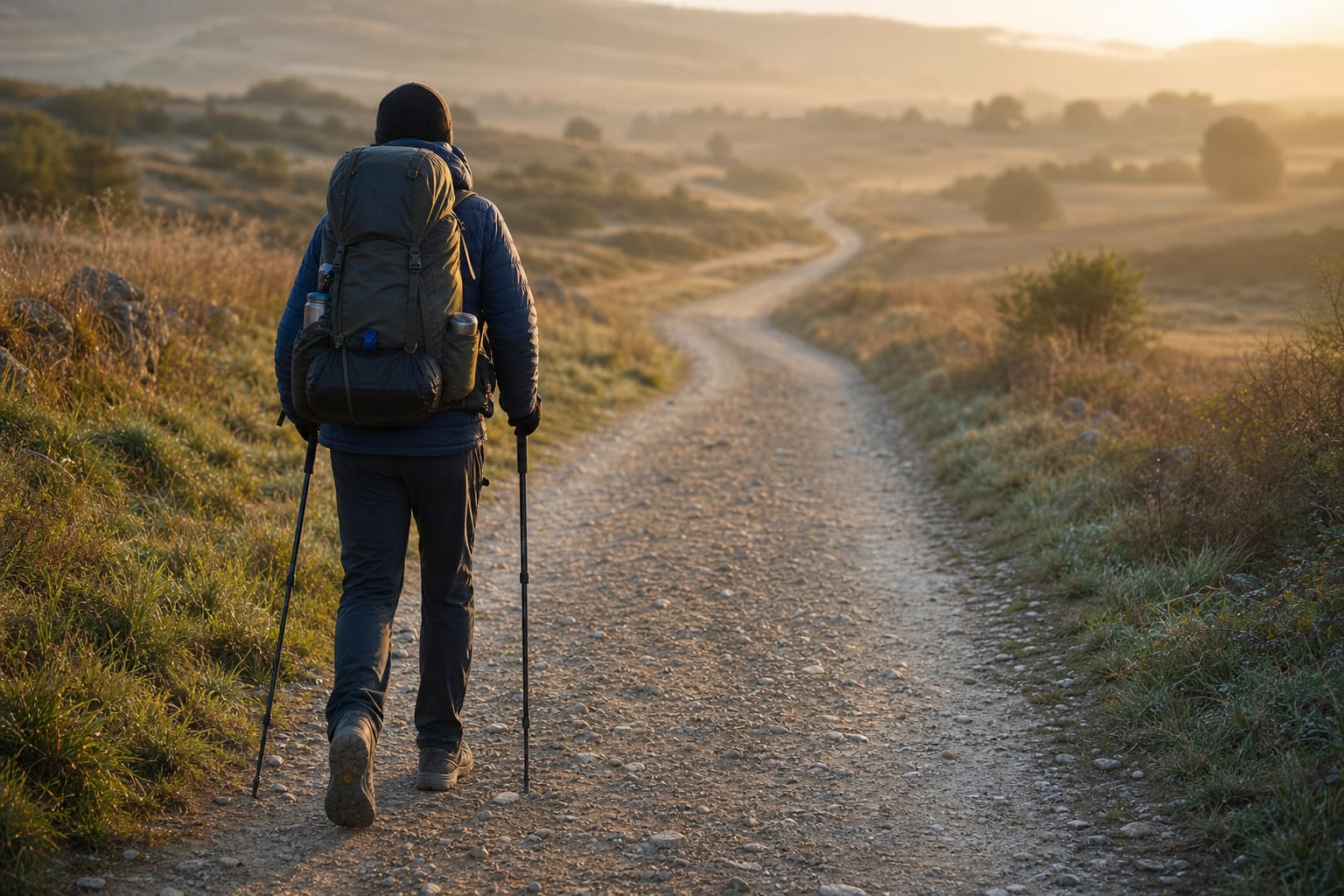
The trap with a single long training walk is that it tells you nothing about how you recover. Plenty of people can grind out one 25 km day on willpower, then wake up unable to face the stairs. The Camino asks you to do it again, and again, so build the back-to-back into your training a few times in the final month. When you increase weekly volume to get there, add no more than 10 to 20 percent a week; ramp faster and you invite the overuse injuries the whole checklist is trying to help you avoid.
If you pass most tests but fail one or two, you are fit enough to start, on an easier route or with shorter daily stages, rather than cancel. The checklist is a planning tool, not a gate. Each failed benchmark points at a specific adjustment: fail the load test and you carry less or use luggage transfer; fail the descent test and you avoid the steepest starts; fail the back-to-back and you cut your daily distance or add rest days. Match the route to your weakest benchmark, not your best.
| Test | Pass benchmark | Borderline | If you fall short |
|---|---|---|---|
| Loaded calf raise | 20+ per side, controlled | 12 to 19, or shaky | Add calf and single-leg work; expect slower descents |
| Step-down descent | Knee-high stair, no pain | Mild ache that fades | Strengthen quads; use poles; avoid the steepest starts |
| Skin and blister | 15 km in real kit, no hot spots | One hot spot, no blister | Refit boots and socks; break them in further |
| Front plank | 60 seconds, flat back | 40 to 59 seconds | Short core sessions twice a week |
| Loaded single-leg balance | 30 seconds per leg with pack | 15 to 29 seconds | Balance and hip work; consider a lighter pack |
| Load-bearing walk | 10 km at 10% body weight, comfortable | Finishes but sore | Cut pack weight; use luggage transfer |
| Back-to-back distance | ~20 km twice, recovers overnight | Day two rough but finishes | Build weekly volume; add rest days on route |
How long it takes to close a gap depends on where you start. Fitter walkers who fail one or two tests can usually get there in four to six weeks. Sedentary walkers should plan on eight to twelve weeks of gradual training, and start at least three months out if you fail the back-to-back or load-bearing tests. None of this is age-gated: pilgrims in their seventies and eighties finish every year. They simply give the plank and back-to-back targets more time and lean on flatter stages and luggage transfer where it helps. The broader "how fit do I need to be" questions this checklist raises are answered in the Camino fitness training FAQ, the same planning ground covered by how to plan your first Camino, and the full countdown that spaces these tests across a year is laid out in the 12-month pre-departure timeline.
Frequently asked questions
How many kilometres should I walk two days in a row to know I'm ready?
Aim for roughly 20 km on day one and a similar distance the next morning, both with your loaded pack. If you finish day two without your legs seizing or new joint pain, your endurance and recovery are trail-ready. Struggling on day two means you need more back-to-back volume, not one longer walk.
What core and balance tests show I'm strong enough for a loaded backpack?
Three quick tests: a 60-second front plank, a 45-second side plank on each side, and 30 seconds of single-leg balance while wearing your loaded pack. If your balance wobbles or collapses under the pack, your stabilising muscles need work before you carry weight over long, uneven days.
How long should I train for the Camino if I fail some of these tests?
Fitter walkers who fail one or two tests can usually close the gap in four to six weeks. Sedentary walkers should plan eight to twelve weeks, and start at least three months out if you fail the back-to-back or load-bearing tests. Increase weekly walking volume by no more than 10 to 20 percent.
Do I need to pass every test, or can I still walk the Camino?
You do not need a perfect score. Passing most tests means you can start, especially on an easier route or with shorter stages. The tests are a planning tool: each failed benchmark tells you what to adjust, from pack weight to daily distance to luggage transfer, rather than whether to cancel.
Can older or less athletic pilgrims meet these benchmarks?
Yes. Age is rarely the barrier; consistency is, and pilgrims in their seventies and eighties finish every year. Older or non-athletic walkers may simply need longer to reach the plank and back-to-back targets, and can lower the bar by using luggage transfer and choosing flatter stages.
My feet pass but my knees hurt on descents. Am I ready?
Descent tolerance is its own benchmark. Knee pain on downhills signals weak quads and stabilisers or too much pack weight. Add controlled step-downs, strengthen your legs, and use trekking poles, which cut knee loading by roughly 25 percent, before tackling steep stages like the descent off the Pyrenees.
External citations
Pilgrim's Reception Office (Oficina de Acogida al Peregrino), Santiago de Compostela
oficinadelperegrino.com/enOfficial pilgrim statistics and the 100 km Compostela rule ground the route distance and daily-stage figures the checklist is built around.
American College of Sports Medicine (ACSM) — exercise guidelines
www.acsm.org/education-resources/trending-topics-resources/physical-activity-guidelinesPeer-reviewed progression and core-endurance standards back the plank, balance, and 10 to 20 percent volume-increase benchmarks in this checklist.
Journal of Sports Sciences — biomechanics of trekking-pole use on descents
www.tandfonline.com/journals/rjsp20Original joint-loading research supports the figure that trekking poles reduce knee load on descents by roughly a quarter.
La Compostela del Lector
You walked this guide to Santiago.
All 771 km, 0 stages, stamped end to end.