
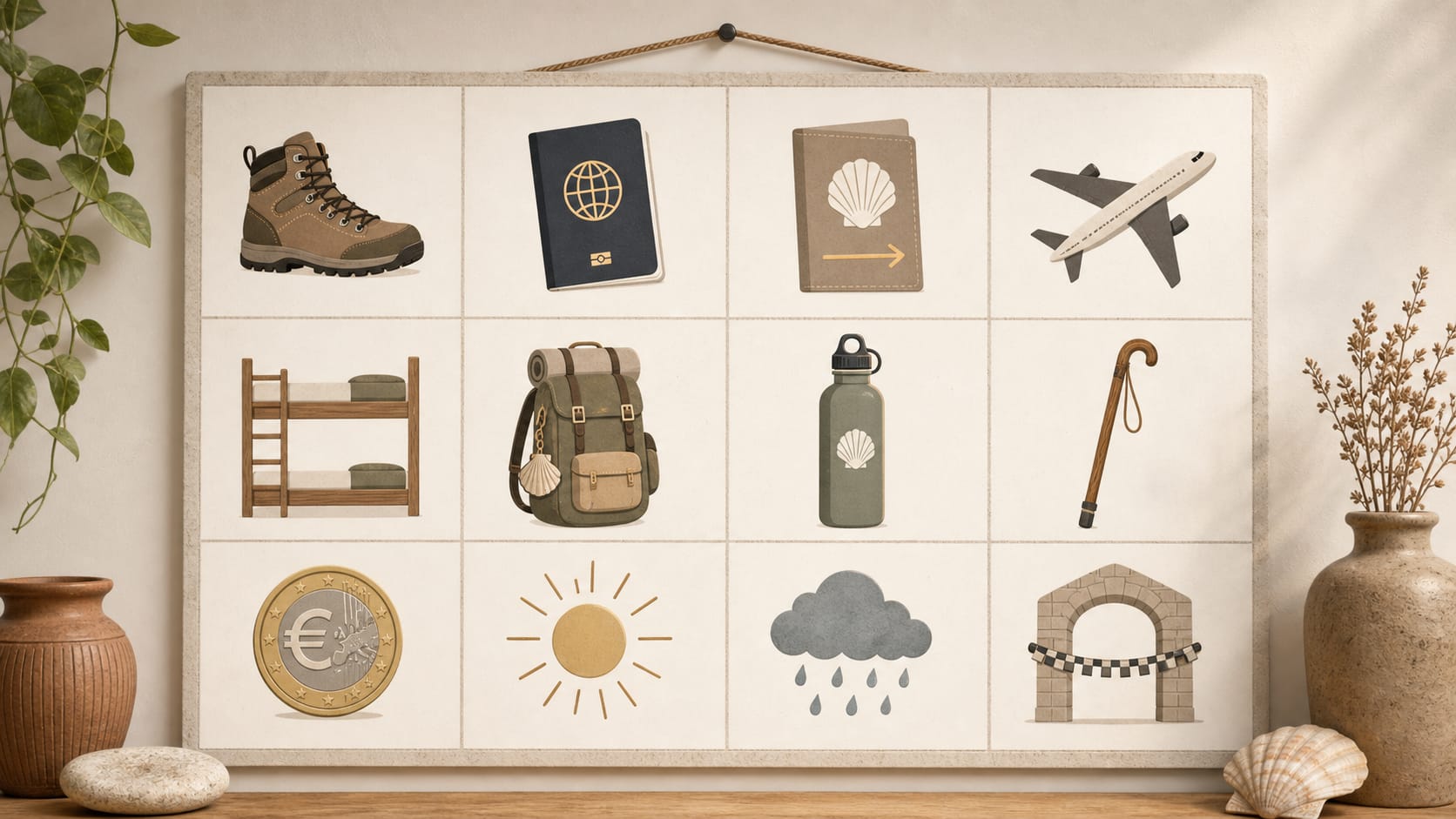
Treat the year as four phases. Months 12 to 10 are about route, dates, passport and flights. Months 9 to 7 add the credential, visa or ETIAS, and a walking base. Months 6 to 4 are the heaviest block: training peaks and gear gets broken in. Months 3 to 1 are bookings, taper and packing. Departure week is logistics only, not the time to test something new.
A first-time international pilgrim runs four parallel streams: training, paperwork, bookings, and gear. Each one has a different lead time, and they collide in different months. The countdown below maps all four onto one calendar so nothing arrives late.
If you are still mapping the bigger picture, the planning pillar guide covers the full sequence (route, season, training, budget) that this timeline sits inside.
A flat checklist tells you what; a countdown tells you when. The credencial that takes three to six weeks to arrive by post cannot be ordered in month one. The shoes that need 100 kilometres of break-in cannot be bought in month one either. Flights are usually cheapest five to eight months out. Albergue beds in peak summer fill three to six months in advance. Each of these streams has its own clock.
Sequencing the four streams against a single calendar is the only way the preparation finishes on time. The rest of this article walks the calendar phase by phase.
Start with the route. The Camino Francés from Saint-Jean-Pied-de-Port is roughly 780 km over four to six weeks. Sarria to Santiago is the 100 km minimum needed to earn the Compostela and fits in five to seven walking days. Both ends of that range are first-Camino-friendly; the wrong pick is the one you cannot fit into your real free time. The route-choice spoke walks through the decision in detail.
Once the route is in mind, lock departure dates against your season window. April through October is the practical walking season; May to mid-September is the peak crowd window. Then check your passport. Most non-EU travellers need at least six months of validity past the planned exit from the Schengen Area, so a passport that expires in nine months from booking is already too short for an autumn walk and needs renewing now.
Order the pilgrim credencial four to six months before departure if you live outside Europe. International shipping from the Pilgrim's Reception Office in Santiago or a national confraternity commonly runs three to six weeks, and stock can lag in the spring rush. Our credencial ordering guide lists confraternities by country, with current prices and lead times.
Sort out entry paperwork in the same window. Visa-exempt non-EU travellers will need an ETIAS pre-authorisation, currently €7 for ages 18 to 70 and usually issued within minutes. Nationals who require a Schengen short-stay visa should budget 15 to 45 calendar days for processing, more in busy periods. For pilgrims flying in from Korea, Japan or other long-haul origins, also add a week or two for credencial post and check that the address on file can sign for a small envelope while you are away.
This is also when training quietly starts. Three to four 30 to 60 minute walks per week, in the shoes you intend to fly with, builds the base that months 6 to 4 will load on top of.
This is the heaviest phase, and the one that quietly decides whether week one of the Camino is fun or grim. Progress from 5 km walks to 20 km loaded outings by the end of month four. Buy your trail shoes by the start of month six and put at least 100 km on them before you fly. Any hot spot or blister in training is a fit verdict on the shoe, not a sign that you need to toughen up — replace the shoe before it ruins week one of the actual walk.
Test the full pack at target weight (around 10 percent of body weight, 6 to 8 kg for most pilgrims) on back-to-back walking days. The body recovers between single sessions, so a Saturday long walk teaches your legs almost nothing about consecutive days. Saturday plus Sunday teaches your feet and knees what the Camino actually demands. The training-for-the-camino guide has week-by-week ramps in 8, 12 and 16-week formats.
Book your first two or three nights in advance so jet lag does not collide with bed hunting on day one. Pre-book any peak-season private rooms three to six months out. After the first nights, most pilgrims walk same-day arrivals into municipal albergues — the booking-vs-walking-up guide covers when to commit and when to stay flexible.
Buy flights once dates are firm. Print a paper copy of your credencial confirmation, your insurance, and your first booked night — Spanish border officers occasionally ask to see proof of onward travel and accommodation, and a printed copy beats a roaming-dependent phone screen.
In the final month, taper training mileage by roughly 30 percent so the legs arrive rested. Assemble the packing list against a kitchen scale, not a hopeful estimate. Anything you have not walked with on a loaded back-to-back day stays home.
Pack your trail shoes in carry-on. A delayed bag should not be able to end your Camino on day one. Carry €200 to €300 in cash plus a fee-free debit card; ATM withdrawals in Spain almost always beat credit-card foreign-transaction rates over a multi-week trip.
Land one or two days before your first stage. The buffer absorbs jet lag, gives you time to collect first stamps in Saint-Jean or your chosen start, and lets you walk a 5 km shakeout to confirm the pack, the shoes and the feet still agree with each other. Departure week is not the time to break in anything new.
The mistakes that wreck first Caminos repeat themselves and almost all live in the calendar:
- Starting training at 12 weeks instead of 24. A 12-week ramp works for active walkers; for sedentary or older pilgrims it compresses the build phase into a single shock that arrives at week one of the walk as blisters and tendinitis.
- Buying trail shoes in the final 30 days. Untested shoes are the single biggest reason first-timers limp into León. Choose shoes by month six.
- Leaving the credencial to the last weeks. Three to six weeks of international post, plus spring stock-outs, plus a lost envelope, equals no Compostela.
- Underestimating peak-season bed pressure. Mid-June to mid-September on popular stages can leave late arrivers without a bed by 3 pm; pre-book at least the first nights and the famous bottlenecks.
- Packing a 12 kg bag you never tested. Pack weight at 10 percent of body weight is a guideline backed by every confraternity for a reason — the trail punishes the extra two kilos relentlessly on day three.
Frequently asked questions
How far in advance should I start preparing for the Camino de Santiago?
Twelve months is the comfortable window for a first-time international pilgrim. Six months is the practical minimum if you already have a current passport and basic walking fitness. Anything under three months forces you to compress training, skip gear break-in, and accept whatever beds remain in peak season.
When should I order my pilgrim credencial?
Order it four to six months before your start date if you live outside Europe. International shipping from the Pilgrim's Reception Office in Santiago or a national confraternity commonly runs three to six weeks, and a four to six month buffer also lets you reorder if the first envelope is lost. Pilgrims inside Europe can usually order eight to ten weeks ahead. Picking one up in person at the start point is a fallback, not a primary plan.
What paperwork do non-EU pilgrims need before the Camino?
Five documents in order of lead time: a passport valid at least six months past your planned Schengen exit; either a Schengen short-stay visa (allow four to six weeks) or ETIAS pre-authorisation for visa-exempt travellers; travel and medical insurance covering hiking and evacuation; your pilgrim credencial (four to six months ahead); and proof of onward travel plus the first booked night for the border check.
Do I need to book albergues in advance on the Camino Francés?
Book your first two or three nights so jet lag does not collide with bed hunting, and pre-book peak-season private rooms three to six months ahead. After the first few nights, most pilgrims walk same-day arrivals into municipal albergues. Quieter routes and shoulder months tolerate more spontaneity.
What is the single biggest preparation mistake first-time pilgrims make?
Buying their trail shoes inside the final month. Untested shoes are the leading cause of blisters and forced rest days. The fix is simple: choose shoes by month six, walk at least 100 km in them before flying, and pair them with the exact socks you plan to wear on trail.
How fit do I need to be before the Camino Francés?
You need to be able to walk 20 km on consecutive days carrying a 6 to 8 kg pack without next-day pain. That is endurance, not athletic conditioning. Habitual everyday walkers often handle the Camino better than gym-fit pilgrims who have never walked a loaded back-to-back day.
Can Korean or Japanese pilgrims rely on English signage and apps on the Camino?
Partly. Yellow arrows and Spanish-language signage cover the route well, and most albergue staff use basic English. Detailed admin — credencial ordering pages, insurance documents, pharmacy interactions — is mostly Spanish or English. Download offline phrase support and a translator before flying, and accept that the first few days will involve more pointing than full sentences.
External citations
Oficina de Acogida al Peregrino, Santiago de Compostela
oficinadelperegrino.com/enAuthoritative source for credencial rules, the 100 km Compostela minimum, and the two-stamps-per-day requirement on the final stretch.
European Union — ETIAS travel authorisation
travel-europe.europa.eu/etias_enOfficial EU page for ETIAS pre-authorisation, required by most visa-exempt non-EU pilgrims to enter Schengen Spain.
REI — long-distance hiking training
www.rei.com/learn/expert-advice/long-distance-hiking-training.htmlIndependent reference for progressive long-distance hiking preparation that backs the six-month training build used in this guide.
La Compostela del Lector
You walked this guide to Santiago.
All 771 km, 0 stages, stamped end to end.