
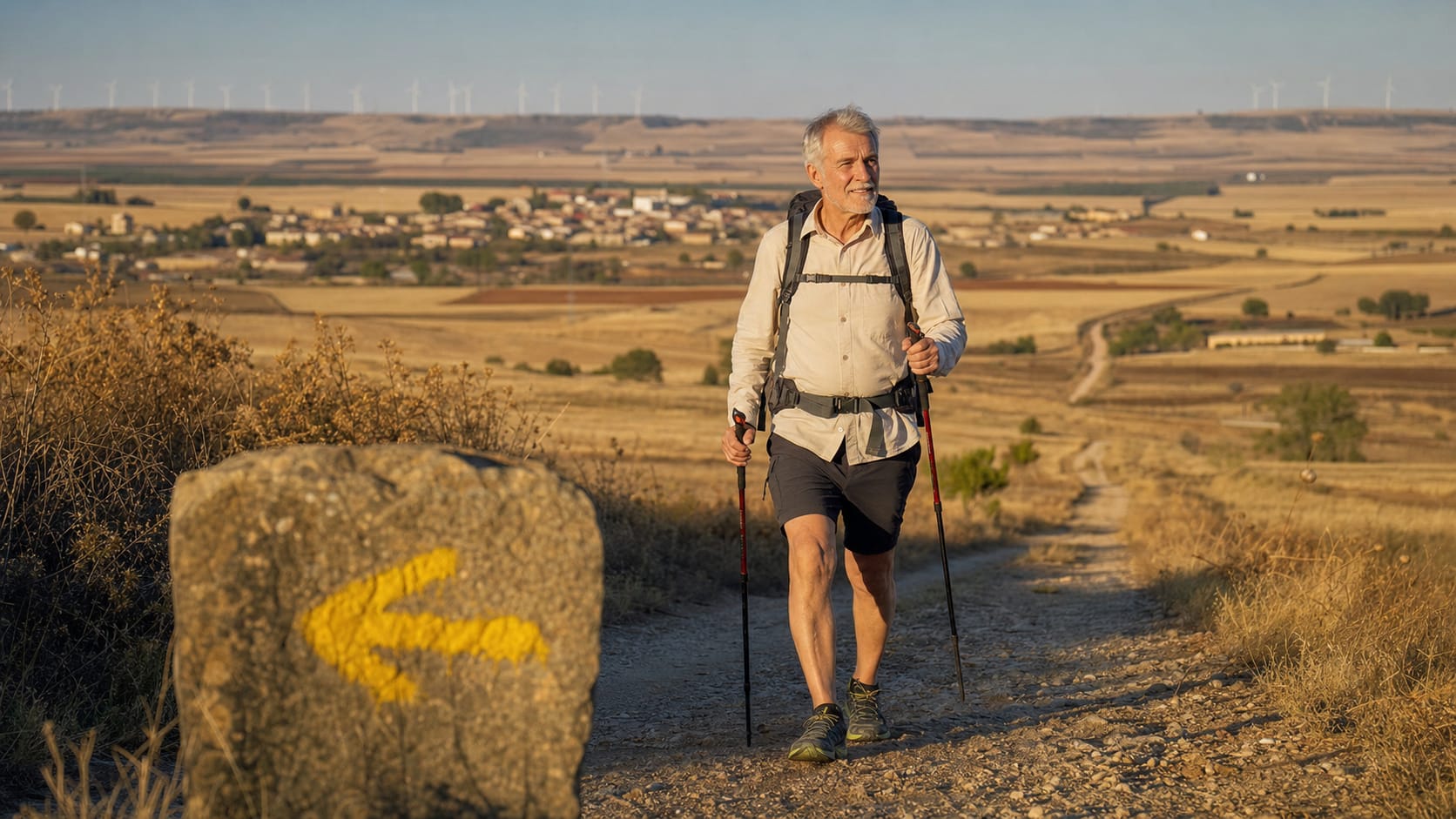
No. You do not need to be fit to start the Camino de Santiago, but you do need a plan. Most beginners, older walkers, and overweight pilgrims complete the route with 8 to 12 weeks of progressive walking, a luggage transfer service, and shorter daily stages. Fitness builds on trail as the body adapts to walking five or six hours a day.
The piece that derails first-timers is not the cardio. It is the feet, the pack weight, and the back-to-back days. A 65-year-old who walks for an hour three times a week is in a better position than a marathon runner who has never carried a loaded backpack for two days in a row. The plan addresses the actual demand of the Camino, not athletic fitness in the abstract.
If you are still mapping out the broader trip, the planning pillar guide covers the full sequence (route, season, training, budget) that this fitness question sits inside. Once a route is in mind, the route-choice FAQ helps you pair fitness with terrain.
What 'fit enough' actually means on the Camino
Fit enough means three things, in order: feet that have walked at least 100 kilometres in your actual Camino shoes, a back that has carried 6 to 8 kilograms for two consecutive days, and a pace you can hold for five hours without your form breaking down. None of these require running, the gym, or a heart-rate monitor. They require walking, week after week, in the gear you will actually fly with.
Where age, weight, and a sedentary office job change the plan
Age and weight do not change the structure of the plan, only the timeline. A 70-year-old desk worker uses the same progression a 30-year-old desk worker uses. They just spread it across 16 to 24 weeks instead of 8 to 12, walk shorter daily stages (16 to 20 km instead of 25), and lean harder on luggage transfer to keep their pack at 2 to 3 kilograms. See our dedicated training-for-the-camino guide for the full week-by-week ramps.
Train by walking, not by joining a gym. Start with three 30-minute walks per week in the exact shoes you will wear on trail, then add a longer back-to-back weekend walk every two weeks. Add backpack weight only after week four, climbing toward 10 percent of body weight by week ten.
The single rule that matters: walk in the shoes you will travel in
Most foot trouble on the Camino is preventable, and the prevention starts at home. Buy your Camino shoes 8 to 12 weeks before departure and walk every single training kilometre in them. Trail-runners need around 100 km of break-in to soften. Any hot spot, blister, or numb toe during training is a fit verdict on the shoe, not a sign you need to toughen up. Replace the shoe before you fly. A pre-departure conditioning checklist that bundles feet, core, and load-bearing readiness is in the works for a future article in this cluster.
Back-to-back weekend walks: why one long walk is not enough
Most Camino fatigue happens on day two, not day one. The body recovers between sessions, so a single Saturday long walk teaches your legs almost nothing about consecutive walking days. A Saturday long walk followed by a Sunday medium walk teaches your feet, hips, and knees to start a stage on already-tired legs. That is the actual demand of the Camino.
A 12-week plan splits into three blocks: base, build, and peak. Weeks 1 to 4 log around 40 kilometres total in unloaded 30 to 60 minute walks. Weeks 5 to 8 reach 60 kilometres weekly with a 6-kilogram pack on weekends. Weeks 9 to 12 simulate the Camino with 25-kilometre back-to-back days, then a half-volume taper in week 12.
Each week mixes three short walks, one strength session, and one long walk that grows by 10 percent. The Saturday-Sunday back-to-back pair is the most important session of the week. The midweek strength session is short (20 to 25 minutes): calf raises, step-ups, single-leg balance holds, and a one-minute plank. None of it needs a gym.
Backpack weight layers in after week four, starting at 3 kilograms and climbing 1 kilogram every week or two until it matches your real Camino weight. The Confraternity of Saint James and most pilgrim associations cap pack weight at 10 percent of body weight, with 6 to 8 kilograms as the practical target.
Most foot trouble on the Camino is preventable. Wear trail-runners broken in over at least 100 kilometres, change socks at the half-stage point, and treat hot spots before they become blisters. Hot spots become blisters in 15 to 30 minutes of continued friction, so the moment you notice rubbing, stop and tape.
The harder call is telling a blister from a real injury. Blister pain is local, surface-level, and improves when you stop pressing the spot. Injury pain is deeper, often radiating, and worsens through the day. Shin, knee, ankle, or Achilles pain that persists into the next morning is not a blister. Any limping that lasts two stages means stop walking and see a doctor in the next town.
The plan does not change much, but the timeline and the route do. Allow 16 to 24 weeks of training instead of 12. Pick a flatter route such as the Camino Portugués Coastal, which averages under 200 metres of daily ascent on most stages. Use luggage transfer end-to-end so your daily pack stays at 2 to 3 kilograms. Book a doctor visit before week one to clear cardio, knees, and any current medication.
Trekking poles change the math meaningfully for older walkers and anyone with knee issues. Two poles redistribute roughly a quarter of the load off the knees on descents, which is where the Camino punishes untrained joints. Keep daily stages under 20 kilometres, finish each stage before the afternoon heat builds, and plan a half-day or rest day every fifth to seventh walking day before you feel you need it.
Plan a half-day or rest day every fifth to seventh walking day before you feel you need it. Keep daily stages under your weekly long-walk distance from training. If you skip food, drop pace below three kilometres per hour, or limp two stages in a row, take a bus to the next town and recover. Skipping a stage by bus is not failure. Walking through escalating pain and ending the trip in week two is the actual failure mode.
The table below compares three common starting points, with the training weeks, weekly volume, pack-weight target, and route recommendation for each.
| Starting point | Training weeks | Weekly volume goal | Pack weight goal | Recommended route |
|---|---|---|---|---|
| Active (already walks 1 hour, 4× weekly) | 8 weeks | 70 km peak with back-to-back loaded days | 6–8 kg (10% of body weight) | Camino Francés from SJPdP |
| Light walker (30 minutes daily, comfortable) | 12 weeks | 60 km peak with back-to-back loaded days | 6–8 kg | Camino Francés from León or Sarria |
| Sedentary, older, or overweight | 16–24 weeks | 40 km peak with daily 16–20 km stages | 2–3 kg with luggage transfer | Camino Portugués Coastal from Porto |
The peak weekly volume is the longest training week in the plan, not a sustained target. Most plans dip to half-volume in the taper week before the flight so you arrive rested.
Frequently asked questions
How long does it take to train for the Camino if I'm starting from a total beginner?
Twelve to sixteen weeks. Beginners should give themselves at least three months of consistent walking, starting with three 30-minute walks per week and growing weekly volume by 10 to 20 percent. Older or overweight walkers benefit from four to six months to keep joint load manageable and build daily-stage stamina.
How do I tell on the Camino whether foot pain is a blister or a real injury?
Blister pain is local, surface-level, and improves when you stop pressing the spot. Injury pain is deeper, often radiating, and worsens through the day. Shin, knee, ankle, or Achilles pain that persists into the next morning, or any limping that lasts two stages, means stop walking and see a doctor in the next town.
Can I walk the Camino if I have arthritis or knee problems?
Yes, with adjustments. Use trekking poles to redistribute load, keep daily stages under 20 kilometres, choose a flatter route such as the Camino Portugués Coastal, and use luggage transfer so your pack weight stays at 2 to 3 kilograms. Get a doctor's clearance before training and discuss anti-inflammatory medication for the trail.
Do I need to speak Spanish to walk the Camino?
No, but a phrasebook helps in pharmacies, small albergues, and rural cafés. Most albergue hosts on the Camino Francés handle basic English. Korean, Japanese, and German speakers should download offline translation packs before departure since cell signal is unreliable across the meseta and Galician hill country.
What is the easiest Camino route for a sedentary beginner?
The Camino Portugués Coastal from Porto to Santiago. It runs around 280 kilometres in flat to gently rolling terrain, has frequent towns, supports luggage transfer end-to-end, and lets you spread the walk over 12 to 14 days at 16 to 20 kilometres per day.
When should I see a doctor on the Camino?
If pain wakes you at night, if you cannot put weight on a joint after a rest, if a blister shows red streaking or discharge, or if you feel chest pressure or breathlessness on flat ground. Most towns over 2,000 people have a centro de salud open weekday mornings.
External citations
Oficina de Acogida al Peregrino — annual Compostela statistics
oficinadelperegrino.com/en/statisticsOfficial source for pilgrim counts by age and starting point, including the share of pilgrims aged 60 and over who finish the route each year.
American Pilgrims on the Camino — Preparing for the Camino
americanpilgrims.org/preparationUS confraternity reference that aggregates the current Compostela rules, daily distance norms, and route-choice guidance for first-time pilgrims, used throughout this FAQ.
Wilderness Medical Society — practice guidelines for foot care
www.wms.org/research/clinical-practice-guidelinesPeer-reviewed prevention and treatment protocols underpinning the foot-care section and the pain-vs-injury decision rules.
La Compostela del Lector
You walked this guide to Santiago.
All 771 km, 0 stages, stamped end to end.