
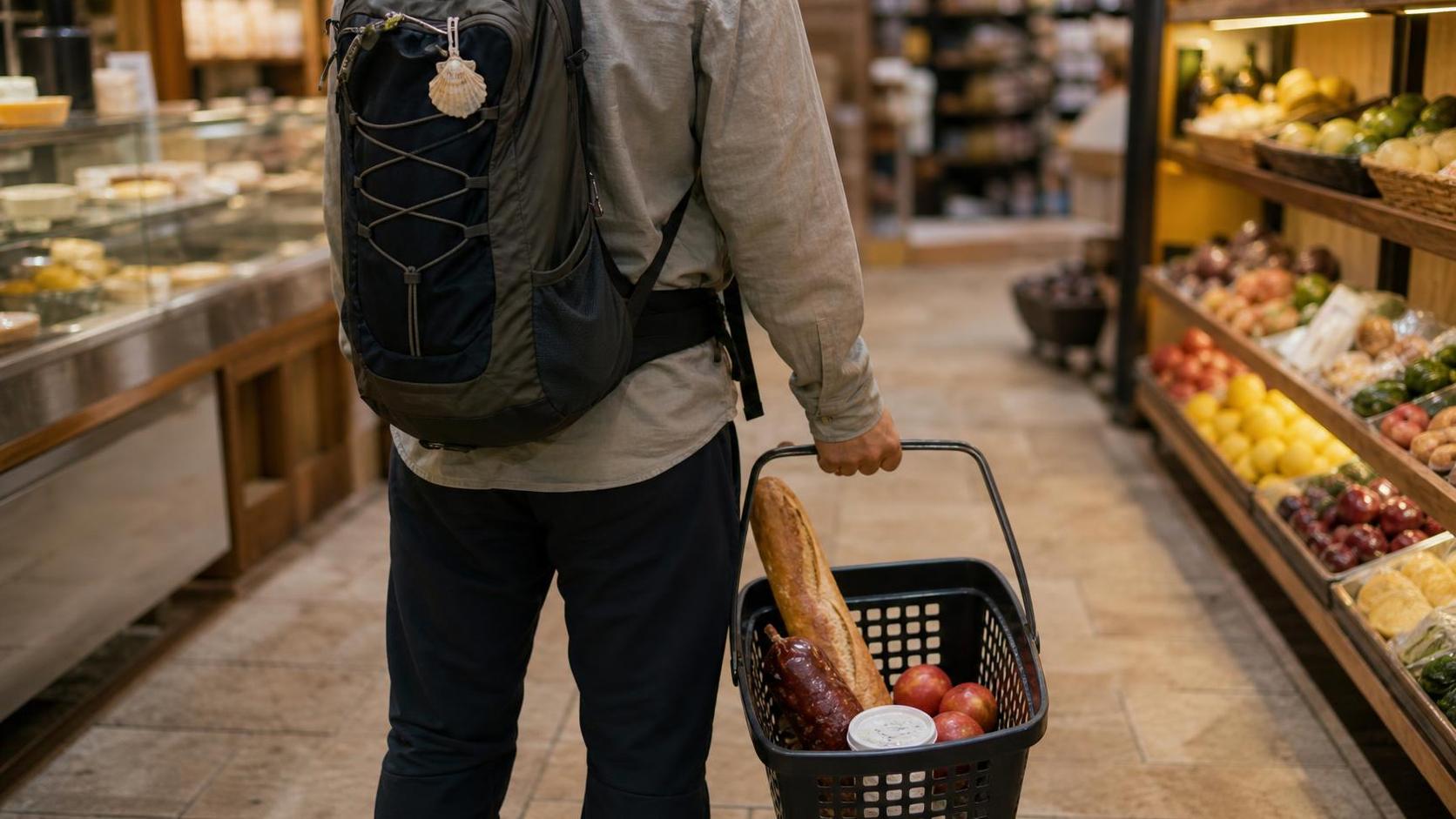
On the Camino Francés food is everywhere until, quite suddenly, it is not. Shops keep Spanish hours, close for the afternoon siesta, shut on Sundays, and disappear altogether on a handful of stages. A supermarket strategy is nothing more than knowing which shop comes next and when it opens, and it keeps you fed cheaply instead of carrying five kilos of tins you will never eat. This guide sits under our full guide to eating on the Camino; here we stay on the practical question of where you actually buy your food.
You will mostly meet four names. Día and Mercadona turn up in nearly every large town, Eroski owns the north-east, and Carrefour Express fills in the bigger stops. After Sarria the Galician chains Gadis and Froiz take over, and between the towns you rely on the small village alimentación.
- Día: the cheapest and most widespread, good for bread, tinned fish and own-brand staples.
- Mercadona: Spain's biggest chain, in cities and larger towns, strong on fresh fruit, yogurt and ready salads. It opens 9:00 to 21:30 Monday to Saturday and closes on Sundays and holidays.
- Eroski: around a thousand outlets concentrated in the Basque Country, Navarra and La Rioja, so it carries the early stages.
- Carrefour Express: the convenience format in larger towns, often central and open longer than Mercadona, sometimes into the evening or on a Sunday.
- Gadis and Froiz: the Galician pair you meet after Sarria. Gadis runs about 219 supermarkets, roughly 179 of them in Galicia; Froiz spreads across Galicia and Castilla y León. Both are where you stock the final week.
An alimentación, or an old-style ultramarinos in a small village, is a different animal: family-run, tiny, and stocked with bread, cheese, cured chorizo, fruit, yogurt and tinned fish. Vital when it is open, and closed more often than you would like.
Big-chain supermarkets in towns usually run straight through, about 9:00 to 21:30, Monday to Saturday. The trouble starts in the villages. Small shops often close for the siesta, roughly 14:00 to 17:00, and some simply do not reopen. Almost everything shuts on Sundays and public holidays outside tourist spots, though summer loosens this and larger towns keep longer hours, some pushing closing time toward 22:00 and opening on a Sunday morning.
| Chain | Where on the Francés | Typical hours | Sundays and holidays | Price | Best pilgrim buy |
|---|---|---|---|---|---|
| Día | Most large towns, widespread | Mon–Sat 9:00–21:30 | Usually closed | Cheapest | Bread, tinned fish, own-brand pasta |
| Mercadona | Cities and bigger towns | Mon–Sat 9:00–21:30 | Closed | Low–mid | Fruit, yogurt, ready salads |
| Eroski | Basque Country, Navarra, La Rioja | Mon–Sat, longer in cities | Some open Sunday morning | Mid | Cured meat, cheese, local produce |
| Carrefour Express | Larger towns, often central | Long, often 9:00–22:00 | Sometimes open | Mid–high | Late or Sunday top-ups |
| Gadis and Froiz | Galicia, after Sarria | Mon–Sat 9:00–21:30 | Mostly closed | Low–mid | Empanada, Galician bread, fruit |
| Village alimentación | Small villages between towns | Irregular, siesta 14:00–17:00 | Often closed | Higher per item | Emergency bocadillo makings |
The rule that saves you: buy when you can, not when you need to. If you pass an open supermarket at midday and the next town is small, shop now.
Build your meals around food that travels well and needs little or no cooking: bread, cured chorizo or jamón, hard cheese, tinned fish, fruit, yogurt, nuts and pasta. Cheap, filling, and light on your back.
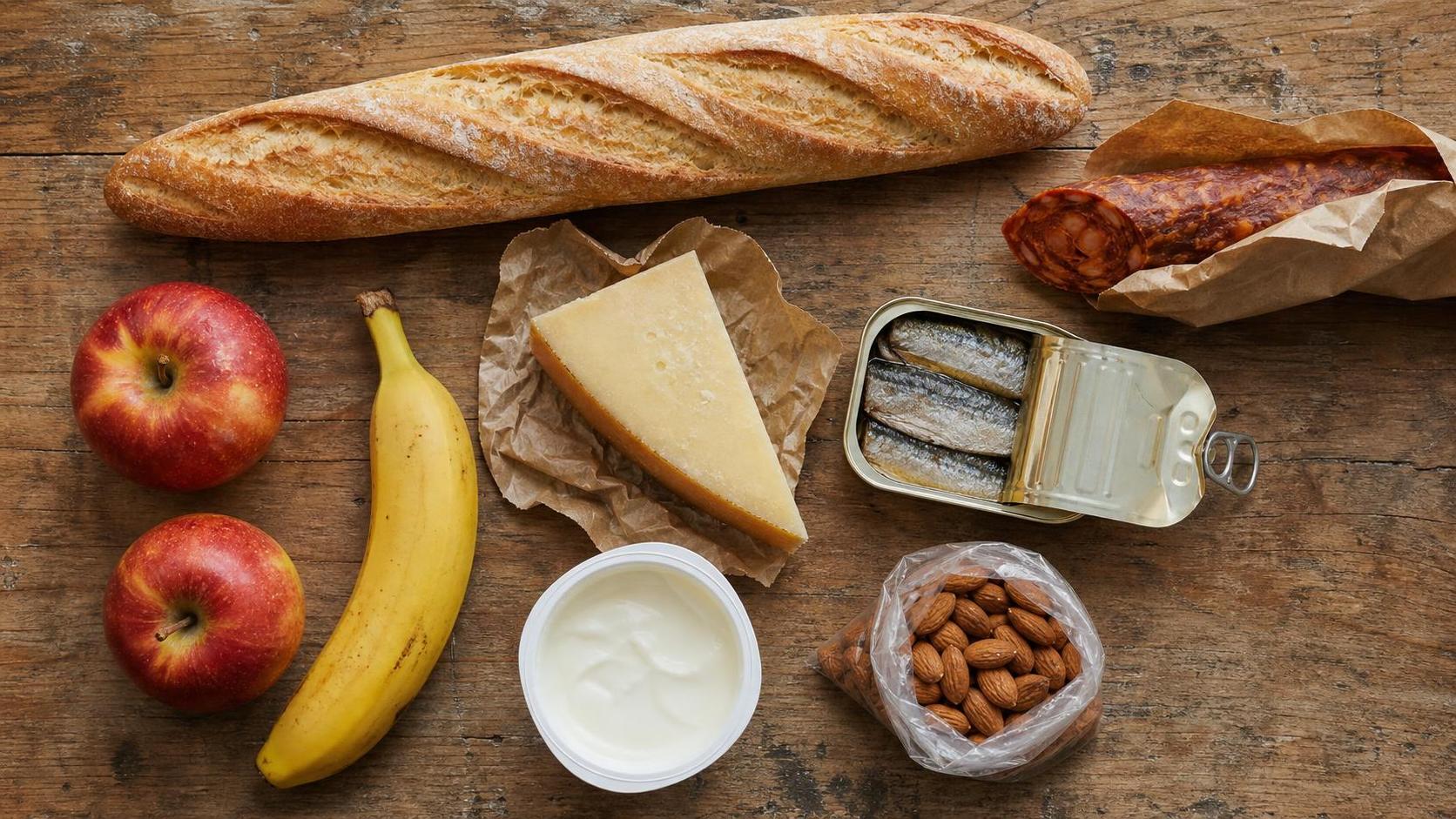
The numbers are friendly. A baguette is under €1, a chorizo €2 to 3, six eggs around €1.50, a litre of milk under €1. A picnic lunch of bread, cheese and fruit comes to about €2 a person, against €4 to 5 for the same thing in a café. Buy only what you will eat that day, plus one emergency bocadillo's worth for the road, and you never haul a pantry up a hill.
Self-catering from supermarkets costs roughly €10 a person a day for two meals, or €15 to 20 for a couple. Eating out for the whole day, breakfast, a pilgrim menu and dinner, runs closer to €25 to 30. The menú del peregrino is €10 to 15 on its own and worth it on the long days, but eaten every night it both empties your wallet and turns repetitive.
Most pilgrims land in the middle: a supermarket breakfast and lunch, an occasional menú del peregrino, and the odd cooked dinner. That mix keeps food well under the bed budget, which is the harder line to control. Our guide to eating on the Camino puts these tiers beside the rest of the daily spend, and Camino breakfast options earn a closer look of their own.
Municipal albergues are the type most likely to have a communal kitchen you can use, though pans, oil and a working hob are hit or miss, so ask at the desk before you shop. When the kitchen works, a shared pot of pasta or lentils drops dinner to about €2 to 3 a person and turns four strangers into a table.
Keep it simple. Buy ingredients that cook in one pot, label nothing, share everything, and clean up after. A tin of lentils warmed through, pasta with whatever the shop had, eggs and salad: none of it needs the gear a real kitchen has, and all of it beats a fourth pilgrim menu in a row.
Most Francés stages have a shop, but a few leave you exposed, and one is famous for it. The stretch from Carrión de los Condes to Calzadilla de la Cueza is about 17 km with no shops, no bars and no fountains, a hard lesson on the Meseta if you walk out of Carrión with an empty pack. Early Sunday mornings and siesta afternoons catch people the same way.
The habit to build is simple: spot the last open shop before a gap and carry a day ahead. On these dry, empty stretches water runs out faster than food and matters more, so read our guide to water sources on the Camino before you take on the Meseta, and fill every bottle at the last fountain marked agua potable.
FAQ
Which Camino Francés stages have no shops, so I should carry food ahead?
Most stages have a shop, but the biggest gap is the roughly 17 km from Carrión de los Condes to Calzadilla de la Cueza, with no shops, bars or fountains. Other thin spots are small Meseta villages and any stage you start on a Sunday. Buy the night before at the last real supermarket and carry a day ahead.
How much do basic groceries cost at a Spanish supermarket on the Camino?
A picnic lunch of bread, cheese and fruit is about €2 a person. A full day of self-catering runs roughly €10 a person, or €15 to 20 for two. Staples are cheap: a baguette under €1, a chorizo €2 to 3, six eggs around €1.50, a litre of milk under €1.
Are supermarkets open on Sundays on the Camino de Santiago?
Usually not. Mercadona and most big chains close on Sundays and public holidays, and small village shops often do too. In summer and in larger tourist towns some open on Sunday mornings. Treat Sunday as closed unless you have confirmed otherwise, and stock up on Saturday.
What is the difference between a supermercado, an alimentación and an ultramarinos?
A supermercado is a full self-service supermarket like Día or Mercadona. An alimentación is a small grocery, often family-run, with the basics. An ultramarinos is an old-style corner shop selling tinned goods, bread, wine and cured meat. In villages you rely mostly on the last two, and their hours are unpredictable.
Can I cook the food I buy in albergue kitchens?
Often, yes. Municipal albergues most reliably have a communal kitchen, but pots, pans and oil vary, and some have only a microwave. Ask at check-in before you shop. Choose one-pot meals like pasta or lentils, share the cooking and the cost, and clean up afterwards.
How do I shop for groceries in Spain if I do not speak Spanish?
Supermarkets are self-service, so you can shop without a word. Weigh loose fruit yourself and print the sticker, or hand it to staff at the counter. Learn a few terms, pan (bread), queso (cheese), agua (water), and use your phone's offline translator for labels and allergens.
External citations
Mercadona, customer information on opening hours (info.mercadona.es)
info.mercadona.esPrimary-source confirmation of a major chain's opening hours and Sunday and holiday closures, rather than a blogger's recollection.
Gronze, Camino Francés stage guides
www.gronze.com/camino-francesThe definitive Spanish Camino planner, listing per-town services stage by stage, which grounds the claims about which sections have no shops.
Día, Gadis and Mercadona official store locators
www.dia.esOfficial store-finder tools verify which towns on each stage actually have a branch and confirm its exact local hours.
La Compostela del Lector
You walked this guide to Santiago.
All 771 km, 0 stages, stamped end to end.