
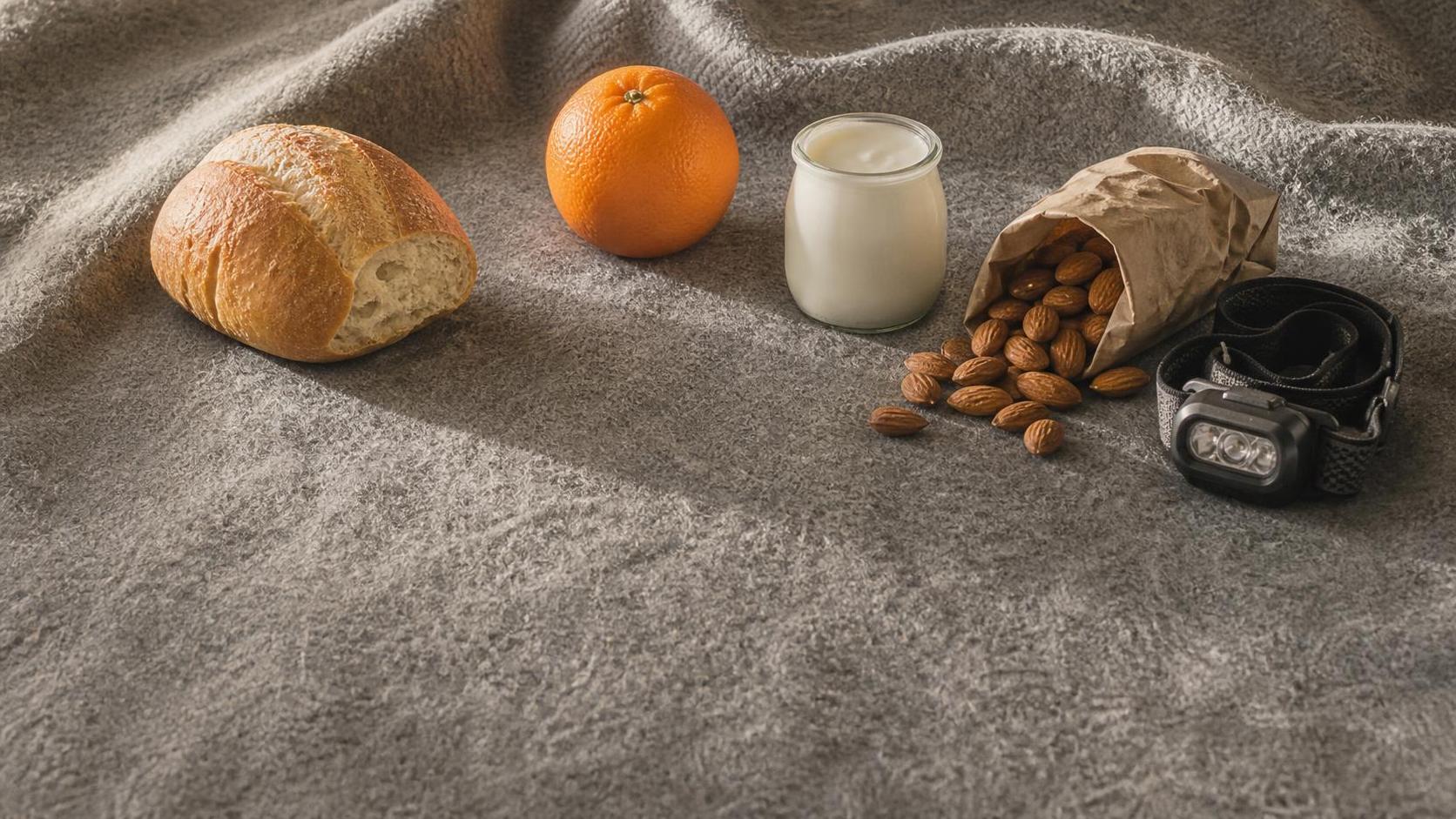
Whatever you bought the night before. At 6am the albergue kitchen is dark, the village bar is shuttered, the bakery has not lit its ovens and the grocery shop will not open for another three hours. The pilgrims walking out around you are eating a bread roll from yesterday's shop, a banana, a yogurt, some nuts. Then they walk 5 to 10 km and take a proper breakfast at the first bar that has its shutter up, which in a village usually means 8:00.
That is the whole system, and it is worth stating plainly because almost nobody says it out loud before you arrive. Spain does not do early breakfast. There is no pre-dawn café culture waiting for you, no 24-hour anything in a village of 90 people. Coffee is the one thing you cannot carry, so coffee is the thing you walk toward.
Most pilgrims are not actually out at 6. Albergues require you to be gone by 8:00, and the real spread is 6:30 to 7:30, with the genuinely early starts belonging to people avoiding Meseta heat in August. But even a 7:00 start lands you on the trail before the first bar opens, so the problem is the same one, just an hour smaller.
Two habits make it painless. Buy four items the evening you arrive, before the shop closes at 20:00. Then check tonight where tomorrow's first bar actually is, because on most mornings it is close and on a handful it is not.
Most of mainland Spain lies west of Greenwich, level with Britain and Portugal, but the country runs on Central European Time. Franco moved the clocks forward in 1940 to match occupied Europe and nobody ever moved them back. The result is a country living well ahead of its own sun: in Galicia the clock runs about eighty minutes ahead of solar time in winter and two and a half hours ahead in summer. Every meal slides late to match. Breakfast at 8 or 9, lunch at 2, dinner at 9 or 10. A bar owner opens when customers arrive, and Spanish customers do not arrive at six in the morning.
The sunrise numbers make it concrete. On 1 October the sun comes up in Santiago de Compostela at 08:31, so a 6am departure is two and a half hours ahead of the sun and about two of those hours are genuinely dark. Even at midsummer, when Pamplona gets light at 06:32 and Galicia closer to 07:00, walking out at 5 means a head torch.
Village size sharpens all of it. In a town of a few thousand with people going to work, the bar opens around 7:00 or 7:30. In a village, 8:00 to 8:30 is the honest expectation, and in a hamlet of 40 the bar is somebody's front room that opens at 9 or whenever they get up. Off-season, a village bar may not open at all on a Monday, and Sunday morning runs late everywhere.
None of that is a problem once you expect it. It only becomes a problem when you leave in the dark assuming that something, somewhere, will be open, and then walk two hours on an empty stomach because it was not.
Ranked by the hour you can realistically have it, not by how good it is. The first two are available in the dark; everything else asks you to wait or to walk.
| Option | Earliest realistic hour | Cost | Rough calories | Weight you carry | Best for |
|---|---|---|---|---|---|
| Pack-ahead food from your own bag | Any hour | €3 for four items | 400–500 | 350–400 g | Leaving before 8:00 |
| Albergue vending machine | Any hour | €1–2 | 150–250 | None | A hot drink before the sun is up |
| Albergue self-service breakfast | 06:00 | €3–6 | 300–400 | None | Leaving between 6:30 and 8:00 |
| Hospitalero-made or donativo breakfast | 06:30 | Donation to €5 | 300–500 | None | Slow starts and company |
| Napolitana from a panadería | 07:30 | €1–2 | 300–400 | None | Towns big enough to have a bakery |
| Tostada con tomate at the first bar | 08:00, 07:00 in towns | €3–4.50 with coffee | ~350 | None | The standard Camino morning |
| Pincho de tortilla | 08:00 | €2.50–3.50 | 250–350 | None | When the tostada is not enough |
| Churros con chocolate | 08:30 | €3.50–4.50 | 500–700 | None | Weekends in larger towns |
| Second breakfast at 10:00 | 10:00 | €4–8 | 500–800 | None | The meal that actually fuels the stage |
Pack-ahead food from your own bag is the only option that exists at 5:45. A crusty roll, a piece of fruit, a small yogurt or a wedge of cheese, and a handful of nuts. It weighs almost nothing, costs about €3, and gets you through the first two hours.
The albergue vending machine is grim and useful in equal measure. Machine coffee for a euro, a packet of biscuits, occasionally a hot chocolate. Not breakfast, but a hot drink in your hands at 6am in a cold stone hallway changes the morning more than it should.
Albergue self-service breakfast is the compromise most private albergues offer: packaged toast, jam, instant coffee or a machine, sometimes cereal and juice. Listed prices run €3 to €6, most often €4 or €5, and service starts at 6:00 in the places that cater to early walkers and 7:00 in the places that do not. Ask at check-in, because the answer varies bunk to bunk.
Hospitalero-made and donativo breakfasts are the ones people remember. Someone gets up early, makes coffee in a real pot, puts bread and jam on a long table and everybody eats together before walking out. You will meet a handful of these in a month, mostly in parish albergues, and they are worth the slower start.
A napolitana de chocolate from a panadería costs a euro or two and is the cheapest warm calories on the route. Bakeries open earlier than bars, around 7:30, and they open on Sunday mornings when the grocery shop does not. Only towns of a certain size have one at all.
Tostada con tomate is the actual Spanish breakfast and the one you will eat most often: toasted bread, grated tomato, olive oil, salt, with a café con leche. Around €3 to €4.50 for both, and closer to €6 once you add a fresh orange juice, which is a bigger upgrade than it sounds. The jam version, con mermelada, is the same price and comes with butter.
Pincho de tortilla is a wedge of potato omelette, €2.50 to €3.50, and it is the upgrade you want on a hard stage. Denser than toast, real protein, and it holds you until lunch. It is also usually ready the moment the bar opens.
Churros con chocolate tend to be a weekend and holiday thing outside the cities, where the churrería tours villages on market days. If one is open on a Tuesday morning in a village, take the photo, it is unusual.
Second breakfast at 10:00 is the meal that does the real work. Most pilgrims walk two to three hours, stop properly, and eat a bocadillo or a second tortilla around mid-morning. The mid-morning slot is Spanish custom rather than a constraint: a bar will make you a bocadillo whenever it is open, so if you skipped breakfast entirely you can order one at 8. Treat the stop as part of the plan rather than a snack and the whole day works better; our guide to eating on the Camino sets it beside lunch, the pilgrim menu and dinner.
They cost roughly the same, €3 to €6 at the albergue against €3 to €4.50 at a bar, and they buy different things. The albergue buys you time: you eat where you slept, you lose no walking minutes, and you are out of the door with something in your stomach. The bar buys you quality: real coffee from a machine that gets used four hundred times a day, hot toast, a toilet you do not have to queue for, and a chair.
The catch is distance. On the Camino Francés the median walk from a village with an albergue to the next village that has a bar at all is 5.1 km, a bit over an hour at walking pace. Half the time it is closer, sometimes the bar is in the same village, and on some mornings it is a great deal further.
Most pilgrims stop choosing after the first week and simply do both: something cold at the albergue or from the pack at 6, then a real stop at the first open bar an hour or two later. The stop is about more than food. It is where you take your boots off, check your feet before a hot spot turns into a blister, and decide whether today is a 20 km day or a 30 km one.
Shops close around 20:00 and all day Sunday, so this happens the evening you arrive, in the twenty minutes between the shower and dinner. Four items, one bag, about €3.
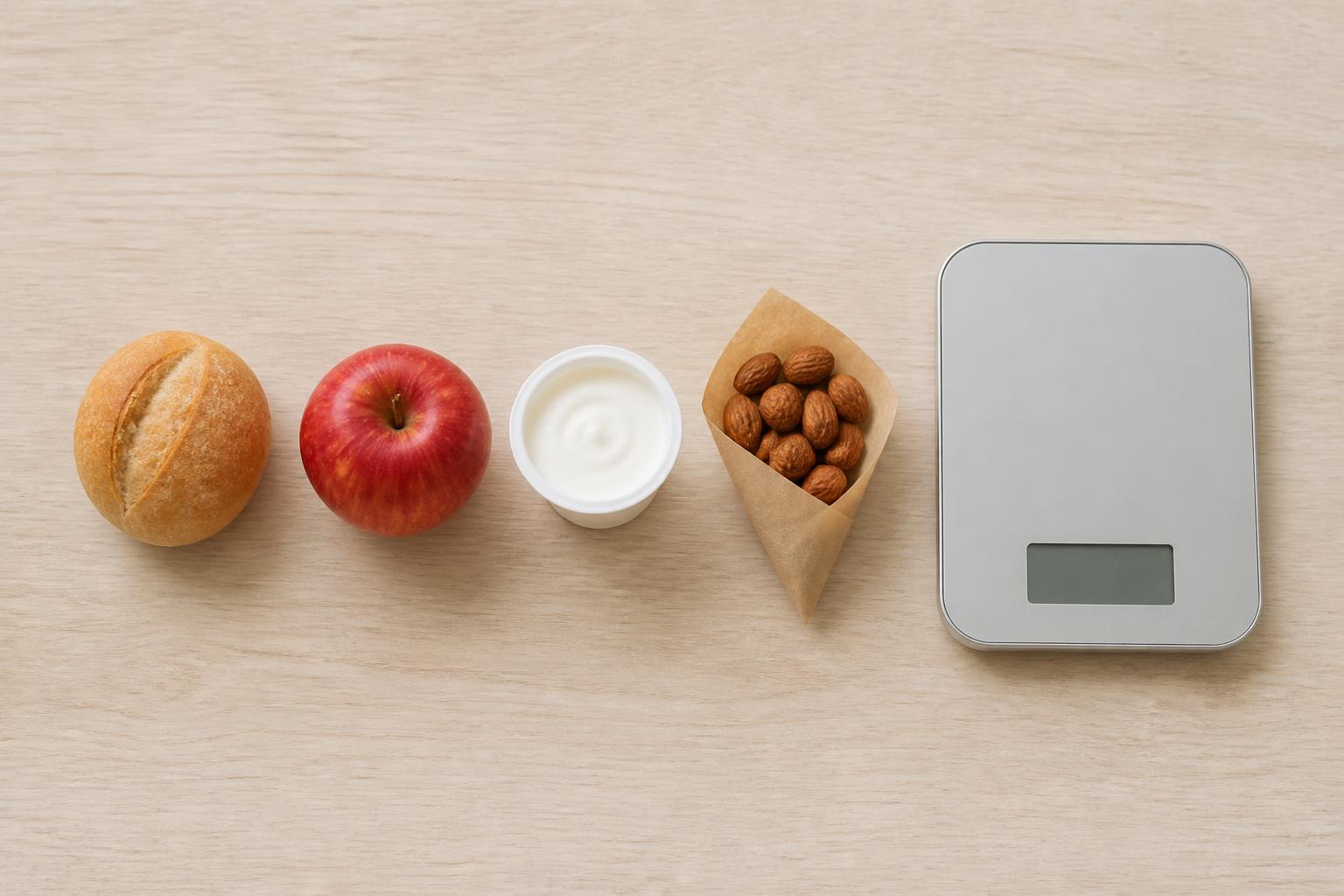
- A bread roll or half a baguette. Under €1. Buy it the same day, not two days ahead, and it will still be edible at 6am.
- A piece of fruit. A banana for the first hour, an orange if you want it to survive a squashed pack. Around €0.50.
- A yogurt or a wedge of hard cheese. About €1. Yogurt is fine overnight in a pack in spring and autumn; in an August heatwave take the cheese instead.
- A handful of nuts. Almonds or mixed nuts, bought once and topped up every few days. This is the item that saves you when the first bar is closed too.
What survives a night in a pack: bread, hard cheese, cured chorizo, nuts, dried fruit, oranges, apples. What does not: anything sliced and soft, tomatoes, bananas after day two, and anything you would be sad to find at the bottom of the bag under a wet rain jacket. Keep it in the top pocket so you can eat it without unpacking in the dark.
The one etiquette line worth knowing: do not eat your own food at a bar's table. A Spanish bar is a business, and the coffee that costs €1.50 is what buys you the chair, the toilet and the wifi. Eat your packed roll on a bench or a church step, then order something when you want to sit down. More of this is covered in albergue etiquette, which runs on the same logic.
Walking with a pack is more work than it feels like, though less than the internet tells you. A 70 kg pilgrim carrying 8 kg burns roughly 350 to 450 kcal an hour on rolling terrain, nearer 300 on the flat Meseta and past 500 on a climb like the one into O Cebreiro. Three hours before your second breakfast is somewhere around 1,100 to 1,300 kcal of work. A café con leche and a tostada give you back about 350, and a good half of that is the olive oil the bar pours over the toast.
The gap is the point. It is not a reason to carry more food, it is a reason to stop and eat properly mid-morning instead of pushing through to a late lunch on coffee alone. The shaky, irritable, everything-hurts feeling at kilometre 12 is usually not fitness. It is arithmetic.
Three things close it without adding weight. Eat the packed breakfast within the first half hour rather than saving it. Take the second breakfast seriously and order the tortilla, not just the coffee. And drink at the same time you eat, because a hot morning quietly costs you more than the calories do, which the water sources guide covers stretch by stretch.
If you are building a daily budget around this, breakfast plus a mid-morning stop runs €6 to 10 a day, and our 30-day cost breakdown puts that beside beds and dinners.
You need eight lines, not a language course. Bar staff on the Camino hear these several hundred times a week and are not judging your accent. Pointing at the counter also works, and everybody does it eventually.
| Spanish | What it gets you |
|---|---|
| Un café con leche, por favor | The standard half-coffee, half-hot-milk |
| Un cortado | Espresso with a splash of milk, smaller and stronger |
| Una tostada con tomate | Toasted bread with grated tomato and olive oil |
| Una tostada con mermelada | Toasted bread with butter and jam |
| Un zumo de naranja natural | Freshly squeezed orange juice |
| Un pincho de tortilla | A wedge of potato omelette |
| Para llevar | To take away |
| ¿Cuánto es? | How much is it? |
Two more that earn their place: ¿Hay baño? for the toilet, and ¿A qué hora abre? to ask what time a place opens, which is the question that saves tomorrow morning. If you read no Spanish at all, order by pointing and pay with a note rather than counting coins in a queue; nobody minds.
For coffee specifically, the vocabulary is small. Café con leche is the default. Café solo is an espresso. Cortado sits between them. Americano is an espresso with hot water, and it is the closest thing to filter coffee you will find.
Most mornings put a bar within an hour's walk. Measured across the Camino Francés, the median distance from a village with an albergue to the next village that has a bar is 5.1 km, and about half of all overnight stops have one within 5 km. But 26 of them are 8 km or more, and 15 are past 10 km. Those are the mornings to know about the night before.
| You sleep in | First village with a bar | Distance |
|---|---|---|
| Carrión de los Condes | Calzadilla de la Cueza | 17.8 km |
| Burgos | Tardajos | 16.5 km |
| Orisson | Roncesvalles | 15.3 km |
| Ferreiros | Portomarín | 14.8 km |
| Logroño | Navarrete | 14.0 km |
| El Burgo Ranero | Reliegos | 13.5 km |
| Villamayor de Monjardín | Los Arcos | 12.6 km |
| Villafranca Montes de Oca | San Juan de Ortega | 11.8 km |
| Hornillos del Camino | Hontanas | 11.5 km |
| Foncebadón | El Acebo de San Miguel | 11.3 km |
The cities behave differently from the villages. Leaving Burgos or Logroño you can get a coffee in town, because city cafés open early and there are dozens of them; the distance in the table is what waits after the last one. Leaving Carrión de los Condes or Orisson, there is nothing at all, and the number is literal.
Two caveats keep this honest. The table says a village has a bar, not that the bar is open when you reach it, so treat every distance as the earliest possible coffee rather than a promise. And a bar with an albergue attached is more likely to serve early than a bar on its own.
Checking tomorrow night takes a minute. Look at the next stage in your guidebook or app and find the first village after your bed with a bar symbol; if it is more than 8 km, buy an extra roll. That is the entire technique. The stage-length guide has more on reading a stage before you walk it, and the full picture of eating across the day sits in our guide to eating on the Camino.
FAQ
Is albergue breakfast worth the money, or should I stop at a bar instead?
Worth it if you are leaving after 6:30 and the albergue serves before you go. At €3 to €6 it costs about the same as a bar, or a little more, and is usually smaller and colder: packaged toast, jam, machine coffee. The bar gives you real coffee, hot toast and a toilet for €3 to €4.50, at the cost of walking to it first, a median 5.1 km on the Camino Francés. Most pilgrims settle on both, something cold at the albergue and a proper stop at the first open bar.
How do I order breakfast in Spanish on the Camino if I don't speak it?
Eight phrases cover it. 'Un café con leche, por favor' gets the standard coffee. 'Una tostada con tomate' or 'con mermelada' gets toast. 'Un zumo de naranja natural' gets fresh orange juice. 'Un pincho de tortilla' gets a wedge of potato omelette. 'Para llevar' means takeaway. '¿Cuánto es?' asks the price. '¿Hay baño?' asks for the toilet. 'Gracias' closes it. Staff hear these dozens of times each morning, and pointing at the counter works when the words do not come.
Can I use the albergue kitchen to make breakfast before I leave?
Sometimes, and less often than pilgrims expect. Most municipal albergues have a kitchen space, but many have no working hob, kettle or pans, and some lock the kitchen overnight. Several also ask for silence before 6:00 or 7:00, which rules out clattering around in the dark. Check the kitchen the evening you arrive rather than at 5:45, and keep a cold pack-ahead breakfast as the fallback.
What is open for breakfast on the Camino on a Sunday?
Bars, mostly, and often later than on a weekday. Small grocery shops and alimentaciones close all day Sunday, and many bakeries close Sunday afternoon or Monday. That makes the Saturday evening shop the one that matters. Larger towns keep some supermarkets open on Sunday morning, but never assume it in a village of 90 people.
Is it rude to eat my own food inside a Spanish bar?
Yes, and it is the etiquette mistake pilgrims make most. A bar is a business, not a shelter. If you sit down, order something: a café con leche is €1.30 to €2 and buys you the table, the toilet and the wifi. Eating your own bocadillo at an outside table without ordering reads as freeloading. Eat packed food on a bench, a wall or a church step, then buy a coffee when you want to sit.
What should I eat for breakfast if I am vegan, coeliac or lactose intolerant?
Pack-ahead becomes the main plan rather than the fallback. Bar breakfast is built on wheat bread and dairy, and village bars rarely have alternatives. Larger supermarkets in Pamplona, Logroño, Burgos and León stock gluten-free bread, plant milk and soy yogurt; village shops do not. Useful lines: 'sin gluten', 'sin lactosa', and 'soy celíaco' or 'soy celíaca'. Fruit, nuts and olive oil on gluten-free bread travel well and need no explaining.
External citations
Gronze, Camino Francés stage guides
www.gronze.com/camino-francesThe reference Spanish-language planner, listing which villages on each stage actually have a bar, a shop or a bakery. It is the data every English-language breakfast guide leaves out.
AEMET, Agencia Estatal de Meteorología, sunrise and sunset tables
www.aemet.es/en/eltiempo/prediccion/muni_mapaOfficial sunrise times for Navarra, Castilla y León and Galicia show how much of a 6am departure is walked in the dark, month by month, instead of guessing at it.
2024 Adult Compendium of Physical Activities
pacompendium.com/adult-compendiumPeer-reviewed MET values for hiking and for carrying a load let the calorie figures for a 25 km stage be calculated rather than asserted.
Xunta de Galicia, rules of use for the public albergue network
www.alberguescaminosantiago.com/2010/03/normas-de-utilizacion-de-la-red-de-albergues-de-galiciaThe public albergues require pilgrims to leave before 8:00. That rule, not enthusiasm, is what sets the shape of the Camino morning and puts most people on the trail before the bars open.
Camino Mío route dataset, Camino Francés villages and services
camino-mio.comThe distances to the first village with a bar are measured on our own Camino Francés village graph, which records the services present in each of the 159 places along the main route.
La Compostela del Lector
You walked this guide to Santiago.
All 771 km, 0 stages, stamped end to end.