
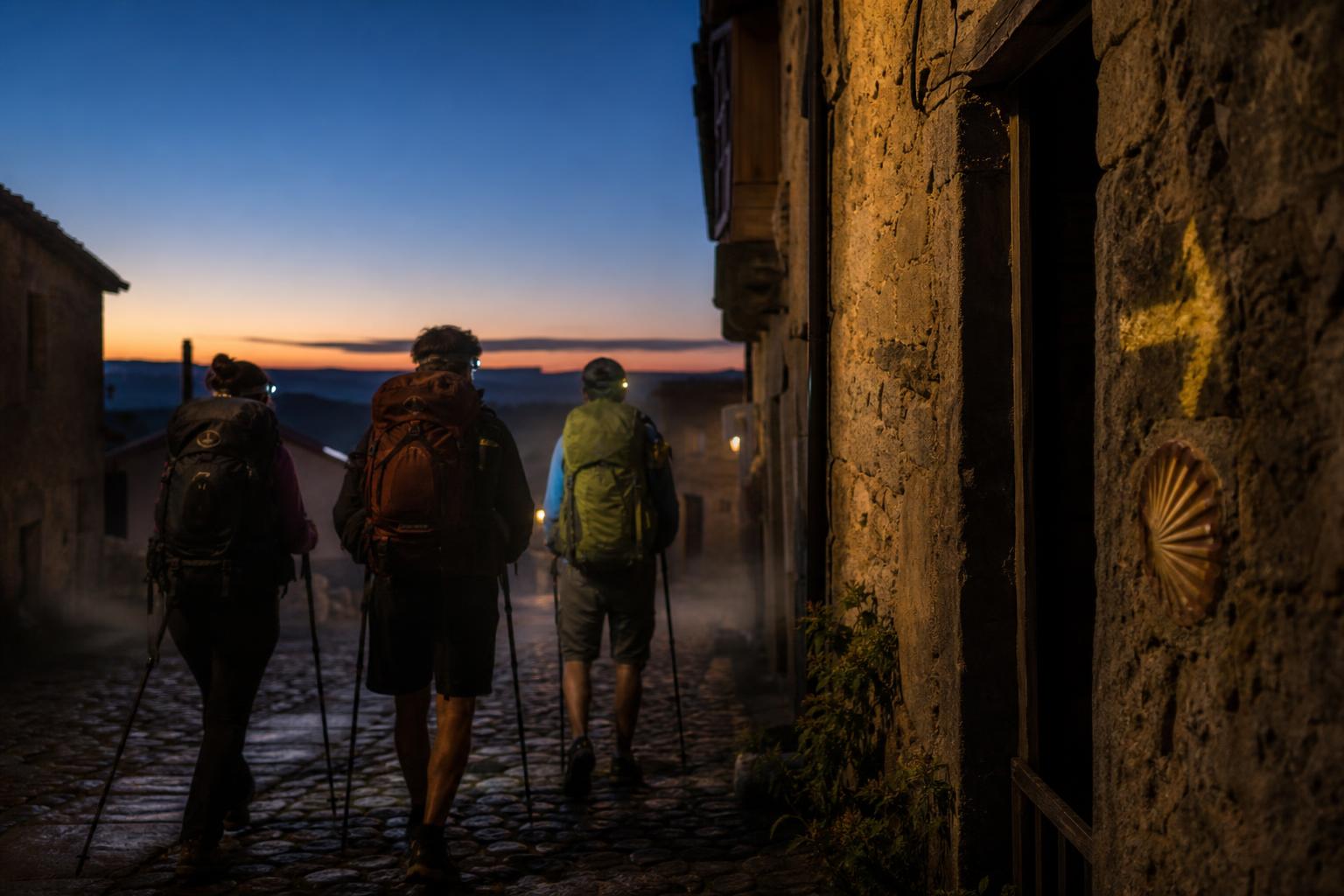
Most first-timers walk four to six hours a day on the Camino, roughly 20 to 25 km at 4 to 5 km/h, and spend six to seven hours door to door once coffee stops, sock changes, and photo breaks are counted. In week one, plan for the top of that range. Your pace, not the guidebook's, sets the clock, and a first-timer's legs move slower and stop more often than the averages assume.
The gap between walking time and total time is where plans go wrong. A stage the book calls "20 km, five hours" becomes a seven-hour day once you add the second-breakfast stop, the boots-off rest, and twenty photos of the first real view. Counting the breaks is the whole trick, which is why the first-Camino planning guide treats a walking day as six to eight hours of your time instead of a clean pace times distance. Everything below turns that into a number you can plan around.
A typical Camino Francés day runs wake at 6:00 to 6:30, walking by 7:00, a coffee stop around 10:00, arrival between 13:00 and 15:00, and albergue lights-out at 22:00. The rhythm is front-loaded on purpose: beds, heat, and Spanish meal times all reward pilgrims who finish by early afternoon.
Morning: the albergue empties before sunrise
Zips and headlamps start around 6:00, and most walkers are moving by 7:00. Many albergues want you checked out by 8:00, so an early start is less a choice than the house rule. The first hour is often quiet and cool, walked on little more than yesterday's bread.
Midday: second breakfast, the sock change, the last 5 km
The first open bar around 8 to 10 km in is where the real fuel goes in: coffee, tortilla, a chance to air your feet and change socks. After that comes the honest part of the day, the final stretch that decides whether you arrive fresh or wrecked.
Afternoon and evening: arrival chores, pilgrim menu, lights out
Arrive between 13:00 and 15:00, claim a bed, shower, wash and hang your clothes, and rest. Dinner comes early by Spanish standards, from about 19:00, and the doors close around 22:00. Finish by mid-afternoon and all of that is unhurried; arrive at 17:00 and it is a scramble.
Most pilgrims cover 20 to 25 km a day. First-timers do better planning 15 to 20 km for the first three or four days, then settling near 18 to 22 km once their feet and shoulders stop complaining. From Saint-Jean-Pied-de-Port the Camino Francés is roughly 770 to 800 km, which works out to 30 to 35 walking days at about 25 km a day, before rest days. Of the nearly half a million pilgrims who reached Santiago in 2024, most walked exactly that kind of stage.
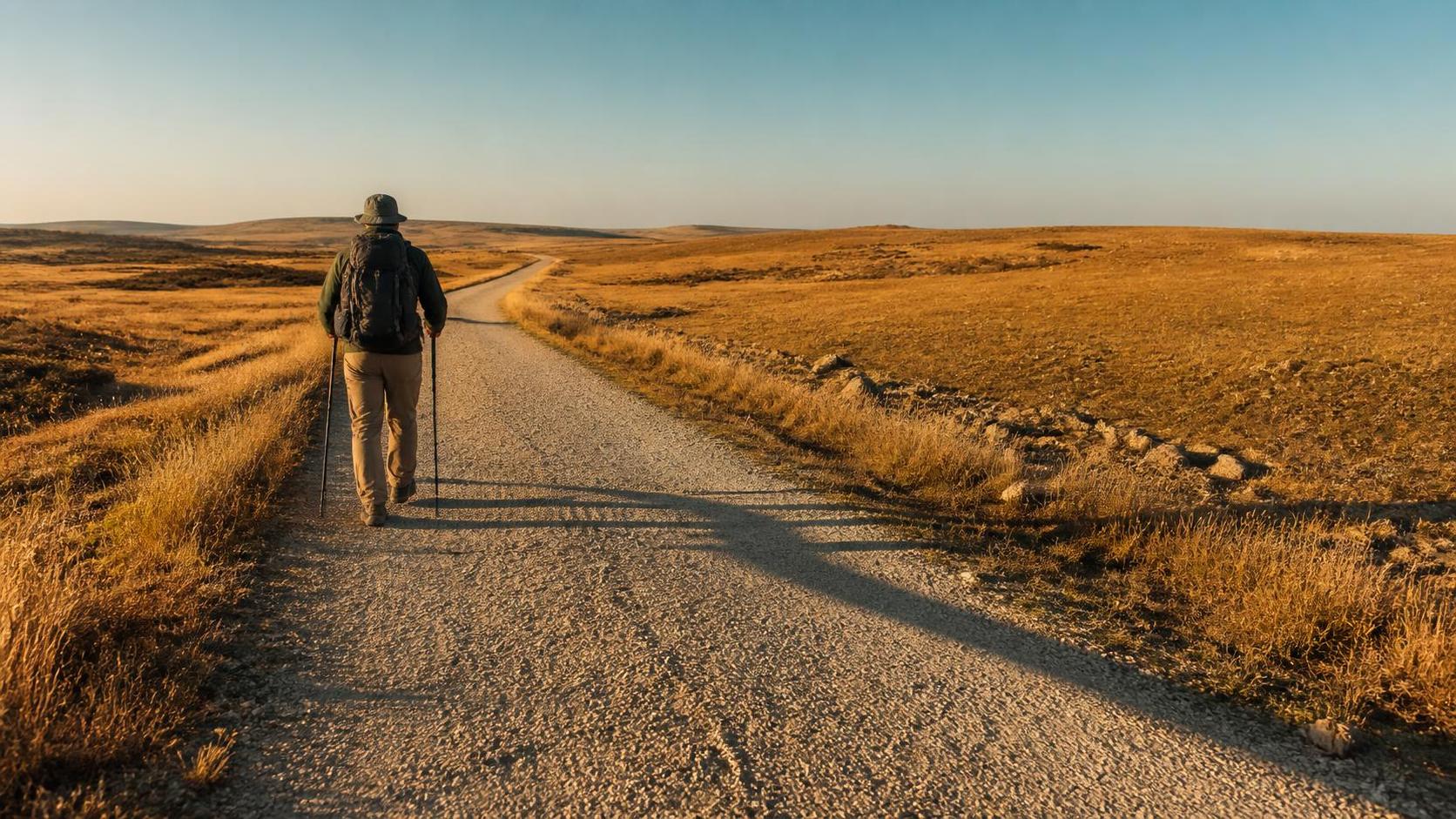
Cumulative fatigue is the part the averages hide. Week one is the hardest, when tendons and feet are still adapting and every kilometre is felt. By week two the body settles, and by week three the same 22 km stage that flattened you at the start can take a full hour less. Plan short and slow at the front, and let the distance grow as your pace does. If you are still weighing where to start and how many kilometres your calendar allows, the route-choice guide pairs distances with the weeks you actually have.
Time a loaded 10 km test walk at home, divide the distance by the hours for your true pace, then add 10 minutes per 100 m of ascent and 10 to 15 minutes of break per walking hour. Those three lines predict your stage times better than any guidebook average, because they run on your legs rather than an anonymous pilgrim's.
Measure your real pace
Walk 10 km with a loaded pack and time it. Distance divided by hours is your honest flat pace. Most people land between 3.5 and 5 km/h, and knowing which end you sit on changes every stage estimate that follows.
Add the climbing
Naismith's rule, first written down in 1892, adds 10 minutes for every 100 m you go up. Flat kilometres are cheap; vertical ones are not, and a big climb can double a short stage.
Add the breaks
Real days are not walked end to end. Add 10 to 15 minutes of stopping per walking hour for coffee, feet, water, and photos, and you have your door-to-door time.
The table below runs that math for common stage lengths. One study of 124 hikes found Naismith-style estimates accurate in about 81 percent of cases, so treat these as a solid planning baseline, not a promise.
| Stage length | Hours at 3 km/h | Hours at 4 km/h | Hours at 5 km/h | Add for 500 m of climb | Arrival if walking by 7:00 |
|---|---|---|---|---|---|
| 15 km | 5:00 | 3:45 | 3:00 | +50 min | around 11:30 |
| 20 km | 6:40 | 5:00 | 4:00 | +50 min | around 13:00 |
| 25 km | 8:20 | 6:15 | 5:00 | +50 min | around 14:30 |
| 30 km | 10:00 | 7:30 | 6:00 | +50 min | around 16:00 |
The arrival column assumes a 4 km/h base with roughly 15 minutes of break per walking hour; a day with 500 m of climb pushes every arrival about an hour later. Saint-Jean-Pied-de-Port to Roncesvalles is the sharpest lesson in why ascent matters. The stage is about 25 km with roughly 1,250 m of climb. Walked flat at 4 km/h, 25 km is 6 hours 15 minutes; Naismith then adds 10 minutes per 100 m, so 1,250 m is another 2 hours 5 minutes. That is around eight hours of walking before a single break, which is why even fit pilgrims treat day one over the Pyrenees as an all-day stage and start it in the dark. If your test-walk pace comes in slower than you hoped, the training guide has the week-by-week plans to raise it before you fly.
No, 25 km a day is not too much for a reasonably fit first-timer, but it is the wrong week-one target. Plan 18 to 22 km days for the first week, hold one 25 km day back until your feet prove out, and treat 25 km as a cruising speed rather than a starting speed.
The decision rule is simple. If you finished yesterday's stage with energy left to explore the town, you are ready to try 25 km. If you arrived wrecked and went straight to your bunk, hold your current distance for another day or two. Feet and tendons set the ceiling, and they adapt on their own schedule no matter what the itinerary says. Big jumps in daily distance, not the distance itself, are what turn into shin splints and week-one dropouts.
In summer, start at 6:00 to 6:30 to bank kilometres before the afternoon heat; sunrise near the coast comes around 6:45 and the light follows you all morning. Meseta afternoons in July and August regularly climb past 30 to 35 °C, so the early start is about safety as much as speed. In October, sunrise slides past 8:00, so leaving before 7:30 means an hour of headlamp walking. Start a little later, or carry a light and follow the waymarks with care, and remember the clocks fall back in late October.
Season shifts your whole clock, not just the start. Shorter autumn days mean less margin if a stage runs long, so the pace worksheet earns its keep most in October. For the fuller trade-off between weather, crowds, and daylight across the year, the best-time-to-walk guide compares the seasons and helps you pick a start month.
When heat, a blister, or a full albergue breaks the plan, shorten the day rather than push through it. Stop at the next village with beds, send your pack ahead tomorrow with a luggage transfer, or take a bus over a road section. Only the final 100 km into Santiago has to be walked continuously for the Compostela, so outside that stretch, cut kilometres freely.
On the Camino Francés, villages with beds appear every 5 to 10 km, which makes shortening a stage a real option rather than a gamble. A luggage transfer such as Paq Mochila runs about €6 to 8 a stage and lets most walkers add a comfortable 2 to 3 km by carrying only a daypack. A rest day every five to seven days keeps the whole trip walkable, and trekking poles shave roughly 10 to 15 percent of the load off tired legs on the long descents. Where a stage or a bed falls through, recompute the day around the next reachable town; the planning guide walks through those on-trail decisions in full.
FAQ
Is walking 25 km a day too much for a first-time Camino walker?
Not if you are reasonably fit, but not in week one. Start at 18 to 22 km while your feet and shoulders adapt, then step up. A simple rule: if you finished yesterday's stage with energy to explore the town, you are ready to try 25 km; if you arrived wrecked, hold your current distance. Big jumps in distance, not the number itself, are what cause injuries.
What time should I start walking on the Camino Francés in summer versus autumn?
In July and August, leave at 6:00 to 6:30 so most kilometres are done before the 30 °C afternoon; sunrise is around 6:45. In October, sunrise comes after 8:00, so a 7:30 to 8:00 start avoids headlamp walking and still lands you in town by mid-afternoon. Adjust for the late-October clock change, which shifts the daylight by an hour overnight.
How many hours a day do you walk on the Camino?
Between four and six hours of actual walking for a standard 20 to 25 km stage at 4 to 5 km/h, or six to seven hours door to door once breaks are counted. Slower walkers, big-climb days, or 30 km stages push that to eight hours or more, which is why measuring your own pace beats quoting the average.
What time do pilgrims usually stop walking each day?
Most stop between 13:00 and 15:00, which leaves time to claim a bed, shower, wash clothes, and rest before dinner. Walking past 16:00 usually means the stage was too long for your pace, the heat slowed you down, or you started late. All three are fixable with tomorrow's plan.
How do I plan Camino stages if I walk slower than average?
Measure your real pace on a loaded 10 km test walk, then plan stages as hours, not kilometres: at 3 km/h, a 20 km stage is nearly seven hours before breaks. Choose 15 to 18 km stages, use the 5 to 10 km village spacing on the Francés to shorten days, and book luggage transfer on the big climbs.
What if I can't finish my planned stage?
Shorten it, do not force it. Stop at the next village with beds, take a bus or taxi over a road section, or split the stage and send your pack ahead. Outside the final 100 km before Santiago, skipping kilometres has no effect on your Compostela eligibility.
External citations
Oficina de Acogida al Peregrino (Pilgrim's Office, Santiago) — annual statistics
oficinadelperegrino.com/en/statisticsOfficial annual pilgrim counts and starting-point data from the Pilgrim's Office in Santiago, the primary source behind the typical daily-distance and route-length figures used here.
Naismith's rule
en.wikipedia.org/wiki/Naismith%27s_ruleThe 1892 walking-time rule, its 10-minutes-per-100 m ascent correction, and the later study finding Naismith-style estimates accurate in about 81 percent of hikes, all of which the pace worksheet builds on.
timeanddate.com — sunrise and sunset, Santiago de Compostela
www.timeanddate.com/sun/spain/santiago-de-compostelaAuthoritative sunrise and sunset times for Santiago de Compostela, the checkable daylight data behind the summer-versus-autumn start-time guidance.
La Compostela del Lector
You walked this guide to Santiago.
All 771 km, 0 stages, stamped end to end.