
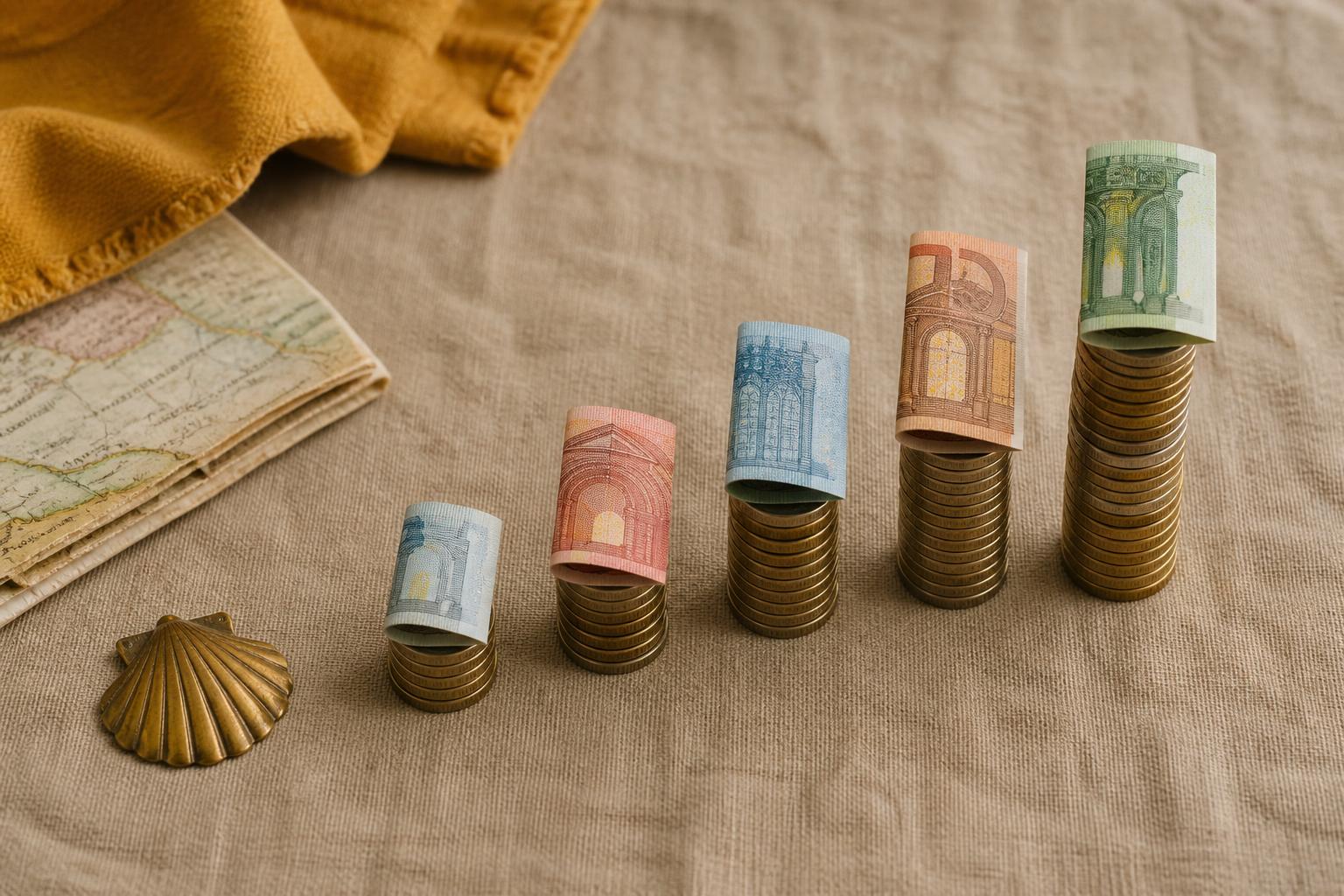
Four things decide what a Camino costs: which route you walk, how many days it takes, where you sleep, and how you eat. Everything else is noise around those four. Get them right and any route on this page turns affordable; get them wrong and the cheapest route in Spain will still empty your account by León.
Accommodation is the biggest single swing. A municipal albergue bed runs €8–15 a night, a private-albergue bunk €15–25, and a private room in a pensión starts around €40 and climbs from there. That one choice, repeated for thirty nights, is a €200 trip or a €1,200 trip before you have eaten a single meal. Food is the second lever and behaves the same way: the pilgrim menu at €12–18 against a supermarket dinner cooked in the albergue kitchen at €3–5. Neither choice has to be all-or-nothing, and most pilgrims mix them by day depending on weather, mood, and how their feet are holding up.
Route length multiplies all of it. A daily rate is only half the equation; the other half is how many days you multiply it by. The full Camino Francés is 32 to 34 walking days, the Portugués from Porto around 12 to 14, and the last 100 km from Sarria or Tui just 5 to 7. That is why a short route walked in comfort can cost less than a long route walked frugally. Pick your daily tier and your day count first, and the total falls out of the two. Cost is only one of the levers a first trip has to settle, so read this alongside the pillar guide on how to plan your first Camino de Santiago, which sets route choice, dates, and training in one place.
In 2026 the Camino Francés and the Camino Portugués are the cheapest full routes at roughly €35–45 a day at the budget tier, thanks to the densest network of donation and municipal albergues in Spain. The Camino del Norte is the most expensive at €55–70 a day, with fewer municipal beds and pricier northern-coast food. A last-100 km walk from Sarria or Tui costs €350–500 in total, the cheapest way onto the trail and the minimum distance to earn a Compostela on foot.
The table below compares each major route at the budget tier: a mix of municipal and donation albergues, supermarket breakfasts and lunches, and the pilgrim menu at dinner. The on-trail total is the whole-route spend at that tier (beds, food, and daily extras). It excludes international flights and starter gear, which are the same wherever you fly to and are covered in their own section below.
| Route | Distance (km) | Typical days | Budget daily (EUR) | On-trail total (EUR) | Cash-only bed density |
|---|---|---|---|---|---|
| Camino Francés | 775 | 32–34 | €35–45 | €1,000–1,500 | Medium |
| Camino Portugués (Central) | 260 | 12–14 | €35–45 | €450–650 | Medium |
| Camino Portugués (Coastal) | 280 | 12–14 | €40–50 | €500–750 | Low–medium |
| Camino del Norte | 825 | 32–35 | €55–70 | €1,900–2,500 | Low |
| Camino Primitivo | 320 | 13–15 | €45–55 | €650–850 | Medium |
| Camino Inglés | 120 | 5–6 | €40–50 | €220–320 | Low |
| Last 100 km (Sarria / Tui) | 100–115 | 5–7 | €45–60 | €350–500 | Medium–high |
Two numbers frame the whole comparison. The Camino Francés carried 45.6% of all pilgrims in 2025 and the Portugués 35.8%, so four in five pilgrims walk one of the two cheapest routes. The price and the popularity reinforce each other, because volume is what keeps the albergue network dense and the beds cheap. Budget numbers here are the disciplined end of the range; most first-timers actually land closer to €60 a day once tired evenings and second coffees are honest, which is exactly what our companion guide on the real 30-day Camino budget works through line by line.
What a low, mid, and high budget buys
At the low end you sleep in municipal and donation albergues, cook breakfast and lunch from supermarkets, and take the pilgrim menu at dinner: €35–45 a day on the Francés or Portugués. The mid tier mixes in the occasional private-albergue bunk and a coffee habit, landing near €60. The high tier is a private room most nights and restaurant dinners, €120–140 a day, which turns any route into a €3,000-plus trip.
The route sets the floor and your tier sets where above it you actually live, but distance quietly re-ranks everything. The Camino Inglés and the Primitivo cost more per day than the Francés, yet both are short enough that their whole-route total lands well under a full Francés month. If your budget is fixed and your holiday is not, a pricier short route can be the cheaper trip. If your time is fixed and you want the most walking per euro, the long cheap routes win outright.
The cheapest Camino route is the Francés, and the reason is infrastructure rather than distance. Its network of donation and municipal albergues is the densest in Spain, so beds stay cheap, kitchens are common enough that self-catering is easy, and there is almost always a €9 municipal bunk within a short walk of a €20 private one. Competition for pilgrims keeps prices honest in a way that thinner routes cannot match.
The Camino Portugués from Porto is a close second and can match Francés prices outright. Portugal is slightly cheaper than Spain for food and coffee, and the Central variant runs through enough towns to keep municipal and parish albergues within reach each day. The Coastal variant costs a little more, with more private-room nights and more resort-town pricing along the Atlantic, but it stays well below the northern routes. If you are still weighing which trail fits you beyond price, our spoke on choosing your Camino route walks through terrain, crowds, and time of year alongside cost.
Where the Camino del Norte gets expensive
The Norte is beautiful, and it is the priciest full route for structural reasons rather than any single splurge. It has fewer municipal albergues per stage, so more nights fall to private albergues and pensiones. The Basque and Cantabrian coast is a genuinely wealthier, more touristed part of Spain, and its bars and supermarkets price accordingly. Stages are hillier and longer, which nudges some pilgrims toward luggage transfer and the occasional rest-day hotel. None of these is large alone; stacked across a month they push the Norte to €55–70 a day and a full-route total near €2,300–2,600 before you have bought a flight.
A €35 day means an albergue bunk, a supermarket breakfast and lunch, and the pilgrim menu at dinner. €60 adds the odd private room, a proper café con leche or two, and laundry when you need it. At €120–140 you sleep in hotels every night and eat in restaurants. Multiply your chosen tier by your walking days and you have the on-trail total; the arithmetic really is that blunt.
Budget tier: €30–40 a day
The €35 day is a municipal or donation bed at €9, a supermarket breakfast at €2, a supermarket lunch at €5, a communal dinner cooked in the albergue kitchen at €4, and €15 in coffee and odds. It is entirely real on the Francés or Portugués in shoulder season, and it is also the tier that asks the most discipline. Week four is when you would happily pay €40 simply not to cook again, and holding the line takes some stubbornness. Around 10 to 20% of the beds you will want (donativos, municipal albergues, tiny village bars) take cash only, so the budget tier lives on cash more than any other.
Comfort tier: €60–90 a day
Sixty euros is where most first-timers actually land whether they planned to or not: a private-albergue bed at €17, breakfast at €4, the pilgrim menu at €13, a second coffee, occasional laundry, and luggage transfer on a hard stage. Ninety adds a private room every second or third night and a glass of wine with dinner. This is the honest baseline for a first Camino. Plan for €40 and you will quietly live at €60, and that gap is simply what a tired day costs.
Hotel tier: €120–140 a day
At the hotel tier you book a private room or small hotel every night, eat in restaurants, and send your pack ahead by transfer service. On the Francés that is a €3,600–4,600 on-trail month; on shorter routes it scales down with the day count. It is not a luxury Camino so much as a Camino that prioritises sleep and privacy over cost, and it is what many older pilgrims and anyone recovering from injury sensibly build toward.
On-trail spending is only half the picture. Before you leave, budget €700–1,200 for return flights, roughly €400–500 for a starter gear kit, and €40–80 for travel insurance and a pilgrim credential. Add those to your daily total and a first Camino Francés realistically costs €2,000–2,800 all in: the on-trail month plus the fixed pre-trip costs that are the same wherever your feet actually go.
For pilgrims flying in from outside Europe, the flight is often the single biggest line on the whole budget and it reshapes the route maths. From North America plan US$600–1,200 return, and from East Asia the fare is higher again, so the pre-trip half of your budget can rival the on-trail half. When the flight costs more than the walking, a longer route is better value per travel dollar, because you are amortising one expensive plane ticket over four weeks of trail rather than one. That single fact pushes many overseas first-timers toward the full Francés rather than a week from Sarria.
Camino de Santiago cost 2026: the full savings target
For a first Camino Francés, set a savings target of €2,000–2,800: about €1,000–1,500 on trail over a month, €700–1,200 for flights, €400–500 for gear, and €40–80 for insurance and a credential. A starter kit averages around €484, with boots at €160–280 and a pack at €160–230 the two biggest lines. Shorter routes need far less on the trail portion (a week from Sarria is a €350–500 walk) but the flight and gear numbers barely move, so on short routes the pre-trip costs quietly become the larger half of the budget.
Pre-trip costs first-timers forget
The credential itself is about €2, and the printed distance certificate you can order in Santiago about €3: trivial, but easy to leave off a list. Travel insurance for a month-long walk is €40–80 and is genuinely non-negotiable, since a torn meniscus on day six without cover is a far harder cost line than any bed. Guided packages change the sum entirely: a supported last-100 km with booked rooms and transfers starts around €702 per person, several times the self-organised €350–500, which is the real price of not carrying the logistics yourself. For the full worked version of these pre-trip numbers, the 30-day budget guide breaks each one down by origin.
Carry €30–50 of cash per person per day, and top up every four to five days in a town with a bank branch. Roughly 10 to 20% of beds (donativos, municipal albergues, and the tiny bars that double as the only shop in a village) take cash only. Withdraw larger amounts to spread the €3–8 ATM fee across more of your spend, use a Spanish bank machine rather than a standalone Euronet where you can, and skip American Express entirely, since most albergues, bars, and restaurants on the Camino do not take it.
Cash vs card on the Camino
Cards work fine in towns above a thousand residents: supermarkets, private albergues, pharmacies, and most restaurants take contactless without a fuss. The cash-only pockets are specific and predictable: donation albergues that run on trust, municipal beds collected by a volunteer, and rural bars with no card terminal. The rule of thumb that keeps you solvent is simple. Never let your cash drop below two days of spend, because the next ATM may be two stages away. A no-fee debit card such as Revolut or Wise lands you closer to the real exchange rate than any airport desk, and refuses the dynamic-currency-conversion trick that quietly costs two to four percent at the machine.
Route stretches with no ATM
The gaps are route-specific. On the Francés, the Meseta between Burgos and León thins out the bank branches, and the climb from Villafranca to O Cebreiro is a stretch where you want cash in hand before you start. On the Portugués the towns come often enough that you are rarely far from a machine, while the Norte and Primitivo have longer rural runs where a closed or empty ATM is a real possibility. The habit that covers all of them is the same: withdraw in the last proper town before a quiet stretch, not in the village at the end of it. On the last 100 km from Sarria the machines are frequent but so are the queues in peak season, so a small buffer of cash saves you standing in one at the wrong moment.
You can shave hundreds off a Camino without giving up anything that matters. None of these is a sacrifice so much as a default worth choosing on purpose:
Favour municipal and donativo albergues over private rooms: the single biggest lever, worth €10–30 a night.
Cook breakfast and lunch from supermarkets and keep the pilgrim menu for dinner.
Carry a refillable bottle; the public fountains on most routes are safe and free.
Walk in shoulder season, when beds are cheaper and the competition for them is gentler.
Share a private room with a walking companion on the nights you want one.
Use a no-fee debit card and withdraw larger amounts less often.
Skip daily luggage transfer unless an injury genuinely calls for it; €5–8 a bag adds up fast.
The season point does more work than it looks. Walking in May or late September rather than peak August lowers bed prices and thins the crowd that drives them up in the first place, and it changes very little about the trail itself. Our guide on the best time to walk the Camino lines the months up against weather, crowds, and cost so you can pick the cheapest window you can comfortably walk in.
How much does the Camino de Santiago cost?
For a full Camino Francés, plan €1,000–1,500 on trail over a month at the budget tier, or closer to €1,800 at the realistic €60-a-day pace most first-timers actually walk. Add €700–1,200 for flights, €400–500 for gear, and €40–80 for insurance and a credential, and a first Camino de Santiago costs €2,000–2,800 all in. Shorter routes cost far less on trail (a week from Sarria is €350–500) but the flight and gear numbers stay the same.
How much should I save in total for the Camino, including flights and gear?
For a first Camino Francés, plan to save €2,000–2,800: about €1,000–1,500 on trail over a month, €700–1,200 for flights, €400–500 for gear, and €40–80 for insurance and a credential. Shorter routes from Sarria or Tui need far less on the trail portion, though the flight and gear costs barely change, so on a short route the pre-trip spend becomes the larger half.
How much cash should I carry on the Camino and how often should I withdraw?
Carry €30–50 per person per day and withdraw every four to five days in a town with a bank branch. Take out larger amounts to dilute the €3–8 ATM fee, keep small notes for donativos and village bars, and use a no-fee card like Revolut or Wise. Never let your cash fall below two days of spend, because the next machine can be two stages away.
Is the Camino Francés or the Portugués cheaper?
They are close. The Francés has the densest network of municipal and donation albergues, so it edges ahead for the tightest budgets. The Portugués from Porto is nearly as cheap, and Portugal is slightly cheaper for food, so a Porto start can match Francés prices outright. Both sit at roughly €35–45 a day at the budget tier.
Can you walk the Camino on €25 a day?
Yes, if you stay only in municipal or donativo albergues, cook from supermarkets, and skip bars and luggage transfer. Twenty-five euros a day is realistic on the Francés in shoulder season, but it leaves little buffer for a private room after a bad night's sleep, so treat it as a floor rather than a plan and keep a small reserve for the days it breaks.
Which Camino route is the most expensive?
The Camino del Norte is the priciest at roughly €55–70 a day. It has fewer municipal albergues, more private-room nights, and pricier northern-coast food, so its full-route total can reach €2,300–2,600 before flights and gear. The Primitivo and the Portugués Coastal sit above the Francés but below the Norte.
Do I need travel insurance, and what does it cost?
Travel insurance is strongly recommended and cheap: roughly €40–80 for a month-long walk. It covers medical care, evacuation off remote stages, and trip cancellation, none of which the Spanish public system guarantees for non-EU pilgrims. On a budget of two thousand euros or more, skipping an eighty-euro policy is the worst value decision on the whole trip.
This comparison narrows the route by price; the rest of the decision sits in the pillar guide on how to plan your first Camino de Santiago, which ties route, dates, credential, and training into one plan. Once you have picked a route, the real 30-day Camino budget turns your chosen daily tier into a worked total, and choosing your Camino route weighs the factors beyond cost. Because season drives accommodation prices, the best time to walk the Camino connects the shoulder-season saving to a start-month decision, and the Camino routes and distances explained sets the day counts this whole page multiplies against.
External citations
Oficina de Acogida al Peregrino — official Santiago pilgrim office
oficinadelperegrino.comThe official pilgrim office publishes the annual route-share and pilgrim-number statistics used to weight route popularity, including the 2025 Francés and Portugués shares cited here.
Gronze — Spanish albergue directory
www.gronze.comThe reference Spanish albergue directory lists current per-night bed prices and stage data, grounding the 2026 accommodation and daily-cost figures for each route.
Wise — published ATM and currency fee schedules
wise.comA primary source for real 2026 foreign-ATM and card fees, backing the cash-versus-card guidance and the €3–8 withdrawal-fee range.
La Compostela del Lector
You walked this guide to Santiago.
All 771 km, 0 stages, stamped end to end.